

A credible business exit is built on reliable financial evidence, not a last-minute polish. If you’re considering how to prepare for business exit UK, start by making sure your financial story is clear, consistent and supported by records. Before choosing a buyer or committing to a sale route, look at whether your accounts, forecasts and the business’s reliance on your involvement will stand up to scrutiny.
This guide explains what buyers may examine, from management accounts and cash-flow forecasts to revenue quality, customer concentration and how the business operates without you. It also sets out practical ways to strengthen financial visibility and address gaps while continuing to run the business. The aim is to build a credible foundation for future decisions, without assuming an exit is imminent. Strategic Finance Director or CFO support can help organise reporting, KPIs and next steps alongside day-to-day priorities.
Key Takeaways
- Explore how to prepare for business exit UK by clarifying your objectives and readiness before choosing an exit route.
- Use consistent management accounts to understand profit, cash flow and working-capital movements, and explain performance clearly.
- Look beyond headline valuation: unexplained financial movements and unclear assumptions can prompt further questions from buyers.
- Make preparation manageable by establishing a financial baseline, resolving information gaps and assigning responsibility for reporting and records.
- Flexible finance leadership can help bring management accounts, cash-flow insight and KPIs together with day-to-day business priorities.
How to prepare for a business exit in the UK before a buyer appears
You don’t need to have decided to sell before you start preparing. You can begin while focused on growth or considering what you want from the next stage of your life. The purpose isn’t to launch a sale process early. It’s to understand how the business performs, where it depends on you and which decisions could affect a future transition.
Exit readiness is evidence-led preparation that helps an owner understand the business and make informed decisions about a possible future transition. It can improve visibility and make future conversations more grounded. It can’t guarantee buyer interest or a higher sale price, and preparing doesn’t commit you to an exit.
What does business exit readiness mean?
A business is better prepared when its records are reliable, its performance can be explained and key decisions are documented. This gives you a clearer view of what is working, what needs attention and where knowledge or relationships depend on one person. Readiness is not the same as choosing a buyer, agreeing a valuation or signing a sale agreement.
Your objectives matter. You might want to reduce your day-to-day involvement, protect continuity for employees, realise value from your ownership or keep the business within the family. Those aims can lead to different priorities. An exit strategy can take different forms, but choosing a route is separate from improving the information you use to assess the business.
For example, if you hope to step back gradually, first identify which responsibilities still rely on you. If you want to preserve the company’s independence, you may have other priorities. Write down what you want a future transition to achieve, but treat this as a starting point rather than a fixed plan.
Why start preparing before a sale process?
Starting early gives you time to spot gaps and improve reporting as part of normal business management. If a buyer approaches unexpectedly, inconsistent records or unexplained changes can be difficult to address alongside negotiations and daily operations. Investigating issues at a manageable pace is often more practical than assembling explanations under pressure.
Everyday decisions can shape future discussions. Taking on a large project, changing prices or investing in new systems may affect cash needs, reported performance or how the business operates. The point isn’t to avoid those decisions. It’s to understand their financial implications and record the reasoning, so you can explain what changed and why.
There’s no single timetable that suits every owner. Treat preparation as a flexible discipline:
- Write down your personal objectives and what a successful transition would mean to you.
- Assess whether the business can explain its performance and operate without your constant involvement.
- Identify gaps in information or decision-making, then address them alongside operational priorities.
This is a practical way to approach how to prepare for business exit UK without prematurely choosing a sale route. Build a clearer picture, make better-informed decisions and revisit your options as your circumstances and business develop.
Which financial evidence helps prepare a UK business for sale?
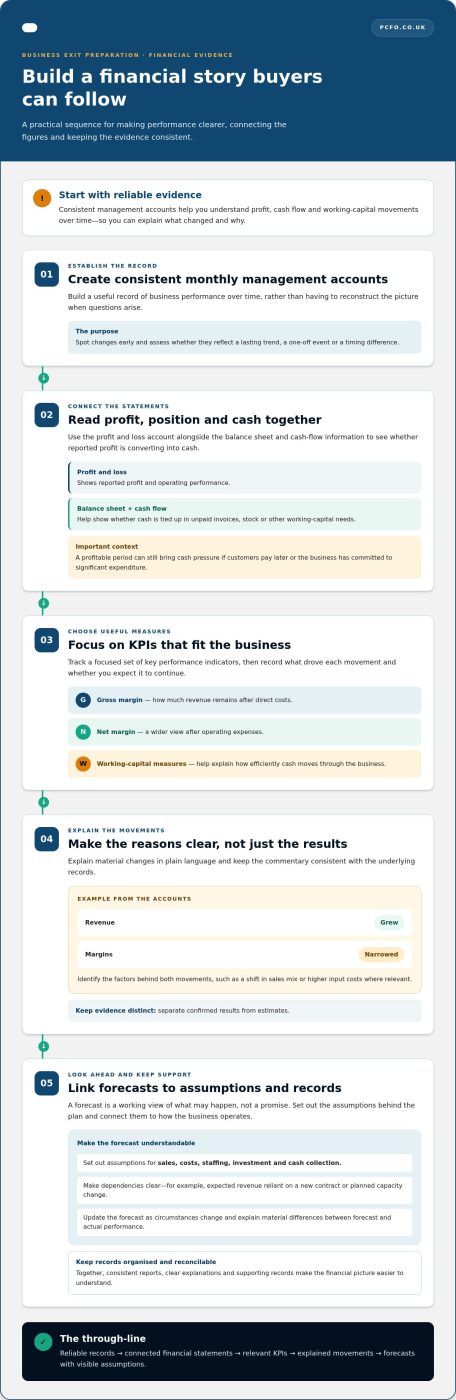
Reliable financial information helps you explain how the business earns profit, manages cash and funds its day-to-day activity. Consistent monthly management accounts build a useful record over time, rather than leaving you to reconstruct the picture when questions arise. They can also help you spot changes early and work out whether they reflect a lasting trend, a one-off event or a timing difference.
Management accounts are regular internal financial reports that connect business performance to decisions, helping owners track trends and explain the financial story behind the figures. For exit preparation, their value lies not only in the numbers, but also in showing how those numbers relate to the way the business operates.
Bring management accounts and KPIs into focus
Read the profit and loss account alongside the balance sheet and cash-flow information. Together, they show whether reported profit is converting into cash, or whether cash is tied up in unpaid invoices, stock or other working-capital needs. A profitable period can still bring cash pressure if customers pay later or the business has committed to significant expenditure.
Choose a focused set of key performance indicators (KPIs) that makes sense for your business. Gross margin shows how much revenue remains after direct costs; net margin gives a wider view after operating expenses. Working-capital measures can help explain how efficiently cash moves through the business. Don’t just note whether a KPI rose or fell. Record what drove the movement and whether you expect it to continue.
Explain material changes in plain language. If revenue grew but margins narrowed, for example, identify the factors behind both movements, such as a shift in sales mix or higher input costs where relevant. Keep your commentary consistent with the underlying records, and distinguish confirmed results from estimates.
Organise forecasts, obligations and supporting records
A forecast is a working view of what may happen, not a promise. Set out the assumptions behind sales, costs, staffing, investment and cash collection, and connect them to operational plans. If expected revenue depends on a new contract or planned capacity change, make that dependency clear. Update the forecast as circumstances change, and explain material differences between forecast and actual performance.
Keep financial records organised and reconcilable. These may include relevant VAT and PAYE records, annual-return records, bank reconciliations, customer and supplier balances, and explanations for unusual transactions. The precise records and filing requirements depend on the business and its circumstances, so check current UK requirements with an appropriately qualified source.
- Match management reports to the underlying accounting records and investigate inconsistencies.
- Record the reason for significant movements or adjustments, with supporting documents where available.
- List unresolved items and assign responsibility for addressing them, rather than leaving them unexplained.
For owners considering how to prepare for business exit UK, this evidence base makes performance easier to assess and discuss. If reporting is difficult to manage alongside business operations, outsourced finance leadership can help bring management accounts, cash-flow insight and KPIs into a clearer routine.
What can undermine buyer confidence during business exit preparation?
A headline valuation can feel like a useful measure of progress, but it doesn’t make a business ready to sell. A valuation is an estimate shaped by assumptions and circumstances. Readiness is about whether the business can explain its performance, support the information it presents and show how it could continue through a transition. No single issue automatically determines value, but gaps can prompt more questions and make discussions harder to progress.
Some factors are within your control, such as reporting consistency and how clearly responsibilities are documented. Others, including market conditions and buyer appetite, sit outside the business. Preparation can help you understand and explain your position, but it can’t remove uncertainty or guarantee a particular outcome.
How do information gaps affect buyer discussions?
Questions can arise when figures don’t connect or the basis for a claim isn’t clear. For example, management reports may not reconcile to accounting records, or a KPI may be defined differently from one period to the next. A forecast might assume new business without showing which operational changes or customer commitments support it.
Address these gaps with context and evidence, not defensive language. Explain what caused a difference, identify the records that support your explanation and distinguish known results from estimates. If an item remains unresolved, state what is outstanding and who is responsible for addressing it. A clear account helps others assess the information without implying that every variance signals a fundamental problem.
Consistent definitions matter too. If “sales” means orders received in one report but invoices raised in another, comparisons may be misleading. Set out what each measure includes and keep that basis consistent. If a definition changes, document when and why.
Can a business be exit-ready if the founder is central to it?
A founder can be central to a successful business and still raise questions about continuity. If key customer relationships, pricing decisions or operational knowledge sit mainly with one person, a prospective buyer may want to understand how those activities would continue. This doesn’t mean the business can’t be prepared. Make dependencies visible and consider how responsibilities could be shared.
Start by recording who makes important decisions and how recurring work gets done. Note key customer and supplier relationships, the processes behind delivery, and any tasks only one person knows how to complete. Then identify practical opportunities to document procedures, delegate decisions or develop additional points of contact. These steps can clarify transition needs, though they don’t guarantee a smoother sale.
- Separate issues you can address, such as record-keeping and unclear responsibilities, from external market factors.
- For each information gap, capture the explanation, supporting evidence and any action still required.
- Review founder dependencies as business risks to understand, not as proof that an exit is impossible.
For owners considering how to prepare for business exit UK, the aim isn’t to make every uncertainty disappear. It’s to understand what the business can evidence, where questions may arise and which practical improvements are worth prioritising.
How to prioritise business exit preparation without disrupting operations
Exit preparation is easier to sustain when it’s part of good business management, not a separate project competing with trading. You don’t need to address every possible issue at once. A flexible sequence helps you focus on work that improves visibility and supports sound decisions, while leaving room to respond to changing business conditions.
Think of the process as a cycle: clarify your objectives, establish a current financial baseline, resolve priority information gaps and review progress. This is a starting point, not a fixed timetable. Your priorities depend on the business, your capacity and what you want a future transition to look like.
Start with objectives and a current financial baseline
Begin with your own priorities. Consider what you would like to happen after an exit, what role you want in the business during a transition and which outcomes matter most. You don’t have to settle on an exit route now. If you want to explore how different routes may fit those aims, this exit strategy planning guide offers broader context.
Next, use current management accounts and cash-flow information to establish a baseline. Note where performance is clear and where you need a better explanation, such as a change in costs, a delayed customer payment or a forecast that no longer reflects the operating plan. This helps distinguish an urgent issue from an improvement that can be scheduled alongside other work.
Keep the baseline practical. Record the information you rely on, when it was last reviewed and any assumptions that need revisiting. Avoid arbitrary targets or deadlines. The aim is to create a useful reference point and build on it as the business develops.
Make preparation manageable alongside trading
Prioritise work according to its effect on financial visibility, record-keeping and business continuity. An overdue reconciliation or unclear reporting responsibility may deserve attention before a less urgent document tidy-up. Assign each task to someone who can act on it, and keep a simple action log with the issue, owner, evidence needed and next review point.
Clear responsibility matters. Agree who prepares financial reports, checks supporting records and flags changes that affect forecasts or KPIs. Review these measures periodically, particularly after a change in trading conditions, costs or operational plans. This keeps the information useful rather than turning it into a static pack produced only for a possible sale.
If establishing this rhythm needs senior financial oversight, strategic Finance Director support can help organise reporting and priorities around day-to-day demands. Learn about PCFO’s finance support.
How PCFO can support your UK business exit preparation
Preparing for a possible exit while running a business takes time and clear financial oversight. PCFO provides flexible outsourced Finance Director and CFO support to help organise financial information and plan practical next steps, without assuming a sale is imminent. The focus is on building visibility and supporting better-informed decisions, not promising a particular transaction or sale outcome.
For owners asking how to prepare for business exit UK, senior finance support can turn a broad intention into manageable work. PCFO supports monthly management accounts, cash-flow management, KPI setting and board-level commercial advice. These activities help you understand performance, identify information gaps and connect financial decisions with longer-term business objectives.
What financial support can help owners prepare?
Regular management reporting brings together information about performance and cash, giving you a clearer basis for business planning. Cash-flow insight helps you understand the timing of receipts and payments, while relevant KPIs provide a way to monitor developments and discuss them with decision-makers. The value comes from using that information consistently, not simply producing reports.
Finance Director or CFO support can also help you review plans and assess the financial implications of different choices. This may include organising priorities for exit or acquisition preparation and bringing commercial considerations into board-level discussions. If day-to-day financial processes also need attention, PCFO’s outsourced accountancy solutions provide related support for financial operations.
The right focus depends on your position and objectives. You might begin by improving the reporting rhythm, clarifying cash-flow assumptions or agreeing which KPIs are most useful to monitor. Flexible support can fit this work around the needs of the business, rather than creating a separate process that is difficult to maintain.
What happens when you begin working with PCFO?
The process starts with a free initial strategy session to discuss your financial position, goals and vision for the business. Support is then tailored to your needs. Onboarding gathers relevant financial information and business objectives, helping establish what matters now and where additional structure may be useful.
This gives you a practical starting point, whether you’re exploring options or want greater clarity about the business’s financial position. You can discuss reporting, cash flow, KPIs and preparation priorities that fit your circumstances. There’s no need to commit to an exit route before taking stock.
To discuss tailored finance and exit preparation support, book a free strategy session with PCFO. It’s a practical first step towards organising the financial work, while decisions about any future transaction remain yours.
Take the next step at your own pace
You don’t need to have settled on an exit route to make a useful next move. Choose one financial question you’d like to answer, then decide who in the business will help you work through it. That commitment can make preparation an ongoing part of planning, rather than a project that begins only when a buyer appears.
If you’re considering how to prepare for business exit UK, PCFO provides flexible, part-time Finance Director and CFO support. This can include monthly management accounts and board-level reporting, with tailored help across financial planning, cash flow and exit preparation. The focus is on building clarity for your decisions, not steering you towards a particular transaction.
Start with a conversation about your goals and what would be most useful for the business now. Arrange a free strategy session with PCFO to explore a practical approach that fits your circumstances and build readiness steadily while keeping your options open.
Frequently Asked Questions
How early should I start preparing for a business exit in the UK?
Start when an exit becomes a possibility you want to explore, even if you haven’t decided to sell. This gives you time to consider the role you want, what a transition should achieve and whether the business can support those aims. There’s no universal lead time. A change in ownership plans, personal priorities or business direction can be a useful prompt to review your position.
What financial records do buyers usually review during due diligence?
Requests vary by transaction, but buyers may ask to examine statutory accounts, management reports, budgets and forecasts, bank reconciliations, and records supporting material transactions. They may also seek details of tax filings, debt, customer and supplier balances, and contracts that affect revenue or costs. Keep source documents organised alongside explanations of unusual entries. A clear audit trail helps show how reported figures connect to underlying activity.
Can I prepare my business for sale whilst continuing to run it?
Yes. Preparation can be incorporated into existing routines rather than treated as a separate sale project. For example, use the monthly finance review to record decisions that affect forecasts, and set aside time in an established leadership meeting to review preparation tasks. If trading demands change, reprioritise the work. The aim is to maintain useful information and decision records without allowing preparation to distract from serving customers.
Is a business valuation enough to prepare a company for sale?
No. A valuation offers an estimate based on a particular set of assumptions, but it doesn’t establish that the information behind those assumptions is complete or that the business can sustain its performance. Ask what evidence supports the valuation and how sensitive it is to changes in revenue, margins or risk. A valuation can inform planning, but it can’t replace preparation or determine what a buyer will ultimately agree.
What is the difference between a share sale and an asset sale?
In a share sale, the buyer acquires shares in the company, which continues as the same legal entity. In an asset sale, the buyer acquires specified business assets, and the sale agreement sets out what transfers and what remains with the seller. The practical, tax and legal consequences can differ, and the appropriate structure depends on the circumstances. Take qualified legal and tax advice before agreeing terms.
Can a business be sold if the founder is essential to its daily operations?
It may be possible, but the founder’s role needs careful consideration. A prospective buyer may want to understand which responsibilities, customer relationships or approvals depend on the founder, and how these could be handled during a transition. Map those dependencies and consider whether knowledge can be documented or responsibilities shared. The right plan depends on the business and transaction; reducing reliance doesn’t guarantee a sale or a particular outcome.
Do I need professional tax and legal advice when preparing for a UK business exit?
Professional tax and legal advice is strongly advisable before you choose a sale structure or agree transaction terms. Advisers can explain how the proposed arrangement may affect tax, contracts, employees, liabilities and the wording of the sale documents. For owners considering how to prepare for business exit UK, involve them early enough to inform planning, and keep advice current as circumstances or proposed terms change.