

The timing of a business exit can shape the options available to you. Business exit strategy planning in the UK commonly takes two to five years, giving you time to prepare the business, consider who might take it on and plan for life after ownership. An exit strategy sets out how you will leave the business and prepare it for a sale or change in ownership.
It’s understandable to focus first on finding a buyer or successor. But timing matters just as much: starting early gives you more room to strengthen the business and compare options, from family succession and a management buyout to investor support or a sale to another company.
This article explains what exit planning involves and how the main options differ. It also shows how your ambitions, the business’s readiness and your preferred handover can shape the timing, helping you approach the decision with a clearer view of what comes next.
Key Takeaways
- Compare family succession, a management buyout and external investment against your priorities for continuity, control and the future of the business.
- Prepare for a sale by understanding what drives business value and presenting a clear, evidence-based case to potential buyers.
- A management buyout can preserve operational knowledge, but its success depends on whether the management team can fund and lead the transition.
- Start planning early enough to strengthen the business and align your exit with your personal ambitions and preferred handover.
- HM Revenue & Customs says distributions from a struck-off company may be taxed unless conditions are met, including that the amount taken is £25,000 or less.
Family succession
Family succession transfers ownership and leadership to relatives or trusted partners, with the aim of keeping the business operating beyond the founder’s exit. In a May 2025 survey, 46% of UK small business owners said they would consider family succession.
Passing the Business to Family or Partners
A transfer can involve a family member, business partner or co-owner taking over shares and responsibilities. The right successor can help preserve relationships with employees and customers, while an unprepared handover can create uncertainty about decision-making and leadership.
Start by assessing each candidate’s interest, capability and willingness to lead. A relative may know the business well but prefer another career; a capable partner may not want, or be able, to acquire your share. In a May 2025 survey, 28% of UK small business owners identified finding a suitable buyer or successor as a key barrier to exit planning. Business exit strategy planning in the UK can help owners make succession choices part of wider business decisions, rather than leaving them until a handover is imminent.
For family succession, separate family expectations from business requirements. Agree who will make operational decisions, how ownership will transfer and what support the outgoing owner will provide. For example, a founder could gradually hand customer relationships and supplier decisions to a family successor before transferring day-to-day leadership. Documenting responsibilities can reduce misunderstandings among relatives.
Passing ownership to a partner or fellow investor can also maintain continuity, but the incoming owner must be willing and able to acquire the share. A May 2025 survey found that 41% of UK small business owners would consider selling to a business partner or co-founder. Discuss the proposed structure, funding and handover early, rather than assuming an existing relationship guarantees agreement.
Eligibility and Seller Costs
Capital Gains Tax may apply to gains from selling a business, while Business Asset Disposal Relief may reduce the tax rate on qualifying gains. Eligibility depends on statutory conditions, and the relief has a lifetime limit, so previous claims are relevant when assessing a seller’s position.
Budget for professional support with legal documentation, financial preparation and buyer due diligence. This work can include reviewing ownership records, preparing reliable accounts, answering buyer questions and negotiating sale terms. The transaction’s complexity will shape the preparation required. Business exit strategy planning in the UK brings these financial and practical considerations into one decision-making process.
For a struck-off company, distributions may be taxed by HM Revenue & Customs unless conditions are met, including that the amount taken is £25,000 or less. This is a separate consideration from a family share transfer, so understand how the business is structured before deciding how to pass it on.
What is business exit planning?
Exit planning connects your preferred future with the steps needed to sell or transfer your business. Valuation, ownership structure and reliable records influence the options available.
Business Valuation Methods
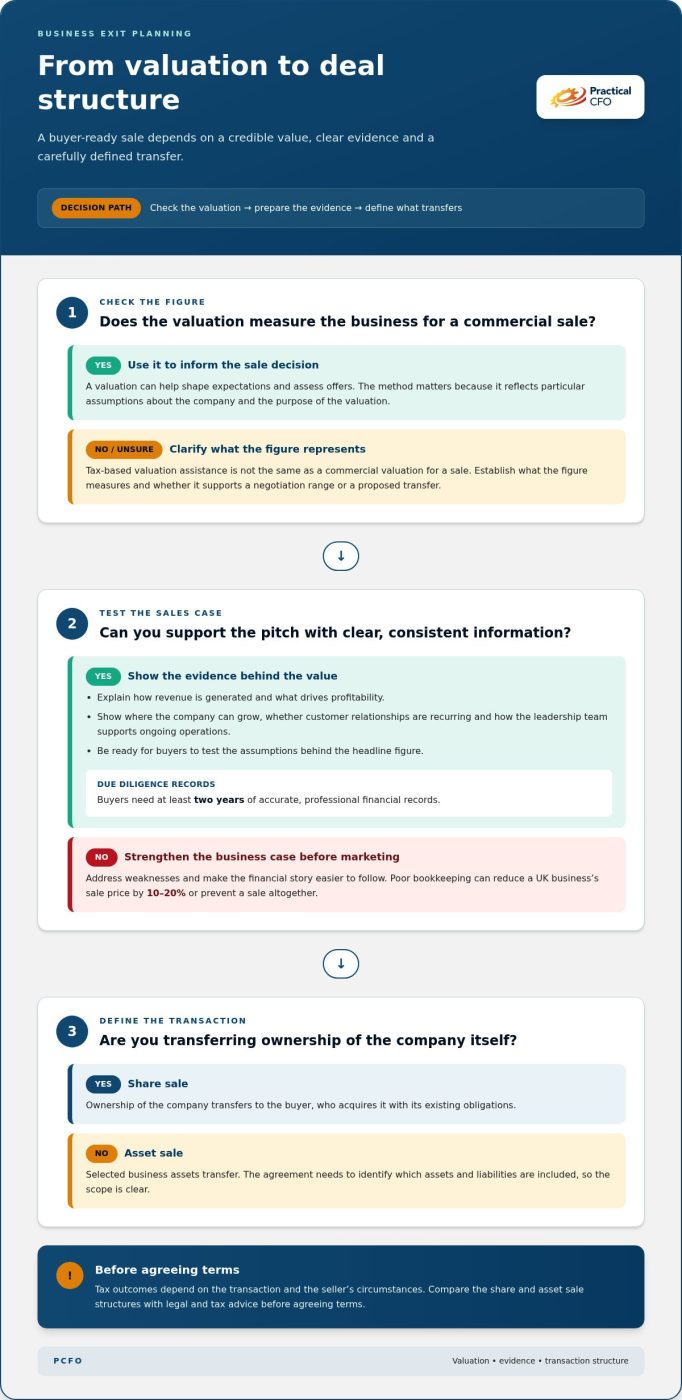
A valuation estimates what a business may be worth using its financial performance, assets and other relevant evidence. The method matters because it shapes expectations and helps owners assess offers.
One approach applies a multiple to earnings: a business valuation might use a multiple such as five times EBITDA. Other approaches may assess assets or use tax-based methods. These figures are not interchangeable; each reflects different assumptions about the company and the valuation’s purpose.
Tax-based valuation assistance is not the same as a commercial valuation for a sale. Before relying on a figure, establish what it measures and whether it supports your decision, such as setting a negotiation range or reviewing a proposed transfer.
Valuation, Sales Pitches and Returns
A sales pitch presents the business’s strengths and supporting evidence to potential buyers, linking its performance to a credible value. Clear, consistent information helps buyers understand what they are acquiring.
Show how revenue is generated, what drives profitability and where the company can grow. For example, explain whether customer relationships are recurring and how the leadership team supports ongoing operations. Avoid relying on a headline figure alone: buyers will test the assumptions behind it.
To maximise returns, address weaknesses before marketing the business and make the financial story easy to follow. Poor bookkeeping can reduce a UK business’s sale price by 10-20% or prevent a sale altogether. Expert advice can help owners prepare, understand implications and assess whether an offer’s terms match their objectives.
Share Sales and Asset Sales
A share sale transfers ownership of the company, while an asset sale transfers selected business assets. The distinction matters because the deal structure affects which assets and liabilities move and how the parties consider tax.
In a share sale, the buyer acquires the company with its existing obligations. In an asset sale, the agreement identifies which assets and liabilities transfer, so the parties must define the scope carefully. Tax outcomes depend on the transaction and the seller’s circumstances. Compare the structures with legal and tax advice before agreeing terms.
Buyer Records and Due Diligence
Buyer due diligence is the review of financial and business information before completion. Organised records help substantiate the sales pitch and answer questions about performance and risks.
Buyers need at least two years of accurate, professional financial records to assess a UK company’s true value. Prepare accounts, management figures, tax records, key contracts and clear information about assets and liabilities. Reconcile figures across documents and explain unusual movements. For practical financial planning support, build a structured view of performance and the decisions that could affect a sale.
Investor support and successful exit examples
Investors can provide capital, expertise or a route to new ownership, but their priorities shape the transition. A successful exit also depends on defining what you want after stepping away.
Defining a Successful Exit
A successful exit meets your financial objectives and leaves the business positioned for its next stage. For one owner, that might mean a clean break; for another, it could mean retaining an ongoing interest while new leadership takes charge.
Define success before choosing a buyer or investor. Consider the role you want after the deal, how much influence you wish to retain and what continuity means for employees and customers. For example, an owner nearing retirement may prioritise a smooth handover, while a founder seeking further growth may value a buyer who can provide capital and strategic support.
These priorities affect the deal structure and buyer’s suitability. A sale with an earn-out or stock-based payments can leave the seller with practical involvement or exposure after completion. Compare the proposed terms with your plans for retirement, future income and the company’s direction.
Finding a Buyer or Successor
Finding a buyer or successor means identifying someone with the interest, resources and ability to take the business forward. A suitable incoming owner can support continuity, while a poor fit may disrupt operations or weaken the transition.
Potential routes include a family member, an existing partner, an external buyer or a larger company. In a May 2025 survey, 47% of UK small business owners said they would consider selling to someone not currently related to them. A further 38% would consider acquisition by a larger company.
Make the business easier to assess by setting out its strengths, risks and growth opportunities. Match each candidate’s objectives with the business’s future needs, including leadership capacity and the resources required to fund growth. A careful process helps attract parties whose plans fit the company, rather than focusing only on headline price.
Transition planning should begin before the outgoing owner leaves. Identify the knowledge they hold, then plan how to transfer key customer relationships, supplier contacts and operational decisions. For instance, an incoming leader can gradually take responsibility for major accounts while the outgoing owner supports the handover.
Keenan Recycling provides a UK exit example: before exiting to BIFFA, it had 21 depots and more than 140 employees. Its scale illustrates why transition planning must consider operational continuity, not only ownership. A buyer’s capital and capacity to lead can matter alongside the sale terms.
Private equity firms typically aim to generate a significant return within a few years of investing. Owners considering investor support should understand the investor’s growth expectations and intended role. Aligning those aims with your exit objectives helps clarify whether external capital supports the future you want for the business.
Management buyouts
A management buyout (MBO) transfers ownership to existing managers, keeping leadership close to daily operations. In a May 2025 survey, 29% of UK small business owners said they would consider an MBO.
Compared with a trade sale, an MBO gives the existing management team a direct route to ownership. Financing can be challenging: managers may know the business well but lack the capital to acquire it.
Management Buyout Options
An MBO lets existing managers acquire the business, while an employee buyout involves employees taking ownership collectively or through a structure established for that purpose. Both options can preserve operational knowledge and limit disruption for customers.
The distinction affects who leads after completion. In an MBO, a small management team may take responsibility for strategy and funding; an employee buyout can involve a broader group. For example, a firm’s senior managers might acquire control while employees participate through an agreed ownership arrangement.
Assess who is ready to take on decision-making, not just ownership. A team familiar with operations still needs a clear plan for leadership, accountability and continuity.
Planning Buyout Succession and Finance
Planning a buyout means preparing the successor team, agreeing the ownership structure and arranging a realistic funding mix. This matters because financing a management or employee buyout can be challenging.
Potential funding may combine managers’ own capital, borrowing, external investment or staged payments agreed as part of the transaction. Each route affects cash flow and the responsibilities of incoming owners, so the proposed structure must fit the business’s financial performance.
Before negotiations, map who will acquire shares, how decisions will be made and how the outgoing owner’s role will change. For example, a founder could agree a defined handover period while the new management team assumes operational control. Keep the transition plan aligned with the financing timetable.
Compare an MBO with a trade sale on more than headline price. An external buyer may bring capital, customers or infrastructure, while an internal team offers detailed knowledge of the company’s systems and relationships. The better fit depends on the owner’s priorities, the business’s future and the buyer’s ability to complete the deal.
Start by assessing whether the management team genuinely wants ownership and can work together as buyers. Then identify the funding gap, prepare financial information and set out a credible plan for ongoing operations. These steps help reveal early whether an MBO is viable or a trade sale deserves more attention.
Employees’ familiarity with customers and processes can support continuity, but ownership alone does not resolve succession. Clarify who will lead, how responsibilities will be shared and how the business will fund its next stage. These decisions turn a potential buyout into a defined exit strategy.
Planning the timing of a business exit
Timing determines how much room business owners have to prepare, compare exit routes and shape the handover. UK exit planning commonly takes two to five years, although some owners start much earlier.
A May 2025 survey found that 22% of UK business owners believed planning should start when setting up the business. Starting early lets owners consider how decisions about hiring, growth and business structure may affect a future sale or succession. It also creates time to clarify personal ambitions, rather than treating the exit date as the only decision.
The planning window with the greatest effect is often one to five years before exit. Within that period, owners can improve profitability and allow 12-24 months for those improvements to show as sustainable trends before a sale. A short-lived rise in earnings may not tell the same story as consistent performance, so timing affects how buyers view the business.
The route influences the timetable. A gradual exit is planned over two to five years, allowing responsibilities to shift in stages. A clean-break exit is planned over six to 18 months, which leaves less time for preparation. The sale phase itself can take 12 or more months to find a buyer, complete due diligence and negotiate terms.
Use milestones to connect preparation with your intended departure. Two years before exit, shape your post-exit vision and identify the ownership route. A year before exit, clarify practical plans, including leadership responsibilities and the handover. Six months before exit, prepare for the next stage and resolve remaining operational priorities. These milestones provide a framework without assuming every transaction follows the same sequence.
For example, an owner planning to pass the company to a management team can use a longer, gradual exit to develop leadership and transfer key responsibilities. An owner seeking a clean break needs to align business readiness, buyer discussions and personal plans within a shorter timetable. In either case, timing should reflect the business’s condition and the owner’s preferred transition.
Early preparation can also benefit owners who later change their minds. Some begin planning as many as 15 years before stepping down, leaving scope to grow the company, take a more hands-off role or revise the intended exit route. A clear timeline makes those choices visible before a pressing deadline narrows them.
Use business planning support to map exit milestones against your company’s performance and your intended timing.
PCFO: Finance Director Services
PCFO supports business owners preparing for an exit through Finance Director Services, bringing financial oversight to planning and decision-making. This support can help you assess business performance, understand how proposed changes affect financial readiness and organise priorities ahead of a sale or ownership transition.
When exit planning connects to wider growth decisions, PCFO’s Business Growth Advisory and Business Planning Consultant services can help align your company plans with your intended direction. Consider support when you want a clearer financial picture, are comparing exit routes or need to prepare the business for its next stage.
To discuss your business planning needs, contact PCFO or visit pcfo.co.uk.
Make your next decision with purpose
Your next step is to turn your preferred future into clear business priorities. Decide what you want your role to become, what the business must be ready to deliver and which financial questions need attention first. These choices can keep discussions focused as your plans develop.
Thoughtful business exit strategy planning in the UK connects the company’s direction with the owner’s ambitions. PCFO’s Finance Director Services and Chief Financial Officer Services can support financial oversight, while Business Growth Advisory can help you consider how growth decisions fit your intended direction.
You don’t need every detail settled before you begin. A focused conversation can help clarify the decisions ahead and establish a practical starting point for planning.
Arrange a discussion with PCFO about your exit plans and take the next step with a clearer sense of direction.
Frequently Asked Questions
How can you generate interest in your business from potential buyers?
Make the opportunity easy for a buyer to understand and assess. Present a concise overview of what the company does, its customer base, strengths, risks and future growth opportunities. Keep supporting financial information consistent with that story, and explain unusual changes clearly. Consider which types of buyer could benefit from owning the business, such as a company seeking complementary capabilities or an investor looking for growth potential.
Supporting clients approaching an exit?
PCFO supports business owners approaching an exit through Exit Strategy Support, alongside Finance Director Services and Chief Financial Officer Services. This support can bring financial planning into exit decisions, connect business performance with your objectives and identify areas that need attention. Business Growth Advisory can also help with decisions about the company’s next stage. The focus is business and financial planning, not personal wealth management or legal transaction work.
What Are My Options?
Your options include selling to an external buyer, transferring the business to family or partners, arranging a management or employee buyout, merging with another company or winding down. The right route depends on your priorities for ownership, continuity, leadership and future involvement. For example, an owner who wants the business to continue under familiar leadership may compare succession with a management buyout, while another may prefer an outside buyer.
Why Do I Need to Plan My Exit?
Planning gives you more control over the decisions that shape your departure and the business’s future. It helps identify what needs to change before a buyer, successor or management team takes over. For instance, if customer relationships depend heavily on you, you can begin transferring those connections before negotiations. Planning also gives you time to consider life after leaving, rather than focusing only on the transaction.
What is a business exit strategy and when should UK owners start planning?
A business exit strategy sets out how an owner intends to leave and how the business will continue or change ownership. UK owners can consider it while setting business goals, then develop the details as plans take shape. Exit planning commonly takes two to five years, although some owners start much earlier. Starting ahead of a target departure gives you time to adapt if your priorities or circumstances change.
What are the main business exit options for UK company owners: trade sale, management buyout, succession or liquidation?
A trade sale transfers the business to an external buyer; a management buyout passes ownership to existing managers. Succession transfers ownership to family, partners or another chosen successor. Liquidation closes the business and deals with its assets and obligations. Each route has different implications for continuity, leadership and the owner’s future involvement. A sale or transfer depends on finding a suitable incoming party, while liquidation requires the business to meet its legal and financial obligations.
What steps are involved in preparing a UK business for sale?
Begin by clarifying your objectives and preferred sale structure, then review the business from a buyer’s perspective. Reconcile financial records, document significant contracts and explain how key customer relationships are maintained. Identify operational dependencies, such as decisions that currently rest with the owner, and plan how to address them. Buyers need at least two years of accurate, professional financial records to assess a UK company’s true value, so organised records support due diligence.
How is a UK private company valued for an exit, and what valuation multiples are typical by sector?
A UK private company’s value may be assessed using earnings, assets or other relevant evidence, depending on the business and the valuation’s purpose. An earnings-based approach may apply a multiple, such as five times EBITDA, but this is an example, not a standard for every company. Sector, profitability, growth prospects, customer concentration and risk can all affect valuation. No single multiple applies across all sectors and businesses.