

A strong revenue figure can still leave an investor uncertain. What investors want to see in financial reports is more than an impressive headline: they need a connected, credible account of how the business performs, manages cash and plans for growth. If you’re unsure which statements and measures deserve attention, or whether your numbers tell a consistent story, you’re not alone.
Clear investor reporting turns accounting data into evidence for a useful discussion. This guide explains which financial statements to include, how to interpret common measures and how to present cash needs, forecasts and assumptions transparently. You’ll also learn how to spot gaps before an investor raises them. Regular management accounts provide a practical foundation: they help you track results over time and connect the profit and loss account with the balance sheet and cash flow statement. With a consistent reporting process, investors have a clearer basis for assessing your business and its plans.
Key Takeaways
- See how investors use connected financial statements to assess business performance, position, cash and plans.
- Learn to explain revenue, profitability and cash flow as related trends, rather than relying on one impressive figure.
- Understand how growth, margins and working capital can each add useful context, even when a business isn’t profitable.
- Discover practical steps to organise records, align reporting periods and check figures before an investor conversation.
- Find out how regular management accounts and finance leadership can help you prepare for questions about performance, cash needs and funding.
What investors want to see in financial reports, and why the full picture matters
Investors need more than a set of accounts or a persuasive forecast. They need connected evidence showing how the business has performed, its current financial position, how cash moves through it and what management expects next. That context helps them assess the business’s health, understand its opportunities and risks, and consider whether funding may be needed to deliver its plans.
An investor-ready financial reporting pack is a clear, consistent set of historical results, current financial information and forward-looking assumptions that helps an investor assess a business and ask informed questions. The emphasis is on how the evidence fits together, not on including every figure available.
Investors may compare reported results with management’s explanation and plans. If a forecast depends on expected growth, for example, the reporting should show how past performance and current resources support that expectation. The information they focus on will vary with the business stage, funding context and questions under discussion.
Which financial documents create the foundation?
The profit and loss account, also called an income statement, shows revenue, costs and reported profit over a period. It helps explain changes in trading performance, but it doesn’t show whether sales have been collected as cash or what the business owns and owes.
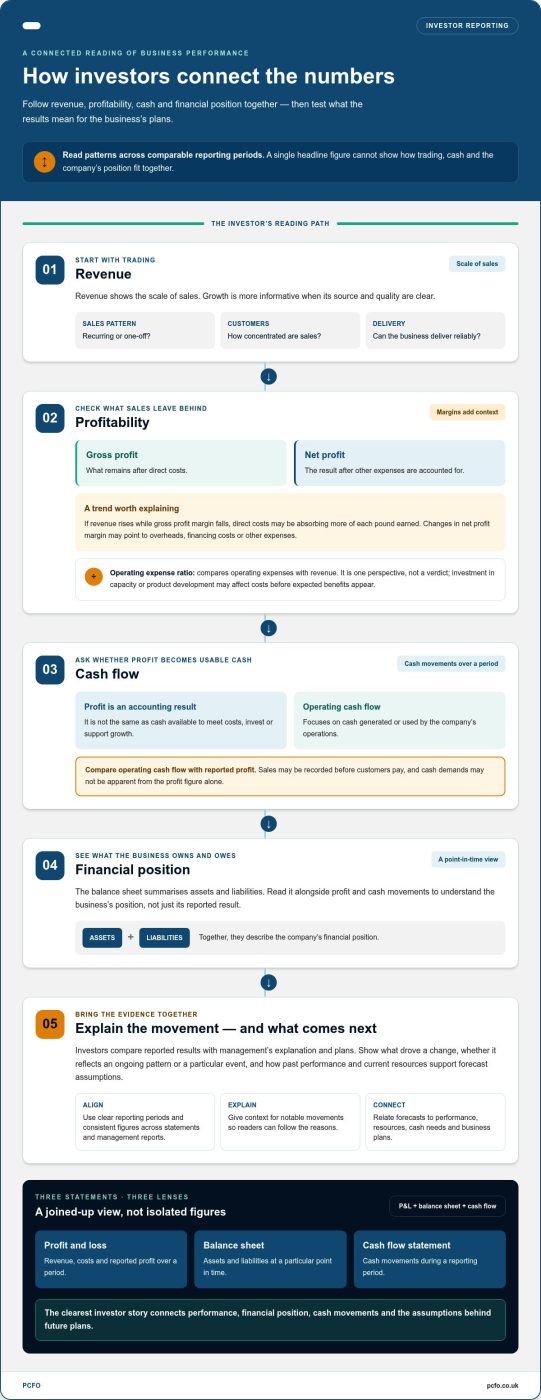
The balance sheet summarises assets and liabilities, showing the company’s financial position at a particular point in time. The cash flow statement records cash movements during a reporting period, helping readers understand how cash has come in and gone out. Together, these are among the core financial statements, each offering a different view of the same business.
Statutory accounts and investor reporting serve related but distinct purposes. Statutory accounts are prepared for formal reporting, while management reports can provide more regular operational detail. Forecasts add a forward-looking view based on assumptions. An investor pack may draw on all three, but its contents should suit the business and the discussion rather than follow a single template.
Why investors look beyond the headline result
Reported profit is useful, but it isn’t the same as cash available to meet costs, invest or support growth. A business might record sales before customers pay, or face cash demands that aren’t apparent from its profit figure alone. Investors therefore look for explanations that connect reported performance with the company’s financial position and cash movements.
Consistent reporting makes that explanation easier to assess. State the reporting periods clearly, align figures across statements and management reports, and explain differences rather than leaving them open to interpretation. If a result changes, give enough context to show what drove the movement and whether it reflects an ongoing pattern or a particular event.
What investors want to see in financial reports is a coherent account they can test, not a collection of isolated numbers. A well-prepared pack gives them a grounded view of performance and the questions that matter next. It also gives you a stronger basis for discussing funding needs and future plans, with the assumptions behind them made clear.
How investors read revenue, profitability, cash flow and financial position
Investors rarely judge a business from one figure in isolation. They look for patterns across reporting periods and connections between revenue, profit, cash and the balance sheet. This joined-up view helps them understand not only whether performance has changed, but what may have caused the change and whether it appears sustainable.
Revenue growth, for example, is more informative when you can explain where it comes from. Investors may consider whether sales are recurring or one-off, how concentrated they are among customers, and whether the business can deliver them reliably. Growth alone doesn’t show how much value each sale contributes or whether the cost of winning and serving customers is manageable. Harvard Business School Online’s guide to how to read and interpret financial statements also highlights the value of considering statements together rather than relying on isolated measures.
What the income statement can reveal
Read revenue, gross profit and net profit across comparable reporting periods. Revenue shows the scale of sales; gross profit indicates what remains after direct costs; net profit reflects the result after other expenses are accounted for. Revenue rising while the gross profit margin falls could suggest direct costs are absorbing more of each pound earned. A change in net profit margin may point to shifts in overheads, financing costs or other expenses.
The operating expense ratio adds another perspective by comparing operating expenses with revenue. It can show how the cost base relates to trading activity, but it isn’t a verdict on its own. Investment in capacity or product development, for instance, may affect costs before expected benefits appear. Explain notable movements and compare like with like, so readers can follow the business’s performance rather than guess at the reasons.
What cash flow and the balance sheet can reveal
Profit is an accounting result; cash is what the business can use to meet payments and fund activity. Operating cash flow focuses attention on cash generated or used by the company’s operations. Comparing it with reported profit can prompt useful questions about payment timing, working capital and the cash demands of growth.
The working-capital ratio, commonly calculated by comparing current assets with current liabilities, can frame discussion about short-term obligations and resources. The debt-to-equity ratio describes the relationship between borrowing and shareholders’ funds, giving context to how the business is financed. Neither should be read without considering the company’s circumstances, sector and funding structure.
Return on equity relates profit to shareholders’ equity. It can help investors consider how effectively capital is being used, but changes in borrowing or the equity base can influence the measure. Taken together, these indicators help explain what the business earns, how it funds operations and what its financial position can support. A finance leader can connect this analysis to board decisions. Outsourced finance leadership support can help establish a consistent view of performance and cash.
How to interpret investor metrics without relying on one headline number
A single metric can create a misleading impression when separated from the rest of the business. Investors consider how growth, margins, cash flow and working capital relate, and what has changed over time. The practical question is not simply whether a measure looks strong, but what it reveals, what may be driving it and what context is needed to interpret it.
An unprofitable business still has meaningful information to report. Revenue trends, gross and net margins, operating costs, cash movements and working-capital needs can help explain its position and priorities. PCFO’s KPI set includes operating cash flow, revenue growth, gross and net profit margins, operating expense ratio, working-capital ratio, return on equity and debt-to-equity ratio. These measures are most useful as connected evidence, not as a scorecard where one number decides the story.
What if revenue is growing but cash is under pressure?
Revenue records sales, but doesn’t show when customers pay or when the business must pay its own costs. Growth can therefore coincide with pressure on available cash. Operating cash flow and working-capital information help frame the discussion: how much cash operations generate, what short-term resources and obligations look like, and whether timing is affecting the business’s funding needs.
Explain the relevant drivers and assumptions plainly. These might include payment timing, changes in costs or planned investment, if they apply to your business. Make clear what is known, what is assumed and how those factors inform cash requirements. This gives investors a basis for assessing your explanation rather than having to infer it from figures alone.
What if the business is not yet profitable?
A loss doesn’t remove the need for clear reporting, nor does it determine how every investor will view the opportunity. Priorities vary. You can still explain the quality and repeatability of revenue, how gross margin is developing, where operating costs are directed and what cash-flow patterns indicate. Set these measures alongside the business’s stage and plans, rather than presenting a loss or growth rate as a complete conclusion.
If you’re seeking investment, connect the funding request to its intended use and the assumptions behind future plans. Explain the milestones or operational changes the funding is expected to support, where relevant, and show how the forecast follows from current information. Avoid presenting projections as certainties. State the assumptions clearly so investors can understand what could affect the outcome.
This guide can help you frame each measure. Context affects interpretation, so use the questions to guide your explanation rather than imply a universal threshold.
| Indicator | Investor question | Useful context | Interpretation caveat |
|---|---|---|---|
| Revenue growth | What is driving sales? | Revenue sources and repeatability | Growth alone doesn’t show cash or profit |
| Gross and net margins | How do sales translate into profit? | Movement in direct and operating costs | Compare like periods and explain changes |
| Operating cash flow | What cash do operations generate or use? | Collections, payments and timing | One period may not show the full pattern |
| Working capital | What short-term resources and obligations matter? | Current assets and liabilities | Business circumstances shape the picture |
| Return on equity and debt-to-equity | How are capital and borrowing being used? | Funding structure and business stage | Neither ratio is meaningful in isolation |
Used together, these measures help answer what investors want to see in financial reports: a transparent explanation of performance, constraints and plans, including where different indicators point to different parts of the story.
How to prepare clear, consistent financial reports for an investor conversation
A reliable reporting pack starts with sound records and ends with a clear explanation of what the figures mean. Work through these steps to catch gaps before the discussion and help investors follow the evidence behind your plans.
- Gather the relevant records. Bring together income statements, balance sheets, cash flow information and management accounts for the periods relevant to the conversation. Include business plans or forecasts where they help explain future priorities. Regular reporting makes this information easier to assemble. Management accounting services can provide a recurring view of performance and support investor preparation.
- Align periods and definitions. Check that reports cover clearly stated, comparable periods. Use the same definitions for each KPI throughout the pack and explain what each measure includes. If a definition or calculation has changed, state that clearly so the reader can distinguish a genuine performance movement from a reporting change.
- Reconcile figures across reports. Compare totals and key balances between the statements and management reports. Investigate differences rather than assuming they are immaterial. Where a difference has a valid explanation, include a concise note. Consistent figures help investors trace the story from reported results to current performance.
- Explain material movements and cash needs. Add brief, evidence-based notes for significant changes in revenue, costs, margins or cash position. Explain relevant risks and what is driving funding requirements. Keep actual results distinct from expectations, and connect each explanation to the supporting information in the pack.
- Review forecasts and the final narrative. Label forecasts as projections, not actual results, and set out the assumptions behind them. Check that the written summary agrees with the numbers and addresses the questions likely to shape the discussion. A Finance Director can strengthen financial oversight and decision-making. Read about the strategic role of a Finance Director in growing businesses.
Before sharing, read the pack as an investor would. Can they follow how the business reached its current position, understand the main risks and see how the forecast connects to the plans? This final review makes what investors want to see in financial reports easier to understand, without overstating what the figures prove.
If you’re preparing for an investor conversation, explore finance support for investor-ready reporting to help organise management information, cash-flow insight and business planning.
How ongoing finance leadership can support investor-ready reporting
Investor-ready reporting is easier to maintain when it’s part of an ongoing finance process, rather than a pack assembled only when funding discussions begin. Regular management accounts and board-level reporting help leaders track performance, identify emerging questions and explain how decisions relate to the numbers. They also create a clearer record of business progress to draw on when an investor conversation arises.
Turn regular reporting into useful decisions
Monthly management accounts can bring the profit and loss account, balance sheet and relevant KPIs into a consistent view. Reviewing them regularly helps leaders notice changes, ask what is driving them and decide whether action is needed. Board-level reporting adds commercial context, connecting financial results with operational priorities instead of treating the figures as a backward-looking exercise.
This ongoing view can also strengthen discussion. When a KPI shifts, leaders can explore the cause, consider its implications and record the response. That gives the business a clearer basis for explaining performance and answering follow-up questions. Forecasting and analysis also involve choices about people, processes and systems. The FP&A consultant versus software comparison offers related considerations.
Prepare for funding discussions with tailored support
Outsourced finance leadership can provide flexible support with financial health, planning, cash-flow management and funding preparation. PCFO supports businesses with funding applications and business planning, alongside finance leadership tailored to their financial position and goals. This helps leaders understand and present their position clearly, without promising that funding will be secured or an investor will approve a proposal.
Support can begin with an initial discovery phase to understand the business’s current financial position, goals and vision. A free initial strategy session gives you an opportunity to discuss these factors and consider what finance support may be useful. Ongoing support can then help maintain management information, review cash flow and connect reporting with business plans as needs evolve.
That continuity can help you prepare for questions before a funding conversation is under way. You can revisit the assumptions behind a plan, explain changes since the previous reporting period and show how financial priorities relate to business decisions. The specific focus will depend on your circumstances. The strategic contribution of finance leadership is explored further in this guide to the strategic role of a Finance Director.
Clear reporting won’t determine an investor’s decision, but it can give you a stronger foundation for discussing your business with confidence. If you’d like to explore tailored finance support for your goals, book a free strategy session.
Make investor readiness part of your next business decision
Investor readiness doesn’t have to begin when a funding conversation is already under way. Make it part of your ongoing planning: consider which decisions your financial information needs to support, where uncertainty remains and what you want to be able to explain clearly. This can make reporting useful beyond an investment discussion and give you a stronger basis for weighing your next steps.
Understanding what investors want to see in financial reports is about preparing to discuss your business clearly, not trying to make every measure look perfect. The right finance support can help you focus on the questions that matter to your goals and shape a practical plan for addressing them.
PCFO’s free strategy session is an opportunity to discuss your financial reporting, funding plans and business goals. Book a free strategy session and take a considered next step towards a clearer financial picture.
Frequently Asked Questions
What financial statements do investors want to see?
Investors commonly review the profit and loss account, balance sheet and cash flow statement together. These help them understand trading results, financial position and cash movements. For a clearer picture, show comparable periods and explain unusual items, such as a one-off cost or delayed customer payment. What investors want to see in financial reports can also depend on the discussion, so organise supporting schedules around the questions your business plan or funding request is likely to raise.
Do investors look at management accounts or statutory accounts?
Investors may use both because they serve different purposes. Statutory accounts provide formal annual reporting, while management accounts can offer more current detail for decision-making. If the latest year-end accounts don’t reflect a recent change in trading, for example, management information may help explain what has happened since. Keep periods and definitions clear, and be ready to reconcile management figures with the annual accounts rather than presenting them as competing versions.
Do investors require audited financial statements?
Not every investor or funding discussion has the same requirements. An investor may request audited accounts as part of its assessment, but that doesn’t make an audit a universal condition for investment. Requirements can depend on the company’s circumstances, the investor and the transaction. Keep records organised and establish what information is requested for the specific process. Statutory audit obligations are separate from an investor’s preferences and depend on applicable company circumstances.
Can a business attract investment if it is not yet profitable?
Yes, a business can seek investment before reaching profitability, but investor priorities differ. Be prepared to explain what is driving the loss, how revenue is developing and what the funding would support. A forecast might show planned spending on capacity before anticipated sales, for example, but the assumptions and risks should be explicit. Investors will form their own view of the opportunity, so don’t present a future return or route to profit as certain.
How do investors assess a company’s cash flow?
Investors may compare cash generated or used by operations with reported profit, then examine the timing of customer receipts and business payments. They may also consider upcoming commitments, available cash and forecast assumptions. To prepare, explain the main expected inflows and outflows, identify where timing is uncertain, and show how changes in sales or costs could affect cash needs. This gives the discussion useful context beyond a single period-end balance.
Which financial KPIs matter most to investors?
There isn’t one KPI set that suits every business. Relevant measures may include revenue growth, gross and net profit margins, operating cash flow, the operating expense ratio and working-capital ratio. Return on equity and debt-to-equity can add context where capital structure is part of the discussion. Choose indicators that connect to your business model and explain how they’re calculated. A smaller set of well-understood measures is more useful than a long list without a clear purpose.
How should a business explain financial forecasts to investors?
Present forecasts as estimates based on stated assumptions, not guaranteed outcomes. Explain the factors behind expected sales, costs, cash receipts and planned investment, and distinguish projections from actual results. It can help to show how the plan changes if a key assumption shifts, such as customer demand or payment timing. Make sure each forecast connects to the business’s objectives and funding needs, and be ready to discuss the evidence supporting its assumptions.