

What if the growth opportunity that looks most attractive is the one your business is least prepared to pursue? A business growth advisor can help you weigh ambition against cash flow, capacity and operational priorities, so you can make decisions based on what your business can realistically support.
When growth plans compete with day-to-day demands, practical guidance can help you decide what deserves attention. The challenge is understanding what an advisor will contribute and whether their expertise matches the decisions you face. Advice is most useful when it connects strategic priorities with financial planning and action.
This article explains what a business growth advisor does, when finance-led support may be useful and how to assess the right fit for your next stage. It also compares growth advisory with fractional CFO support, which brings senior financial leadership to planning and strategic decisions without a permanent executive hire. The aim is to help you identify considered next steps, not to suggest that growth is guaranteed.
Key Takeaways
- A business growth advisor can help you prioritise opportunities. Strategic advice is distinct from day-to-day management and accounting administration.
- Test growth plans against resources, timing, cash flow and risk. Use scenarios to compare assumptions before committing.
- Assess an advisor’s remit, financial expertise, continuity and implementation support against your business’s needs and in-house capabilities.
- Consider advisory support when investment choices, capacity constraints or uncertain assumptions make decisions harder, even if the business is not in financial difficulty.
- PCFO’s growth advisory and business planning can work alongside fractional or outsourced Finance Director and CFO support.
What does a business growth advisor do for a growing company?
A business growth advisor helps leaders assess priorities and turn them into informed decisions. A finance-led advisor also focuses on the financial planning and oversight behind those decisions. The role is strategic. It does not replace day-to-day management, account processing or responsibility for running the business.
An advisor can bring an outside perspective to choices that are difficult to assess from within the business. Like a business consultant, they can help identify challenges and consider practical ways forward. The work depends on the company’s stage, objectives and agreed scope. Advice can support better-informed decisions, but it cannot guarantee growth, profit or a particular commercial result.
What kinds of decisions can a business growth advisor support?
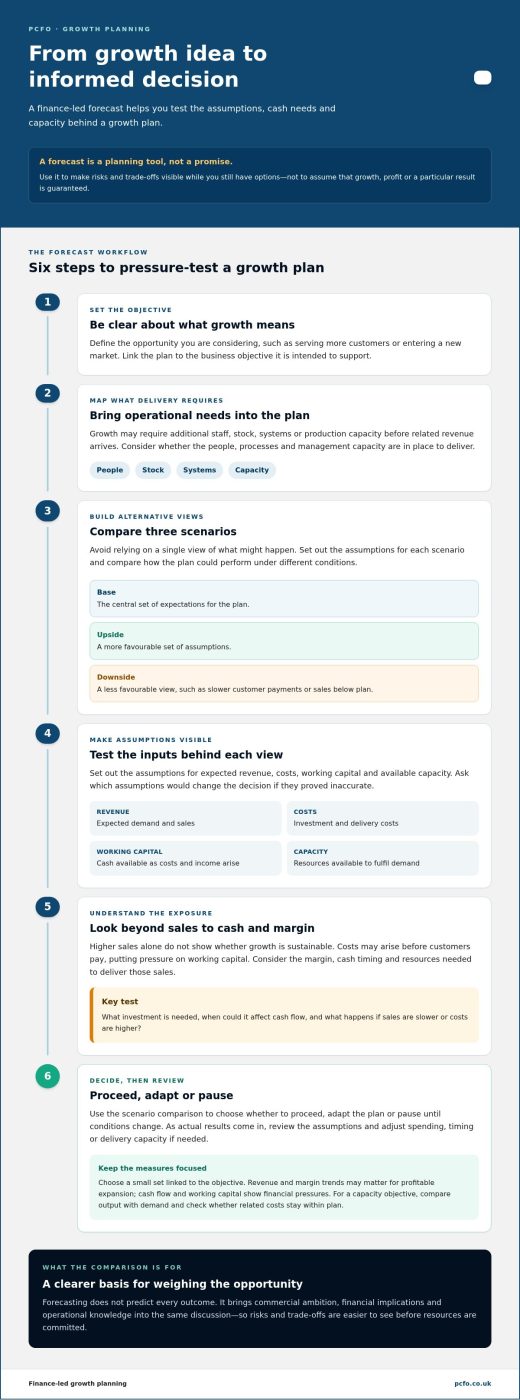
Growth can put competing demands on cash, people and management time. An advisor can help you decide which opportunities merit attention and what your business may need to pursue them. Entering a new market, for example, could require spending on stock, staff or systems before additional revenue arrives.
Before committing resources, test the assumptions behind the plan. This could mean examining expected demand, delivery capacity, timing and the effect of slower sales or higher costs. The purpose is not to predict every outcome. It is to make risks and trade-offs visible while you still have options.
Useful questions to explore include:
- Does the business have the people, processes and capacity to deliver the proposed growth?
- What investment is needed, and when could it affect cash flow?
- Which assumptions would change the decision if they proved inaccurate?
This brings commercial ambition together with its financial implications. It gives decision-makers a clearer basis for comparing priorities, rather than treating a promising idea as automatically viable.
How does a finance-led advisor differ from general growth support?
Growth support comes in different forms. Some programmes focus on identifying needs, sharing guidance or directing businesses to relevant resources. That can help a company find a starting point or identify a type of support. An ongoing advisory relationship focused on the business’s own financial plans serves a different purpose.
A finance-led business growth advisor can give sustained attention to forecasts, cash flow, budgets and management information. These tools help leaders understand how strategic choices may affect the company’s finances over time. If you are considering new equipment, for instance, forecasts can help compare its expected cost and timing with available resources and other priorities, while brokers such as Lending Box can assist in securing suitable commercial financing options.
Financial insight does not replace commercial judgement or operational knowledge. It adds another perspective, helping leaders assess what a plan may require and whether its assumptions remain realistic. Finance-led support is particularly relevant when growth decisions and financial oversight need to be considered together. Broader advice or public support may be more suited to signposting, specialist programmes or early-stage guidance.
How financial insight connects a growth plan to business decisions
A growth objective becomes actionable when you can see what it requires financially and operationally. To increase sales by serving more customers, for example, a business may need additional staff, stock or production capacity before it receives the related income. Timing matters: costs may arise well before customers pay, putting pressure on working capital.
Higher sales do not, by themselves, show whether growth is sustainable. The margin, cash timing and resources needed to deliver those sales matter too. A business growth advisor with financial expertise can bring these factors into the same discussion, helping leaders weigh the opportunity against the financial exposure.
Using forecasts to test growth assumptions
A forecast is a planning tool, not a promise. Instead of relying on one view of what might happen, compare base, upside and downside scenarios. Set out the assumptions behind expected revenue, costs, working capital and available capacity in each. For example, a slower customer payment cycle in the downside scenario may show that an otherwise attractive expansion leaves less cash for day-to-day commitments.
Comparing scenarios gives leaders a structured way to decide whether to proceed, adapt the plan or pause until conditions change. Review the assumptions as actual results come in. If demand is below plan or costs rise, the forecast can help show the likely effect and whether spending, timing or delivery capacity needs to change.
Public guidance serves a different purpose from ongoing financial oversight. The UK Business Growth Service is a route to government business growth support. A company may also need tailored forecasting and financial review to inform its own decisions.
Choosing measures that show whether growth is sustainable
Choose a small set of measures linked to your objective, rather than tracking every available figure. For profitable expansion, revenue and margin trends may be relevant alongside cash flow and working capital. If the priority is increasing delivery capacity, you might also monitor whether output is keeping pace with demand and whether related costs are staying within plan.
Management information helps you compare planned performance with actual results. A gap is a prompt to investigate, not a conclusion on its own. Lower revenue could reflect delayed sales, a change in demand or a forecasting assumption that needs review. Read the figures together and in context, then agree whether action is needed.
Regular review turns financial information into a decision-making tool. PCFO’s financial leadership and growth advisory can connect planning with financial oversight as your business assesses its next steps.
What to look for in a business growth advisor’s practical approach
A useful advisory relationship makes clear how the work relates to the decisions your business needs to make. First identify the challenge: do you need broad strategic direction, stronger financial planning or senior input to put an agreed plan into action? The right fit depends on your business’s stage, objectives and in-house capabilities.
Use the framework below to compare types of support. These are different models, not a ranking. Agree the advisor’s remit around your needs rather than making assumptions based on their title.
| Area | Questions to consider |
|---|---|
| Remit | Does the work focus on a specific growth priority, wider business planning or financial leadership? |
| Financial depth | Will the advice consider forecasts, cash flow and financial implications, or focus mainly on broader commercial direction? |
| Continuity | Do you need input for a defined decision, or an ongoing senior perspective as priorities develop? |
| Implementation support | Will the work help translate recommendations into planning and decision support, or primarily offer guidance? |
How to assess scope, financial depth and follow-through
Start with the decisions you need to make, then agree what the advisor’s remit covers and what stays with your leadership team. If your priority is expanding capacity, for example, useful support could connect the commercial objective with financial planning, forecasts and the assumptions behind investment choices.
Where relevant to the agreed work, look for clear outputs such as a business plan, financial projections or structured decision support. Make sure responsibilities and review points are understood, so you know how recommendations will inform decisions and how progress will be considered. The approach should suit the business, not follow a one-size-fits-all process. PCFO’s business growth advisory and business planning work can be shaped around a company’s strategic priorities. For more detail, explore the business growth advisory guide.
Why senior financial leadership can complement growth advice
Some growth challenges call for senior financial oversight alongside strategic advice. A Finance Director or CFO can bring a financial perspective to business planning and strategic decisions, helping leaders assess the implications of their choices. PCFO provides fractional and outsourced Finance Director and CFO services, bringing senior financial leadership on a part-time or outsourced basis rather than through a permanent executive hire.
This differs from routine bookkeeping, which centres on accounting administration, and from statutory audit, a separate professional service. A business growth advisor may provide broad strategic guidance, whilst finance-led leadership focuses on financial planning and oversight. For more detail on the Finance Director role, read the strategic Finance Director guide.
When to hire a business growth adviser and how to prepare
Consider a business growth advisor when an important decision has several moving parts and your team would benefit from a clearer financial view. You do not need to be in financial difficulty. Advice can be useful while the business is performing well, particularly before committing resources to a new direction or when growth puts new demands on capacity.
The aim is not to hand responsibility for the decision to someone else. It is to make the options, assumptions and constraints easier to assess, so leaders can choose a course of action with a better understanding of what it involves.
Signals that growth decisions need more financial oversight
Growth often brings added complexity: more commitments, more dependencies and a greater need to coordinate decisions. That does not mean something is wrong. It may mean the business has reached a point where informal planning or existing finance capacity no longer gives leaders the insight they need.
- Competing investment priorities: If you are weighing a new system against extra staff or equipment, financial oversight can help compare the cost, timing and strategic purpose of each option.
- Uncertain cash requirements: If a plan involves paying costs before customer income arrives, clearer projections can help you assess the likely effect on working capital.
- Capacity pressure: If the team is stretched or delivery could become a constraint, leaders may need to decide whether to adjust the pace of growth, invest in capacity or change how work is organised.
- Limited internal finance capacity: If your team can report past performance but lacks the time or expertise to explore future scenarios, senior financial input may help inform the next decision.
One signal alone does not dictate a particular course. Together, these pressures can show where additional financial perspective would be useful.
Preparing for a focused conversation about growth
A short, structured preparation can keep an initial discussion grounded in real decisions. Work through these steps:
- State the objective. Describe what you want the business to achieve and why it matters now.
- Set out the constraints. Note relevant limits on cash, people, time, operational capacity or internal expertise.
- Summarise recent performance. Highlight what is going to plan, where results differ from expectations and what may explain the gap.
- Name the decisions ahead. Identify the choices you need to make, their timing and what would help you reach a considered decision.
- Define a useful outcome. Decide whether you need clearer priorities, a plan, financial projections or support assessing options.
A productive first discussion starts with a clear goal, an honest view of constraints, recent performance and the decision you need to make. Existing accounts, forecasts and management information can provide helpful context. They do not need to be perfect. Being clear about what you know and what remains uncertain is a useful starting point.
If you are weighing a growth decision and would value finance-led planning support, explore PCFO’s business growth advisory.
How PCFO brings financial leadership into business growth advisory
Growth plans involve choices about priorities, investment and the financial capacity needed to deliver them. PCFO provides business growth advisory, business planning and senior financial leadership for growing UK businesses. Its fractional and outsourced Finance Director and CFO services provide senior support on a part-time or outsourced basis, without requiring a permanent executive hire.
This can suit a business seeking an advisor who connects commercial objectives with financial planning. The work can be shaped around your priorities, whether you are assessing an opportunity, reviewing a plan or weighing strategic options. No particular decision can guarantee a specific result. The value is in bringing financial insight to the choices ahead.
Combining growth advisory with outsourced finance leadership
Business growth advisory helps leaders consider where to focus and how to progress priorities. Finance Director or CFO support adds a senior financial perspective to planning and strategic decisions. Together, these services can help you examine the financial implications of a plan alongside its wider business purpose.
For example, if you are considering increasing capacity, financial leadership can help you plan the investment and understand its place in the business’s financial outlook. The advice depends on your objectives and circumstances. This is different from routine bookkeeping or statutory audit: the focus is senior financial leadership and planning, not simply processing transactions or providing an audit opinion.
PCFO also provides outsourced accountancy solutions and exit strategy planning to address businesses’ wider financial and planning needs. Different businesses need different combinations of support, so begin with the decisions and priorities that matter to yours.
Choosing a practical next step with PCFO
To focus an initial conversation, identify the immediate question you are trying to answer. You might be weighing investment priorities, reviewing a business plan or looking for a clearer financial view of your next stage. Bring the context that explains the decision, including your objectives, current constraints and available financial information.
PCFO’s business growth advisory and planning support is shaped around a business’s planning needs. A clear starting point helps establish which decisions matter most and where senior financial input can be useful. You do not need to arrive with every answer. Being open about what is known, what remains uncertain and what you want to achieve gives the discussion a practical foundation.
Discuss your business growth priorities with PCFO to explore how financial leadership could support your planning. The conversation starts with your circumstances and the decisions ahead.
Make your next growth decision with greater clarity
You do not need to have every detail of your growth plan settled before taking a useful next step. Start with the decision that feels most pressing, the outcome you are working towards and what you still need to understand. This gives a business growth advisor a practical starting point and keeps the conversation focused on your business rather than a generic growth formula.
PCFO supports growing UK businesses with fractional and outsourced Finance Director and CFO services, business growth advisory, business planning consultancy, exit strategy planning and outsourced accountancy. The right support depends on the question in front of you and the financial perspective your business needs. A considered conversation can help clarify those needs without assuming a particular outcome.
If you are ready to explore your options, discuss your business growth priorities with PCFO. A clear next step can make a complex decision more manageable and help you move forward with confidence.
Frequently Asked Questions
Is a business growth advisor the same as a business coach?
Not necessarily. A business coach often focuses on the owner’s goals, leadership and accountability. A business growth advisor typically works on business-level priorities such as strategic planning, operational capacity or financial considerations. The roles can overlap, and titles are not always used consistently. If you need help comparing a business decision and its commercial implications, make that focus clear at the outset.
Can a business growth advisor help a company prepare for funding?
Yes. An advisor can help strengthen the planning behind a funding proposal. This may include setting out how the funds would be used, the business need they address and the assumptions supporting the plan. Alongside internal planning, specialist finance partners such as Koval Investments can help organisations optimise their credit profiles and explore practical funding solutions. Advisory support can improve preparation, but it cannot guarantee that a lender or funder will approve an application.
Is business growth advice only for companies in financial difficulty?
No. Businesses can seek advice when they are stable and considering a significant decision, not only when finances are under pressure. A company with reliable trading might want to assess whether to enter a new market, invest in systems or expand its team. Considering the financial and operational implications early can help leaders make a deliberate choice rather than wait for a challenge to become urgent.
Can a business growth advisor help with an exit strategy?
Yes. Business growth advice can sit alongside exit strategy planning when an owner is considering a future sale or another change in ownership. Planning may involve the business’s objectives, the work needed to prepare and how an exit could affect wider decisions. PCFO supports businesses with exit strategy planning. This is business-focused support, not a promise of a sale or a particular exit value.
What information should I have ready before discussing business growth advice?
You do not need a perfect pack of documents. It helps to explain what decision is coming up, why it matters and what you are unsure about. Bring relevant context, such as ownership or leadership priorities, key customer or supplier dependencies, and commitments that could affect your options. Note which assumptions are based on evidence and which still need testing. This makes it easier to focus the discussion.
Can a business growth advisor help an established SME as well as a start-up?
Yes. A business growth advisor can support businesses at different stages, with the focus shaped by their circumstances. A start-up might need to test whether its commercial model and planned costs are workable. An established SME could be reviewing a new market, a change in leadership or a more complex growth plan. The useful starting point is the decision to be made, not the company’s age.