

What if the software isn’t the first thing your SME needs to change? When financial information is spread across spreadsheets and disconnected tools, choosing a new system can seem like the obvious fix. But financial systems implementation for smes is more likely to succeed when you first understand and improve the workflows behind the numbers.
You may already know that your finance processes need to be more joined up. The challenge is deciding what to replace, what to retain and what to integrate, without disrupting invoicing, reporting or month-end routines. A system should support the way your business operates, not add unnecessary work for the team.
This practical guide explains how to plan, compare and implement a financial system that fits your current needs and can support future growth. You’ll learn how to map finance workflows, assess options against business priorities, prepare reliable data and manage a controlled transition. You’ll also see how clear finance processes and leadership can turn better information into stronger cash visibility, planning and decisions.
Key Takeaways
- Successful financial systems implementation for smes starts with improving finance workflows, not simply installing new software.
- Build a practical blueprint around business objectives, existing processes, essential requirements, clear ownership and measures of success.
- Compare internal-led, software-provider-led and finance-led approaches by considering workflow knowledge, team capacity and continuity planning.
- Use staged preparation, testing, data migration and review to help protect invoicing, payment processing and reporting during the transition.
- Connect dependable financial information to routine decisions, business planning and growth priorities through ongoing finance leadership.
What financial systems implementation means for an SME
Financial systems implementation is the process of aligning finance tools, data, workflows and people so that information is recorded, checked and used consistently. It means improving how finance work gets done, not simply buying accounting software and switching it on. The distinction matters: software can provide useful functions, but it won’t resolve unclear responsibilities, duplicated processes or reports that don’t answer the questions leaders need to make decisions.
For an SME, implementation may involve improving existing tools, connecting systems or adopting new software. The right scope depends on the business’s size, complexity, finance team and current arrangements. A growing company might need clearer invoicing and cash reporting, whilst a business with several income streams may need more structured processes and management information. Enterprise resource planning (ERP) systems bring different business functions together, but an SME’s finance requirements don’t automatically call for a full ERP project.
Common triggers include growth, repeated manual rework, records held in disconnected places and limited visibility of performance. These are reasons to examine the whole finance function, rather than assume new software alone will fix the problem.
Which finance processes might an SME system support?
Map each workflow separately. This makes handovers and gaps easier to spot, and helps define what a system change should cover:
- Bookkeeping: recording transactions, reconciling accounts and maintaining financial records.
- Invoicing: preparing and issuing customer invoices, then tracking what has been paid or remains outstanding.
- Expenses: collecting, checking and recording staff claims and business purchases.
- Payroll information: coordinating relevant figures and records with the process used to run payroll.
- Management reporting: bringing results together so leaders can review performance, cash position and plans.
Not every workflow needs to move into one platform. In the UK, HMRC’s Making Tax Digital framework is relevant when considering digital records and tax-related processes, but the requirements that apply depend on the business and its circumstances. Check current HMRC guidance before setting project requirements, and avoid assuming that one software choice or workflow suits every SME.
What signals that existing systems need attention?
Look for repeated spreadsheet work, the same figures entered in multiple places, or different versions of a report being circulated. These patterns consume time and make it harder to establish which information is current. Delayed reporting can also slow decisions, but the cause may be late data, unclear review responsibilities or inconsistent routines, rather than the software itself.
Growth often exposes these weaknesses. More transactions, staff or reporting needs can make informal checks unreliable and blur ownership of tasks. Before changing systems, identify who prepares, reviews and uses each key output. Part-time or outsourced Finance Director and CFO support can help connect those responsibilities and reporting needs with the business’s plans.
Build an SME finance-systems blueprint before configuring software
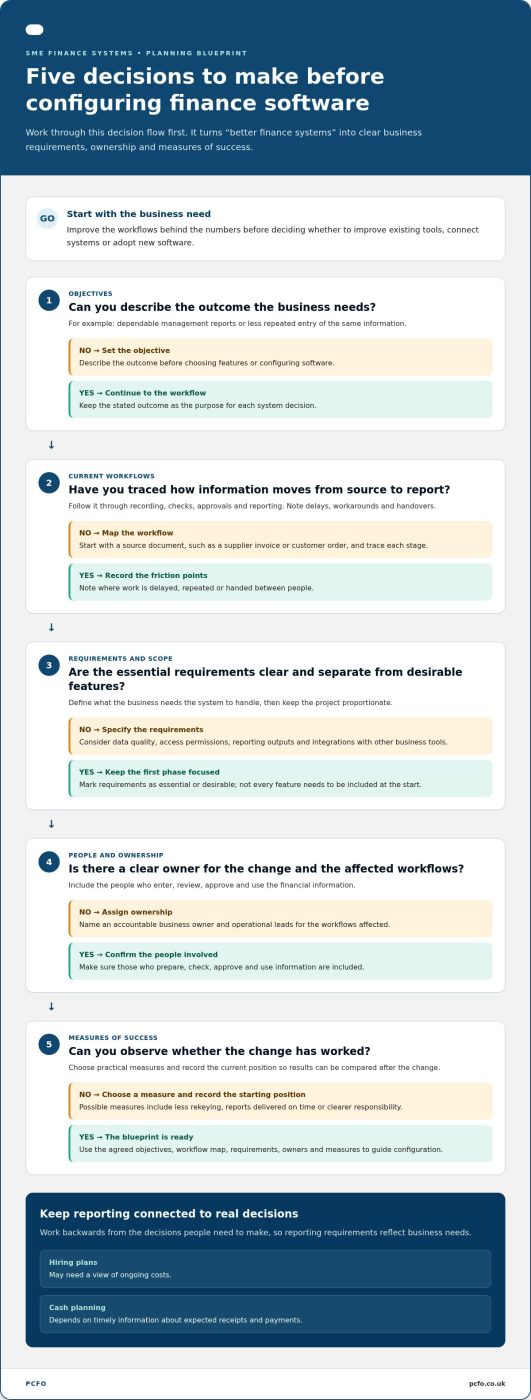
A clear blueprint turns a broad desire for “better finance systems” into decisions the business can act on. For financial systems implementation for smes, document what needs to improve, who the change affects and how you’ll judge whether it has worked before choosing configurations or adding features.
Set out requirements before configuring software, so that each system decision has a clear business purpose. Use this five-step blueprint:
- Set objectives. Describe the outcomes you need, such as producing management reports on a dependable schedule or reducing repeated entry of the same information.
- Map current workflows. Trace how financial information moves from source documents through recording, checks and approvals to reports. Note delays, workarounds and handovers.
- Define requirements. Specify data quality needs, access permissions, reporting outputs and integrations with other business tools. Separate essentials from desirable features so the project stays proportionate.
- Assign ownership. Name an accountable business owner and operational leads for the workflows affected. Include the people who enter, review, approve and use the information.
- Set success measures. Choose observable measures, such as less rekeying, reports delivered on time or clearer responsibility. Record the current position first so you can compare results after the change.
Map workflows, users and decision needs
Follow a transaction from its source, such as a supplier invoice or customer order, through entry, review and approval, into financial records and management reporting. At each stage, identify who acts and what information they need. Then work backwards from decisions: a hiring plan may need a view of ongoing costs, while cash planning depends on timely information about expected receipts and payments. This keeps reporting requirements tied to real business choices.
Set scope, ownership and measures of success
Not every feature belongs in the first phase. Mark requirements as essential, useful later or outside the project’s scope. For example, reliable access controls and accurate core reports may be essential, whilst an additional dashboard could wait if it doesn’t support a current decision. This distinction helps prevent a system project expanding without a clear benefit.
Ownership should be visible in practice, not just on a project chart. The business owner is accountable for priorities and decisions; operational leads explain how work is carried out and help identify what must continue during change. A Finance Director can connect system requirements with planning, performance measures and growth priorities, as explained in this guide to the strategic role of a Finance Director.
Review your measures against their starting point after launch, and use the findings to guide improvements. When system decisions need to align with wider business planning, finance leadership and business planning support can help keep the work focused on the decisions the business needs to make.
Compare financial systems implementation approaches for SMEs
The right approach depends on the scale of the change, the knowledge available internally and the level of finance oversight required. Financial systems implementation for smes can be led by the business, a software provider or finance leadership. These approaches can also be combined, provided responsibilities are clear.
Software configuration and finance-process design are related, but distinct. A provider may configure fields, permissions and workflows within a system. The business still needs to decide how information should move, who checks it and what reports support decisions. Keep that distinction clear when agreeing responsibilities.
Internal-led: Business ownership is close to the work, and staff may understand existing processes well. The main constraint is internal capacity: project tasks can compete with day-to-day finance, and undocumented workflows may be missed. Continuity depends on allocating time for decisions, testing and adoption.
Software-provider-led: The provider brings product and configuration knowledge, which can help with technical setup. Business ownership and detailed workflow knowledge still need to come from within the SME. Agree who will make process decisions, validate outputs and plan around essential finance routines during the change.
Finance-led: Finance leadership can connect system choices to reporting, controls and business objectives. This approach brings a finance-function view, though operational users still need to explain how work happens in practice. Clear decision rights and staged changes help maintain continuity.
For many SMEs, a blended model is practical: the provider handles technical configuration, internal users explain and test workflows, and finance leadership guides priorities and reporting design. The right balance depends on the project, not on one preferred model.
When an internal-led implementation may fit
An internal-led approach can work well when the scope is narrow, workflows are already understood and someone has the authority and time to coordinate decisions. For instance, a contained change to an existing process may not need extensive oversight. However, competing responsibilities can stall progress, while undocumented steps risk being carried into the new setup. Give users time to review requirements, test realistic transactions and learn revised routines.
When finance leadership adds value
Finance leadership is particularly useful when the change affects several workflows or the business needs better information for planning. A Finance Director or CFO can help assess whether proposed reports answer management questions, whether responsibilities and controls are clear, and how decisions align with business priorities. This is strategic oversight, not a substitute for technical configuration. The distinction between planning expertise and software is explored in this guide to FP&A consultant versus software.
To limit disruption, identify an accountable business owner, agree which operational routines must continue, and make decisions in manageable stages. Part-time and outsourced finance leadership can connect system choices with wider reporting and planning needs.
Implement financial systems in manageable stages
A staged transition gives your team clear checkpoints and makes it easier to protect essential finance work. The scale of each stage should reflect the change: connecting a single workflow may need a lighter plan than replacing several systems. In either case, financial systems implementation for smes should include preparation, configuration, testing, migration, launch and review.
- Prepare: Confirm scope, responsibilities, records to move and the finance activities that must continue throughout the change.
- Configure: Set up agreed workflows, reporting, access permissions and integrations. Compare the configuration with documented requirements before moving on.
- Test: Run user acceptance testing with representative transactions and expected outcomes. Check the full process, not just whether information can be entered.
- Migrate: Cleanse agreed data, transfer it and reconcile key balances and records against the source information.
- Launch: Introduce the new process in a sequence the business can support, with users trained and a clear route for resolving issues.
- Review: Check reports, exceptions and user feedback, then assign and prioritise any corrective actions.
Plan continuity explicitly. Decide how invoices will be raised and tracked, how payment processing will continue and how reporting will be produced during the transition. For example, if a workflow moves in stages, document which process is authoritative at each point. This reduces the risk of duplicate entries or uncertainty about which figures to use.
Prepare data and test real finance workflows
Inventory data sources and identify duplicate, incomplete or outdated records before migration. Agree which information needs to move, and reconcile key totals so that the new system starts from a position the business understands. Then test typical transactions from entry through approval and reconciliation to the resulting report. Record each issue in one shared log with its impact, owner, status and agreed resolution. Don’t rely on affected outputs for decisions until the issue is resolved or its limitations are clearly understood.
Plan launch, adoption and early review
Train users on the tasks they actually perform, and document revised routines such as who checks an invoice or prepares a report. Choose a launch sequence that fits team capacity and protects time-sensitive finance work. Go-live readiness means the key workflows have been tested, migrated data has been reconciled and users are prepared to carry out their roles. After launch, review early outputs and questions, identify process exceptions and assign corrective actions with clear owners.
Finance leadership can keep transition decisions connected to reporting needs and business priorities. If you’re planning a change and need experienced financial oversight, explore finance leadership support to align system decisions with the wider finance function.
Turn implementation into better financial decisions with ongoing finance leadership
A financial system creates value when the finance team uses dependable information in routine decisions, not simply when the software is live. For financial systems implementation for smes to support lasting improvement, the information it produces needs to be timely, understood and relevant to the choices business leaders face.
That calls for ongoing attention to how finance work is performed and how reports are used. Finance Director or CFO oversight can connect reporting with business plans, growth priorities and the questions leaders need answered. For example, a cash report is more useful when it helps the business consider upcoming commitments and available capacity, rather than presenting figures without context.
Measure whether the system is improving finance work
Use the measures agreed during project planning as a starting point. Compare the new process with its baseline and review whether reports arrive when decision-makers need them, whether reconciliations produce fewer unexplained exceptions, and whether staff spend less time on manual work. Ask users whether they trust the information and understand who is responsible for each step.
Look beyond headline measures. A recurring reconciliation difference might point to a workflow problem, whilst an access issue could indicate that permissions or responsibilities need refining. Gather examples, establish the cause and assign a practical action. That could mean adjusting a process, clarifying who reviews a transaction or improving guidance for users. Regular review helps the finance function adapt as the business changes.
Connect system outputs with business planning
Reliable management information can inform discussions about cash, capacity and investment. A Finance Director or CFO can interpret results in the context of business priorities, helping leaders consider what the figures mean for a proposed hire, planned spending or a growth decision. The aim isn’t to produce more reports for their own sake. It’s to make relevant information available and clear enough to support considered action.
Outsourced accountancy can form part of this joined-up finance function by supporting consistent accounting work and information flows. It’s not a software product or a substitute for decisions about how the business should use financial information. Instead, accounting support and finance leadership can play complementary roles: dependable records provide a sound basis for reporting, whilst strategic oversight connects that reporting to plans and priorities. SMEs considering this broader support can explore outsourced accountancy solutions in the context of their finance needs.
Keep the conversation focused on the decisions your business wants better information to support. If finance leadership would help link reporting with planning and growth, discuss Finance Director support with PCFO and consider your priorities.
Make your next finance decision with confidence
Treat your finance system as part of how the business plans and adapts, rather than a project that ends at launch. As priorities shift, review whether the information your team relies on still supports the decisions ahead. A considered approach to financial systems implementation for smes can help build a finance function that grows with the business.
PCFO works with growing UK businesses through part-time and outsourced Finance Director and CFO services, business planning and growth advisory, and outsourced accountancy solutions. These services bring financial information, planning and leadership into closer alignment, with support shaped around the business’s needs.
If you’re considering your next steps, discuss how finance leadership can support your business. A clear conversation about your priorities can help you identify where to focus and move forward with confidence.
Frequently Asked Questions
Is cloud financial software automatically secure?
No. Cloud software isn’t automatically secure; protection depends on the provider’s controls and how your business manages access and information. Review current security documentation to understand the measures in place, then assign permissions according to each person’s role. Use appropriate authentication, understand how backups are managed and establish clear procedures for staff. For example, someone preparing invoices may not need the same access as a person approving payments.
Can an SME keep spreadsheets after implementing financial software?
Yes, spreadsheets can still support analysis or temporary transition tasks, provided they don’t become competing records. Name the authoritative system for each type of financial information, document who owns each spreadsheet and explain how figures are calculated. If a spreadsheet repeatedly requires manual updates, check whether the underlying process or reporting need can be addressed more reliably. The right boundary depends on your workflows, reporting requirements and control environment.
How much historical financial data should an SME migrate?
There’s no universal period to migrate. Decide based on what current workflows and reports need, the quality of existing records and how the business accesses older information. Active data may be needed for ongoing work, whilst older records could remain securely accessible in their existing format instead of being transferred. Document the rationale, identify who can retrieve archived information and check applicable record-retention obligations before implementation.
What happens if the new finance system is not ready at the planned launch?
Don’t switch simply to meet a date if agreed readiness criteria haven’t been met. The accountable owner should review unresolved test results, data reconciliation, user preparation and any effect on essential finance activities, using a clear escalation route for decisions. A controlled delay or narrower launch may be preferable to relying on untested processes. Record the decision, outstanding issues and next steps so teams know which procedures remain in use.
Should an SME replace every finance tool at the same time?
Not necessarily. A single change may simplify how tools work together, but it can increase coordination demands and pressure on day-to-day finance. Staging changes can make testing and learning more manageable, although linked processes may sometimes be better changed together. For financial systems implementation for smes, base the sequence on workflow dependencies, team capacity, data movement and business priorities, rather than assuming one rollout pattern suits every organisation.
How often should an SME review its financial systems after implementation?
Set a review routine that reflects how much the business changes and how important the affected processes are, rather than relying on a universal timetable. Check whether access remains appropriate, data is dependable and reports still support decisions. Note recurring workarounds and user questions, too. Assign an owner to track findings, and add a review after a material change to business operations, responsibilities or the system itself.