

A high valuation isn’t a gift from a buyer; it’s the calculated result of eighteen months of rigorous financial hygiene and strategic storytelling. You’ve likely spent years building your company, yet the thought of opening your books to a private equity firm or a strategic acquirer often feels daunting. It’s natural to worry that a lack of a dedicated finance leader or fragmented records might leave significant money on the table. Most founders feel overwhelmed by the complexity of different valuation methods, especially in a market where buyers are testing forecasts more rigorously than ever before. This guide will show you how to master business valuation preparation UK so you can present a clean, professional business that commands a premium.
You’ll learn how to meticulously organise your financial data and strategic narrative to maximise company value before a sale or investment. We’ll explore the essential value drivers, the mechanics of modern valuation methods, and how to build a narrative that turns raw data into a compelling investment case. By the end, you’ll have the confidence to enter negotiations with a clear understanding of what your business is truly worth and the evidence to back it up.
Key Takeaways
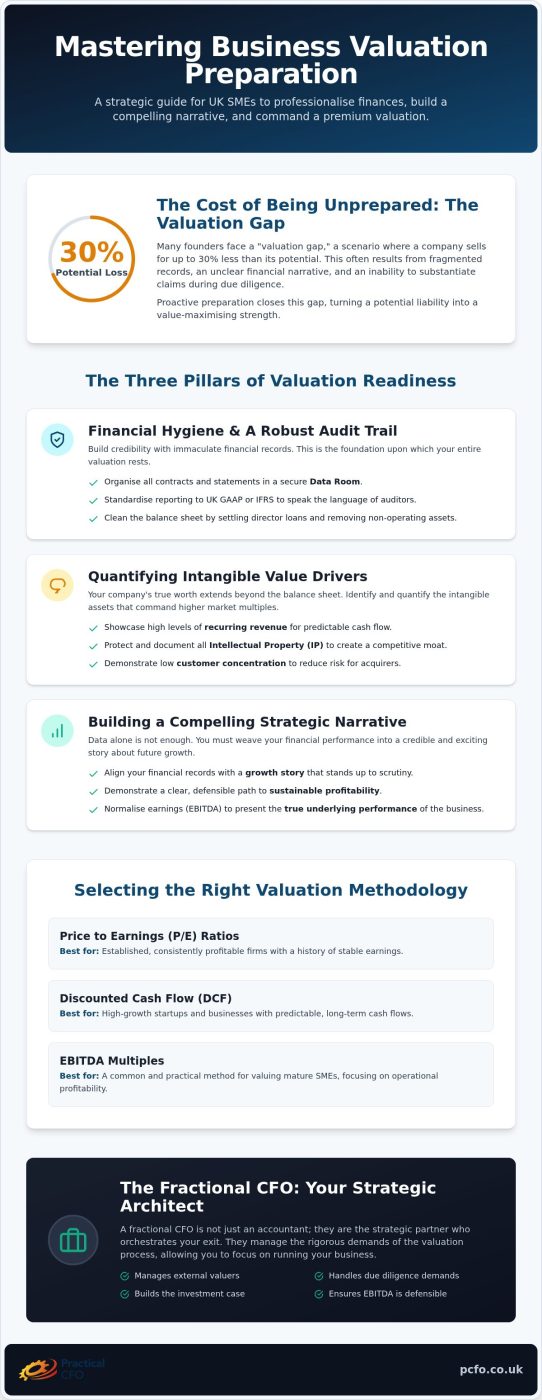
- Understand how proactive business valuation preparation UK prevents the common “valuation gap” where unprepared founders lose up to 30% of their company’s potential sale value.
- Learn to professionalise your finance function by centralising contracts and financial statements within a secure Data Room to ensure a clean audit trail.
- Identify the specific intangible value drivers, such as recurring revenue and intellectual property, that allow your business to command a higher market multiple.
- Determine the most effective valuation methodology for your industry, from Price to Earnings (P/E) ratios for established firms to Discounted Cash Flow (DCF) for high-growth startups.
- Discover how a fractional CFO serves as the strategic architect of your exit, managing the rigorous demands of external valuers and legal advisors.
Why Business Valuation Preparation is Critical for UK SMEs in 2026
Effective business valuation preparation UK is far more than a mathematical exercise. It’s the strategic alignment of your financial records with a growth narrative that stands up to intense scrutiny. The UK market in 2026 has shifted significantly. With the Bank of England base rate at 3.75% as of July 2026, the cost of capital remains a primary concern for investors. They’ve moved away from vanity metrics like top-line revenue growth in favour of sustainable cash flow and quality of earnings. If you don’t demonstrate a clear path to profitability, your valuation will suffer.
Unprepared businesses often fall victim to the valuation gap. This is a scenario where a company sells for 20-30% less than its potential because the founder cannot substantiate their claims. By applying fundamental business valuation principles early, you can identify these risks before they become liabilities. Success requires a lead time of at least 12 months. This window allows you to professionalise the finance function and ensure every pound of EBITDA is defensible under the microscope of due diligence.
The Consequences of Poor Preparation
Messy data kills deals. When a buyer’s team discovers inconsistencies in your management accounts or contracts, they lose confidence in the entire operation. This leads to deal fatigue, where the momentum of a transaction stalls and the founder becomes drained by repetitive requests for data. Buyers frequently use these discovery phases for price chipping, using minor financial discrepancies as a tool to lower their offer. The emotional toll on founders is often heavy when avoidable errors, discovered late in the process, undermine years of hard work.
Valuation as a Management Tool
Viewing valuation prep as a one-off event is a missed opportunity. It’s better to use this process to uncover operational weaknesses whilst you still have time to fix them. If your customer concentration is too high or your recurring revenue is lower than industry benchmarks, you need to know now. Integrating these health checks into your strategic business planning ensures that shareholder expectations are aligned amongst the board. It transforms a stressful exit into a methodical, value-maximising journey that reflects the true worth of your company.
Financial Hygiene: Organising Your Data for a Robust Audit Trail
Credibility is the primary currency in any high-stakes transaction. Most founders focus on the final figure, but the reliability of that number depends entirely on your financial hygiene. Standardising your financial reporting to meet UK GAAP or IFRS requirements is a non-negotiable step in business valuation preparation UK. It ensures your data speaks the same language as the auditors and investment analysts who will eventually scrutinise your books. Consult this UK business valuation guide to understand how different methods rely on this baseline of data integrity.
Centralising your records into a “Data Room” is a critical exercise. This secure digital space should house all contracts, IP documents, and historical financial statements. It’s also the time to clean up your balance sheet. Director loans and non-operating assets, such as personal vehicles or unrelated property, should be settled or removed. Unresolved HMRC queries are a major red flag. Even a minor tax dispute can stall a multi-million pound deal or lead to significant retentions in the final contract.
Professionalising the Finance Function
Transitioning from basic bookkeeping to sophisticated management accounting services is essential for scaling firms. You need to implement robust internal controls that prove the accuracy of your figures. Buyers look for historical consistency in your month-end closing processes. If your numbers fluctuate due to poor accounting practices rather than business performance, you’ll lose leverage during negotiations. Our team at PCFO often provides the steady hand needed to bridge this operational gap before a sale.
Normalising Your Earnings (EBITDA)
Buyers typically value SMEs as a multiple of EBITDA, but your statutory accounts might not reflect your true earning potential. You must identify “add-backs”. These are one-off expenses, such as a redundant office fit-out or a specific legal fee, that won’t recur under new ownership. It’s equally important to distinguish between personal expenses and genuine business costs to avoid awkward questions during due diligence. EBITDA normalisation is the process of revealing the true underlying profitability of the business. By stripping away these anomalies, you provide a clear, defensible view of the cash flow a buyer is actually purchasing.
Beyond the Balance Sheet: Quantifying Intangible Value
While financial hygiene provides the foundation, the true premium in your valuation comes from the strategic narrative you build around intangible assets. While most UK SMEs are valued between 3x and 8x adjusted EBITDA, those with strong intangibles consistently hit the higher end of that range. Identifying these value drivers is a core part of business valuation preparation UK. You must assess the strength of your customer base; high churn rates or excessive customer concentration, where one client represents over 20% of turnover, act as significant “valuation haircuts” during the negotiation process.
Documenting your “Secret Sauce” is equally vital. This includes your intellectual property, proprietary processes, and brand equity. If your margins are significantly higher than the industry average, you need to prove why they are sustainable. Buyers aren’t just purchasing historical profit; they’re buying the future certainty of those profits. This strategic phase of business valuation preparation UK ensures you aren’t just selling a balance sheet, but a future-proofed asset.
The Management Team Multiplier
The most common obstacle to a high valuation is “founder reliance.” If the business cannot thrive without your daily involvement, it represents a high risk to a buyer. Proving a business is scalable requires a high-calibre leadership team and clear succession planning. Having a fractional CFO on your board signals to investors that you have professional oversight and rigorous financial governance. This presence alone can add a premium by reducing the perceived risk of the transition and providing a steady hand during due diligence.
Market Positioning and Scalability
Buyers want to see a clear “moat” that protects your business from competitors. This could be a unique geographic advantage, a specialised niche, or superior technology. Using business growth advisory helps you map out future revenue streams that a buyer can exploit post-acquisition. You should quantify your Total Addressable Market (TAM) to justify aggressive growth forecasts. If you can show that you’ve only captured a small fraction of a growing £500 million market, your valuation narrative becomes far more persuasive to an ambitious acquirer.
Selecting the Right Valuation Methodology for Your Industry
Choosing the correct methodology is a pivotal step in business valuation preparation UK. The “best” method isn’t universal; it depends on your sector, your growth stage, and the quality of your earnings. For established, profitable UK SMEs, the Price to Earnings (P/E) ratio remains the standard. This approach applies a multiple to your post-tax profits, reflecting the market’s appetite for your specific industry. Most UK small businesses currently trade between 3x and 8x adjusted EBITDA, though exceptional firms can exceed these benchmarks by proving superior operational resilience.
High-growth or pre-profit firms often require a Discounted Cash Flow (DCF) analysis. This is the gold standard for companies that are currently reinvesting all capital into scaling but can demonstrate significant future cash flows. Conversely, asset-based valuations are typically reserved for property-heavy firms or those in liquidation. For a healthy service or tech business, relying solely on assets will significantly undervalue your goodwill and intellectual property. Whilst the “times revenue” method is popular in tech circles, it carries risks in the UK market if your margins don’t justify the top-line figures. A valuation is ultimately what a willing buyer will pay in the current market.
Methodology by Sector
In the SaaS and Tech sectors, buyers focus heavily on Monthly Recurring Revenue (MRR) and churn rates. A low churn rate indicates a “sticky” product, which justifies a higher multiple. Professional services firms, such as consultancies or agencies, are judged on contract longevity and the stability of billable hours. If your revenue is tied to one-off projects, you’ll face a steeper discount. Manufacturing businesses must balance heavy asset loads with operational efficiency. Buyers in this space look for modernised plant equipment and lean processes that protect gross margins against rising energy and raw material costs.
The Role of Comparable Transactions
Finding “Comps” in the UK market requires a nuanced approach, as most SME deal terms are not public record. Industry averages can be misleading because they often aggregate data from businesses with vastly different risk profiles. You need to look for transactions involving firms of a similar size, geographic reach, and service mix. Maintaining confidentiality whilst gathering this intelligence is a delicate process that often requires professional oversight. If you are unsure which methodology best reflects your company’s worth, our exit strategy support team can provide a professional assessment to ensure you don’t leave money on the table.
How a Fractional CFO Streamlines Your Valuation Journey
A Fractional CFO serves as the lead architect for your exit strategy planning. Their primary role is to ensure that every aspect of your business valuation preparation UK is handled with the intellectual rigour required by sophisticated buyers. They don’t just report on the past; they translate complex financial data into a compelling investment deck that highlights growth potential and mitigates perceived risks. This strategic storytelling is what bridges the gap between a standard valuation and a premium offer.
During a transaction, the volume of requests from M&A lawyers and external valuers can be overwhelming for a founder. A CFO manages these relationships, acting as the primary point of contact to ensure consistency in the data provided across all channels. This board-level oversight is essential because it allows you to keep the business running at peak performance whilst the sale progresses. If operational performance dips during the due diligence phase, buyers will almost certainly use that volatility to renegotiate the price.
The Bridge Between Accounting and Strategy
Your year-end accountant is indispensable for tax compliance, but they are often too focused on historical reporting to effectively value your future trajectory. A CFO identifies and mitigates potential deal breakers, such as weak internal controls or inconsistent revenue recognition, before they ever reach a buyer’s desk. For most UK SMEs, the cost-effectiveness of fractional support is significant. You gain access to high-level corporate expertise and strategic foresight without the heavy salary commitment of a full-time executive hire, providing a clear advantage during a high-stakes transaction.
Next Steps for UK Founders
Preparing for a sale or investment requires a methodical approach to ensure no value is left on the table. We recommend following these immediate steps to professionalise your stance:
- Conduct an initial “Valuation Audit” to establish your current market baseline and identify obvious weaknesses.
- Establish a structured 12-month timeline for financial house-cleaning, focusing on balance sheet reconciliation and contract organisation.
- Secure your intellectual property and ensure all proprietary processes are documented and defensible.
- Contact PCFO for a confidential consultation to discuss how our business valuation preparation UK services can support your specific growth or exit plans.
Taking these steps early ensures that when you eventually enter the boardroom, you do so with a “clean” business and the confidence to negotiate from a position of strength.
Securing Your Company’s Legacy and Financial Future
Maximising your company’s value requires a shift from historical reporting to proactive strategic storytelling. As explored in this guide, successful business valuation preparation UK involves more than just tidying the books; it requires a deep understanding of your sector’s specific value drivers and the professionalisation of your finance function. By normalising your EBITDA and documenting intangible assets like management strength, you provide the clarity that 2026 investors demand. This methodical approach ensures you don’t leave money on the table due to avoidable “valuation haircuts” or data inconsistencies discovered during due diligence.
Our team of expert fractional CFOs brings extensive M&A experience and tailored financial leadership to scaling firms. We specialise in UK SME growth and exit strategy, acting as the steady hand you need to navigate complex negotiations. Whether you’re planning a strategic sale or seeking fresh investment, we’re here to ensure your business is ready for intense scrutiny. Speak to a PCFO advisor about your business valuation preparation today to protect the equity you’ve worked so hard to build. You’ve created a remarkable company; now is the time to ensure the market recognises its true potential.
Frequently Asked Questions
How long does it take to prepare a business for valuation in the UK?
Strategic preparation typically requires 12 to 18 months to achieve the best results. This timeframe allows you to professionalise your finance function and resolve any operational issues that might devalue the firm. Whilst a basic calculation can be done quickly, a robust business valuation preparation UK process ensures all data is defensible during due diligence. Starting early prevents the “valuation gap” where unprepared founders lose significant equity.
What is the most common valuation method for UK small businesses?
The most common methodology for established UK SMEs is the EBITDA multiple, often referred to as the Price to Earnings (P/E) approach. This method applies a sector-specific multiplier to your adjusted earnings to reflect market demand and risk. Most profitable small businesses trade between 3x and 8x adjusted EBITDA. It provides a transparent baseline that both buyers and sellers can easily understand during negotiations.
Can I value my own business using a spreadsheet?
You can certainly perform a preliminary internal calculation using a spreadsheet, but it won’t hold weight with sophisticated investors or HMRC. External parties require an independent, credentialed assessment to ensure the valuation is objective and follows recognised standards. A self-calculated figure often ignores complex risk factors and intangible value drivers, which can lead to unrealistic expectations or missed opportunities during a sale.
What documents do I need to prepare for a UK business valuation?
You must gather three to five years of statutory accounts, current management accounts, and detailed tax records. Beyond financials, you need a comprehensive Data Room containing employment contracts, intellectual property registrations, and major client agreements. Having these documents organised and ready for scrutiny is a cornerstone of effective business valuation preparation UK, as it demonstrates high levels of corporate governance and operational transparency.
How does an HMRC tax investigation affect my business valuation?
An ongoing HMRC tax investigation acts as a major red flag that can significantly depress your business valuation. Buyers typically view unresolved tax queries as a contingent liability, often leading to heavy price chipping or the use of restrictive indemnity clauses. It’s essential to resolve any outstanding compliance issues before entering a formal valuation process to protect your leverage and ensure a smoother transaction.
Should I hire a business broker or a CFO for valuation preparation?
You should ideally utilise both, but a CFO is critical for the preparation phase. Whilst a broker focuses on finding a buyer and managing the sales process, a CFO acts as the architect of your financial narrative. They ensure your data is robust and defensible before it reaches the market. Hiring a fractional CFO provides the strategic oversight needed to professionalise your books without the cost of a full-time executive hire.
What is the difference between a formal valuation and a market appraisal?
A formal valuation is a detailed report conducted by a credentialed appraiser for legal, tax, or statutory purposes. In contrast, a market appraisal is a more commercial estimate of what a buyer might realistically pay in the current economic climate. Appraisals focus heavily on market sentiment and comparable transactions, making them more suitable for founders exploring a potential exit or strategic investment.
How often should a UK SME update its business valuation?
UK SMEs should ideally update their valuation annually as part of their strategic planning cycle. Regular updates help you track how operational changes and market shifts impact your company’s worth over time. It’s also vital to re-evaluate your position after significant events, such as a major contract win, a shift in Bank of England interest rates, or the launch of a new proprietary product.