

If you were to walk away from your desk today, would your business still be worth the same amount tomorrow? Many UK founders spend years building an enterprise, only to realise that a buyer’s perspective on value is often starkly different from their own. It’s natural to feel a sense of unease when faced with the prospect of messy historical accounts or the intense scrutiny of due diligence. However, a high valuation is not a matter of luck; it’s the result of deliberate, strategic business valuation preparation UK that begins long before you reach the negotiating table.
This article provides a clear roadmap to help you professionalise your finance function and de-risk your operations. You’ll discover how to secure the highest possible multiples in the current 2026 market and ensure a seamless transition. We’ll examine the specific financial hygiene required to satisfy sophisticated buyers and the essential steps needed to transition from a founder-led business into a scalable, valuable asset that commands respect during negotiations.
Key Takeaways
- Learn how proactive preparation mitigates ‘risk discounts’ and ensures your business is viewed through a lens of transparency and growth.
- Master the financial hygiene required for business valuation preparation UK, from normalising EBITDA to professionalising your accounting standards.
- Identify the operational value drivers, such as intellectual property and recurring revenue, that significantly influence your final sale multiple.
- Discover how a structured Virtual Data Room serves as a single source of truth to streamline due diligence and maintain deal momentum.
- Understand the strategic role of a fractional CFO in architecting an exit strategy that maximises value whilst minimising operational disruption.
The Strategic Importance of Business Valuation Preparation in the UK
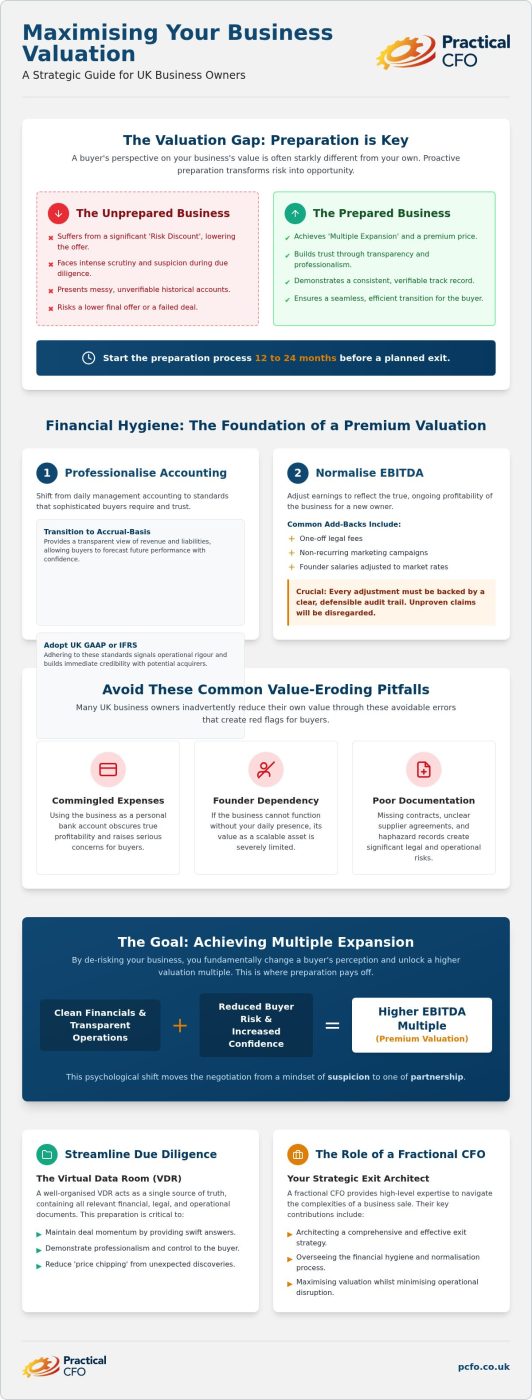
Business valuation preparation UK is not a singular event; it’s a proactive strategy designed to enhance financial and operational transparency. It ensures that when a potential acquirer looks under the bonnet, they see a well-oiled machine rather than a collection of hidden risks. Whilst many owners view valuation as a simple calculation of historical earnings, sophisticated buyers look for evidence of future sustainability. Adhering to established business valuation principles is essential, but for UK SMEs, the ultimate goal is to move beyond a basic fair market value. Instead, you want to reach a strategic value that reflects what your company is worth to a specific buyer who can leverage your assets for their own growth.
Unprepared businesses often suffer from a ‘risk discount’. If a buyer cannot easily verify your numbers or sees operational chaos, they’ll lower their offer to compensate for the uncertainty. To avoid this outcome, you should ideally begin the preparation process 12 to 24 months before a planned exit. This lead time allows you to rectify systemic issues, professionalise your reporting, and demonstrate a consistent track record of performance that justifies a premium price.
Why Preparation Dictates the Final Multiple
Professional reporting does more than just present data; it builds trust. When your financials are clean and transparent, you significantly reduce the perceived risk for the buyer. This deliberate de-risking leads to what’s known as Multiple Expansion. This is where a buyer is willing to pay a higher multiple of your EBITDA because they have high confidence in your future cash flows. It’s a psychological shift that moves the acquirer from a mindset of suspicion to one of partnership. They’re no longer looking for reasons to walk away; they’re looking for reasons to invest.
Common Pitfalls of Unprepared UK SMEs
Many UK business owners inadvertently erode their own value through avoidable errors that surface during the business valuation preparation UK phase. Common issues include:
- Commingled Expenses: Treating the business as a personal bank account makes it difficult for buyers to ascertain true profitability.
- Founder Dependency: If the business cannot function without your daily presence, it has little value to an acquirer who needs a scalable asset.
- Poor Documentation: Missing or unsigned employee contracts and haphazard supplier agreements create significant red flags during UK due diligence.
Addressing these gaps early ensures that the eventual due diligence process is a straightforward formality rather than a deal-breaker. By resolving these pitfalls, you present a business that is ready for a seamless transition.
Financial Hygiene: Organising Your Accounts for a Premium Valuation
Financial hygiene is the cornerstone of effective business valuation preparation UK. Whilst cash-basis accounting may suffice for daily management, sophisticated buyers require accrual-basis records to understand the timing of revenue and liabilities. This transition provides a transparent view of your company’s economic reality, allowing potential acquirers to forecast future performance with confidence. Adhering to UK GAAP or IFRS standards builds immediate credibility, signalling that your finance function operates with the same rigour as a much larger organisation.
Professionalising these processes often requires a level of precision that internal teams may lack. Implementing outsourced accountancy solutions allows you to deploy high-level expertise to clean up historical accounts and establish robust reporting frameworks. This investment pays dividends during the sale process, as it reduces the likelihood of price chipping during due diligence. It’s about presenting a narrative of stability and control.
Normalising EBITDA for Maximum Impact
The foundation of most UK business valuations is a normalised EBITDA. This process involves adjusting your earnings to reflect the true profitability of the business under new ownership. Common add-backs include one-off legal fees, non-recurring marketing campaigns, or adjustments to bring founder salaries in line with market rates. Every adjustment must be backed by a clear audit trail. If you can’t provide evidence for an add-back, a buyer will likely disregard it, directly lowering your final valuation. Clear documentation transforms these adjustments from subjective claims into defensible financial facts.
Tax Compliance and HMRC Alignment
Buyers have zero tolerance for tax uncertainty. Your VAT, Corporation Tax, and PAYE records must be impeccable and fully aligned with HMRC filings. Any discrepancies found in a due diligence checklist can lead to significant holdbacks or indemnity demands. R&D tax credit claims are a frequent area of scrutiny; ensure your technical reports are robust and the qualifying expenditure is clearly ring-fenced. Whilst aggressive tax planning might reduce your current liabilities, it often creates perceived risks that hinder the sale price. If you are unsure where your records stand, seeking professional exit strategy support can help identify and resolve these vulnerabilities before they become deal-breakers.
Operational Value Drivers: Enhancing Intangible Assets
Beyond the balance sheet, a buyer’s interest is piqued by the strength of your intangible assets. Identifying and protecting your Intellectual Property (IP) is a critical step in business valuation preparation UK. Whether it’s proprietary software, trade secrets, or a recognised brand, these assets provide a competitive moat that justifies a premium multiple. As noted by IP specialists Henry Goh & Co, a strong patent portfolio is often central to demonstrating this long-term value to potential investors. Buyers also prefer the predictability of recurring revenue models over one-off transactional sales. Shifting your business model toward subscriptions or long-term service contracts creates a reliable cash flow forecast that simplifies the process of how to value a business accurately.
A business that relies entirely on its founder is difficult to sell. You must prove the enterprise can thrive without your daily involvement. Documenting Standard Operating Procedures (SOPs) is essential to demonstrate that your processes are repeatable and transferable. A strong management team with long-term incentives signals to a buyer that the leadership will remain stable post-exit. Review your supplier contracts carefully; ensure you understand ‘change of control’ clauses that could complicate a transition during the final stages of a deal.
Market Positioning and Growth Potential
Acquirers don’t just buy your past; they buy your future. Defining your Total Addressable Market (TAM) helps potential buyers see the untapped upside. Use data to prove customer loyalty, focusing on low churn rates and high lifetime value. By crafting a compelling ‘Growth Story’, you move the conversation away from historical averages and toward a higher forward-looking multiple. This narrative shows exactly how a buyer can scale the business using your existing foundations, turning your operational efficiency into a tangible financial asset.
The Virtual Data Room: Preparing for Rigorous Due Diligence
The Virtual Data Room (VDR) serves as the single source of truth for any prospective buyer. It is the digital vault where every claim made during negotiations is scrutinised and verified. An organised VDR accelerates the deal pace, which is vital for preventing ‘deal fatigue’. This phenomenon occurs when a transaction drags on so long that parties lose interest or market conditions shift. In the context of business valuation preparation UK, the VDR is where your strategic claims are either validated or debunked. A Finance Director plays a pivotal role here, acting as the curator who audits every file to ensure it matches the narrative presented in the preliminary stages.
Categorising documents logically is the first step toward a successful audit. You should organise files into clear streams: Financial, Legal, Commercial, and Human Resources. This structure allows the buyer’s professional advisors to work efficiently, reducing the time your own team spends answering repetitive queries. If you need expert oversight to manage this process, our Finance Director Services can provide the steady hand required to professionalise your data management.
A Checklist for a Sale-Ready Data Room
A comprehensive VDR should contain all the evidence a buyer needs to justify their investment. Essential components include:
- Financial Records: At least 3 to 5 years of detailed P&L statements, balance sheets, and robust cash flow forecasts that align with your growth story.
- Legal Documentation: Articles of Association, an up-to-date share register, and all material contracts with suppliers or customers.
- HR and Compliance: Standard employment contracts, pension scheme details, and key person insurance policies to prove operational continuity.
- Operational Assets: Evidence of IP ownership, lease agreements, and internal process manuals.
Managing the Information Flow
Staging disclosure is a tactical necessity to protect your sensitive commercial information. You don’t reveal your full customer list or proprietary secrets in the first week. Instead, you release data in phases as the buyer demonstrates increasing levels of commitment. Consistency across every provided data point is non-negotiable. If your share register contradicts your cap table, or your management accounts don’t match your VAT returns, you lose credibility instantly. The ‘Q&A’ phase of due diligence stands as the ultimate test of preparation.
The Role of a Fractional CFO in Valuation Preparation
SMEs often possess excellent operational teams but lack the high-level financial leadership required to navigate a complex sale. A fractional CFO bridges this gap by providing board-level insight without the prohibitive cost of a full-time executive. This strategic partner becomes the architect of your business valuation preparation UK, ensuring that every financial decision made in the lead-up to an exit is aligned with maximising the final multiple. They bring a level of intellectual rigour that transforms a standard finance function into a powerful value-building asset.
Integrating these efforts into a comprehensive exit strategy planning services programme allows you to professionalise your approach long before a buyer is even identified. The CFO acts as a vital buffer between the founder and the acquirer, handling technical scrutiny whilst allowing the owner to focus on daily operations. This separation prevents emotional fatigue and ensures that negotiations remain grounded in financial facts rather than personal sentiment. It’s about having a seasoned expert at the helm who knows exactly how buyers think and what they’re looking for.
Strategic Oversight and Future-Proofing
A CFO uses strategic budgeting and forecasting to validate your company’s valuation through data-driven evidence. They identify ‘Value Leaks’, such as inefficient working capital cycles or unoptimised supplier terms, that can drain the final sale price if left unaddressed. Beyond the numbers, they prepare the founder professionally for the intensity of due diligence. By simulating the buyer’s perspective, they help you address vulnerabilities before they can be used as leverage to chip away at your price.
Cost-Effectiveness of the Fractional Model
The ROI of a fractional CFO is best measured by the preservation of the sale multiple. Losing just 1x on a multiple due to poor business valuation preparation UK can result in a significant loss of wealth for the shareholders. The fractional model offers the flexibility to scale support as you move through different stages of the valuation journey, providing expert guidance without a permanent increase in overheads. This agile approach ensures your business is sale-ready, scalable, and positioned for a premium exit. Discover how our Finance Director services can prepare your business for a premium exit.
Securing Your Legacy Through Strategic Preparation
A premium valuation is rarely the result of market timing alone. It is the product of deliberate, long-term business valuation preparation UK that addresses financial transparency and operational resilience. By professionalising your accounts and de-risking your business model, you transition from a founder-led enterprise into a scalable asset that commands a higher multiple. The involvement of a fractional Finance Director ensures that your Virtual Data Room is robust and your growth story is defensible under the most rigorous due diligence.
At PCFO, we provide specialist UK SME growth and exit advisory services designed to maximise shareholder value. Our experienced Finance Directors are available on a fractional basis to implement a proven framework that prepares your business for a seamless transition. Whether you’re planning an exit in twelve months or five years, the actions you take today will define your eventual success. Secure your business’s future with expert Exit Strategy Support from PCFO and approach your next chapter with confidence.
Frequently Asked Questions
What is the most common method for business valuation in the UK?
The most frequent method for valuing a UK SME is applying a multiple to its EBITDA (Earnings Before Interest, Taxes, Depreciation, and Amortisation). This approach focuses on operating profitability and cash flow potential. Whilst other techniques like asset-based valuations or discounted cash flow models exist, buyers typically prefer EBITDA multiples as they provide a clear benchmark against industry peers and reflect the true earning power of the enterprise.
How long does it take to prepare a business for a strategic sale?
Strategic business valuation preparation UK typically requires a 12 to 24-month lead time. This duration allows for the professionalisation of your finance function, the cleanup of historical accounts, and the mitigation of operational risks. Starting early ensures you can demonstrate a consistent track record of performance under a de-risked model. Rushing the process often leads to price chipping during due diligence as buyers uncover unresolved issues.
Can I use my year-end accounts for a business valuation?
Year-end accounts are rarely sufficient for a sophisticated valuation. Whilst they provide a statutory snapshot, buyers require granular management accounts and a normalised view of your earnings. This involves adjusting for one-off expenses and founder-related costs to reveal the true underlying profitability of the business. Relying solely on year-end figures often masks the real value of the enterprise, potentially leading to an undervalued offer during negotiations.
What is a ‘good’ EBITDA multiple for a UK SME in 2026?
In the 2026 UK market, a good multiple typically ranges between 4x and 8x EBITDA, though this varies significantly by sector. Technology and recurring service models often command higher multiples, whilst capital-intensive industries may sit at the lower end. Factors such as management depth, customer diversification, and intellectual property protection play a critical role in pushing your multiple toward the higher end of the industry average.
Do I need a formal valuation before I put my business on the market?
You aren’t legally required to have a formal valuation, but it is highly recommended to establish a realistic price anchor. An independent valuation provides you with a defensible baseline for negotiations and helps identify any value gaps that need addressing. Without this benchmark, you risk entering the market with unrealistic expectations or, conversely, accepting an offer that fails to reflect the strategic value you have built.
How much does professional business valuation preparation cost?
The cost of business valuation preparation UK depends on the complexity of your accounts and the current state of your operations. Rather than a fixed fee, many businesses utilise fractional CFO services to manage costs whilst accessing high-level expertise. This investment should be viewed through the lens of ROI; the increase in your final sale multiple often far outweighs the professional fees required to professionalise your finance function.
What happens if my business is not ready for due diligence?
If a business is unprepared for due diligence, the most common outcomes are price chipping or total deal failure. Buyers lose confidence when they encounter messy records or inconsistent data, leading them to either lower their offer or walk away entirely. This lack of readiness also causes deal fatigue, where the transaction becomes so protracted and stressful that momentum is lost, often leaving the business in a weaker position.
How does a fractional CFO differ from my current accountant during a sale?
Your current accountant typically focuses on historical reporting and tax compliance. In contrast, a fractional CFO provides strategic, forward-looking leadership. During a sale, the CFO acts as the architect of the valuation, identifying value drivers and leading negotiations with potential acquirers. They provide the board-level insight needed to defend your growth story and manage the complex information flow required throughout the due diligence process to secure the best exit.