

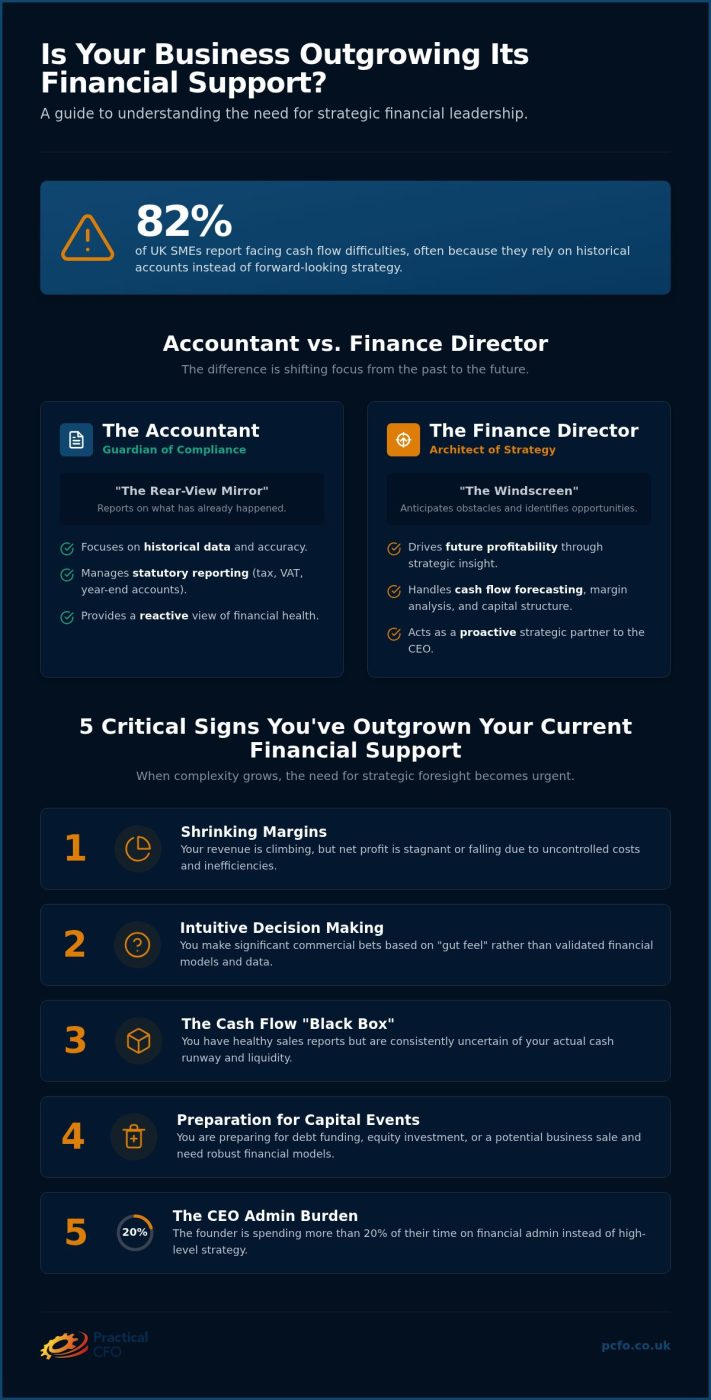
82% of UK SMEs have reported facing cash flow difficulties, yet many business owners continue to navigate their growth by looking solely at the rear-view mirror of their year-end accounts. You might feel like a passenger in your own financial discussions, nodding along to figures that explain where you’ve been rather than where you’re going. It’s a common frustration to feel uncertain about your future cash runway whilst trying to scale at pace. If you’re asking, “do I need a finance director”, it’s usually because the gap between basic compliance and strategic foresight has become a visible risk to your stability.
This article provides a clear framework to help you decide if it’s time to invest in high-level financial leadership. You’ll discover the critical signs that your business has outgrown its current support and how a Finance Director transforms rapid growth into sustainable, long-term profit. We will also examine the ROI of strategic finance versus simple compliance, alongside the practical differences between fractional and full-time appointments to ensure you find the right fit for your business lifecycle.
Key Takeaways
- Distinguish between historical compliance and strategic leadership to understand why your business needs more than a standard accountant.
- Recognise the five critical growth signals, such as stagnant margins or “gut-feel” decision making, that indicate it is time to ask: “do I need a finance director?”
- Uncover how a Finance Director identifies hidden waste and negotiates better commercial terms to improve your cash runway and profitability.
- Evaluate the commercial benefits of the fractional model, which provides the expertise of a seasoned CFO without the overhead of a full-time executive salary.
- Establish a clear roadmap for moving beyond basic reporting towards a strategic partnership that prepares your business for future scaling or an eventual exit.
What is a Finance Director and How Do They Differ from an Accountant?
Many business owners mistakenly assume that a senior accountant and a Finance Director perform the same function. This misconception often leads to a strategic ceiling where growth is limited by a lack of forward-looking insight. A Finance Director is a board-level leader who translates complex financial data into a roadmap for commercial success. Whilst an accountant ensures your records are accurate, a Finance Director ensures those records are used to build a more profitable future.
The clearest way to understand the distinction is through the “Rear-view Mirror” versus “Windscreen” analogy. Your accountant is primarily looking through the rear-view mirror. They report on historical performance, ensuring that what has already happened is recorded correctly for tax purposes. In contrast, a Finance Director, often referred to as a Chief Financial Officer (CFO) in larger organisations, looks through the windscreen. They anticipate upcoming obstacles, identify opportunities for expansion, and manage the capital structure needed to support your ambitions. If you find yourself asking “do I need a finance director”, you’ve likely reached the point where looking backward is no longer enough to guide you forward.
The Accountant: Guardian of Compliance
The primary role of a traditional accountant is to maintain the financial integrity of the business. Their focus remains firmly on historical data, statutory reporting, and ensuring you remain compliant with HMRC regulations. They are the specialists who handle your corporation tax returns, VAT submissions, and year-end accounts. This work is foundational; without it, your business cannot legally operate. However, the limitations of this role become apparent in a fast-growth environment. Reactive reporting tells you that you ran out of cash last month, but it rarely provides the early warning signals required to prevent that crisis from occurring in the first place.
The Finance Director: Architect of Strategy
A Finance Director moves beyond the “what” of your finances to focus on the “why” and the “how”. Their remit includes future-proofing the business through robust cash flow forecasting and rigorous margin analysis. They don’t just report on profit; they actively drive it by identifying which products, services, or departments are genuinely contributing to the bottom line. This level of business growth advisory uk is what allows a CEO to stop making decisions based on “gut feel” and start using validated data. By acting as a strategic sounding board, they provide the intellectual rigour necessary to stress-test your commercial plans before you commit significant capital to them.
5 Signs Your Business Has Outgrown its Current Financial Support
Growth is a double-edged sword. Whilst increasing turnover is a positive indicator, it often masks internal inefficiencies that can lead to a “growth trap”. If you are currently asking “do I need a finance director”, it’s usually because the complexity of your business has outpaced the capability of your existing financial support. When your operations expand, the distance between your bank balance and your actual financial health begins to widen.
Here are five critical indicators that your SME has reached a strategic turning point:
- Shrinking Margins: Your revenue is climbing, but net margins are shrinking or remaining stagnant due to uncontrolled costs.
- Intuitive Decision Making: You make significant commercial bets based on “gut feel” rather than validated financial models and data.
- The Cash Flow “Black Box”: You have healthy sales, yet you are unsure of your actual cash runway. With 82% of UK SMEs reporting cash flow difficulties, this lack of visibility is a high-risk factor.
- Preparation for Capital Events: You are preparing for a significant move, such as debt funding, equity investment, or a business sale.
- The Admin Burden: The CEO or founder is spending more than 20% of their working week on financial administration and bookkeeping tasks instead of high-level strategy.
The “Profitless Growth” Trap
Scaling volume without scaling financial oversight is a frequent precursor to insolvency. It’s easy to assume that more sales will naturally solve cash flow issues, but without rigorous control, increased activity often just accelerates “leaky” overheads. An FD identifies these leaks, whether they are inefficient supplier contracts or underperforming product lines. By implementing strategic budgeting and forecasting, they ensure that every pound of new revenue contributes to the bottom line rather than just passing through the business.
External Pressure: Investors and Lenders
Sophisticated investors and high-street lenders rarely provide significant capital without seeing board-level financial representation. They require more than just a set of year-end accounts; they want to see a proactive management of risk and a clear capital structure. If you are seeking expansion capital, you’ll face the rigours of due diligence. An FD prepares the business for this scrutiny, ensuring your data is defensible and your projections are grounded in reality. Engaging Finance Director Services early in this process provides the professional reassurance that external stakeholders look for in a scaling SME.
The ROI of a Finance Director: Cost vs. Value Realisation
Viewing a Finance Director as a mere overhead is a common mistake for scaling SMEs. When you ask “do I need a finance director”, you aren’t just looking for a new headcount; you’re looking for a measurable return on investment. A strategic FD pays for themselves by identifying and eliminating “zombie” projects—those initiatives that consume capital and management time without delivering a clear contribution to the bottom line. By conducting rigorous post-investment reviews, they ensure that your resources are focused exclusively on high-growth, high-margin opportunities.
Beyond internal cost control, an FD acts as a high-level negotiator. They possess the commercial gravitas to secure better terms with suppliers and lenders, which directly improves your working capital. This might involve renegotiating credit terms from 30 to 60 days or securing lower interest rates on debt facilities. The cost of inaction in these areas is often far higher than the investment in financial leadership. Without this oversight, financial risks can remain hidden until they become critical failures.
Margin Improvement and Cost Control
An FD improves gross margin by performing granular price-volume analysis and identifying hidden cost variances within the supply chain.
They look beyond the top-line revenue to evaluate the quality of your earnings. By identifying high-margin versus low-margin customers, an FD helps you refocus your sales efforts on the clients who actually drive profit. This data-driven approach prevents the common trap of chasing volume at the expense of sustainability. It allows for strategic overhead reduction whilst maintaining the operational capacity you need to scale. You stop spending blindly and start investing with precision.
Raising Capital and Maximising Valuation
A Finance Director is essential for presenting a “clean” and attractive financial story to external stakeholders. If you’re seeking investment or debt funding, they ensure your data is defensible and your projections are grounded in reality. Robust financial leadership can add a significant multiple to your business valuation by reducing the perceived risk for potential buyers or investors. They manage the complex relationships with auditors and banks, ensuring that your business is always “investment-ready”.
For those considering a future sale, engaging professional exit strategy planning services is a vital step. An FD ensures that your financial records are structured to withstand the rigours of due diligence. They work to optimise your capital structure and clean up the balance sheet long before the first offer arrives. This proactive management ensures you don’t leave money on the table when it’s time to transition out of the business.
Full-Time vs. Fractional: Finding the Right Fit for Your Scale
Choosing between a full-time executive and a fractional partner is a pivotal commercial decision. For many SMEs, the question isn’t just “do I need a finance director”, but rather “what level of engagement does my current scale justify?” A full-time FD in 2026 commands a significant package. In London, the median salary sits at £130,009. For SMEs in the £5m to £50m revenue bracket, base salaries typically range between £90,000 and £160,000. When you factor in Employers’ National Insurance, pension contributions, and bonuses, the total cost of employment can easily surpass £200,000 per annum.
The fractional model offers a strategic alternative. It allows you to access corporate-level experience for just a few days a month. There is a clear distinction between this and an “interim” FD. An interim professional is usually a short-term gap filler, hired to maintain the status quo during a recruitment search or a period of leave. A fractional FD is a long-term strategic partner who provides consistent leadership and institutional knowledge. They are embedded in your business, focusing on future-proofing and strategic navigation rather than just holding the fort.
The Case for Fractional Finance Leadership
Accessing specialised expertise for 2 to 4 days a month provides the strategic oversight needed to professionalise your finance function without the full-time overhead. You gain the ability to scale this support up or down as your business evolves, ensuring you only pay for the leadership you actually utilise. This “Goldilocks” solution is ideal for businesses that have outgrown their accountant but aren’t yet complex enough to require a daily board-level presence. For a detailed breakdown of costs, read our guide on fractional CFO pricing UK.
When a Full-Time Hire is Inevitable
Certain triggers make a full-time appointment necessary. This usually occurs once revenue exceeds £20 million or when complexity spikes due to international subsidiaries and M&A activity. High-frequency reporting requirements for institutional investors can also necessitate a permanent in-house presence. Interestingly, a fractional FD is often the best person to help you recruit your first full-time hire. They can define the role, screen candidates, and manage the onboarding process to ensure a seamless transition. If you’re unsure which model fits your current trajectory, explore our Finance Director Services to see how we can support your growth.
How PCFO Partners with UK Business Owners
PCFO operates as an embedded extension of your leadership team, providing the intellectual rigour and strategic foresight required to navigate the complexities of the UK SME market. We don’t believe in distant consultancy. Instead, we act as your “Authoritative Strategic Partner,” ensuring that every financial decision aligns with your long-term commercial objectives. If you’ve been asking “do I need a finance director”, you’ve likely realised that growth without a clear roadmap is a significant risk to your stability.
Our approach combines board-level leadership with efficient outsourced accountancy solutions. This dual focus ensures that your strategic decisions are always built upon a foundation of clean, accurate data. By integrating into your board, we help you transition from reactive reporting to proactive decision-making. We take the time to understand your specific business lifecycle, whether you are in a phase of rapid expansion or preparing for a strategic exit.
The first 90 days of a PCFO engagement are designed to establish immediate control and build a foundation of trust:
- Days 1 to 30: A comprehensive audit of your current financial systems, identifying immediate risks and “leaky” overheads.
- Days 31 to 60: Implementation of robust cash flow forecasting and management reporting that provides meaningful insights to a non-financial CEO.
- Days 61 to 90: Development of a long-term strategic roadmap, including capital structure optimisation and business growth advisory.
Strategic Oversight and Growth Advisory
Commercial business planning is at the heart of our partnership. We move beyond the numbers to help you navigate the specific challenges of scaling within the UK economy, from managing Corporation Tax margins to preparing for potential equity rounds. Our role is to identify risks before they become crises, providing you with the clarity needed to lead with confidence. We provide the steady hand at the helm, ensuring that your business remains resilient whilst you focus on high-level expansion.
Ready to Take Control of Your Financial Future?
Expert financial guidance provides more than just better margins; it offers the peace of mind that comes from knowing your business is on a sustainable path. Waiting too long to resolve the question of “do I need a finance director” is often the most expensive mistake a founder can make. The cost of missed opportunities and hidden inefficiencies far outweighs the investment in strategic leadership. Take the first step towards professionalising your finance function today. Book a strategic consultation to assess your business needs and discover how we can transform your growth into sustainable profit.
Securing Your Business Trajectory
Scaling a business requires a fundamental shift from monitoring the past to architecting the future. The transition from basic accountancy to strategic financial leadership is a critical milestone for any growing UK SME. Recognising the signs of “profitless growth” or the mounting burden of financial admin allows you to act before these challenges become structural crises. By choosing a fractional model, you gain access to corporate-level expertise and institutional knowledge without the prohibitive overhead of a full-time executive hire.
If you are still weighing up the question, “do I need a finance director”, consider the peace of mind that comes from having an embedded partner dedicated to your long-term success. Whether you are navigating complex cash flow hurdles or preparing for a significant exit, professional guidance ensures your hard work translates into sustainable profit. We invite you to Book a Strategic Consultation with a PCFO Director to assess your current financial health and explore how our expertise in UK SME growth can support your ambitions. Your business deserves the clarity and confidence that only seasoned financial leadership can provide.
Frequently Asked Questions
What is the difference between an FD and a CFO in the UK?
In the UK SME sector, these titles are often used interchangeably, though a CFO typically implies a broader remit involving investor relations and capital structure. A Finance Director usually focuses on internal financial strategy and operational performance. Both roles act as board-level strategic partners rather than just compliance managers. The choice of title often depends on your company’s international ambitions or its current stage in the funding lifecycle.
How much does a part-time Finance Director cost for a UK SME?
The cost depends on the engagement level and the professional’s specific experience. Industry data for 2026 suggests that daily rates for fractional roles typically range between £600 and £1,100. Monthly retainers for one day a week often fall between £2,000 and £3,200. This model allows businesses to access high-level expertise at a fraction of the £130,000 median salary required for a full-time London-based director, providing a significant return on investment.
Can my existing accountant act as a Finance Director?
Whilst an accountant is essential for statutory reporting, they rarely possess the strategic leadership experience required for an FD role. Accountants focus on historical accuracy and tax efficiency. A Finance Director provides forward-looking business growth advisory, focusing on cash flow forecasting and risk management. If you’re asking “do I need a finance director”, it’s likely because your business requires strategic navigation that goes beyond year-end accounts and HMRC filings.
At what revenue level do I need a Finance Director?
There is no single revenue trigger, but many UK businesses seek fractional support once they surpass £2 million in turnover. At this scale, complexity increases and “gut feel” decision-making becomes high-risk. By the time a company reaches £10 million to £20 million, the need for a board-level financial leader becomes critical to manage margins and capital structure. The decision should be based on your operational complexity and growth speed rather than revenue alone.
What are the main tasks of a fractional Finance Director?
A fractional FD focuses on high-impact strategic activities that drive value. These include:
- Developing robust three-way cash flow forecasts to ensure future stability.
- Identifying and eliminating inefficient overheads or “zombie” projects.
- Negotiating better commercial terms with suppliers and lenders to improve working capital.
- Providing business planning consultancy to prepare for scaling or an eventual exit.
They transform raw data into actionable insights that empower the CEO to lead with confidence.
How many days a month does a fractional FD typically work?
Engagement levels are flexible and adapt to your specific business lifecycle. Most SMEs start with two to four days per month, which provides enough time for strategic oversight, board meetings, and performance reviews. During periods of intense activity, such as a funding round or an acquisition, this can be scaled up temporarily. This flexibility ensures you always have the right level of leadership without the burden of a permanent executive overhead.
Will a Finance Director help me raise investment?
An FD is instrumental in the fundraising process. They prepare the business for the rigours of due diligence by ensuring all financial data is defensible and transparent. Beyond organising the “data room”, they help craft a compelling financial story for investors and lenders. Having a seasoned professional at the board table provides the commercial credibility that institutional investors require before committing significant capital to a growing SME.
What happens if I continue scaling without an FD?
Scaling without strategic oversight often leads to “profitless growth”, where rising turnover masks shrinking margins and hidden inefficiencies. Without an FD, you risk running out of cash runway despite healthy sales figures. You may also find yourself trapped in the “admin burden”, spending too much time on financial tasks instead of strategy. Eventually, the lack of professional financial leadership becomes a barrier to securing investment or achieving a high-value business exit.