
The tax bill on a business sale depends on what you sell and how the business is structured. Capital gains tax on selling a business in the UK may be charged at 18% or 24% for individuals in 2026/27, depending on income; qualifying gains using Business Asset Disposal Relief are taxed at 18%, according to HM Revenue & Customs.
It’s understandable to focus on the sale price, but that figure alone won’t tell you how much tax is due. The taxable gain, allowable sale costs, relief eligibility and whether the deal is an asset or share sale all affect the calculation.
This guide explains how the rules differ for sole traders, partnerships and limited companies, and how to estimate the gain after allowable costs. It also covers reliefs and why planning before a buyer appears can shape your options, helping you approach a sale with a clearer view of its tax implications.
Key Takeaways
- Identify whether the deal is an asset sale or a share sale, as your business structure shapes how the proceeds are taxed.
- Assess your eligibility for Business Asset Disposal Relief and how your ownership history may affect the rate available.
- Work out the taxable gain by accounting for the asset or shares’ original cost and allowable sale expenses.
- Plan ahead of a sale to understand how timing, deal structure and available reliefs could influence your tax position.
Business Asset Disposal Relief eligibility and rate
Business Asset Disposal Relief (BADR) can reduce Capital Gains Tax on qualifying business gains. Eligibility depends on the type of disposal and whether you meet the relevant ownership and trading conditions.
Relief eligibility requirements
For a share sale, BADR eligibility depends on meeting ownership and company conditions before selling shares. According to HM Revenue & Customs, you must hold at least 5% of the shares and voting rights; the share-sale conditions must also be met for 24 months before the sale. Sole traders and partners generally need to have owned the business for at least two years, according to HM Revenue & Customs. These tests matter because qualifying status determines whether the relief rate can apply.
Relief rates and lifetime limits
BADR applies a reduced CGT rate to qualifying gains within your available lifetime limit. According to HM Revenue & Customs, the rate is 14% for qualifying profits on disposals from 6 April 2025 to 5 April 2026, and 18% for qualifying UK disposals from 6 April 2026. HM Revenue & Customs also states that the lifetime limit is £1 million in total. For 2026/27, the annual exempt amount is £3,000, according to HM Revenue & Customs. Your remaining limit and other gains affect the amount subject to tax.
Business Asset Rollover Relief has different conditions. The replacement asset must be used for trading, as must the asset sold, and it must be bought within three years after disposal or up to one year before. Where a sale includes property, Stamp Duty Land Tax may range from 0% to 12%, depending on the value. Include the property transfer in your deal-cost assessment.
To report a business sale, retain the sale agreement, records of the original cost and allowable sale fees, and the figures used to allocate proceeds between assets. Most share-sale gains are reported through Self Assessment, with tax normally paid after the tax year in which the sale completes.
Late or inaccurate reporting can leave tax unpaid or gains incorrectly calculated, potentially leading to penalties and interest. Keep supporting records that explain the valuation, sale costs and relief claimed.
Tax treatment for sole traders, partnerships and limited companies
Your legal structure determines who is taxed and whether the charge falls under Capital Gains Tax or Corporation Tax. The same sale price can therefore produce different tax outcomes for a sole trader, a partnership and a limited company.
For a sole trader or partnership, the sale proceeds are apportioned between the business assets. Each asset disposal is considered separately, so goodwill, property and equipment can have different gains. Trading stock is treated as trading income, not a capital gain. When a sole trader or partnership ceases trading, plant and machinery proceeds above tax written-down value can create a balancing charge treated as trading income. Taxable profits from selling business assets may be charged at 20%, 40% or 45%, depending on the taxpayer’s circumstances. Business Asset Disposal Relief may apply to eligible gains, but it doesn’t turn trading income into a capital gain.
A limited company pays Corporation Tax on gains from selling its assets, rather than Capital Gains Tax. Tangible asset gains are calculated against the tax written-down value or original purchase price. The main Corporation Tax rates for company gains and profits are 19% and 25%. By contrast, when an individual sells shares, they generally pay Capital Gains Tax on the gain, not the full consideration. A substantial level of non-trading activity can affect whether a company meets trading conditions; the threshold described is more than 20% of total business activity.
Consider how surplus company cash will be treated before agreeing the deal. In an asset sale, the company receives the proceeds; distributing them to shareholders can trigger a further personal tax charge, through dividend tax or Capital Gains Tax. A share sale instead transfers the company, with its assets and liabilities, to the buyer. The treatment of cash and the sale structure therefore matter when comparing the net proceeds to shareholders.
For a clearer view of the options, Business Growth Advisory can support financial planning around a proposed sale, including the effect of structure and cash extraction on the business’s growth plans.
Calculating the taxable gain and allowable sale costs
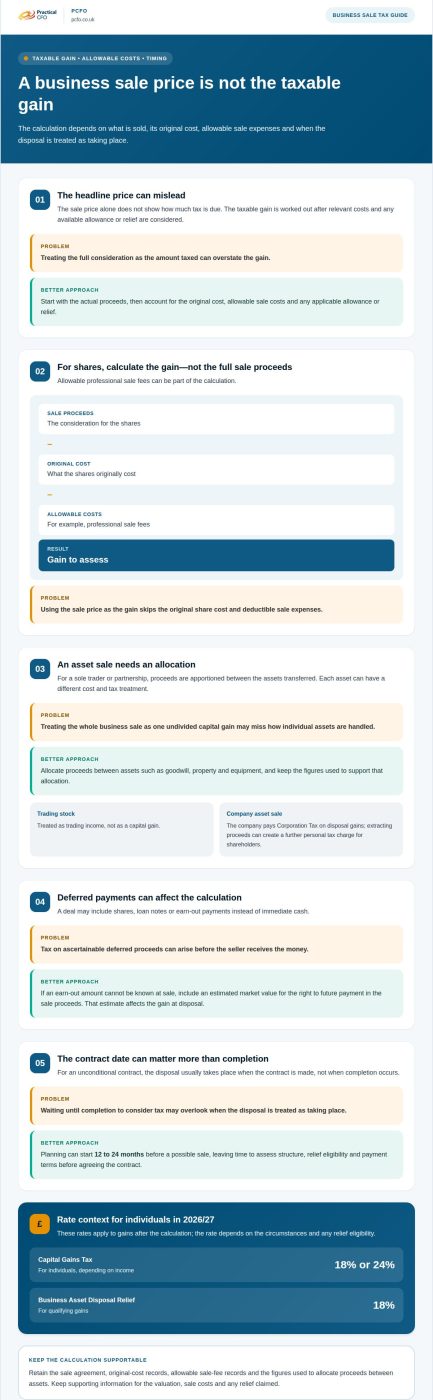
For a share sale, the starting calculation is sale proceeds minus the original cost of the shares and allowable costs, such as professional sale fees. The result is the gain, not the full sale price. Apply any available allowance or relief when working out the taxable amount. Keep the calculation tied to the actual consideration and costs attributable to the disposal.
For a sole trader or partnership, sale proceeds must be apportioned between the assets transferred. This matters because each asset can have a different cost and tax treatment. Trading stock is treated as trading income rather than a capital gain, so it should not be included as though it were a capital asset. A limited company selling assets pays Corporation Tax on disposal gains; extracting the proceeds can create a further tax charge for shareholders.
Payment terms can alter when tax falls due. Some deals include shares, loan notes or earn-out payments instead of immediate cash. Tax on ascertainable deferred proceeds can arise before the seller receives the money. If an earn-out amount cannot be known at sale, the seller includes an estimated market value for the right to future payment in the sale proceeds. That estimate affects the gain calculated at disposal.
Timing also matters. For an unconditional contract, the disposal usually takes place when the contract is made, not when completion occurs. Planning can therefore start 12 to 24 months before a possible sale, allowing time to assess structure, relief eligibility and payment terms before agreeing the contract.
For most share sales, report the gain through Self Assessment. Tax is normally paid after the end of the tax year in which the sale completes. Include the gain and relevant costs in the return, even where some consideration is deferred; the timing of tax may not match receipt of cash.
Tax planning before selling a business
Start planning before a buyer appears. A review 12 to 24 months before a possible sale can reveal whether the current structure, ownership and trading position support intended reliefs. Owners may need time to meet relief conditions or consider a restructure. Planning for capital gains tax on selling a business in the UK also means comparing the tax position under different sale timings before accepting an offer.
Incorporation Relief may defer Capital Gains Tax when a business transfers to a company in exchange for shares, provided the whole business and its assets, except cash, transfer. Gift Hold-Over Relief may apply when a qualifying business asset is given away, including an asset used for trading by the giver as a sole trader or partner. A qualifying sale to an employee ownership trust may also be free of Capital Gains Tax for the seller, subject to conditions. Each relief has distinct requirements, so the proposed transaction must fit the relevant rules.
Deal structure affects more than Capital Gains Tax. VAT and stamp taxes may apply depending on the sale arrangements, particularly where transactions involve cross-border activities or operations that require guidance from international tax consultancies such as CiDATax SRL. An asset sale can leave proceeds within a limited company, and distributing that cash to shareholders may create a further personal tax charge. A share sale instead changes ownership of the company. Map expected proceeds, company profits and shareholder income together to understand how capital gains tax on selling a business in the UK fits into the overall financial outcome.
Pre-sale planning is also a chance to test whether the original business structure still suits the owners’ objectives. Compare a direct disposal with a proposed transfer, and model how each affects relief eligibility, timing and cash received. A business planning review can help bring those financial and strategic considerations into one sale plan.
PCFO
PCFO helps business owners connect sale planning with the company’s wider financial direction. Its Finance Director and Chief Financial Officer Services can support financial oversight, while Business Growth Advisory and Business Planning Consultant services help owners assess strategic options before a transaction.
Consider involving PCFO while you are weighing a sale structure, planning how proceeds may be used, or aligning exit timing with business goals. This gives you a clearer view of the financial decisions surrounding the sale, alongside the tax calculations and eligibility rules discussed above.
Contact PCFO to discuss how your sale planning fits your business objectives.
Shape your next business decision
Planning for capital gains tax when selling a business in the UK is not only about estimating the bill. It also means considering how the proceeds could support the next stage, whether that involves reinvestment, retirement or another venture. Tax planning is one part of a wider exit decision, alongside the company’s future and the owners’ priorities.
A useful next step is to model more than one outcome: what the business needs during a transition, what the owners want to retain, and which direction best supports future growth. This helps frame the sale as a strategic choice, not only a tax calculation.
PCFO’s Finance Director Services, Chief Financial Officer Services and Business Growth Advisory can support this wider financial perspective, connecting business performance, planning and exit decisions.
If you’re preparing for a sale or weighing your next move, discuss your business sale with PCFO. A considered plan can help you move forward with a clearer sense of direction.
Frequently Asked Questions
How much tax will I pay when I sell my business?
The amount depends on your business structure, taxable gain, income and available reliefs. For individuals in 2026/27, business-sale gains are generally taxed at 18% or 24%, depending on income; qualifying BADR gains are taxed at 18%. A limited company instead pays Corporation Tax on gains from asset disposals. For a useful estimate, separate the sale proceeds by asset or shares, then account for allowable costs and relief eligibility.
Can I still claim if I have used BADR before?
Yes, a previous claim doesn’t automatically prevent another BADR claim, but it uses part of your lifetime limit. HM Revenue & Customs states the limit is £1 million in total, so subtract qualifying gains covered by earlier claims to establish what remains. For example, a prior claim on one disposal may leave less relief available for a later sale. You must still meet the eligibility conditions for the new disposal.
Did the Budget cut the BADR rate?
No. The BADR rate rose to 14% for qualifying disposals from 6 April 2025 to 5 April 2026, then to 18% from 6 April 2026. The announced Budget change concerns the lifetime limit, not a rate cut: it is set to fall from £1 million to £500,000 for disposals from 6 April 2027, but the change is not yet law. The disposal date affects which rules apply.
Do I pay taxes if I reinvest the sale proceeds?
Reinvesting the proceeds doesn’t automatically remove a Capital Gains Tax liability. Business Asset Rollover Relief may defer tax if both the asset sold and its replacement are used for trading, and the replacement is bought within the permitted timing window. It is a specific relief, not a blanket exemption for any investment. The type of asset acquired and its use in the trade therefore matter.
Do other exit routes have different tax treatment?
Yes. A gift, transfer into a company or sale to an employee ownership trust may be treated differently from an ordinary sale. For example, Incorporation Relief may defer Capital Gains Tax when a business transfers to a company for shares and the qualifying business assets transfer. Gift Hold-Over Relief may also defer a gain on eligible gifts. Each route has distinct conditions, so the transaction’s structure is central.
Does BADR apply when my company sells its assets?
BADR is a relief for qualifying individuals, not a relief claimed by the company on its own asset disposal. The company pays Corporation Tax on gains from selling its assets. If the company then distributes sale proceeds to shareholders, they may face a further personal tax charge, such as dividend tax or Capital Gains Tax. This means an asset sale and a shareholder’s sale of company shares can produce different tax outcomes.