

What if the biggest cash flow risk isn’t a lack of sales, but not knowing when the money will arrive? For UK small businesses, late customer payments can make it difficult to balance supplier bills, tax commitments and investment. Government estimates that small businesses are owed more than £20 billion in unpaid invoices at any given time. Effective cash flow management for SMEs means spotting pressure early enough to respond, not simply recording what has already happened.
If you’re unsure which payments will arrive, or whether there’ll be enough cash to cover upcoming commitments, a regular review can help. Bring expected receipts and payments together, check their dates and decide who will follow up any changes. You don’t need to be a finance specialist to make this process useful.
This guide explains what drives cash in and out, how to build a manageable monitoring routine and what actions can help when a shortfall looks likely. You’ll also learn how to assess the timing of bills, tax and planned spending, and make growth decisions with a clearer view of available cash. With a consistent review, cash flow becomes a decision-making tool, not just a spreadsheet.
Key Takeaways
- Profit and a healthy-looking bank balance don’t always show how much cash is available for upcoming commitments.
- Map when customer receipts are expected against when supplier bills and other payments are due to spot timing gaps.
- Use a regular cash flow management for SMEs routine to update figures, review changes and assign clear follow-up actions.
- Distinguish a temporary delay from recurring cash pressure so you can respond to the cause, not just the immediate shortfall.
- Connect cash forecasts with hiring, investment and growth plans to make decisions with greater clarity.
What cash flow management means for an SME, and why profit is not cash
Cash flow management is the ongoing process of monitoring, anticipating and acting on the money moving into and out of a business. It helps you understand what is in the bank today, what is likely to arrive, what must be paid and whether the timing leaves enough cash to meet commitments.
Forecasting supports this wider discipline. A forecast estimates future receipts and payments over a chosen period. Managing cash flow also means comparing those estimates with what actually happens, investigating differences and deciding what to do. Cash flow forecasting is one way to look ahead, but its value comes from using that view to guide timely decisions. For SMEs, cash flow management is a repeatable decision-making process, not just a spreadsheet.
Cash flow versus profit: what should an owner understand?
Profit measures income earned against costs incurred over an accounting period. Cash flow tracks when money is received and paid. They answer different questions, so a profitable business can still face pressure if cash arrives after bills fall due.
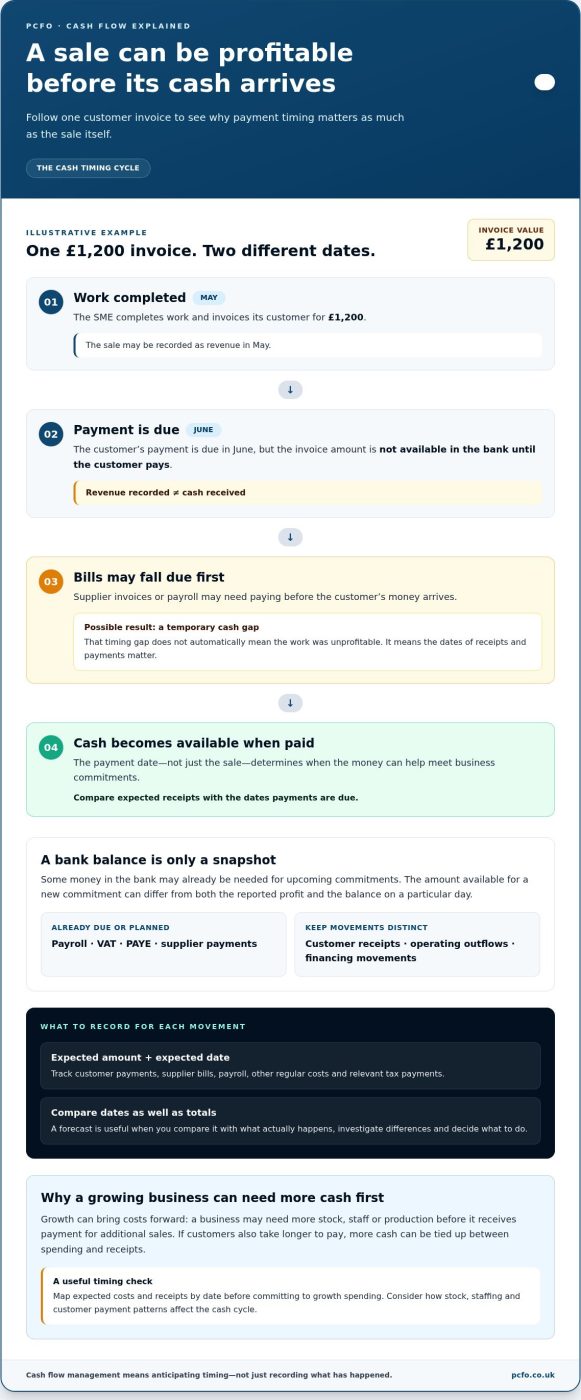
For example, an SME invoices a customer £1,200 for work completed in May, with payment due in June. The sale may be recorded as revenue in May, but the £1,200 won’t be available in the bank until the customer pays. If supplier invoices or payroll fall due first, the business may face a temporary cash gap. That doesn’t automatically mean the work was unprofitable. It means the timing of receipts and payments matters.
A bank balance is also only a snapshot. Some of the money shown may already be needed for upcoming payroll, VAT, PAYE or supplier payments. The amount available for a new commitment is therefore different from both the profit reported for a period and the balance on a particular day.
Which cash movements should SMEs keep in view?
Group expected movements so you can see what drives the balance. Track customer receipts separately from operating outflows and financing movements. For each item, record the expected amount and date, then compare the dates as well as the totals.
- Receipts: customer payments, including the expected payment date for each invoice.
- Operating outflows: supplier bills, payroll and other regular business costs, plus VAT and PAYE where relevant.
- Financing movements: borrowing received and repayments due, where applicable.
Payment dates and amounts depend on each company’s circumstances. Keeping them visible gives you a more useful picture than looking at income or the bank balance alone. It also gives you a practical starting point for a regular review.
How SME cash flow works: timing, working capital and the cash cycle
Cash moves through a business in stages. You may pay for stock or labour before completing a sale, invoice a customer after delivery, then wait for payment. The longer money stays tied up in this cycle, the less is immediately available for other commitments. When receipts arrive after payments are due, the timing gap can create short-term cash pressure, even if sales and demand are growing.
Working capital is the cash and other resources tied up in day-to-day operations. It includes money owed by customers and stock waiting to be sold, balanced against short-term amounts the business owes. Tracking these moving parts makes cash flow management for SMEs more practical: the focus is not just on sales, but on how quickly business activity turns back into usable cash.
How receivables, payables and stock affect available cash
Debtor days describes how long, on average, it takes to collect customer invoices. If that period lengthens, more of your cash remains with customers for longer. Stock has a similar effect: you spend money to buy or make goods before they’re sold, and the customer’s payment may come later still.
Supplier payment timing matters too. Plan around the payment dates you’ve agreed rather than treating them as optional. Review those due dates alongside expected customer receipts to spot a squeeze early and plan responsibly.
Why growth can put pressure on cash flow
Growth often brings costs forward. A business might need to buy more stock, recruit staff or increase production before it receives payment for the additional sales. If customers also take longer to pay, the business must fund a larger gap between spending and receipts. Growth can therefore increase cash needs before it improves the cash position.
Illustrative scenario: A small wholesaler wins a larger order and pays suppliers for extra stock upfront. It then pays for additional warehouse support while fulfilling the order. The customer pays under its usual invoice terms, so the related cash arrives after some of those costs fall due. The opportunity may be sound, but the owner needs to understand and plan for the interim funding requirement.
Before committing to growth spending, map expected costs and receipts by date. Consider how changes to stock levels, staffing or customer payment patterns affect the cash cycle. For broader scaling considerations, read our business growth advisory guide. If you’re exploring external finance, GOV.UK business finance support outlines options and support for UK businesses.
If managing these moving parts is stretching your internal capacity, flexible finance leadership for growing businesses can help connect cash information with growth decisions.
How to diagnose cash flow pressure before it becomes a crisis
A cash flow check should show what is expected to arrive, what is committed to leave and how much headroom remains between those dates. Looking only at the current bank balance can give false reassurance. It won’t show whether a large payment is due before the next customer receipt, or whether part of the balance is already spoken for.
Start by distinguishing a temporary timing gap from a recurring issue. A one-off customer delay may create short-term pressure that eases when payment arrives. Repeated late collections, rising overdue balances or regular difficulty meeting commitments can point to a persistent problem that needs investigation. Cash flow management for SMEs works best when you look for patterns, not just individual low-balance days.
Which warning signs deserve attention?
Watch for overdue invoices, unexpected outflows and repeated reliance on last-minute transfers or short-term borrowing to cover routine payments. These are prompts to investigate, not diagnoses on their own. A late receipt might be an isolated delay or part of a wider collections problem. Look at how often the issue occurs, which payments are affected and whether the underlying cause is changing.
Cash headroom means the funds left after allowing for known commitments. There’s no universal level that suits every SME. Assess it against your payment schedule, the reliability of expected receipts and the potential effect of a delay.
How to turn financial information into a clear picture
Bring bank activity, sales invoices, supplier commitments and relevant VAT or PAYE dates into one dated view. Compare actual movements with what you previously expected. If a receipt is late or a cost is higher than planned, note the reason and consider what it changes in the weeks ahead.
Illustrative example: Assume £4,000 is available before the listed movements. This simplified view excludes any other receipts or payments, so the balance is indicative rather than a complete forecast.
| Date | Expected movement | Indicative balance |
|---|---|---|
| 10 June | Customer receipt: +£3,000 | £7,000 |
| 12 June | Supplier payment: −£2,200 | £4,800 |
| 15 June | Payroll: −£3,400 | £1,400 |
| 20 June | Tax payment: −£1,000 | £400 |
If the customer receipt slips beyond 10 June, the sequence changes. That’s an early prompt to review the expected payment, upcoming commitments and possible actions, rather than relying on the bank balance alone. If a funding need remains after reviewing timing and commitments, the British Business Bank finance options page outlines options for smaller businesses. For broader financial oversight, see our strategic Finance Director guide.
A practical cash flow management routine for UK SMEs
A useful routine turns financial information into decisions. It doesn’t need to be complicated, but it does need clear ownership and a consistent sequence: update the information, review the timing of receipts and payments, investigate changes, then agree who will act and by when. This keeps cash flow management for SMEs focused on practical next steps rather than producing figures nobody uses.
What to review each week and each month
A short weekly check can focus on the near term. Confirm expected customer receipts, payments due, significant changes and commitments that may need attention. If a receipt hasn’t arrived as expected, assign someone to follow it up and consider how the delay affects planned payments.
Use a broader monthly review to look for patterns. Compare actual cash movements with previous expectations, investigate meaningful differences and identify recurring issues, such as slower collections or stock levels tying up more funds. Choose a frequency that reflects your transaction volume and uncertainty. A business with frequent payments or less predictable receipts may need closer monitoring than one with a more stable cash cycle.
Which actions can improve cash visibility and control?
Make responsibilities explicit. Assign someone to own invoice follow-up and someone to oversee payment approvals. Make sure people who make spending decisions know how to raise emerging cash pressure. Clear ownership reduces the chance that an overdue balance or upcoming commitment goes unnoticed.
- Keep invoice processes consistent. Issue invoices promptly, make payment expectations clear and follow up overdue balances in line with your agreed process.
- Plan significant spending. Review proposed purchases, hiring and other commitments against expected receipts and operational payments before confirming them.
- Review cash tied up in operations. Consider whether stock levels reflect likely demand, and understand how supplier payment terms affect the dates cash leaves the business.
- Record actions and owners. Note what needs follow-up, who is responsible and when it will be reviewed again.
This routine is a management check, not a detailed forecasting tutorial. It helps you keep information current and respond to changes. A forecast can support the process by projecting likely receipts and payments, but the review still needs to test assumptions and prompt action. Adjust the routine as your business changes, rather than treating one cadence as right for every SME.
If maintaining this discipline is stretching your internal capacity, explore flexible finance leadership support to connect cash information with operational and growth decisions.
When an SME needs finance leadership to manage cash flow confidently
Not every small business needs dedicated finance leadership. But as decisions become more complex, it can be harder to rely on historical reports and the owner’s available time alone. Recurring uncertainty about cash, rapid change or difficulty seeing how today’s commitments affect future plans may signal a need for stronger financial oversight.
When is additional financial expertise useful?
Bookkeeping and reporting help you record transactions and understand what has happened. Strategic oversight uses that information to look ahead and support decisions. Consider whether you can clearly assess the cash impact of recruiting, investing in equipment, taking on a larger contract or changing payment terms. If you’re making those decisions without a reliable view of timing and available cash, additional expertise may help.
A useful test is whether your current reporting gives you enough clarity to answer three questions: what cash is likely to be available, which commitments could change that position, and what choices are open to you? If the answers are consistently unclear, or cash reviews are repeatedly pushed aside by competing demands, the gap may be one of capacity or forward-looking insight. That doesn’t mean every SME needs a full-time finance executive.
How PCFO can support stronger cash flow decisions
PCFO provides fractional and outsourced Finance Director and CFO support for growing UK businesses that need finance leadership without a full-time executive role. This support can connect cash information with management decisions, so hiring, investment and growth plans are considered alongside expected receipts and commitments.
Business planning and growth advisory bring a longer-term view to those choices. Outsourced accountancy solutions support the financial information owners use to understand their business. Together, these services can help build a clearer basis for discussion and planning. The right support depends on where the business is, what decisions lie ahead and where internal capacity is stretched.
For cash flow management for SMEs, the aim is not simply to produce more reports. It is to use reliable financial information to make timely, informed choices. If your business would benefit from flexible finance leadership or broader planning support, explore how PCFO supports growing businesses.
Make cash flow a stronger basis for your next decision
Good cash flow management for SMEs is an ongoing discipline: look beyond profit and today’s bank balance, track when money is due, and act on emerging pressure before it limits your options. A manageable review routine helps you compare expected receipts with commitments, investigate changes and assign clear follow-up actions.
Use that information to assess decisions such as hiring, investment and growth with a clearer view of their timing and cash impact. If internal reporting no longer gives you the time or forward-looking insight you need, additional finance leadership can help connect the figures to your plans.
PCFO provides fractional and outsourced Finance Director and CFO services, combining finance leadership with business planning and growth advisory. Explore practical finance leadership for your business and consider what support fits your next stage.
With a consistent routine and the right perspective, you can approach cash decisions with greater clarity and confidence.
Frequently Asked Questions
What is cash flow management for SMEs?
Cash flow management for SMEs is the process of monitoring, anticipating and acting on money moving into and out of a business. It means tracking expected customer receipts alongside payments such as supplier bills, payroll and tax commitments, then responding if the timing creates pressure. The aim is to understand what cash is available for upcoming decisions, rather than relying only on reported profit or the bank balance today.
Why can a profitable business have cash flow problems?
A profitable business can face cash pressure because profit and cash measure different things. A sale may be recorded before the customer pays, while costs such as wages, supplier invoices or stock purchases may need to be paid sooner. For example, completing work and invoicing in May doesn’t mean the money will be in the bank that month. The timing gap can make it difficult to meet commitments, without proving that the work was unprofitable.
How often should a small business review its cash flow?
Review cash flow as often as your transaction volume and uncertainty require. A short weekly check can highlight near-term receipts, payments due and changes that need action. A broader monthly review can help identify recurring patterns, such as customer payments arriving later than expected. A business with frequent transactions or less predictable cash movements may need closer checks. The key is a routine that is manageable and frequent enough to flag pressure in time to respond.
What are the main causes of cash flow problems in SMEs?
Common causes include late customer payments, supplier bills falling due before receipts arrive, and cash tied up in stock or unpaid invoices. Growth can add pressure if spending on staff, equipment or materials comes before the related customer money. Unexpected costs, weak invoice follow-up and limited visibility of upcoming tax or payroll commitments can also contribute. Look at the timing and recurrence of the pressure to identify its cause. One late payment alone may not reveal the wider picture.
How can a small business improve cash flow without increasing sales?
Improve visibility and timing first. Issue invoices promptly, set a clear follow-up process for overdue balances and review which costs or stock purchases can be planned more carefully. Map significant payments against expected receipts before committing to additional spending. You can also review supplier terms and discuss changes where appropriate, while continuing to meet agreed commitments. These steps won’t guarantee more cash, but they can help reduce avoidable delays and make better use of the cash already moving through the business.
What is the difference between cash flow management and cash flow forecasting?
Cash flow management is the wider discipline of monitoring cash movements, anticipating pressure and taking action. Cash flow forecasting is one tool within it: a forward-looking estimate of when money is expected to arrive and leave. A forecast can help reveal a future gap, but it needs regular review against actual receipts and payments. If assumptions change, update the view and decide what action is needed rather than treating the forecast as a fixed prediction.
When should an SME consider outsourced finance leadership for cash flow management?
Consider additional finance leadership if cash uncertainty keeps recurring, business decisions are becoming more complex or internal reporting doesn’t provide enough forward-looking insight. Bookkeeping and historical reports explain transactions and past performance. Strategic oversight helps connect cash information with decisions such as hiring, investment and growth. PCFO provides fractional and outsourced Finance Director and CFO services, giving growing businesses access to finance leadership without requiring a full-time executive role.