

What if your business plan could flag a cash flow gap before it constrains growth? For many UK SMEs, financial reports explain what has happened but offer little guidance on the decisions ahead. A business planning consultancy UK businesses can rely on should do more than prepare figures for a lender. It should connect those figures to practical decisions and a workable strategy.
It’s understandable to want confidence in your forecasts. Weak financial modelling can undermine funding discussions or leave the board without the information needed to challenge key assumptions. In 2026, a business plan needs to be a working financial tool, not a document that sits on a shelf.
This article explains how a business planning consultant can help build a clear three-to-five-year financial roadmap, strengthen investor readiness and support informed growth decisions. It covers cash flow forecasting, scenario planning and fractional CFO expertise, and how these can work together to give your business a clearer path forward.
Key Takeaways
- A strategic business plan looks forward, linking financial decisions to long-term value rather than focusing only on historical results.
- Understand how compliance-led accounting differs from growth-focused financial leadership, and where each supports your business.
- Use integrated cash flow modelling alongside profit projections to test whether your plans are financially workable.
- Assess a business planning consultancy UK firms can partner with by looking for commercial insight and practical support for leadership decisions.
- Explore how fractional CFO or Finance Director expertise can strengthen planning, funding readiness and the decisions involved in scaling.
Defining the Role of a Business Planning Consultancy in the UK
A business planning consultancy UK SMEs can use effectively is a strategic partner, not simply a source of reports or administrative support. Its role is to connect financial insight with leadership decisions, helping owners align resources with business ambitions and build long-term value.
Business planning brings a company’s financial resources and objectives into alignment. A business plan sets out a company’s goals and how it intends to achieve them; the What is a Business Plan? overview provides a useful foundation. A consultancy adds a forward-looking finance leadership perspective, turning the plan into a framework for decisions, investment and growth.
What Does a Strategic Business Planning Consultant Actually Do?
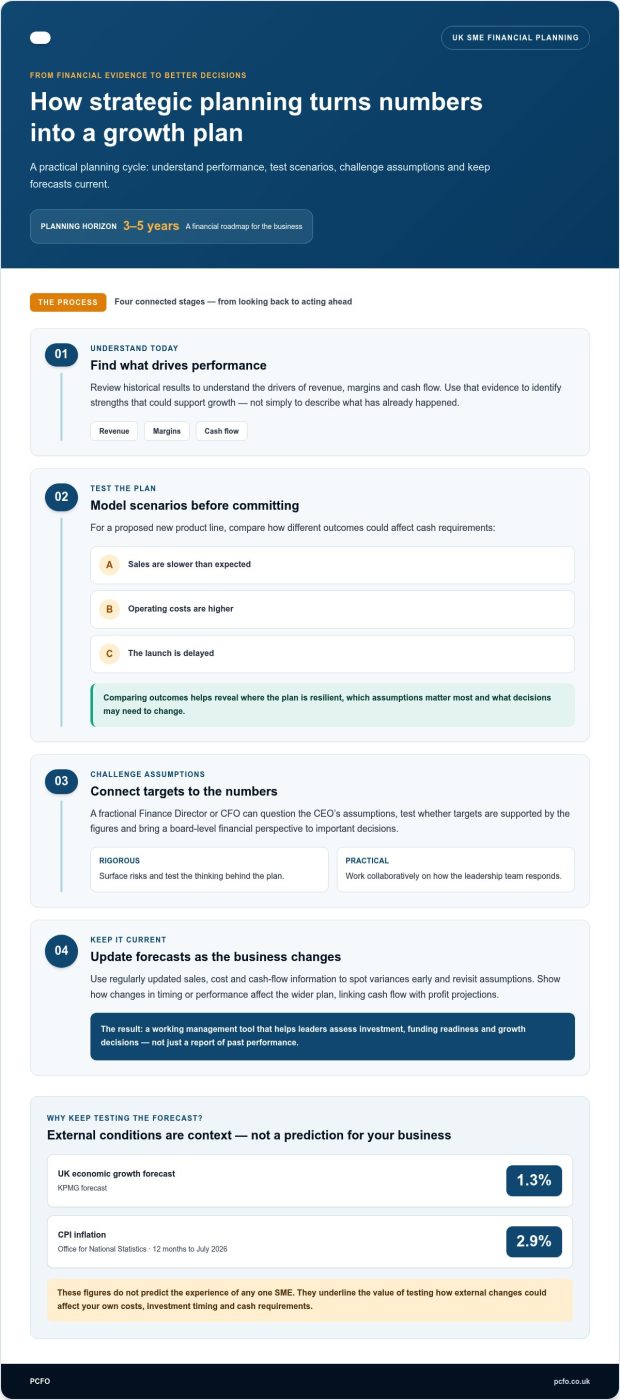
The work starts with understanding how the business performs today. A consultant reviews historical results to identify what drives revenue, margins and cash flow, then considers which strengths could support growth. The aim is not to dwell on past results, but to use them as evidence when deciding what to do next.
That analysis informs financial models that test different scenarios. For example, an SME considering a new product line could model how slower sales, higher operating costs or a delayed launch would affect its cash requirements. Comparing the outcomes helps leaders see where a plan is resilient, which assumptions carry the most weight and what decisions may need to change.
Strategic finance leadership also brings constructive challenge. A fractional Finance Director or CFO can question the CEO’s assumptions, test whether targets are supported by the numbers and bring a board-level financial perspective to important decisions. The relationship should be collaborative: rigorous enough to surface risks, and practical enough to help the leadership team respond.
The 2026 Landscape: Why Static Plans Are No Longer Sufficient
A plan based on last year’s figures can quickly lose value when trading conditions, costs or priorities shift. In 2026, KPMG forecasts UK economic growth of 1.3%, while the Office for National Statistics reported CPI inflation of 2.9% in the 12 months to July 2026. These figures do not predict the experience of any one SME, but they underline why leaders need to test how external changes could affect their own forecasts.
Useful planning connects current financial information with operational decisions. Regularly updated sales, cost and cash flow data can help leaders spot variances early and revisit assumptions before problems grow. A model should show how changes in timing or performance affect the wider plan, rather than treating cash flow as separate from profit projections.
UK SMEs must also consider relevant tax, reporting and market developments when assessing a plan. A finance leader can help translate changes into practical questions: could they affect costs, investment timing or cash requirements? This makes planning an ongoing management discipline and gives the board a clearer basis for decisions as the business evolves.
Strategic Planning vs. Traditional Accounting: Understanding the Difference
Accurate accounts are essential, but they do not automatically provide a growth strategy. Traditional accounting and strategic finance leadership serve different purposes. One helps maintain reliable records and meet reporting obligations; the other uses financial insight to guide decisions about the future. The distinction matters when a growing SME needs to manage cash, assess investment or prepare for funding discussions.
“My accountant already does this” is a reasonable question. Your accountant may provide valuable advice and management information. The key is whether someone is also responsible for connecting that information to commercial decisions, testing the assumptions behind plans and constructively challenging the leadership team. That is a core part of a Finance Director’s remit. A finance director’s strategic role differs from the work of keeping accounts accurate and compliant.
Compliance Accounting: Looking in the Rear-view Mirror
Compliance-led accounting centres on reliable financial records, statutory filings and meeting HMRC obligations. Bookkeeping captures transactions, while year-end accounts report performance over a completed period. These activities provide dependable information, but they mainly explain what has already happened.
Historical reports alone will not show whether hiring ahead of demand is affordable, how a delayed customer payment could affect cash or which costs are rising faster than revenue. This is not a question of whether traditional accountants provide value or commercial insight. Compliance work and board-level financial leadership simply have different scopes and priorities.
Strategic Planning: Mapping the Road Ahead
Strategic planning turns financial information into choices. It can bring together cash flow forecasts, runway management, investment requirements and funding readiness, then show how different assumptions affect the business. A finance leader might also examine margins by product or customer, identify profit leaks and explore overhead reductions without overlooking the capabilities needed for growth.
Good plans depend on sound underlying information. Outsourced accountancy solutions can support that foundation by organising financial data and maintaining accurate records. Reports and software alone do not determine what action to take. A business planning consultancy UK SMEs work with should connect the numbers to commercial priorities and help leaders interpret the implications.
Compliance accounting: Records transactions and supports filings. Its central question is, “Are the accounts accurate and obligations met?”
Management accounting: Summarises recent performance and helps track budgets, costs and variances. It asks, “How are we performing against plan?”
Strategic planning: Models future choices, cash needs and risks. It asks, “What should we do next, and can the business fund it?”
These functions can complement one another. For example, accurate bookkeeping informs management reports, while a fractional Finance Director can use those reports to test an expansion proposal, challenge optimistic sales assumptions and assess the cash needed to deliver it. Find out more about PCFO’s finance leadership support and how it can connect financial data to leadership decisions.
Core Components of a High-Impact Business Plan for Scaling Firms
A useful plan gives leaders more than a sales target and a profit forecast. It connects commercial priorities to the resources, cash and capabilities needed to deliver them. For a scaling firm, the roadmap should bring together revenue assumptions, costs, investment needs, cash flow, risks and measures of progress. That way, decision-makers can see how one choice affects the rest of the business.
Business growth advisory UK businesses use can help translate growth ambitions into operational and financial steps: what to invest in, which milestones matter and how leadership will know whether the strategy is working. A business planning consultancy UK SMEs engage should shape a roadmap around the company’s circumstances, rather than rely on a generic template.
Cash flow modelling is central. A profit and loss projection may show a profitable year overall, but it will not necessarily reveal when cash is needed to pay suppliers, recruit staff or carry stock. An integrated model connects expected income and costs with the timing of payments and investment. This helps leaders assess whether the business can fund its plans as they unfold, not just whether those plans look profitable on paper.
- Commercial assumptions: Set out the drivers behind sales, pricing, margins and customer demand.
- Cash and funding: Map expected inflows, outflows, working capital requirements and potential funding needs.
- People and operations: Link recruitment, capacity and delivery plans to their financial impact.
- KPIs and ownership: Choose a focused set of measures, assign responsibility and review progress against agreed targets.
KPIs make the plan actionable. A firm might monitor gross margin, debtor days, recurring revenue or customer acquisition costs, depending on its model. Each measure should help answer a decision-relevant question. If performance moves off plan, leaders can investigate the cause and adjust forecasts or actions before a small variance becomes a larger concern.
Advanced Financial Modelling and Scenario Planning
“What if?” analysis helps test plans against uncertainty. To model a funding round, show how the timing and amount of investment could affect cash, hiring and growth milestones. For a new product launch, compare expected sales with slower uptake and identify costs that arise before revenue does. For international expansion, include the additional operating requirements and test whether the opportunity fits the business’s financial capacity.
These models should be working tools, updated as actual results and assumptions change. Regular reviews keep the plan relevant and give leaders a consistent basis for choosing between options.
Exit Strategy and Value Maximisation
Exit planning is useful well before an owner is ready to sell. Including exit strategy planning in the roadmap can help identify potential value drivers, such as dependable earnings, strong customer relationships and processes that do not rely on one individual. Potential buyers will assess each business on its own merits, so these are planning considerations, not guaranteed valuation outcomes.
Preparing early also gives the finance function time to organise clear, consistent records and explain the performance behind the figures. That groundwork can make due diligence more manageable and support informed decisions, whether the owner pursues a sale or continues to grow independently.
Evaluating Business Planning Consultants: A Framework for UK Leaders
Choosing a business planning consultancy UK leaders can rely on means looking beyond polished forecasts and qualifications. The right partner should understand how financial decisions affect operations, growth and risk, then help the leadership team turn that understanding into action. Credentials matter, but they are most useful alongside relevant commercial experience.
Assess a consultant against practical criteria. Have they worked with businesses at a similar stage, and can they explain how their analysis supported a decision? Look for a clear approach to forecasting, scenario planning and measuring progress. A good fit will question assumptions constructively, communicate with non-financial leaders and work alongside your management team rather than deliver a report and step away.
- Relevant experience: Ask how they have supported businesses facing comparable growth, funding or operational challenges.
- Decision impact: Explore how their analysis has influenced choices, not just how they have presented financial data.
- Working relationship: Discuss how they will collaborate with your CEO, board and finance team.
- Clear outcomes: Agree what progress will look like, how it will be tracked and when the plan will be reviewed.
To assess return on investment, establish a baseline before work begins. Depending on your priorities, measures could include improved forecast accuracy, earlier visibility of cash pressures, stronger funding preparation or progress against agreed growth targets. Not every benefit appears immediately as a direct saving. Better-informed decisions and risks identified early can also be valuable, so agree how both financial and strategic outcomes will be assessed.
The Fractional Advantage: High-Level Expertise, Scalable Cost
A fractional CFO or Finance Director provides senior financial leadership without requiring a full-time appointment. This can suit an SME that needs board-level insight but whose scale or priorities do not justify a permanent finance leadership role. The finance leader can work with the management team, bridging routine finance activity and strategic decisions.
Support can change as the business does. A funding process, expansion or ownership transition may call for closer involvement, while a more stable period may need a different level of input. The fractional CFO pricing UK guide can help frame the investment around the scope of support and the outcomes the business needs, rather than treating consultancy as a one-size-fits-all expense.
Questions That Reveal Strategic Value
Ask a potential consultant about experience with your stage of growth, examples of decisions they have helped shape, and how they will work with your team. Look for clear explanations of their reasoning, not just technical language. A strong working relationship should make it easier to raise difficult questions and act on the answers.
Learn how PCFO’s fractional CFO and Finance Director support can help connect planning with financial leadership.
PCFO: Integrating Strategic Finance into Your Growth Journey
PCFO supports UK SMEs that need experienced financial leadership to make growth decisions with greater clarity. Through fractional CFO and Finance Director services, strategic finance becomes part of the leadership conversation, rather than an occasional review of figures. This support connects financial insight with decisions about investment priorities, expansion and exit planning.
A part-time CFO or Finance Director can work alongside the CEO and management team, helping interpret performance, test assumptions and turn priorities into financial plans. PCFO also provides outsourced accountancy solutions, supporting the financial information that leaders use to make decisions.
A Collaborative Approach to Financial Leadership
PCFO works as a strategic partner, not simply an external contractor delivering a report. That means understanding the leadership team’s objectives and providing clear, direct guidance, including when the numbers challenge an existing assumption. Reliable financial insight can reduce uncertainty and give leaders a firmer basis for action.
Planning should reflect each business’s goals, stage and operating realities rather than rely on a generic template. The support can focus on current priorities, whether that means improving financial visibility, planning for growth or preparing for an eventual exit.
Your Next Steps Towards Scalable Growth
A useful starting point is to review the financial picture alongside the decisions ahead. This can help identify gaps in forecasting, unclear performance measures or areas where the business needs stronger financial oversight. From there, leaders can agree priorities and build a practical sequence of actions instead of trying to solve every challenge at once.
Moving from unplanned growth to considered expansion takes more than ambition. It calls for clear accountability, regular review of financial performance and a shared understanding of what the business can support. A finance leader can help connect plans to resources, track progress and adjust course as new information emerges. That discipline supports better decision-making while keeping sight of the opportunity ahead.
For a more structured approach, PCFO provides fractional CFO and Finance Director support, business growth advisory, business planning and exit strategy support. A business planning consultancy UK SMEs work with should bring clarity to upcoming decisions and create a considered route from current performance to future ambition.
Give Your Next Decision a Clear Financial Direction
The next stage of growth does not need to be driven by instinct alone. A finance partner can help turn uncertainty into informed choices, giving your leadership team a clearer view of the risks and resources involved in pursuing an opportunity.
For UK SMEs seeking a business planning consultancy UK partner, PCFO provides strategic finance leadership through fractional Finance Director and CFO services, business planning and growth advisory. The focus is on connecting financial insight to the decisions that shape the business, so plans can be reviewed and acted on as circumstances change.
Ready to give your growth plans a clearer financial direction? Speak with PCFO about strategic finance leadership and business planning support.
Frequently Asked Questions
What is the difference between a business planning consultant and a traditional accountant?
A business planning consultant helps leaders use financial insight to make forward-looking decisions, while a traditional accountant typically focuses on accurate records, accounts and compliance work. The roles can complement each other. For example, an accountant may prepare reliable financial information, while a consultant helps assess whether a proposed hire is affordable under different sales scenarios. A business planning consultancy UK SMEs use effectively connects financial evidence to commercial choices rather than replacing essential accounting work.
How much does business planning consultancy cost for a UK SME in 2026?
There is no single fee for business planning consultancy because the investment depends on the work involved. A focused review of forecasts differs from ongoing financial leadership, complex scenario modelling or support for an investor process. Define the decisions you need help with, the deliverables required and the level of ongoing input, then assess the proposed scope against those priorities. Consider both direct financial improvements and the value of clearer decisions or earlier visibility of risk.
When is the right time to hire a business planning consultant?
Consider engaging a consultant when important decisions are being made without reliable forecasts or clear financial challenge. Signs may include repeated cash surprises, uncertainty about whether recruitment is affordable or difficulty explaining growth plans to a board or lender. You do not need to wait until a problem becomes urgent. Bringing in support before a major investment or expansion can help your team assess the options and prepare for their financial implications.
Can a business planning consultant help my company secure Series A or B funding?
A consultant can help prepare your business for investor discussions by strengthening financial models, explaining assumptions and showing how funding could support defined milestones. For example, a model can connect a proposed investment to planned hiring, operating costs and expected progress. This preparation can make your case clearer, but it cannot guarantee that investors will provide funding. The quality of the commercial opportunity and investors’ assessment also matter.
What should be included in a strategic business plan for a UK company?
A strategic plan should connect the company’s objectives to the resources and measures needed to deliver them. Include revenue assumptions, costs, cash requirements, planned investment, key risks and ownership of major actions. Add relevant performance measures, such as gross margin or customer retention, where they help leaders track progress. Ensure the assumptions reflect the company’s market and operating context, and review the plan as results or priorities change.
How long does the business planning process typically take?
The time required depends on the plan’s complexity, the quality of available information and how quickly key decisions can be made. A business with organised records and a clearly defined objective may progress differently from one that needs to reconcile assumptions across teams or build new forecasts. Agree the purpose, information needed, decision-makers and review points at the outset. This gives everyone a practical sequence of work without relying on an arbitrary timeframe.
What is a fractional CFO, and how do they support business planning?
A fractional CFO provides senior financial leadership on a part-time or outsourced basis, rather than as a full-time executive. They can help a leadership team assess financial trade-offs, refine forecasts and connect business priorities to financial decisions. For instance, before committing to a new service, they can help model its resource needs and potential effects on cash. This gives growing businesses access to strategic finance expertise suited to their needs.
Does PCFO provide statutory audit or personal tax services?
PCFO’s work centres on business finance leadership, growth advice, planning and outsourced accountancy. It does not provide statutory audit services. Personal tax advice is separate from planning a company’s finances, so owners should treat their individual tax position as distinct from business forecasts and strategic decisions. Keeping those matters separate helps ensure company plans focus on business performance, resources and objectives.