

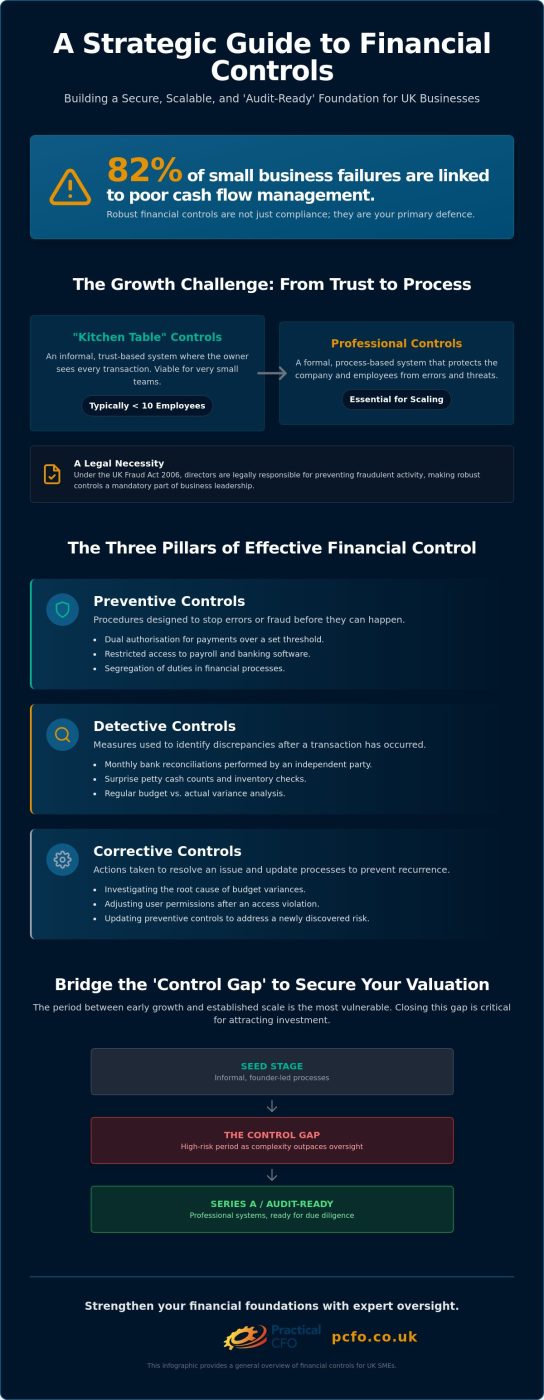
Did you know that 82% of small business failures are directly linked to cash flow mismanagement? As you focus on expansion, it’s common for internal systems to struggle under the weight of new demands. Implementing robust financial controls for small business uk isn’t just a compliance exercise; it’s the essential infrastructure that allows you to scale without losing your grip on reality.
We understand the frustration of losing hours to manual accounting errors or the quiet anxiety that comes from inaccurate reporting. You deserve a clear, reliable view of your bottom line that protects you from risks like internal fraud or the threat of “ghost” employees. This guide offers a comprehensive checklist to help you build a business that’s both secure and “audit-ready” for potential investors. We will explore the strategic frameworks that turn financial safety into a platform for sustainable growth, ensuring your organisation remains resilient whilst navigating the UK’s evolving regulatory landscape.
Key Takeaways
- Understand why informal oversight fails as your team grows and how to implement professional financial controls for small business uk that support sustainable scaling.
- Identify the core categories of internal control and learn why a strategic human review is more vital than software alone for protecting your assets.
- Access a high-impact checklist to secure your business against the specific risks that frequently lead to HMRC scrutiny or internal financial leakage.
- Discover how to use automation tools to embed rigorous safeguards without introducing the “red tape” that can stifle organisational agility.
- Learn how fractional leadership provides the independent oversight required to ensure your business remains “audit-ready” for future investors or exit opportunities.
Understanding Financial Controls in the UK SME Landscape
Internal financial controls are the specific policies and procedures an organisation adopts to ensure the accuracy of financial reporting and the safeguarding of assets. For those seeking a comprehensive overview of internal controls, it is helpful to view them as the nervous system of your business. They provide the feedback loops necessary to detect errors before they become catastrophes. Without these systems, you’re essentially flying blind as your company expands.
Many UK founders start with “kitchen table” controls. This is an informal, trust-based system where the owner sees every invoice and approves every payment personally. However, this model invariably fails once a business exceeds 10 to 15 employees. At this stage, the volume of transactions outstrips a single person’s capacity for oversight. Relying solely on the integrity of staff is no longer a viable strategy for risk management; it becomes a bottleneck that prevents you from focusing on high-level strategy.
Under the UK Fraud Act 2006, directors have a clear responsibility to prevent fraudulent activity, making robust financial controls a legal necessity rather than an optional extra. This requires a psychological shift. You must move from trust-based management to process-based leadership. To learn more about how strategic advisory can help you implement these frameworks, it is often useful to engage external expertise. It isn’t about a lack of faith in your team; it’s about building a system that protects both the company and the employees from avoidable errors and external threats.
The Three Pillars: Preventive, Detective, and Corrective
Effective financial controls for small business uk generally fall into three distinct categories:
- Preventive: these stop errors or fraud before they happen. A common example is requiring dual authorisation for BACS payments or restricting access to payroll software to specific senior staff.
- Detective: these identify discrepancies after a transaction has occurred. Monthly bank reconciliations and surprise petty cash counts are standard detective measures that highlight where processes might be failing.
- Corrective: these are the procedures you follow once an issue is found. They involve fixing the immediate error and, more importantly, updating the preventive controls to ensure the mistake doesn’t happen again.
Why Growth Demands Robust Oversight
As your turnover and headcount increase, complexity grows exponentially. A “Control Gap” often emerges between Seed and Series A funding rounds. This is the dangerous period where the original, informal processes haven’t yet been replaced by professional systems. Bridging this gap is essential for your business valuation. Investors don’t just buy your revenue; they buy the reliability of your numbers. A business that is audit-ready with a documented control environment is significantly more attractive to a potential buyer or venture capital firm. It demonstrates that your growth is sustainable and that your assets are adequately protected.
The Core Categories of Internal Financial Control
Establishing effective financial controls for small business uk requires more than just installing software. Whilst modern tools like Xero or QuickBooks provide the raw data, they do not provide the professional judgement necessary to interpret it. You must organise your control environment into logical functions such as procurement, payroll, and banking. This structure ensures that every pound leaving the business is accounted for and verified by a human eye. True financial security is found at the intersection of robust technology and diligent manual oversight.
The culture of your organisation, often called the “tone at the top,” dictates the success of these systems. If senior leaders treat financial processes as obstacles to be bypassed, the rest of the team will mirror that behaviour. Professional discipline starts in the boardroom. It requires a commitment to transparency that filters through every level of the company. Meeting the baseline UK government financial record-keeping requirements is merely the starting point for a high-growth business.
Segregation of duties is the structural firewall that prevents a single point of failure from becoming a terminal financial loss. By ensuring no single individual has total control over a transaction from start to finish, you create a natural system of checks and balances that protects your assets.
Segregation of Duties (SoD)
The core principle of SoD is simple: the person who initiates a transaction should never be the one who completes it. For example, the employee who raises a sales invoice should not be the same person who reconciles the bank account. In a very small team, achieving this can be difficult due to limited headcount. You might need to involve an external partner to act as the independent reviewer. Engaging Finance Director services can provide this necessary layer of oversight without the cost of a full-time executive hire.
Authorisation and Approval Levels
Clear spending limits prevent unauthorised overheads from spiralling out of control. You should establish a hierarchy where managers have specific budget caps, whilst larger expenditures require director-level approval. Implementing a Purchase Order (PO) system is an excellent way to control costs before they are even incurred. Additionally, you must have a formal process for authorising new suppliers. This prevents “ghost vendor” fraud, where payments are diverted to fraudulent accounts through fake invoices that appear legitimate at first glance.
The Strategic Financial Controls Checklist for UK Businesses
Implementing robust financial controls for small business uk requires a transition from theoretical planning to disciplined execution. This checklist provides a high-impact framework that you can immediately review with your finance team. It focuses on high-risk areas where UK SMEs typically experience revenue leakage or face scrutiny from HMRC. By categorising these tasks by frequency, you ensure that oversight becomes a consistent habit rather than a reactive response to a crisis.
For many business owners, managing this level of detail whilst trying to scale can feel overwhelming. Understanding The Strategic Role of a Finance Director: A Guide for Growing UK Businesses can help you determine when it is time to delegate these technical oversight tasks to a professional partner. A structured approach to these checks ensures your organisation remains resilient and audit-ready at all times.
Cash and Banking Controls
- Monthly Bank Reconciliations: These must be completed within five days of the month-end. Crucially, the reconciliation should be signed off by a director or a senior manager who does not have day-to-day bookkeeping responsibilities.
- Dual Authorisation: Ensure your banking mandate requires two separate users to authorise any outgoing BACS or CHAPS payments. This is a primary defence against both internal error and external “push payment” fraud.
- Weekly Aged Creditor Review: Review who you owe money to and when. This allows you to manage cash flow timing effectively and maintain strong relationships with key suppliers.
Sales and Accounts Receivable
- Weekly Aged Debtor Review: Late payments cost the UK economy billions annually. A formalised credit control process should trigger automated reminders at seven days overdue and personal follow-ups at fourteen days.
- Ledger Reconciliation: Reconcile sales reports from your CRM or Point of Sale (POS) systems to your general ledger every week. This ensures that every sale made is actually recorded in your accounting software.
- Credit Note Verification: Monthly reviews of all credit notes issued to customers are essential. Unauthorised credit notes are a common way for revenue to “leak” out of a business unnoticed.
Payroll and Expenditure
- Monthly Payroll Sanity Check: Compare the total payroll figure against the previous month before the payment is finalised. Investigate any variance over 5% to ensure no “ghost” employees or incorrect bonuses have been processed.
- Bank Detail Validation: Perform a spot check on employee bank details quarterly. This prevents fraudulent diversions where payroll funds are sent to an account controlled by someone other than the intended recipient.
- Quarterly VAT and MTD Reconciliation: With Making Tax Digital (MTD) requirements expanding, ensure your digital records are reconciled every quarter. This reduces the risk of HMRC penalties and ensures your tax liabilities are accurately forecast.
Implementing Controls Without Stifling Business Agility
A common concern amongst entrepreneurs is that introducing formal processes will create “red tape” that slows down decision-making. However, effective financial controls for small business uk should act like the brakes on a high-performance car; they exist not to stop you, but to allow you to travel at higher speeds with confidence. When systems are designed correctly, they provide the safety net that enables aggressive growth without the fear of a hidden financial collapse.
The key to maintaining agility is the use of “Exception Reporting.” Rather than reviewing every single transaction, you only focus your attention on data points that fall outside of pre-defined parameters. This targeted approach respects your time and keeps the organisation lean. To ensure these changes are met with support rather than resistance, communicate them to your team as a form of mutual protection. Explain that these processes are designed to eliminate manual errors and protect employees from unfair suspicion should a discrepancy occur.
Leveraging Technology for Automated Controls
Modern accounting ecosystems allow you to embed safeguards directly into your workflow. Tools such as Xero, QuickBooks, and Dext utilise AI-driven fetching to categorise invoices and automate data entry. This significantly reduces the risk of human error whilst creating a permanent, cloud-based audit trail. You can set up automated alerts for unusual bank activity or significant budget variances, ensuring that potential issues are flagged in real-time. This digital infrastructure is essential for complying with Making Tax Digital and preparing for future investment rounds.
To maintain the security and efficiency of this digital infrastructure, you can discover Proactive Networking Ltd for managed IT services that support your business’s growth.
To ensure your staff are correctly trained on these new digital protocols, you can explore Bespoke eLearning Content Design to develop custom training modules that help embed these financial controls into your daily operations.
If you find that your current systems are still too manual or prone to error, our Outsourced Accountancy Solutions can help you implement a tech stack that balances rigour with efficiency.
The Monthly Management Review
The Management Accounts pack is your most powerful detective control. This monthly report should go beyond a simple Profit and Loss statement to include a deep dive into Gross Margin variance, overhead trends, and your current burn rate. A structured board-level review of these figures ensures that the finance function remains accountable and aligned with your strategic goals. It provides the visibility needed to pivot quickly when market conditions change. By monitoring these key metrics, you can identify “leaks” in your profitability long before they impact your cash reserves, ensuring your business remains resilient and ready for sustainable scaling.
The Role of Fractional Leadership in Financial Oversight
Implementing financial controls for small business uk is a significant undertaking, but maintaining them is where most owners struggle. You cannot be the CEO and the internal auditor simultaneously. A fractional Finance Director provides that essential “FD-level eye” without the prohibitive cost of a full-time C-suite executive. They act as the independent reviewer, ensuring that the checklist we discussed earlier is actually followed and that your team remains disciplined. This oversight creates a layer of professional distance that is often missing in smaller organisations.
At PCFO, we act as your authoritative strategic partner. We build the systems and the culture of accountability so you don’t have to “police” the finance function yourself. This collaborative approach provides the intellectual rigour needed to navigate complex growth phases. It offers a sense of calm confidence that your assets are protected, allowing you to focus on the high-level trajectory of your business. Having a steady, experienced hand at the helm is particularly valuable during high-stakes periods, such as when navigating the 18% capital gains tax rate for business disposals or preparing for a funding round.
From Bookkeeping to Strategic Finance
It’s vital to distinguish between simple accountancy and strategic finance. A bookkeeper focuses on recording what happened in the past. In contrast, a CFO or FD focuses on planning what happens next. Whilst bookkeeping ensures you meet your basic compliance duties, fractional FD services bridge the gap between simple reporting and proactive business growth advisory. This shift in perspective is what turns a standard finance function into a strategic asset. You move from simply avoiding errors to actively identifying opportunities for capital efficiency and sustainable scaling.
Future-Proofing Your Business
Robust financial controls for small business uk today are the foundation of a successful exit strategy tomorrow. Potential investors or buyers will conduct deep due diligence on your control environment. If they find gaps, it can lead to a lower valuation or even the collapse of a deal. An outsourced finance function maintains investor confidence by demonstrating that your organisation is mature, transparent, and professionally managed. This preparation ensures that when the time comes to sell or seek investment, your business is already “audit-ready” and positioned for maximum value.
Discover how our Finance Director Services can secure your business growth.
Building a Foundation for Sustainable Scaling
Transitioning from informal oversight to a professional control environment is a pivotal moment in your business lifecycle. You’ve seen how robust financial controls for small business uk protect your assets whilst enabling you to make decisions based on accurate, real-time data. By implementing a structured checklist and embracing automation, you move from a reactive state to a position of strategic foresight. These systems don’t just prevent error; they build the institutional trust that investors and buyers demand.
Establishing this infrastructure doesn’t have to be a solitary task that distracts you from your core mission. As specialists in UK SME growth, we provide fractional FD services tailored to your specific budget and objectives. Our team offers deep expertise in business planning and exit strategy, acting as an embedded advisor to future-proof your organisation. Secure your business with expert Finance Director oversight from PCFO. With the right systems in place, you can lead your company towards its next phase of growth with absolute confidence.
Frequently Asked Questions
What are the most common financial control failures in UK small businesses?
The most frequent failures include a lack of segregation of duties, inconsistent bank reconciliations, and inadequate authorisation levels for electronic payments. These gaps often allow manual errors to persist or create opportunities for internal fraud that go undetected for significant periods. Without clear policies, businesses frequently struggle with inaccurate cash flow reporting, which leads to poor strategic decision-making.
How much does it cost to implement professional financial controls?
The investment required depends on the complexity of your operations and the digital tools you choose to adopt. Whilst there are initial costs associated with software subscriptions and professional advisory, these are typically offset by the time saved through automation and the prevention of costly financial leaks. Most organisations find that a structured control environment pays for itself by reducing waste and improving the business’s overall valuation.
Can I use my current accountant to set up these internal controls?
You can, provided they have the strategic capacity to look beyond basic compliance and tax filing. Many traditional accountants focus on historical reporting rather than future-proofed systems. You might find that a specialist Finance Director is better equipped to design bespoke financial controls for small business uk that align with your specific growth trajectory and operational needs.
What is the difference between an internal audit and a financial control?
A financial control is a day-to-day procedure, such as a dual-authorisation requirement, designed to prevent or detect errors in real-time. An internal audit is a periodic, high-level review that evaluates whether those controls are actually functioning as intended. Think of the control as the safety mechanism and the audit as the independent check to ensure the mechanism hasn’t failed.
How often should a small business review its financial control policies?
You should conduct a formal review of your financial controls for small business uk at least once a year. It is also essential to reassess your policies whenever the business undergoes a major change, such as a significant increase in turnover, a change in senior staff, or the adoption of new accounting software. Regular updates ensure your safeguards remain effective as your risk profile evolves.
Does HMRC require small businesses to have specific internal controls?
HMRC does not mandate a specific list of controls, but they do require you to maintain accurate and complete financial records. Under Making Tax Digital (MTD) regulations, you must keep digital records and use functional compatible software to submit your returns. Robust internal controls are the most reliable way to ensure you meet these legal obligations and avoid potential penalties during a tax enquiry.
What should I do if I suspect a breakdown in our financial controls?
You should immediately initiate a forensic review of your recent transactions and reconciliations to identify the extent of the issue. It is often beneficial to engage an independent professional to conduct this investigation to ensure objectivity. Once the root cause is identified, you must implement corrective measures and update your preventive controls to stop the breach from recurring.
How do smart software tools like Xero help with controls?
Software tools provide automated audit trails that record every change made to your financial data, identifying exactly who performed each action. They allow you to set up restricted user permissions, ensuring that staff only access the functions necessary for their specific roles. These tools also facilitate real-time bank feeds, making it easier to maintain the disciplined reconciliation processes essential for financial safety.