

You’ve likely spent late nights staring at a complex spreadsheet, wondering if your cash runway will truly stretch to your next major milestone. It’s a common source of anxiety for founders across Britain who face increasing pressure from investors to provide pinpoint accurate forecasts in a shifting market. Mastering financial modelling for startups uk is often viewed as a mere box-ticking exercise for a pitch deck, but it’s actually the most vital tool for your strategic autonomy.
We recognise that the transition from a basic forecast to a sophisticated, investor-grade model can feel overwhelming. This guide provides a clear roadmap to help you build a robust framework that secures capital and drives sustainable growth. You’ll learn how to transform financial data into a functional architecture for hiring and spending, giving you the confidence to lead your business with absolute cash flow visibility and professional composure.
Key Takeaways
- Understand why a robust financial model serves as your strategic “single source of truth,” aligning your operational goals with long-term business strategy.
- Master the integration of Profit & Loss, Balance Sheet, and Cash Flow statements to ensure effective financial modelling for startups uk and maintain absolute liquidity.
- Transition from speculative top-down forecasting to a resource-based, bottom-up approach that identifies the specific unit economics driving your growth.
- Protect your startup against market volatility by stress testing your assumptions through rigorous optimistic, base, and pessimistic scenario planning.
- Discover how professional Finance Director oversight ensures model integrity, preventing the strategic risks associated with inaccurate or poorly structured financial data.
The Strategic Importance of Financial Modelling for UK Startups
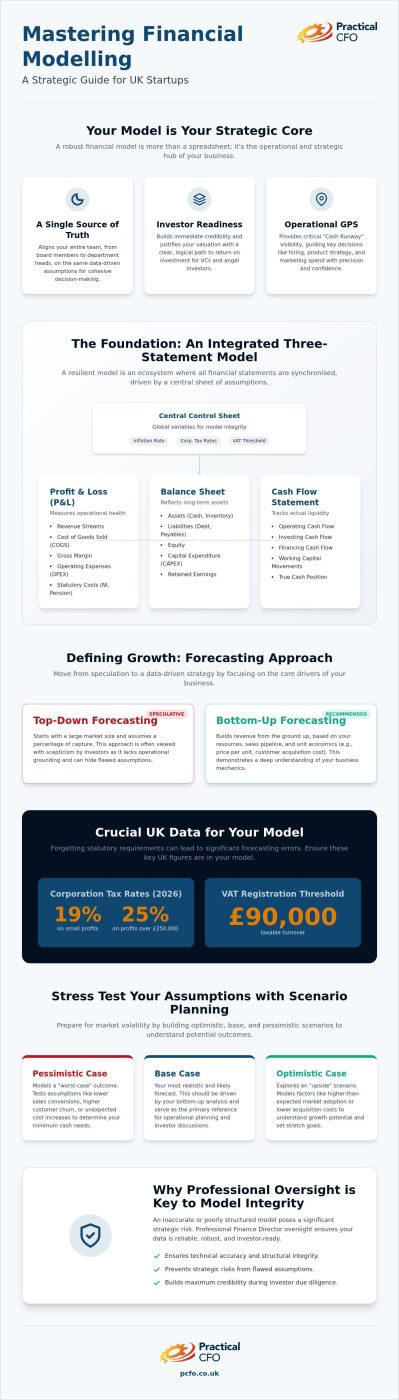
What is Financial Modelling? At its core, it’s a mathematical translation of your business strategy into a functional framework. It isn’t just a spreadsheet of historical data; it’s a forward-looking architecture that quantifies your ambitions. For founders, financial modelling for startups uk acts as the single source of truth. It ensures that stakeholders, from board members to department heads, are operating from the same set of data-driven assumptions rather than guesswork.
In the 2026 UK market, the focus has shifted significantly. Whilst previous years were often defined by “survival mode,” today’s landscape demands a transition to “strategic scaling.” A simple annual budget is no longer sufficient to manage this complexity. You need a dynamic multi-year forecast that adapts as your market conditions change. This tool allows you to move beyond reactive decision-making and into a proactive stance, ensuring your resources are always allocated where they generate the most value.
Investor Readiness and Due Diligence
A robust model builds immediate credibility with Venture Capitalists and Angel investors. It demonstrates that you understand the mechanics of your growth and the levers that control it. When you enter a funding round, the model justifies your valuation by showing a clear, logical path to return on investment. You should expect rigorous scrutiny during this process. Preparing for the oversight of a professional finance director during due diligence is essential. They’ll look for integrity and depth in your assumptions. A well-constructed model proves that your business is a professional operation, not just a collection of hopeful ideas.
Operational Navigation: Your Business GPS
Think of your financial model as a GPS for your operations. It provides the visibility needed to decide when to hire your next key team member or when to pivot your product strategy. For early-stage UK startups, “Cash Runway” visibility is the difference between controlled growth and sudden failure. Your model aligns departmental goals across sales, marketing, and product development. It ensures that every team understands the financial reality of their targets. When your marketing spend is linked directly to your revenue forecast, you can scale with composure and precision, knowing exactly how much capital remains available.
Constructing the Foundation: The Three-Statement Model
A resilient financial model isn’t a collection of isolated tabs. It’s an ecosystem where the Profit & Loss (P&L), Balance Sheet, and Cash Flow statement work in total synchronicity. When you engage in financial modelling for startups uk, your objective is to ensure that a change in one cell ripples accurately through the entire structure. This integration is managed through a “Control Sheet”, a dedicated space for global variables like inflation, the £90,000 VAT registration threshold, and current Corporation Tax rates. By centralising these assumptions, you maintain a clean, auditable model that remains robust under investor scrutiny.
The Integrated Profit and Loss (P&L) Forecast
Your P&L should be organised to reveal the true health of your operations. Start by separating revenue streams and Cost of Goods Sold (COGS) to clearly see your gross margin. As you scale, categorising operating expenses (OPEX) allows you to identify where efficiencies are being gained. For UK businesses, it’s vital to incorporate statutory requirements such as Employer National Insurance and pension contributions. You must also account for the tiered Corporation Tax rates, which as of April 2026, stand at 19% for small profits and 25% for companies with profits over £250,000. Forgetting these statutory costs can lead to a significant deficit in your forecast.
Cash Flow and Balance Sheet Synchronisation
Profit is a matter of opinion, but cash is a matter of fact. Many founders find themselves in a “profitable” position whilst their bank balance dwindles due to timing differences in payments and receipts. Your model must link the P&L directly to the Cash Flow statement to track these working capital movements. Factoring in capital expenditure (CAPEX) is equally important. These investments sit on your Balance Sheet and impact your long-term liquidity rather than just your monthly expenses.
Maintaining this level of detail requires technical precision. Utilising outsourced accountancy solutions ensures that your historical data is accurate, providing a solid base for your future projections. If you’re looking to refine your strategy, our team can provide the Business Growth Advisory needed to turn these numbers into actionable insights. This professional oversight prevents the “garbage in, garbage out” trap that often undermines early-stage spreadsheets.
Defining Growth Drivers: Revenue Models and Unit Economics
Effective financial modelling for startups uk requires a shift from “top-down” market sizing to “bottom-up” resource-based forecasting. Instead of assuming you’ll capture a percentage of a multi-billion pound market, you should build your model based on the actual levers you control. This involves identifying specific drivers such as lead generation volumes, conversion rates, and sales cycle lengths. For SaaS businesses, this means focusing on Monthly Recurring Revenue (MRR) and churn, whilst marketplaces must track Gross Merchandise Value (GMV) and take rates. Validating these future assumptions with historical data provides the intellectual rigour investors expect. Unit Economics is the direct link between a single customer and profit.
Moving beyond simple revenue projections allows you to see the mechanical relationship between your activities and your bank balance. If your model shows that doubling your sales team leads to a linear increase in revenue, you must ensure the underlying data supports that assumption. A well-structured model doesn’t just predict the future; it explains it through the lens of your operational capacity.
Mastering Unit Economics: CAC and LTV
Sustainable scaling depends on your ability to acquire customers profitably. Calculating your Customer Acquisition Cost (CAC) across various UK marketing channels allows you to identify where your capital is most effective. When paired with Lifetime Value (LTV), you can determine your LTV:CAC ratio, a critical metric for long-term viability. In the 2026 investment climate, raw growth is no longer the sole priority. Investors now place significant emphasis on the “Payback Period”, the time it takes to recover the cost of acquiring a customer, as it directly impacts your cash runway and overall liquidity.
The Impact of UK Tax Incentives
Fiscal efficiency is a cornerstone of strategic business planning. You should build R&D Tax Credits into your cash flow forecast with precision to ensure you aren’t over-leveraged whilst awaiting HMRC rebates. Additionally, understanding the current SEIS and EIS rules is vital for your cap table management. With the SEIS lifetime company investment limit at £250,000 and EIS annual limits reaching £10 million, these schemes remain powerful tools for attracting UK investors. Professional business growth advisory uk helps you optimise these fiscal levers, ensuring your model reflects the true benefit of these incentives. This proactive approach reinforces your position as a well-managed, investment-ready enterprise.
Scenario Planning and Stress Testing Your Model
Relying on a single “Base Case” is a significant risk in the volatile startup ecosystem. Whilst your primary forecast represents your expected path, it doesn’t account for the inherent unpredictability of scaling. Effective financial modelling for startups uk incorporates a “Three-Scenario” approach: Optimistic, Base, and Pessimistic (Downside). This framework allows you to visualise potential outcomes and prepare contingency plans before they’re needed. By using sensitivity analysis, you can identify which specific variables have the most profound impact on your cash reserves. Whether it’s lead conversion rates, average contract values, or direct labour costs, knowing which levers move the needle allows you to focus your management efforts where they matter most.
Beyond standard fluctuations, your model should consider “Black Swan” events or sudden market shifts. These are rare but impactful occurrences that can deplete your runway overnight. A robust model gives you the foresight to navigate these challenges with a steady hand. It ensures your business remains resilient even when external conditions become unfavourable, providing a clear path through uncertainty.
Stress Testing for Resilience
Resilience is built by asking difficult questions of your data. What happens if your sales cycle doubles in length? For B2B startups, this can create a severe cash gap that isn’t immediately obvious on a P&L statement. Similarly, you should model the impact of a 20% increase in customer churn. This helps you understand how sensitive your long-term runway is to retention issues and customer dissatisfaction. Testing your “Breakeven Point” is also vital. It provides a clear target for when the business becomes self-sustaining, reducing your dependence on external capital. These tests transform your model from a static document into a dynamic tool for survival.
Scenario Planning for Strategic Decisions
Scenarios are powerful tools for making informed operational choices. You can use your model to calculate the projected ROI of a major new hire or a new territory launch before committing any capital. It also allows you to compare fractional cfo pricing uk structures against the total cost of a full-time executive hire, including benefits and overheads. By modelling these different paths, you can set performance milestones for your management teams that are rooted in financial reality. This level of foresight ensures that every strategic move is backed by data, giving you the confidence to scale at pace. If you’re ready to future-proof your business strategy, our strategic advisors can help you build a model that stands up to the most rigorous stress testing.
Why Professional Oversight is the Key to Model Integrity
A sophisticated spreadsheet is a powerful asset, but it’s only as reliable as the assumptions underpinning it. The principle of “Garbage In, Garbage Out” is particularly relevant to financial modelling for startups uk. If your initial data is flawed or your growth logic is overly optimistic, the resulting forecast will mislead your strategic decisions. Whilst automation software can generate aesthetically pleasing charts, it cannot replace the intellectual rigour of an experienced professional. For those looking to master these technical skills, Financial Modelling University offers advanced training to help professionals build more robust, investor-grade frameworks. Software lacks the ability to challenge a founder’s assumptions or provide the nuanced context required for board-level reporting. Transitioning from founder-led finance to professional leadership is a critical step in your company’s evolution, ensuring your financial strategy is built on a foundation of objective reality.
The Fractional CFO Advantage
Engaging a fractional CFO allows you to access high-level strategic expertise without the overhead of a full-time executive salary. This model is particularly effective for scaling businesses that require sophisticated financial architecture but aren’t yet ready for a permanent C-suite hire. An external perspective is invaluable; it identifies blind spots in your growth assumptions that you might overlook from within the business. By linking your current financial model to exit strategy planning services early in your journey, you ensure that every operational decision increases the ultimate value of your company. This foresight prepares you for future investment rounds or a strategic sale with absolute confidence.
Maintaining the Model: Monthly Variance Analysis
Your financial model must be a living document to remain useful. It requires updating every month with “Actuals” to compare your real-world performance against your initial “Forecast”. This process, known as variance analysis, is essential for identifying trends before they escalate into crises. If your marketing spend is higher than projected whilst your conversion rates are lower, you need to know immediately. A part-time FD plays a vital role here, translating these technical variances into strategic insights for your board. They provide the calm, authoritative voice needed to explain performance gaps and propose data-driven course corrections. This disciplined approach to financial modelling for startups uk ensures your business remains agile, transparent, and attractive to long-term stakeholders.
Securing Your Strategic Future
Building a robust financial model is more than a technical requirement for fundraising; it’s the foundation of your operational autonomy. By integrating the three-statement framework with rigorous unit economics and scenario planning, you transform a static spreadsheet into a dynamic business GPS. We’ve explored how professional oversight ensures the integrity of your data, providing the intellectual rigour necessary for board-level reporting and Series A or B funding readiness. Mastering financial modelling for startups uk allows you to move from reactive survival to proactive, strategic scaling with absolute confidence in your cash runway.
As authoritative strategic partners for UK SMEs, our specialists in fractional FD and CFO leadership are ready to help you navigate this transition. We provide the steady hand needed to future-proof your business and maximise its long-term value. To gain total visibility over your growth trajectory, book a consultation with a PCFO expert to build your strategic financial model today. You don’t have to navigate the complexities of financial leadership alone.
Frequently Asked Questions
What is the best software for financial modelling for startups in the UK?
How far ahead should a startup financial model forecast?
A standard model should forecast 36 months into the future. This timeframe is long enough to demonstrate growth potential but short enough to remain grounded in realistic assumptions. For businesses focused on long-term exit strategy support, extending this to five years may be necessary to show a full maturity cycle. This provides the visibility required to plan for major capital events or structural shifts.
Why do investors ask for a three-year financial model?
Investors request a three-year view to assess your path to profitability and your understanding of long-term unit economics. It proves that your business is a sustainable venture rather than just a short-term project. This duration allows stakeholders to see how you plan to deploy capital across multiple hiring and product cycles. It also helps them understand your future funding requirements and potential return on investment.
What is a “bottom-up” revenue forecast and why is it better?
A bottom-up forecast calculates revenue based on operational inputs like marketing spend, lead generation, and sales capacity. It’s superior because it’s rooted in reality rather than vague market-share percentages. This methodology provides much higher credibility during financial modelling for startups uk as it shows exactly how you will generate every pound of turnover. It allows you to identify the specific levers that drive your growth.
How do R&D tax credits affect my startup’s cash flow model?
R&D tax credits should be modelled as a discrete cash inflow based on when you expect the HMRC rebate to arrive. It’s a mistake to treat these credits as a monthly reduction in operating costs. Since the rebate often arrives many months after the financial year ends, accurate timing is essential. Including the rebate at the wrong time can lead to a significant and dangerous misunderstanding of your actual cash runway.
What is the difference between a financial model and a business plan?
A business plan describes your strategy and market position in words, whilst a financial model proves that strategy through numbers. Think of the business plan as the “what” and “why”, and the model as the “how” and “how much”. Both must be perfectly aligned to provide a cohesive narrative to your board. The model acts as the numerical evidence that your strategic plan is actually viable and achievable.
Do I need a CFO to build my financial model?
Whilst a founder can build a basic spreadsheet, a CFO or Finance Director provides the intellectual rigour needed for institutional investment. They ensure the model is auditable, integrated, and strategically sound. Having professional oversight reduces the risk of formula errors that could undermine your credibility during a high-stakes pitch. A CFO also helps you interpret the data to make better operational decisions as you scale.
How often should I update my startup’s financial model?
You should update your financial modelling for startups uk on a monthly basis. This ensures that your forecast reflects the current reality of your bank balance and market conditions. Regular updates allow you to spot variances early, giving you the flexibility to pivot your strategy before a small deficit becomes a major problem. This monthly discipline keeps your management team focused on the most important financial targets.