

A new finance product won’t necessarily solve a working capital problem. Supply chain finance optimisation starts with understanding where cash is tied up, whether in inventory, customer payments or supplier terms, and when that pressure occurs. Without this view, a funding or software decision may address the symptom rather than the cause.
If cash feels stretched, you’re not alone in facing a complex cycle. Finance, procurement and operations each hold part of the picture, which can make it harder to assess how a proposed change will affect cash flow, suppliers and day-to-day delivery. The aim isn’t simply to free up cash, but to do so without creating new risks.
This guide explains how to diagnose working capital pressure and compare process changes, external finance and technology against your business’s needs. You’ll also learn how to build a phased improvement plan with measurable outcomes and clear ownership. Joined-up cash flow analysis and forecasting can help your team make informed decisions before committing to change.
Key Takeaways
- Supply chain finance optimisation should improve the movement of cash, not simply push payments further down the chain.
- Map your cash cycle and establish a baseline to distinguish underlying causes, such as excess stock or invoice disputes, from symptoms.
- Compare process changes, funding approaches and digital tools by their effect on cash timing, suppliers, data needs and governance.
- A focused pilot with clear owners can help your teams test changes, monitor results and refine the plan before wider implementation.
- Finance leadership can connect working capital analysis with procurement and operational decisions through forecasting and scenario planning.
What supply chain finance optimisation means for cash flow
Supply chain finance optimisation improves the movement of cash between buyers, suppliers and operational processes, so working capital supports the business without undermining the wider supply chain. It starts with understanding how purchasing, stock, production, invoicing and collections affect cash, then identifying process changes that address delays or inefficiencies.
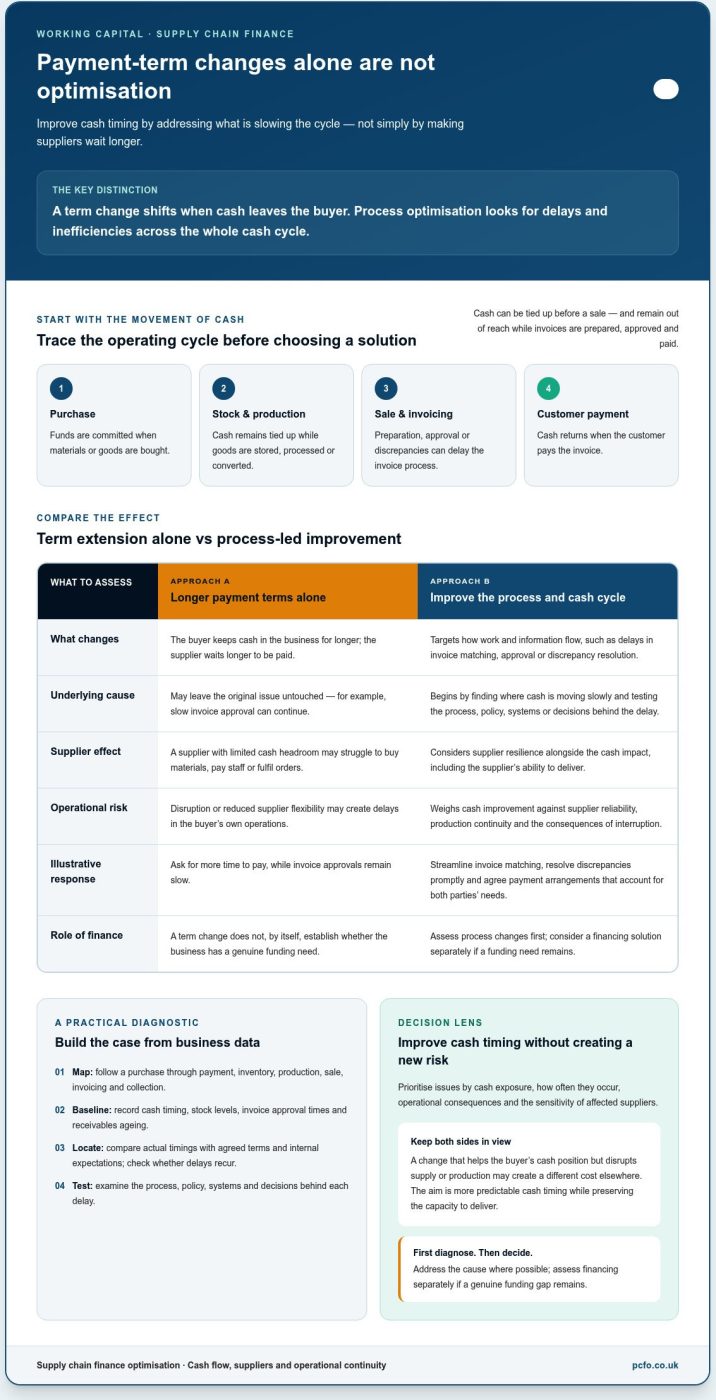
This is different from simply extending payment terms or arranging external finance. A funding solution may change when cash is available, but it won’t necessarily fix excess stock, slow invoice approval or late customer payments. Process optimisation addresses how work and information flow. Financing solutions can be considered separately if a genuine funding need remains. For a wider explanation of common structures, see What is Supply Chain Finance?
Good decisions consider the cash conversion cycle alongside supplier resilience and operational continuity. A change that improves the buyer’s cash position but disrupts supply or production may create a different cost elsewhere. The objective is to make cash timing more predictable while preserving the capacity to deliver.
Where working capital becomes trapped in the supply chain
Follow cash through the full operating cycle. The business commits funds when it purchases materials or goods. Cash may remain tied up while stock is stored, processed or converted into finished products. Once a sale is made, the business still waits for the invoice to be prepared, approved and paid before cash returns.
That sequence can create pressure even as sales rise. A stock build-up may absorb cash before goods are sold, whilst slow collections delay the return of cash after a sale. Check when purchasing happens, how long inventory remains in the business, where production or invoice approvals stall, and how quickly customers pay.
Payment timing is only one part of the picture. If a supplier is critical to production, changing order patterns or payment arrangements could affect its ability to deliver. Assess the cash impact alongside supplier reliability, alternative sources and the operational consequences of interruption.
Why payment-term changes alone are not optimisation
Longer payment terms may leave a buyer’s cash in the business for longer, but they also mean a supplier waits longer to be paid. If that supplier has limited cash headroom, the change could affect its ability to buy materials, pay staff or fulfil orders. The buyer may then face delays or reduced flexibility in its own operations.
For example, a buyer could seek more time to pay a supplier while continuing to approve invoices slowly. The supplier experiences a longer wait, but the underlying administrative delay remains. A more sustainable improvement might be to streamline invoice matching and resolve discrepancies promptly, while agreeing payment arrangements that account for both parties’ needs.
Before changing terms, examine the cause of the cash pressure and consider who bears the effect of the proposed change. That distinction is central to supply chain finance optimisation: improve the process and cash cycle where possible, then assess whether a financing solution is needed to address a remaining gap.
How to diagnose supply chain finance opportunities before choosing a solution
Before comparing finance options or systems, establish where cash is moving slowly and why. Supply chain finance optimisation starts with a measured baseline, not a product selection. A clear diagnosis helps you distinguish a genuine funding requirement from a process issue, and gives teams a way to judge whether a change has made a difference.
Use a consistent sequence, with finance, procurement, sales and operations contributing the information they own:
- Map the cash cycle. Follow a purchase from order and supplier payment through inventory, production, sale, invoicing and customer collection.
- Establish a baseline. Record current cash timing and relevant measures, such as stock levels, invoice approval times and receivables ageing.
- Locate delays. Identify where actual timings diverge from agreed terms or internal expectations, and whether the pattern is recurring.
- Test the causes. Check the process, policy, systems and decisions behind each delay before considering a solution.
Map the cash cycle using usable business data
Start with payable and receivable ageing, inventory movements, cash flow forecasts and payment patterns. Compare actual payment and collection dates with supplier or customer terms, as well as internal expectations for ordering, invoice approval and stock use. This reveals where time is added between a business event and its cash impact.
Bring data together across functions, but record its limitations. Finance may hold ledger and forecast information; procurement can explain order patterns and supplier terms; operations can clarify stock movement and production delays; sales teams can provide context on customer billing and collection. If records are incomplete or inconsistent, flag the gap rather than treating an estimate as a verified result.
Prioritise the causes with the greatest business impact
Not every delay deserves the same response. Rank each issue by cash exposure, how often it occurs, its operational consequences and the sensitivity of affected suppliers. Then test whether its root cause lies in process, policy, systems, disputes or forecasting. For example, slow collections may reflect unresolved invoice queries rather than customer payment behaviour alone.
For each priority, document the baseline, the evidence used, the intended measure of change and a named owner. A useful measure might track invoice approval time or the age of stock, provided the data is available and consistently defined. Review the measure with the teams responsible for the process so it reflects operational reality as well as finance reporting.
This assessment gives decision-makers a sound basis for choosing what to address first. PCFO’s part-time Finance Director support can help connect working capital analysis with procurement and operational decisions through forecasting.
Supply chain finance options compared: process, funding and technology
Once you understand where cash pressure originates, compare options by the problem they address, not by their headline features. Process changes may remove avoidable delays. Financing can alter when cash is received or paid, but it won’t correct inaccurate invoices, unsuitable stock levels or weak purchasing controls. Digital tools can improve access to information, provided the underlying data and responsibilities are sound.
The options below have different implications for cash timing, suppliers, information requirements, implementation and oversight. No finance solution is automatically suitable for every business or supplier. Supply chain finance optimisation means weighing the trade-offs against your operating model and the causes you have identified.
| Option | Cash timing | Supplier impact | Data, implementation and governance |
|---|---|---|---|
| Process changes | Can reduce avoidable delays in purchasing, invoice approval or collection. | May improve predictability if processes are clearer and more consistent. | Needs accurate process information, agreed owners and coordination across teams. Review changes against defined measures. |
| Buyer-led finance | May allow a supplier to receive payment earlier against an approved buyer invoice, subject to the arrangement. | Could offer an earlier payment route, but participation and suitability can vary by supplier. | Requires reliable invoice approval, clear contractual terms and oversight of eligibility, responsibilities and risks. |
| Receivables solutions | May bring forward access to cash tied up in eligible receivables, depending on the structure. | Can affect how customer payments and collections are managed. | Needs dependable receivables records and careful assessment of contractual terms, costs and business-specific risks. |
| Digital tools | Can make cash and process information easier to view, but visibility alone doesn’t release cash. | May support information sharing where suppliers are included in the process. | Requires usable data, integration planning, user adoption and clear accountability for decisions and access. |
Operational improvements versus financing arrangements
Start with recurring operational friction. Accurate invoices, prompt dispute resolution, disciplined inventory management and purchasing controls can address delays at their source. If invoices regularly wait for approval because purchase orders and receipts don’t match, improving the matching and escalation process may be more direct than introducing a financing arrangement. Assess any funding structure against its contractual terms and the business’s specific risks.
When software supports optimisation, and when it does not
Technology may help if information is fragmented across systems or manual workflows prevent timely decisions. Better visibility can support coordination, but implementation effort, data quality and staff adoption all matter. A tool won’t resolve unclear ownership or replace judgement about stock, payment terms and supplier needs. Assign people to maintain the data, interpret exceptions and act on what the information shows.
Compare options against the same criteria, then model their likely effects on cash, operations and suppliers before committing. This keeps the decision grounded in business needs rather than assuming that a funding product or new system is the answer.
How to implement a supply chain finance optimisation plan
Turn the diagnosis into a controlled programme of change. A phased approach lets you test whether an intervention works in practice before extending it across the business. Agree the intended outcome first, then involve finance, procurement, operations and supplier-facing teams so each understands the change and its potential effects.
Use a sequence that keeps decisions and accountability clear:
- Agree the objective. Define the issue to address, such as slow invoice approvals, avoidable stock build-up or uncertainty in cash timing. Be clear about the desired business outcome and any limits that protect service continuity.
- Select a focused pilot. Choose a defined process, product area or supplier group that reflects the diagnosed bottleneck. Keep the scope manageable enough to monitor, but relevant enough to provide useful evidence.
- Assign owners. Name a lead for the change and owners for the data, supplier communication and operational steps. Agree how teams will escalate exceptions before the pilot begins.
- Monitor and refine. Compare results with the baseline, review unintended effects and decide whether to continue, adjust or stop the intervention.
Set the scope, ownership and measures for a pilot
Record baseline measures before changing terms or workflows. Depending on the bottleneck, these might include cash conversion timing, overdue invoices, invoice exceptions or inventory movement. Define each measure consistently and note its source, assumptions and any data limitations so later comparisons are fair.
Set a review cadence that fits the process and make responsibilities explicit. For example, procurement may own supplier communication, operations may monitor delivery or stock effects, and finance may track cash measures and forecast changes. Agree who can approve adjustments and how issues are escalated if the pilot affects service or supplier relationships.
Monitor risks and adapt the plan
Review cash results alongside supplier response, service continuity, invoice exceptions and cash forecast variance. A change can appear beneficial in one measure while creating pressure elsewhere. After a pilot, review cash, supplier and operational effects together before deciding whether to scale, revise or stop the intervention.
Use scenario analysis to consider how the outcome might change if demand shifts, customer collections take longer or supplier conditions change. This helps the team assess whether an improvement is robust or depends on assumptions that may not hold. Keep a record of decisions and the evidence behind them, including unexpected results.
Scale only when the pilot has produced reliable evidence and the relevant teams can manage the process consistently. If results are mixed, refine the intervention or gather better data before expanding it. A disciplined rollout makes supply chain finance optimisation a managed business change, rather than a one-off finance initiative.
PCFO’s part-time Finance Director support connects cash analysis with commercial and operational decisions.
How PCFO finance leadership can support better working capital decisions
Working capital decisions often cross finance, procurement, sales and operations. PCFO’s part-time and outsourced Finance Director and CFO support can help bring these perspectives together, connecting cash flow analysis with the commercial choices that shape purchasing, inventory and customer collections. This gives leadership a clearer basis for prioritising action.
For growing businesses, this kind of finance leadership can add strategic oversight without the need for a full-time executive hire. It can also help make supply chain finance optimisation part of wider business planning, so changes are considered in light of cash requirements, operating priorities and growth plans.
From financial data to coordinated business decisions
A finance leader can help turn separate data points into a shared view of the cash cycle. For example, purchasing plans and inventory movements can be considered alongside supplier payment timing, sales forecasts and customer collections. That joined-up discussion can help teams understand how a procurement decision might affect cash availability, or how a change to stock policy could influence fulfilment and future receipts.
Forecasting supports this work by showing the possible timing and implications of proposed changes. Scenario planning can help leadership compare different assumptions, such as a shift in demand or a delay in collections, before committing to a course of action. It doesn’t remove uncertainty, but it can make the assumptions, trade-offs and potential cash pressure more visible.
PCFO’s strategic finance director support for growing businesses can form part of a wider approach to financial leadership.
Choose support that fits the business stage
The right level of input depends on the organisation’s needs. A business may need focused Finance Director guidance on working capital priorities, or broader CFO input to connect cash planning with growth and strategic decisions. Flexible, part-time support can provide experienced oversight whilst the business develops its finance capability and decision-making processes.
PCFO’s outsourced accountancy guide provides context on finance operations. The cash flow forecasting article covers building and using forecasts. These resources address different needs, from financial processes to forward-looking planning.
PCFO supports analysis, forecasting, business planning and informed financial decisions. If you’re reviewing cash pressure or weighing possible changes, finance leadership can help you assess working capital priorities and consider the implications for your next decisions.
Make working capital a platform for confident growth
The next step is to decide which working capital priority deserves leadership attention first. That choice can shape how confidently your business takes on growth, responds to changing demand and commits resources. Keep the focus on decisions your teams can influence, and revisit priorities as trading conditions and plans evolve.
Effective supply chain finance optimisation is an ongoing management discipline, not a one-off project. It benefits from clear financial oversight and decisions informed by the commercial realities across your business. PCFO supports growing businesses with part-time and outsourced Finance Director and CFO input, alongside business planning, growth advisory and outsourced accountancy expertise.
If you’re ready to give your cash priorities clearer direction, discuss your working capital priorities with PCFO. A considered conversation can help you identify where finance leadership could support your next decisions. With the right focus and ownership, you can move forward with greater clarity.
Frequently Asked Questions
Is supply chain finance optimisation only relevant to large businesses?
No. A growing business can benefit if its cash is regularly committed to stock, customer invoices or supplier costs before receipts arrive. The scale of the business matters less than whether it can identify a recurring pressure and act on it. A smaller firm might begin by reviewing a product range with slow turnover or checking whether billing milestones match its delivery process, rather than launching a business-wide programme.
Can supply chain finance optimisation improve cash flow without changing supplier payment terms?
Yes. Supply chain finance optimisation can focus on internal processes, leaving agreed supplier terms unchanged. For instance, a business could review reorder points for slow-moving items, reduce unnecessary stock purchases or invoice customers promptly once contract milestones are met. These changes may alter when cash is committed or collected. Their effect depends on the business’s circumstances, so assess customer service and supply reliability alongside the cash impact.
How much working capital can supply chain finance optimisation release?
There’s no reliable figure without examining your business’s data and operating cycle. The amount depends on which assets or processes are tying up cash, how consistently the issue occurs and whether a proposed change is practical. Separate cash released by an operational improvement from funding that advances access to cash but creates a repayment obligation or other contractual commitment. A forecast can help show the potential effect under different assumptions.
Does supply chain finance optimisation affect supplier relationships?
It can, particularly if a change alters order patterns, payment processes or the information a supplier must provide. Involve affected suppliers early enough to understand practical concerns, and explain what will change and how exceptions will be handled. For example, a revised ordering schedule may help your planning but could affect a supplier’s production arrangements. Monitor delivery performance and feedback, not only your own cash measures.
What information is needed to assess supply chain finance opportunities?
Gather transaction-level records that help connect operational events with cash movements. Useful details include purchase order dates, goods-received dates, invoice issue and approval dates, due dates, actual settlement dates, stock movement and customer receipts. Keep reference numbers consistent so transactions can be matched across records. Note missing dates, manual adjustments and changes in how data is recorded, as these can affect the reliability of comparisons.
How soon can a business see the effect of supply chain finance optimisation?
The timing varies with the change being tested and how quickly reliable evidence becomes available. A revised invoice approval step may show an early process effect once new invoices pass through it. Adjusting purchasing behaviour or stock levels may take longer because existing commitments and demand patterns influence results. Set a review point that suits the business cycle, and distinguish a short-term movement from a sustained change before deciding what to do next.