

More sales do not automatically make a business more profitable. Scaling a business without losing profitability means increasing revenue while keeping costs, cash flow and margins under control, often by improving how work is delivered rather than simply adding people and expense. That is the key difference between scaling and growth.
It is understandable to focus on new customers and higher turnover when a business is expanding. But if costs rise just as quickly, the extra activity may add pressure without improving profit. Sustainable expansion depends on knowing which work earns a healthy margin, how much cash it requires and whether your systems can handle more demand.
This article explains how to distinguish growth from scaling and protect cash flow and profitability as your business expands. You will learn how to plan investment, monitor margins and build financial reporting that gives you a clearer view of performance, helping you make informed decisions about when and how to grow.
Key Takeaways
- Distinguish expansion from true scaling by assessing whether your processes can handle more demand efficiently.
- Track margins alongside sales to spot when rising costs are eroding the value of new work.
- Plan cash needs before committing to investment, so growth doesn’t leave the business short of working capital.
- Build regular financial reporting that helps you make timely decisions as operations become more complex.
What is the difference between growing and scaling a business?
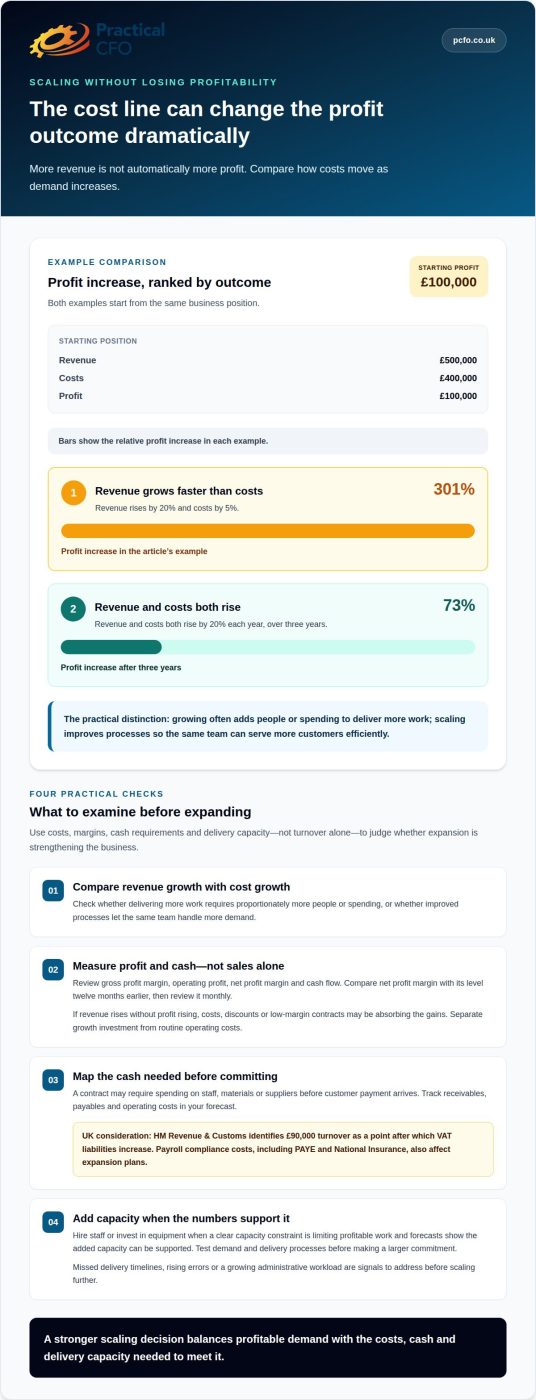
Distinguish revenue growth from scaling by assessing costs, delivery capacity and cash requirements. These four practical checks help business owners judge whether expansion is strengthening the business or adding pressure.
-
Distinguish Growth from Scaling
Compare how revenue and costs change as demand increases. Growth often means adding people or spending to deliver more work; scaling improves processes so the same team can serve more customers efficiently. For example, a business starting with £500,000 revenue, £400,000 costs and £100,000 profit could increase profit by 73% after three years if revenue and costs both rise by 20% each year. If revenue rises by 20% and costs by 5%, profit increases by 301%.
-
Use Financial Data to Assess Growth
Measure profitability using gross profit margin, operating profit, net profit margin and cash flow, not revenue alone. Compare net profit margin with its level twelve months earlier, then review it monthly. Rising revenue without rising profit may mean costs, discounts or low-margin contracts are absorbing the gains. Separate growth investment from routine operating costs to see whether new spending is producing returns.
- Map cash needs before committing to expansion. A new contract can require spending on staff, materials or suppliers before customer payment arrives, creating working-capital pressure despite strong sales. Track receivables, payables and operating costs in your forecast. In the UK, HM Revenue & Customs identifies £90,000 in turnover as a point after which VAT liabilities increase. Payroll compliance costs, including PAYE and National Insurance, also affect expansion plans.
- Hire staff or invest in equipment when a clear capacity constraint is limiting profitable work, and forecasts show the added capacity can be supported. Test demand and delivery processes before making a larger commitment. Rapid expansion without planning can stretch teams and finances, reduce service quality and weaken customer satisfaction. In specialised sectors such as disability support, where providers like paramountcaresolutions.com.au coordinate hands-on care, balancing workforce capacity with participant needs is essential to uphold standards. Treat missed delivery timelines, rising errors or a growing administrative workload as signals to address before scaling further.
How does scaling impact cashflow, margins, and profitability?
Sales can increase while profitability weakens if delivery costs rise faster. Protect margins by regularly reviewing prices, operating efficiency and the quality of each deal.
-
Protect Margins Through Pricing and Efficiency
Review pricing against the value delivered and the cost of fulfilling each sale. Track gross margin by product or service, then investigate declines before increasing sales volume. For example, £1m revenue with £600,000 in direct costs gives a 40% gross margin. At £1.5m revenue and £1m direct costs, the margin falls to around 33%. Improve workflows before accepting lower returns.
-
Review Low-Margin Deals
Assess each discount, acquisition cost and contract’s delivery demands before pursuing more volume. A low-margin deal can consume staff time, materials and management attention without contributing enough profit. Check whether extra service requirements, expedited delivery or rework erode the expected return. If a deal’s contribution is weak, revise its price or terms, or prioritise work with stronger margins. More workload alone is not evidence of profitable expansion.
-
Compare Economies and Diseconomies of Scale
Compare unit costs as output increases. Economies of scale occur when shared systems, purchasing power or more efficient processes reduce the cost of each unit. Diseconomies emerge when added complexity, coordination and overheads push unit costs up. Monitor delivery quality and staff workload alongside costs. If extra volume creates bottlenecks or errors, efficiency gains may be disappearing even as revenue rises.
-
Plan Costs and Processes for Scaling
Map the costs behind expansion, including staffing, materials, suppliers, equipment and overheads. Automate repeatable administrative workflows, standardise processes and clarify approvals before demand grows. Then test capacity, forecast the investment and expand in stages, reviewing results before committing further. Strong sales don’t ensure cash arrives in time: a £250,000 contract may need £100,000 spent on staff, materials and suppliers before payment. Business growth planning can help structure these decisions.
Retaining cash for business investment
Fund expansion with a clear cash plan, not profit figures alone. A growing business can report a profit and still lack the cash to invest.
-
Monitor and Forecast Cash Flow
Build a 13-week cash flow forecast and update it as actuals change. Include expected customer receipts, supplier payments, payroll and planned investment. A forecast showing the bank balance falling to £20,000 in three months gives owners time to respond. Compare expected and actual cash movements, then investigate late receipts or unexpected spending before they become funding gaps.
- Separate profitability from cash availability before committing capital. Profit records income and costs, while cash flow shows when money enters or leaves the bank. A business can therefore be profitable but unable to pay bills on time. Forecast the cash required for planned growth and retain enough working capital to meet operating commitments as well as investment needs.
-
Strengthen Cash Flow to Fund Investment
Shorten the cash conversion cycle by managing stock, supplier terms and customer payment times. For example, a business paying suppliers after 30 days, holding stock for 45 days and receiving customer payments after 60 days has cash tied up during the cycle. Faster invoicing and prompt follow-up can improve cash availability; reducing average customer payment time by a couple of weeks can make a meaningful difference.
- Use retained profits to fund sustainable growth where cash forecasts support it; reinvestment can avoid taking on debt and interest payments. Before seeking additional capital, prepare a detailed cash flow forecast and test different sales and cost scenarios. Understand expected cash requirements over the next 6-12 months before taking significant dividends or distributions. This helps UK business owners balance investment with the funds needed to keep daily operations running.
Finance function capacity and management reporting
As revenue increases, informal finance processes can make progress harder to see. Use clear reporting and defined responsibilities to keep expanding operations financially visible.
- Assess whether your accounting systems and processes can handle a larger volume of transactions. Map how invoices, expenses and approvals move through the business. Identify duplicate data entry, slow month-end tasks and unclear ownership. Then standardise workflows or automate repetitive steps. Reliable records help leaders distinguish genuine performance changes from late or inconsistent bookkeeping, with professional accounting practices such as lco.co.il offering guidance on structured bookkeeping, audits and statutory financial declarations.
- Set consistent categories for revenue streams and expenses, then define reporting timelines. Use the same definitions across teams so comparisons remain meaningful as the business expands. Reports should show actual results against budget, explain material differences and identify emerging pressures. Clear, timely figures let managers respond to trends rather than rely on outdated summaries.
- Make budgets active management tools, not static documents. Review assumptions against trading performance and changing market conditions, then adjust plans when the evidence supports it. Give each department clear financial boundaries and goals. For example, a sales team can track revenue and customer-acquisition spending, while operations monitors delivery costs and capacity. Owners can then see how local decisions affect overall profitability.
- Build reporting around decisions leaders need to make. Track revenue, gross profit, operating costs, cash flow and investment separately, with consistent definitions and assigned owners. Compare actual progress with forecasts, investigate variances and record resulting actions. As reporting needs grow more complex, strengthen your finance function with strategic financial leadership that connects management information to planning and decisions.
PCFO
PCFO helps business owners connect expansion plans with cash flow, margins and financial reporting. Its Finance Director Services, Chief Financial Officer Services, Business Growth Advisory and Business Planning Consultant services bring financial insight into growth decisions. This support is particularly useful when revenue is increasing but forecasting, investment planning or management reporting needs greater focus.
With clearer forecasts and decision-ready financial information, you can assess capacity, understand the cash required for expansion and monitor whether growth is supporting profitability. The right support depends on the challenges your business needs to address.
Contact PCFO to discuss your business’s growth plans.
Make your next growth decision with confidence
Give your next expansion decision clear evidence and ownership. Set practical milestones for demand, delivery capacity and financial performance, then agree who will review progress and decide whether to proceed. This creates a disciplined route from ambition to action, rather than treating expansion as a single, irreversible leap. A strategy for scaling a business without losing profitability should also make clear when to pause, adjust or invest further.
PCFO supports this planning through Finance Director Services, Chief Financial Officer Services and Business Growth Advisory. These services connect financial insight with the decisions shaping your business’s next stage.
Contact PCFO to discuss scaling and identify a considered next step for your business. With clear priorities and sound financial direction, you can move forward with greater confidence.
Frequently Asked Questions
What does it mean to scale a business?
Scaling means increasing a business’s capacity and output without requiring costs and management effort to rise at the same rate. For example, a documented onboarding process can help a team serve additional clients consistently, rather than relying on the founder to explain every task. The aim of scaling a business without losing profitability is to make delivery repeatable while preserving the value customers receive.
Does cash flow become a problem when scaling?
Yes, cash flow can become a constraint if spending happens before customer payments arrive. For example, a large order may require upfront materials and staff time while payment terms delay incoming cash. Review the timing of deposits, invoices and supplier payments before accepting new commitments. A profitable order can still create pressure if the business cannot fund delivery until payment clears.
How can poor forecasting affect scaling success?
Poor forecasting can leave a business unprepared for the timing and scale of its funding needs. If sales arrive later than expected, planned hiring or equipment purchases may still create immediate costs. Forecast different scenarios, including slower customer payments and higher delivery spending. Comparing these cases helps decision-makers identify which assumptions matter most and adjust expansion plans before cash or capacity becomes constrained.
How does leadership become a bottleneck?
Leadership becomes a bottleneck when routine decisions wait for one person’s approval. For instance, if a founder must approve every supplier order, customer concession and staffing decision, work can stall as activity expands. Assign decision-making authority to capable team members, define which issues require escalation and document repeatable processes. This gives teams room to act consistently while leaders focus on strategic priorities.
What are the biggest mistakes businesses make when scaling?
Common mistakes include expanding before delivery is repeatable, adding fixed commitments too early and pursuing sales without understanding the work involved. A business may accept varied customer requests that make services harder to standardise and resource. Set expansion milestones around demand, operational readiness and cash availability. Review each stage’s results before committing to further hiring, new capacity or wider market activity.
What are the early warning signs that scaling is going wrong?
Look for delivery delays, more rework, rising complaints and recurring differences between budgets and actual results. These may indicate that processes or staffing are struggling to keep pace with demand. Also investigate whether administrative backlogs are growing or managers are spending more time resolving avoidable issues. Address the cause early, before service quality declines or operational problems become harder to correct.