

In a family business, a financial decision is rarely just a business decision. The financial challenges faced by a family-run business in the UK are distinct because family members may hold majority ownership and control, while also balancing business growth, family relationships and personal needs. That overlap can shape how money is invested, paid out and planned for the future.
Growth brings familiar pressures, from managing cash flow to funding expansion. In a family-run business, it can also raise questions about who makes decisions, how responsibilities are shared and how the business can support different generations without weakening its financial position.
This article explores four challenges: balancing family relationships with management, communicating about financial decisions, planning for growth and succession, and weighing commercial ambitions against family needs. You’ll learn why these pressures arise and how clear roles, open communication and forward-looking financial planning can support more confident decisions.
Key Takeaways
- Recognise how shared ownership and family responsibilities can shape financial decisions as a business grows.
- Set clear roles and decision-making boundaries to help keep business discussions constructive.
- Use regular, two-way communication and strategic planning to align family members on the business’s direction.
- Balance reinvestment and growth with family financial needs by making priorities and expectations clear.
1. Why are family businesses different from other businesses?
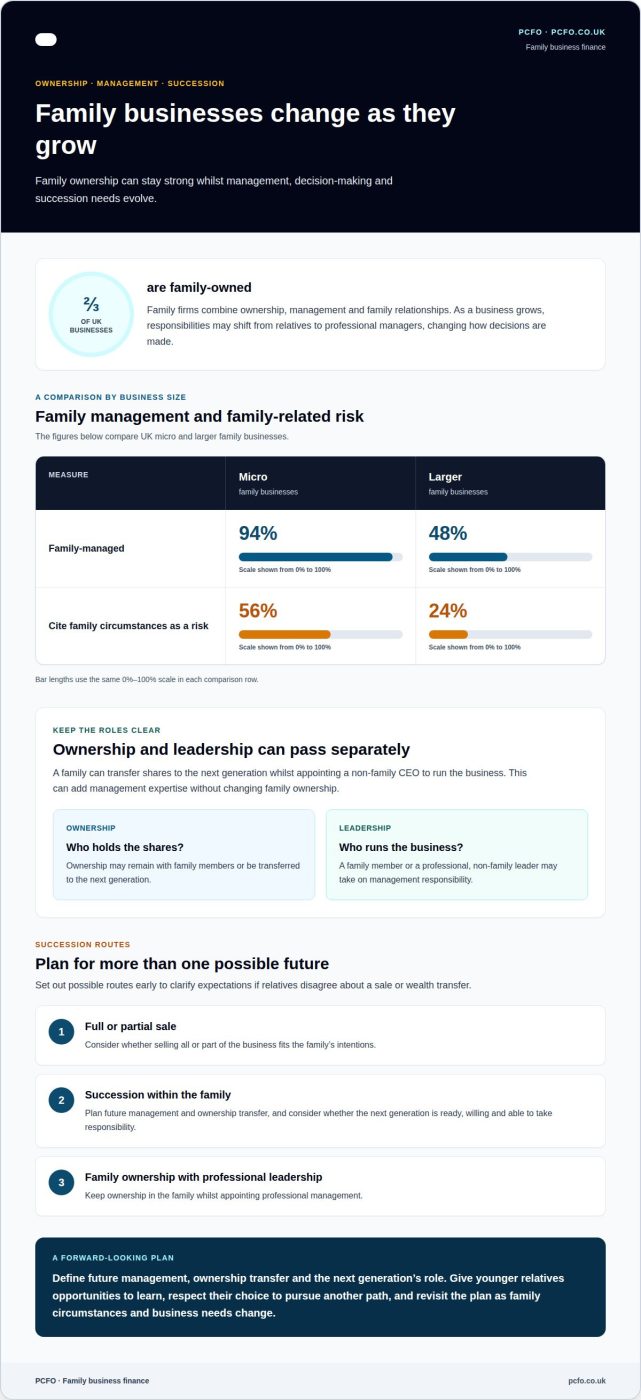
Family businesses combine ownership, management and family relationships, so financial decisions can affect both the company and relatives’ expectations. In the UK, two thirds of businesses are family-owned. Among micro family businesses, 94% are family-managed, compared with 48% of larger family businesses. As a firm grows, responsibilities can shift from relatives to professional managers, changing how decisions are made.
Succession planning is more than choosing the next leader. A defined plan should address future management, ownership transfer and whether the next generation is ready, willing and able to take responsibility. Give younger relatives opportunities to learn and engage while respecting their choice to pursue another path. Revisit the plan as family circumstances and business needs change.
Leadership and ownership can pass separately. A family might transfer shares to the next generation but appoint a non-family CEO to run the business, adding management expertise without changing family ownership. If relatives disagree about a sale or wealth transfer, setting out possible routes early can clarify expectations. Consider a full or partial sale, succession within the family, or continued family ownership with professional leadership.
Cash-flow pressure can make these decisions harder. A cash-flow forecast helps owners identify timing gaps and plan spending before those gaps affect operations.
Growth can also bring employment costs. The Apprenticeship Levy allowance reduces the amount owed by £15,000 across the year, according to UK Government. Include relevant payroll costs in forecasts, alongside hiring and training plans. This helps family owners weigh the investment in skills against other priorities, such as reinvestment, distributions and preparing successors.
2. Balancing family relationships and business management
Family members may act as owners, managers and relatives at the same time. That overlap can blur accountability, especially when a business decision affects a family member’s role or income. Among UK micro family businesses, 56% cite family circumstances as a risk; among larger family businesses, 24% do. Clear structures help separate discussion of ownership from day-to-day management. Define who makes operational decisions, who approves major investments and how concerns reach the board.
Disputes over pay, ownership and profit-sharing are easier to manage when principles are documented before conflict arises. Set out how pay reflects responsibilities and performance, how profits are retained or distributed, and how share transfers are handled. A shareholders’ agreement can record arrangements for share transfers and representation. For example, family shareholders can agree to offer shares to existing shareholders first. Review the arrangements when roles, ownership or the business’s financial position changes.
Non-family managers can bring expertise in finance, operations or strategy, but recruitment alone won’t secure their contribution. Give each manager defined authority, measurable objectives and a clear route to raise concerns. Explain the family’s vision and how decisions are made. To retain key employees, consider how recognition and rewards reflect their contribution. Bonuses or share incentives may be options, depending on the role and the company’s plans.
Regular meetings can prevent difficult conversations from being postponed until a crisis. Use separate forums for family matters and business performance, with agendas, recorded decisions and agreed follow-up actions. An independent adviser or external director can bring impartial oversight when relatives disagree or the business needs a different perspective. The right governance structures should suit the firm’s size and character, rather than add unnecessary process. If growth is stretching existing management arrangements, business growth advisory can help connect leadership decisions with the company’s plans.
3. Family communication and strategic planning
A family strategy meeting gives members a place to discuss business priorities separately from day-to-day operations. Set an agenda covering performance, investment, family involvement and upcoming leadership decisions. Record agreed actions, responsibilities and deadlines, then share relevant updates with family shareholders who aren’t involved in running the company. This creates a consistent channel between owners and management.
Clarify expectations before family members join the business. Define the role, reporting line, required skills and how performance will be reviewed. For example, a relative interested in leadership could gain operational experience before taking on broader responsibility. These steps help separate family relationships from workplace decisions and make opportunities clearer to employees outside the family.
Retirement and pension planning also belong in financial discussions. Forecast how employer pension contributions fit alongside investment, cash requirements and future distributions. Assess contributions in light of their business purpose, and monitor annual and lifetime pension allowances because excess contributions may result in tax penalties. Include the effect of retirement plans on both family income and the company’s available capital.
Tax planning can affect succession and wealth transfers, but it shouldn’t determine the whole strategy. Consider ownership, timing and the family’s intentions together, including whether Business Property Relief may be relevant. A structured plan helps family members understand the decisions under consideration and the reasons behind them. For complex transitions, map possible scenarios and their effects on control, leadership and business finances. Beyond commercial holdings and equity, multi-generational wealth preservation frequently encompasses high-value tangible assets, where specialist custodians such as ESP | Exclusive Storage Program illustrate how dedicated care protects luxury automotive collections over the long term.
Family-run businesses may pursue general grants, loans or tax relief according to their activities and eligibility, rather than family ownership alone. The UK government committed to increasing the British Business Bank’s financial capacity to £25.6bn, but this is not a dedicated family-business grant. Assess any funding route against its purpose, repayment implications and fit with the company’s plans.
4. Balancing business growth with family financial needs
Growth decisions can affect family income as well as the company’s ability to invest. Agree how much profit to retain for equipment, recruitment or expansion, and how much may be distributed to family shareholders. Review those priorities alongside household needs and the business’s cash position. Making the trade-offs explicit helps prevent expectations from diverging when a major investment arises.
Tradition can guide a family business’s culture, but it shouldn’t prevent useful innovation. For example, a firm known for personal service might test online sales while retaining direct customer support. Set a clear purpose for each investment, then assess its commercial value and fit with the family’s principles. Succession planning can also help the next generation contribute ideas while preserving the values owners want to keep central.
Work and family life often overlap when relatives share a workplace. Establish boundaries, such as keeping routine business discussions out of family meals and setting agreed times for urgent decisions. A clear process for raising concerns can reduce conflict and protect personal relationships. Review these boundaries when responsibilities change, such as when a relative takes on a leadership role or steps back from daily operations.
To improve cash flow and resilience, review expected receipts and payments regularly, follow up overdue invoices promptly, and compare planned spending with actual results. Use different scenarios to understand how delayed customer payments or slower sales could affect wages, suppliers and investment. This gives owners time to adjust spending and protect essential commitments before pressure builds.
Family interests and business priorities are easier to balance when owners agree decision criteria in advance. A growth plan can define investment priorities, family distributions and the conditions for changing course. If you’re aligning expansion with family needs, discuss a business growth plan to turn those priorities into a practical financial direction.
PCFO: Chief Financial Officer Services
PCFO provides Chief Financial Officer Services to help family-run businesses connect financial decisions with growth plans and family priorities. Turn to this support when forecasting, investment choices or succession decisions need a clearer financial perspective. Finance Director Services can also provide strategic financial leadership as a business’s management needs develop.
For expansion decisions, PCFO’s Business Growth Advisory and Business Planning Consultant services help bring commercial ambitions and financial planning together. This gives owners a clearer basis for decisions, from balancing reinvestment with distributions to planning for future leadership.
If your business would benefit from structured financial leadership or growth planning, contact PCFO to discuss your priorities.
Build a financial plan that grows with your family business
The financial challenges of a family-run business in the UK can change as ownership, leadership and family priorities evolve. A useful next step is to turn those priorities into a working financial plan, with clear assumptions, responsibilities and review points. This gives family members a shared basis for decisions while leaving room to adapt when circumstances shift.
PCFO offers Finance Director Services and Chief Financial Officer Services to support financial leadership, alongside Business Growth Advisory for businesses planning their next stage. This support connects day-to-day financial information with longer-term choices, helping owners make decisions with a clearer view of the business implications.
If you’re ready to discuss the financial priorities shaping your next stage of growth, contact PCFO to discuss your finances. A considered plan can help your business move forward while keeping its future aligned with the family’s aims.
Frequently Asked Questions
Why are family businesses different from other businesses?
Family businesses connect commercial decisions with ownership, relationships and expectations. For example, reinvesting profits may affect relatives who rely on distributions, while a leadership appointment can change workplace responsibilities and family dynamics. It helps to distinguish ownership decisions from operational ones and agree how family shareholders receive information about performance and major changes.
What are the most common financial challenges facing family-run businesses in the UK?
Common pressures include keeping cash available for operating costs, funding growth, managing family expectations around pay and profit, and planning ownership transitions. These pressures can interact: expansion may require retained profits while family members expect income from the business. To assess the financial challenges facing a family-run business in the UK, review cash forecasts alongside investment plans, shareholder expectations and upcoming leadership changes.
What are the costs and requirements for getting finance for a UK family business?
Finance costs and requirements depend on the type and amount of funding, repayment period, business performance and the lender’s assessment. A lender may review accounts, cash-flow forecasts, existing borrowing and the purpose of the funds. For example, a forecast showing how a new machine could support sales helps explain the business case. Compare the repayment schedule with expected cash receipts before committing to borrowing.
How do UK tax rules affect family businesses, including inheritance tax and business relief?
Tax rules can affect how a family business pays owners, transfers shares and passes assets between generations. Business Property Relief may be relevant to inheritance tax planning, so families should consider how ownership and succession arrangements fit together. For example, a proposed share transfer can affect both control and tax planning. Keep business and personal decisions connected, but don’t let tax alone dictate succession choices.
What are the financial implications of succession planning for UK family businesses?
Succession planning can affect ownership, leadership, cash requirements and the timing of wealth transfers. A transfer may involve gifting or selling shares, changing ownership arrangements, or preparing the business for a new leader. Each route can affect family control and the funds available for investment or retirement. Map these choices early, including the departing owner’s financial needs and the resources a successor will require.
How do rising wages, energy bills, inflation and business rates affect UK family firms?
Rising wages, energy bills, inflation and business rates can squeeze margins by increasing operating costs. If selling prices don’t rise at the same pace, less cash may remain for investment, debt repayments or family distributions. Review costs by category, identify which are fixed or usage-based, and model how changes affect margins. This helps owners decide where to adjust budgets or operating plans.