

What if the primary barrier to your company’s next stage of growth isn’t your product or your sales team, but a lack of high-level financial foresight? Many UK business owners find themselves at a crossroads where a standard high-street accountant no longer provides the strategic depth required. It’s common to feel a sense of anxiety as you try to scale, especially when cash flow forecasting becomes more complex and the prospect of Series A funding or an exit strategy looms on the horizon. You aren’t alone in needing more than just historical reporting; you need a partner who understands where the business is going, not just where it’s been.
By integrating part time FD services into your leadership team, you gain access to seasoned, board-level expertise at a fraction of the cost of a full-time executive hire. This guide will demonstrate how fractional financial leadership provides the clarity and robust roadmap necessary to future-proof your organisation. We will explore how an embedded advisor can optimise your financial systems, enhance team performance, and ensure your business is fully prepared for significant investment or a successful sale.
Key Takeaways
- Identify when your growing business has outgrown a traditional accountant and requires the strategic oversight provided by part time FD services to navigate complex scaling.
- Understand how fractional leadership delivers sophisticated cash flow forecasting and board-level reporting to ensure absolute financial clarity for stakeholders.
- Evaluate the cost-efficiency of the fractional model, comparing the total cost of ownership against a full-time hire whilst maintaining executive-level impact.
- Learn why exit planning and Series A preparation should begin up to three years in advance to build a robust, scalable financial architecture.
- Discover the benefits of an embedded advisor approach that focuses on future-proofing your business and optimising internal team performance.
Understanding Part-Time FD Services: Beyond Standard Accountancy
For many UK SMEs, the transition from a small venture to a scaling enterprise brings a new set of challenges that a standard high-street accountant isn’t equipped to handle. Whilst your accountant ensures your books are balanced and tax returns are filed, they often lack the capacity to provide forward-looking commercial advice. This is where part time FD services become essential. Rather than a distant consultancy project or a recruitment exercise, this model provides an embedded, fractional leader who sits within your management team to drive strategy from the inside.
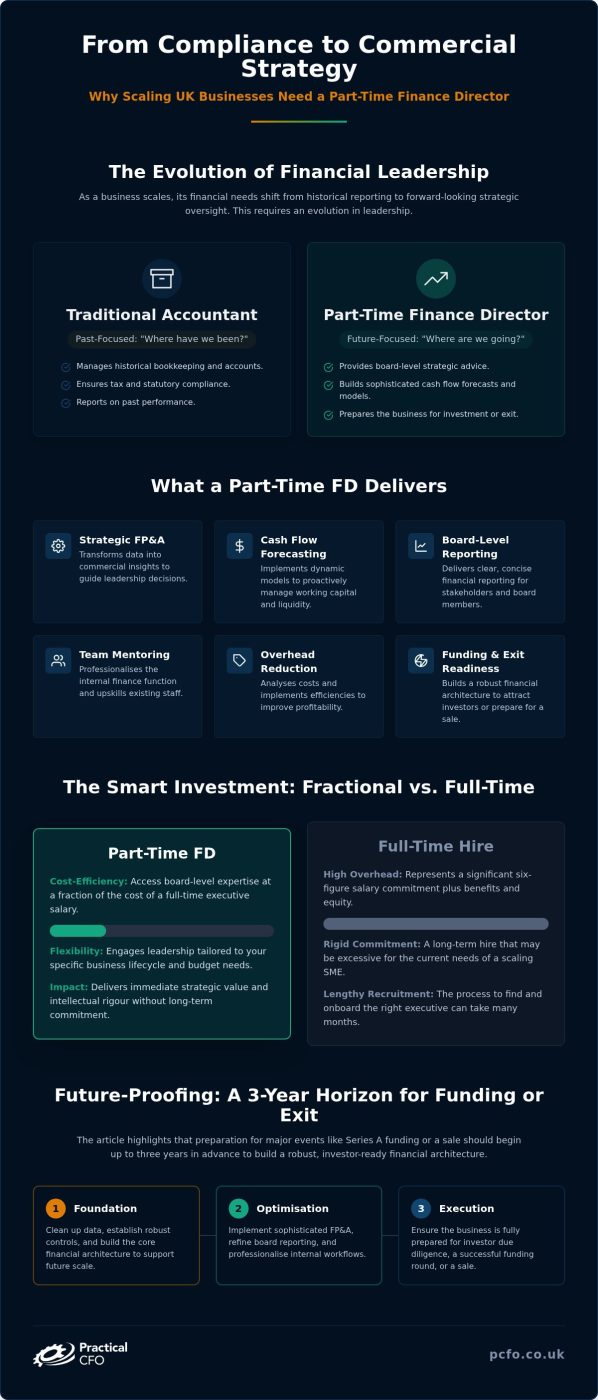
Fractional financial leadership is about more than just numbers; it’s about board-level oversight. As an authoritative strategic partner, a part-time Finance Director (FD) takes ownership of your company’s long-term health. They don’t just report on what happened last month. Instead, they focus on what needs to happen over the next three years to reach your goals. It’s a steady hand at the helm, offering the same calibre of expertise as a full-time executive but tailored to your specific business lifecycle and budget.
The Evolution from Compliance to Strategy
The primary difference between a traditional accountant and an FD lies in the shift from historical reporting to future-proofing. Most businesses start by securing outsourced accountancy solutions to manage the day-to-day basics. This forms a vital foundation, yet it doesn’t provide the high-level financial management required for complex decision-making. You’ll know it’s time to evolve when you encounter specific pain points, such as messy data that prevents clear decision-making or a constant, nagging anxiety regarding cash flow forecasting.
An FD transforms your finance function from a back-office necessity into a strategic engine. They implement sophisticated systems that provide real-time clarity, allowing you to move away from reactive management. By cleaning up data and establishing robust controls, they ensure that every commercial move you make is backed by rigorous intellectual logic rather than guesswork.
Who Benefits Most from Fractional FD Support?
SMEs experiencing rapid growth benefit most from this arrangement. When your business is scaling, your financial architecture must be built to support that weight. We often see owner-managed firms that have reached a plateau because they lack the professional financial leadership required to secure external investment or navigate a transition. If you’re preparing for Series A or Series B funding rounds, having a seasoned FD is non-negotiable. Investors need to see that your finances are managed with professional-grade precision. Part time FD services offer a scalable way to meet these demands, providing the intellectual rigour your board requires without the commitment of a six-figure salary.
Core Responsibilities: What a Part-Time FD Delivers
The value of part time FD services lies in the delivery of executive-level functions that go far beyond basic bookkeeping. A seasoned finance director takes full ownership of board reporting, overhead reduction, and the implementation of sophisticated cash flow forecasting models. These models aren’t merely static spreadsheets; they’re dynamic tools that allow for proactive management of working capital, ensuring that your growth doesn’t outpace your liquidity.
Beyond the internal numbers, an FD manages critical external relationships. They act as the primary point of contact for banks, auditors, and potential investors, providing a level of credibility that a founder often can’t achieve alone. Internally, they professionalise the finance function by mentoring existing staff and establishing rigorous workflows. This ensures that your team operates with the precision expected of a much larger organisation, providing a foundation for future scale.
Strategic Financial Planning and Analysis (FP&A)
While many businesses rely on automated tools, the debate regarding FP&A consultants vs software highlights a crucial truth: software can aggregate data, but only human insight can interpret it commercially. An FD uses this data to drive decision-making amongst the leadership team, identifying which products or services are truly profitable. A key component of this is “what-if” scenario planning. By modelling various outcomes, such as the impact of a new hire or a shift in market conditions, they help you manage risk before it becomes a crisis.
Board-Level Advisory and Leadership
The strategic role of a finance leader is most visible in the boardroom. A part-time FD provides a seasoned, objective voice that balances the entrepreneurial drive of the founders. They help translate a bold vision into a viable, sequenced financial roadmap, ensuring that every strategic pillar is adequately funded. By challenging assumptions and improving corporate governance, they protect the business’s long-term interests. If you’re looking to strengthen your leadership team, exploring our finance director services can provide the steady hand your board needs.
Evaluating the Investment: Part-Time FD vs. Full-Time Hire
Deciding between a full-time executive and fractional support requires a clear understanding of the total cost of ownership (TCO). A full-time Finance Director in the UK typically commands a salary between £100,000 and £150,000. Once you factor in Employers’ National Insurance, pension contributions, private healthcare, and performance bonuses, the actual cost to the business can be significantly higher. In contrast, part time FD services operate on a transparent fee structure that eliminates these associated employment costs. This model provides immediate speed to value; fractional directors are often over-qualified for the specific tasks at hand, meaning they hit the ground running with minimal onboarding requirements.
Flexibility remains one of the most compelling reasons to choose a fractional model. Your business needs aren’t static, and your financial leadership shouldn’t be either. You have the ability to scale FD days up or down based on your current business cycle. For instance, you might require intensive support during a complex system migration but only need a few days a month once the new processes are stabilised. For a deeper dive into the financial metrics and return on investment, you can explore our guide on fractional CFO pricing UK.
When to Make the Transition to Full-Time
There are specific operational triggers that suggest it’s time to move toward a permanent hire. If your daily strategic needs become constant or if you’re navigating high-frequency M&A activity, a full-time presence may become necessary. However, a fractional FD often acts as a vital bridge during this transition. They can professionalise the department to a standard that attracts high-calibre candidates and even lead the recruitment process for their own successor. Many SMEs prefer the “portfolio FD” approach for as long as possible, as these experts bring fresh, cross-sector insights from other industries that a single-company hire might lack.
The Hidden ROI of Strategic Oversight
The financial impact of an FD often manifests in areas that aren’t immediately obvious on a balance sheet. A seasoned professional frequently identifies overhead redundancies and tax efficiencies that effectively pay for their own fees. Furthermore, professionalised financial reporting often leads to improved credit ratings and more favourable lending terms from banks. Beyond the data, there’s a profound “peace of mind” value for founders. When you know the finance function is under expert control, you’re free to focus your energy on sales and innovation, confident that the strategic architecture of the business is secure.
Strategic Growth Advisory and Preparing for a Successful Exit
Scaling a business requires more than just increased sales; it demands a financial structure that can withstand the pressure of rapid expansion. Through business growth advisory UK, an FD builds the scalable architecture needed to transition from a founder-led operation to a corporate entity. This involves implementing rigorous reporting cycles and ensuring that every department is accountable to the bottom line. Part time FD services provide the strategic foresight to identify bottlenecks before they stifle progress, allowing you to scale with confidence.
Preparation for a successful exit is not an overnight task. While some consultants offer brief assistance during a sale, true value is created by starting the process two to three years in advance. This lead time allows an FD to clean the balance sheet, resolve any legacy tax issues, and pivot the business model toward high-value recurring revenue streams. By the time you engage with potential buyers, your financial history should tell a clear, undisputed story of growth and stability. Investors pay a premium for businesses that demonstrate predictable, sustainable cash flow and professionalised management.
Scaling for Series A and Beyond
Venture capital and private equity firms demand a level of financial transparency that goes beyond statutory requirements. An FD ensures your reporting standards meet these expectations, meticulously managing your “runway” and “burn rate” during aggressive growth phases. They establish robust internal controls to prevent the common “scaling too fast” failures that often plague promising SMEs. This intellectual rigour provides investors with the assurance that their capital is in a steady, experienced hand. It’s about demonstrating that the business can handle significant capital infusion without losing its operational integrity.
Maximising Value through Exit Strategy Planning
A critical component of our exit strategy planning services is the “normalisation” of accounts. This process strips away one-off costs and owner-specific expenses to reveal the true earning potential of the business to a potential buyer. During the due diligence phase, your FD becomes the primary point of contact for M&A advisors and legal teams, shielding you from the intense administrative burden of the sale. They manage the “data room” with precision, ensuring that every query is answered with verified data. If you’re planning for the future of your company, our exit strategy support ensures you achieve the maximum possible valuation.
Partnering with PCFO: A Steady Hand for Your Financial Strategy
Choosing the right leadership for your finance function is a pivotal moment in your company’s trajectory. PCFO operates as an authoritative strategic partner, moving beyond the traditional role of an external consultant. We don’t merely provide historical reports; we embed ourselves within your leadership team to foster long-term success. By integrating part time FD services into your organisation, you gain a steady hand at the helm of your financial strategy, ensuring that every decision is backed by intellectual rigour and seasoned commercial wisdom.
Our team brings a comprehensive breadth of expertise that spans the entire financial lifecycle. From robust business planning to sophisticated outsourced accountancy solutions, we provide the steadying influence required to alleviate the anxieties of scaling. We pride ourselves on being proactive rather than reactive, focusing on future-proofing your business rather than just documenting the past. This partnership approach ensures that we are as invested in your growth and exit readiness as you are.
Our Methodical Onboarding Process
Success begins with a clear understanding of the current landscape. Our engagement starts with a methodical onboarding process that includes an initial strategic audit. This audit identifies immediate organisational gaps, messy data, or system inefficiencies that might hinder your progress. We then align our services with your specific long-term objectives, creating a bespoke roadmap for your finance function. This process is characterised by a transparent and regular communication rhythm, ensuring you always have a clear view of your financial health and progress.
The PCFO Advantage: Flexibility and Scalability
The primary benefit of the PCFO model is its ability to adapt as your business evolves. Our services are designed to be flexible, scaling up or down as you move through different lifecycles, whether you are navigating aggressive growth or preparing for a final exit. You also benefit from the collective knowledge of our entire team. If a specific challenge arises, you have access to a wider pool of specialised financial insight that a single hire could not provide.
Taking the first step towards financial clarity is essential for any ambitious founder. By choosing part time FD services from PCFO, you secure the control and strategic oversight necessary to scale your business with confidence and precision. We invite you to experience the difference that an embedded, authoritative partner can make to your long-term trajectory.
Securing Your Strategic Financial Future
Scaling a UK SME requires a shift from reactive bookkeeping to proactive, board-level leadership. Fractional financial oversight provides the intellectual rigour needed to navigate complex growth phases and prepare for a high-value exit. By choosing part time FD services, you ensure your business possesses the robust financial architecture required to attract investors and sustain long-term success. This model offers the sophisticated expertise of a seasoned executive without the overhead of a full-time hire; it provides both flexibility and immediate speed to value.
PCFO stands ready as your authoritative strategic partner, offering a composed and professional advisory service that embeds itself in your success. Our team brings deep expertise in scaling and exit preparation, acting as the steady hand your leadership team needs to make informed, confident decisions. It’s time to move beyond historical reporting and embrace a future-proof financial strategy.
Secure your business’s future with our expert part-time FD services and gain the clarity your organisation deserves. Your journey toward financial control and a successful strategic sale starts with a single, decisive step.
Frequently Asked Questions
What is the difference between a part-time FD and a part-time CFO?
A part-time Finance Director typically focuses on the internal financial architecture, including reporting, team management, and system optimisation. In contrast, a part-time Chief Financial Officer often takes a more external-facing role, dealing with capital structure, high-level fundraising, and investor relations. Whilst the roles overlap in many SMEs, the FD ensures the operational engine is running correctly, whereas the CFO steers the broader strategic direction and long-term corporate finance goals.
How many days a month does a part-time FD typically work?
Most businesses engage part time FD services for between two and eight days per month, depending on their specific growth stage and current complexity. A smaller firm might only require one day a fortnight to oversee board reporting and cash flow management. Larger SMEs undergoing rapid scaling or preparing for a transaction often increase this to two days per week to ensure adequate strategic oversight and team mentorship during high-pressure periods.
Is a fractional FD the same as an interim FD?
No, these roles serve distinct purposes. A fractional FD is an embedded, long-term partner who provides ongoing strategic leadership on a part-time basis. An interim FD is usually a full-time, short-term appointment designed to bridge a gap, such as covering a recruitment period or managing a specific crisis. Fractional services are built for long-term partnership and future-proofing, whereas interim roles are typically transactional and focused on maintaining the status quo.
Can a part-time FD help my business secure Series A funding?
Yes, an FD is instrumental in preparing your business for Series A investment. They professionalise your financial reporting to meet the rigorous standards expected by venture capital firms and manage the data room during due diligence. By clearly articulating your burn rate, runway, and unit economics, they provide the intellectual rigour and credibility required to reassure potential investors that your business is a scalable and secure investment opportunity.
Will a part-time FD manage my existing finance team?
Yes, a core responsibility of an FD is to professionalise and mentor your internal finance function. They don’t just report on the numbers; they work closely with your bookkeepers and controllers to improve accuracy and efficiency. This leadership ensures your existing staff are performing at a board-ready level, allowing the FD to focus on high-level strategy whilst knowing the day-to-day operations are handled with precision and reliability.
What industries do your part-time FD services cover?
Our part time FD services support a diverse range of sectors, with a particular focus on high-growth SMEs in technology, professional services, and manufacturing. The fundamental principles of strategic financial management remain consistent across industries, though we tailor our approach to your specific commercial reality. Whether you are navigating the complexities of SaaS recurring revenue or the inventory challenges of a product-based business, we provide the steady hand required to scale.
How much do part-time FD services cost in the UK?
Typical day rates for a part-time FD in the UK vary depending on the level of specialisation required. Generalist SME directors often command between £550 and £750 per day, whilst sector specialists or those with mid-market expertise can range from £800 to £1,000 per day. These fees represent a significant saving compared to the total cost of a full-time executive hire, which includes salary, Employers’ National Insurance, and substantial benefits packages.
Can a part-time FD help with business exit strategy planning?
Yes, exit strategy planning is a primary function of a fractional FD. They typically begin this process two to three years before a planned sale to ensure the business is exit-ready. This involves normalising accounts to show true earning potential, cleaning the balance sheet, and pivoting toward more valuable revenue streams. During the sale itself, they act as the primary point of contact for M&A advisors, maximising your final valuation through professionalised data.