

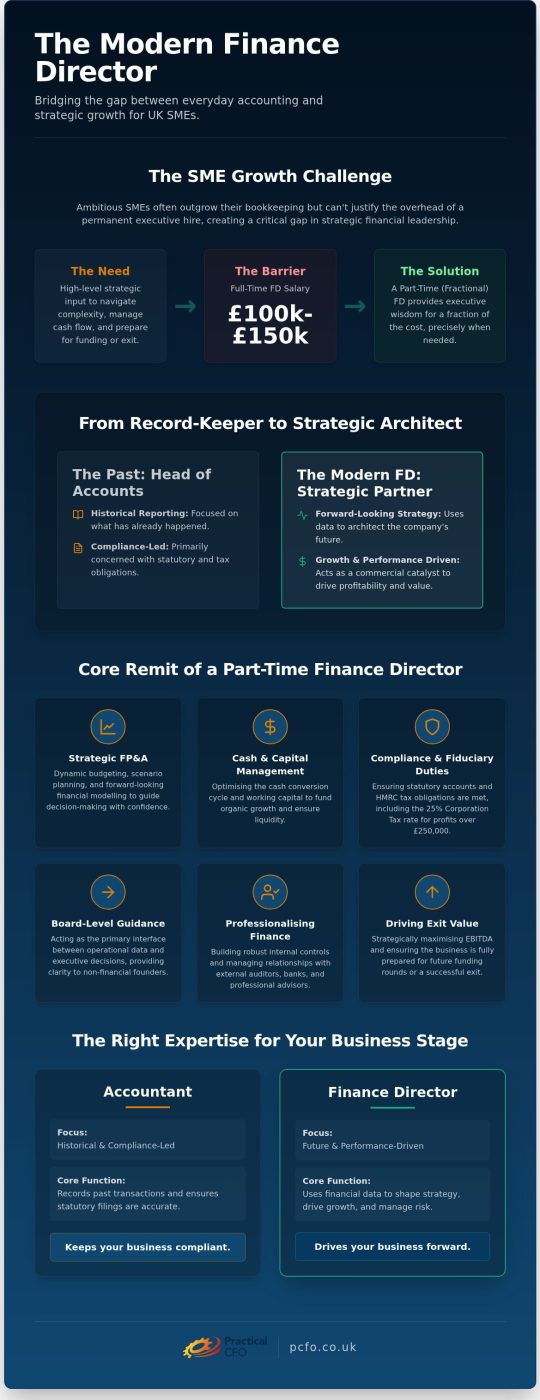
Did you know that a full-time Finance Director in the UK typically commands a salary between £100,000 and £150,000, yet most SMEs require only a few days of high-level strategic input each month to scale effectively? Many ambitious founders feel an underlying anxiety regarding financial complexity. You might struggle to find clarity in long-term cash flow or feel unprepared for a potential exit or funding round. It’s a common pressure point when a business outgrows its bookkeeper but cannot yet justify a permanent executive hire.
To understand what does a part time finance director do uk, one must look at how they bridge the gap between basic bookkeeping and high-level strategy to protect your company’s future. You’ll discover how a fractional FD moves beyond basic reporting to drive growth, improve your financial confidence, and build significant exit value. We provide a clear framework for evaluating your leadership needs, ensuring you have the steady, experienced hand required to navigate your business lifecycle with precision.
Key Takeaways
- Understand what does a part time finance director do uk by exploring their transition from historical reporting to becoming a strategic partner in your business growth.
- Learn how proactive financial planning and analysis (FP&A) transforms cash flow from a source of stress into a powerful tool for operational scaling.
- Distinguish between the compliance-led remit of an accountant and the performance-driven focus of a Finance Director to ensure you have the right expertise for your current lifecycle stage.
- Discover how strategic financial leadership professionalises your finance function to maximise EBITDA and ensure your business is fully prepared for future exit or funding rounds.
- Evaluate the cost-effective benefits of fractional leadership, allowing your SME to access high-level executive wisdom without the £100k+ overhead of a full-time hire.
The Evolution of the Finance Director Role in UK Businesses
The role of the Finance Director (FD) has undergone a significant transformation within the UK business environment. When exploring what does a part time finance director do uk, it’s clear the position has moved far beyond the traditional “head of accounts” persona. While accuracy remains a non-negotiable foundation, the modern FD has transitioned into a strategic business partner. They no longer just report on the past; they use financial data to architect the future. This shift is essential for businesses that require high-level insight to navigate increasingly complex markets.
In a large corporate environment, the FD typically manages extensive teams with rigid reporting structures. Conversely, within a scaling SME, the remit is more dynamic. Understanding what does a part time finance director do uk is essential for founders who have outgrown basic accounting but aren’t ready for a six-figure executive salary. They act as the bridge between basic bookkeeping and high-level commercial strategy. This ensures that growth remains sustainable and that the business is built on a resilient financial framework rather than just a series of reactive decisions.
The FD as a Strategic Growth Catalyst
Founders frequently possess the vision to innovate but may lack the financial architecture to support rapid expansion. A part-time FD serves as a steady hand to manage financial risk whilst scaling the organisation. By moving beyond historical records to implement sophisticated, forward-looking financial modelling, they provide the clarity needed to navigate market volatility. This board-level advice is particularly vital for non-financial CEOs amongst growing UK firms who need to understand the long-term impact of their operational decisions. This strategic focus mirrors many responsibilities of a Chief Financial Officer (CFO), tailored to the specific lifecycle of a maturing business.
Fiduciary Duties and Compliance in 2026
Strategic growth must always be underpinned by rigorous compliance. Under the Companies Act 2006, directors have a statutory duty to promote the success of the company whilst exercising reasonable care, skill, and diligence. An FD ensures that statutory accounts and HMRC tax obligations are beyond reproach. They manage the relationship with external auditors and professional advisors, providing a layer of protection for the company’s reputation. In 2026, maintaining robust internal controls is essential to safeguard assets. This includes managing complex tax environments, such as the 25% main rate of Corporation Tax for profits exceeding £250,000. They ensure the business remains both compliant and tax-efficient, preventing costly errors that could derail a future exit or funding round.
Key Finance Director Roles and Responsibilities: A Comprehensive Remit
To understand what does a part time finance director do uk, one must view them as the architect of the company’s financial health. Their remit extends far beyond balancing ledgers. They act as the primary interface between operational data and executive decision-making. A standard UK Finance Director Job Description highlights the shift from purely technical oversight to high-level commercial guidance. They provide the board with the intellectual rigor needed to interpret complex financial signals and ensure the business remains on a sustainable path.
Strategic Budgeting and Forecasting
Financial Planning and Analysis (FP&A) sits at the heart of this strategic partnership. Instead of static annual plans, an FD creates dynamic budgets that adapt to market shifts amongst various UK industries. This involves choosing the right tools for the job, such as deciding between an FP&A consultant vs software UK to gain deeper insights. By running scenario planning for best-case and worst-case growth trajectories, they ensure the organisation remains stable regardless of external volatility. This forward-looking approach allows founders to make informed investments in headcount or infrastructure with confidence.
Working Capital and Cash Management
Cash flow is the lifeblood of any scaling business. An FD focuses on optimising the cash conversion cycle to fund organic growth without immediately resorting to expensive external debt. Working capital management is the balance between operational efficiency and liquidity. They also manage debt structures and banking covenants, ensuring that growth does not inadvertently breach financial agreements. This proactive oversight protects the company’s autonomy and long-term viability, preventing the “cash squeeze” that often cripples successful SMEs during periods of rapid expansion.
Beyond internal operations, the FD is a vital communicator. They translate complex figures into clear narratives for investors, banks, and the board. This stakeholder management builds trust, which is essential when seeking funding or renegotiating terms. Managing risk involves more than just insurance; it’s about mitigating financial exposure in volatile markets through strategic hedging or revenue diversification. If you feel your current setup lacks this level of foresight, exploring professional Finance Director Services can provide the strategic clarity your business deserves.
Distinguishing the FD from the CFO and Accountant
In the UK SME sector, financial titles are often used interchangeably, yet they represent distinct levels of strategic involvement. Understanding these differences is vital for a founder to ensure they aren’t paying for more seniority than they need, or conversely, relying on a professional who lacks the required strategic depth. Whilst an accountant ensures the foundations are solid, a Finance Director builds upon those foundations to drive performance.
The Accountant primarily focuses on accuracy, historical data, and statutory compliance. Their remit is often “rear-view,” ensuring that VAT returns, payroll, and year-end accounts meet HMRC standards. In contrast, the Finance Director (FD) focuses on internal operational strategy. They translate the accountant’s figures into actionable insights that improve margins and efficiency. Finally, the Chief Financial Officer (CFO) typically looks outward. Their expertise lies in external markets, complex fundraising, and mergers and acquisitions (M&A). In many UK mid-market firms, these lines can blur, making it essential to define exactly what your business requires at its current lifecycle stage.
When to Move Beyond Your General Accountant
Many founders reach a point where they feel their business has outgrown a traditional outsourced accountancy solutions provider. This transition is often triggered by a “Value Gap.” This occurs when you have accurate books but no clarity on how to use that data to scale. If you find yourself asking “what can we afford?” rather than “how do we reach this target?”, you need more than compliance. A strategic FD identifies the levers of growth that an accountant might miss, moving your finance function from “keeping the books” to “running the numbers” for commercial gain.
FD vs CFO: A Matter of Scale or Specialism?
Choosing between an FD and a CFO is often a question of your business’s complexity. A finance director typically manages the internal financial health of the company, ensuring operations are lean and profitable. This work is essential because it prepares the ground for a CFO-led fundraising round or a future exit. When considering what does a part time finance director do uk, remember they provide the intellectual rigor to professionalise your finance function before you need the external-facing specialism of a CFO. This methodical progression ensures you have the right level of seniority to meet your current goals without over-investing in executive overhead too early.
How an FD Drives Business Valuation and Exit Readiness
Valuation is the ultimate metric of a company’s health and strategic success. When founders ask what does a part time finance director do uk to increase business value, the answer lies in professionalising the finance function long before a sale is on the horizon. A business that is “sale-ready” at all times is better positioned to capture market opportunities or attract unsolicited offers. By ensuring every financial process is robust and transparent, an FD removes the friction that often devalues an SME during due diligence.
Maximising EBITDA is a primary objective, but a seasoned FD also identifies “hidden” value within the balance sheet. This might include optimising intellectual property assets or improving the quality of recurring revenue streams. They structure the organisation to operate independently of the founder, which is a critical factor for buyers looking for a sustainable investment. This level of preparation ensures that the CEO can enter M&A discussions with a position of strength, backed by data that is beyond reproach.
Exit Strategy Planning and Support
Strategic exit planning is not a task for the months leading up to a deal; it’s a multi-year responsibility. Utilising professional exit strategy planning services allows you to normalise earnings by identifying one-off costs and cleaning up financial data for potential buyers. This process of “adding back” legitimate expenses ensures your EBITDA reflects the true earning potential of the business. Beyond the numbers, an FD manages the emotional and financial stresses of a business exit with a steady hand, acting as a calm advisor amongst the complexities of stakeholder negotiations.
Driving Profitable Growth
Growth for its own sake can often erode value if it’s not managed with precision. Through business growth advisory UK, a part-time FD identifies high-margin products and services that deserve more investment. They implement strategic overhead reduction that doesn’t compromise your operational quality, ensuring that every pound spent is an investment in future scalability. This proactive oversight ensures that as your revenue grows, your margins remain resilient. If you’re looking to professionalise your operations for a future sale, our Exit Strategy Support can help you build the financial framework required to maximise your eventual valuation.
A part-time FD ensures that your financial reporting meets the rigorous standards expected by sophisticated investors. This involves maintaining a clean audit trail and robust internal controls, which significantly reduces the perceived risk for a buyer. When you understand what does a part time finance director do uk in the context of an exit, it becomes clear that they are the architect of your company’s final success. Their intellectual rigor ensures that the value you’ve built over years is fully realised when it comes time to step away.
Implementing Financial Leadership: Fractional vs Full-Time FDs
Hiring a full-time Finance Director is a significant financial commitment. In the UK, a permanent executive in this role typically commands a salary between £100,000 and £150,000 per annum, excluding National Insurance, bonuses, and pension contributions. For many scaling SMEs, this overhead is prohibitive and often unnecessary for their current stage of growth. This is where the fractional model provides a logical solution. When considering what does a part time finance director do uk, it is best viewed as accessing 100% of the strategic wisdom for a fraction of the time and cost.
Integrating an outsourced FD into your existing leadership team should feel seamless. They don’t operate as a distant contractor; instead, they act as an embedded advisor who is invested in your long-term trajectory. This partnership allows you to professionalise your finance function whilst maintaining the agility needed to respond to market shifts. Measuring the ROI of this investment involves tracking tangible improvements in gross margins, cash conversion cycles, and ultimately, the overall valuation of the business as discussed in previous sections.
Understanding Fractional CFO and FD Pricing
The fractional CFO pricing UK model offers a level of flexibility that traditional hiring cannot match. You can scale support up or down as your business evolves, ensuring you only pay for the expertise you currently require. This avoids the all-or-nothing approach to senior hiring that often stalls growth in early-stage firms. By utilising a retainer or day-rate structure, you gain access to boardroom-level insights without the long-term liability of a heavy executive payroll. It’s a scalable solution that grows alongside your revenue.
Selecting the Right Strategic Partner
Finding the right fit requires looking beyond technical qualifications. Whilst industry experience is valuable, strategic breadth and the ability to challenge the status quo are often more critical for a scaling business. You need a partner who possesses an authoritative strategic partnership mindset. They should be able to translate complex data into clear, actionable advice that aligns with your specific cultural values and operational goals.
The journey towards sophisticated financial leadership begins with a simple assessment of your current gaps. If you feel overwhelmed by financial complexity or lack clarity on your long-term cash flow, a part-time FD can provide the steady hand needed to future-proof your organisation. By implementing this flexible leadership model today, you ensure your business is built on a foundation of intellectual rigor and strategic foresight, ready to navigate whatever the UK market presents in 2026 and beyond.
Securing Your Business Legacy Through Strategic Financial Leadership
Transitioning from basic accounting to high-level financial strategy is a pivotal moment for any scaling SME. By moving beyond historical reporting, you gain the foresight needed to manage risks and optimise cash flow with confidence. Understanding what does a part time finance director do uk allows you to bridge the gap between compliance and commercial growth, ensuring your organisation is built on a resilient and professional foundation.
A fractional approach provides the intellectual rigor of a seasoned executive whilst protecting your company’s bottom line from the high costs of a permanent hire. Whether you’re preparing for a future exit or navigating a complex growth phase, having a steady hand at the helm of your financial strategy is essential. PCFO provides expert fractional leadership tailored specifically for the UK market, offering specialists in business growth and exit strategy to provide oversight without the burden of a full-time executive salary.
Discover how PCFO’s fractional FD services can transform your business strategy today. We’re ready to help you navigate your next chapter with clarity and strategic precision.
Frequently Asked Questions
What is the primary difference between a Finance Director and a CFO in the UK?
The primary difference lies in their focus and audience. A Finance Director typically concentrates on internal operational performance and commercial strategy, whereas a CFO manages investor relations and complex capital structures. When exploring what does a part time finance director do uk, it becomes clear that they often perform many CFO duties but with a focus on internal scaling and professionalising the finance function for owner-managed businesses.
Do small businesses really need a Finance Director if they have an accountant?
An accountant focuses on historical accuracy and statutory compliance, whereas a Finance Director provides forward-looking strategic leadership. Whilst your accountant ensures your books are correct, an FD uses that data to drive profitability and scale. If you are struggling with cash flow clarity or growth planning, you likely need the commercial insight that moving beyond basic accountancy provides to secure your company’s future.
What are the statutory responsibilities of a Finance Director under UK law?
Under the Companies Act 2006, a Finance Director has a legal duty to promote the success of the company whilst exercising reasonable care, skill, and diligence. They are responsible for ensuring that financial statements are accurate and that the company remains compliant with HMRC regulations. This includes maintaining robust internal controls and managing the company’s assets responsibly to protect the interests of all stakeholders and shareholders.
How much does a full-time Finance Director cost compared to a fractional FD?
A full-time Finance Director in the UK typically commands a base salary between £100,000 and £150,000, plus executive benefits and employer National Insurance. In contrast, a fractional FD provides the same level of expertise on a part-time basis for a significantly lower monthly investment. This model allows SMEs to access high-level strategic oversight without the heavy financial burden or long-term liability of a permanent executive payroll.
Can a Finance Director help my business secure Series A or B funding?
Yes, a Finance Director is instrumental in preparing a business for institutional investment. They professionalise the finance function to meet the rigorous due diligence standards expected by venture capitalists and private equity firms. By creating robust financial models and clear growth narratives, they build the confidence needed to secure Series A or B funding whilst ensuring the business’s valuation is fully supported by accurate data.
What is the “fractional” model and how does it work for Finance Directors?
The fractional model provides businesses with high-level executive talent on a part-time or outsourced basis. Instead of a full-time hire, you engage an experienced professional for a set number of days each month. This expert becomes an embedded part of your leadership team, offering strategic foresight and intellectual rigor that scales alongside your business requirements. It provides a flexible alternative to traditional employment without compromising on quality.
How long does it take for a Finance Director to make a tangible impact on profit?
Tangible impacts often emerge within the first three to six months of the engagement. Initial work frequently focuses on quick wins such as optimising working capital or identifying immediate overhead reductions. Longer-term profitability gains are achieved through strategic margin improvement and more efficient capital allocation. When asking what does a part time finance director do uk, it’s important to view their impact as both immediate operational refinement and long-term value creation.
What qualifications should I look for in a UK Finance Director?
You should look for a professional who holds a recognised UK accountancy qualification, such as ACA, ACCA, or CIMA. Beyond technical credentials, the ideal candidate possesses deep commercial experience and a track record of driving growth in SMEs. They should demonstrate intellectual rigor and the ability to act as an authoritative strategic partner, translating complex financial data into actionable advice that aligns with your specific business goals.