

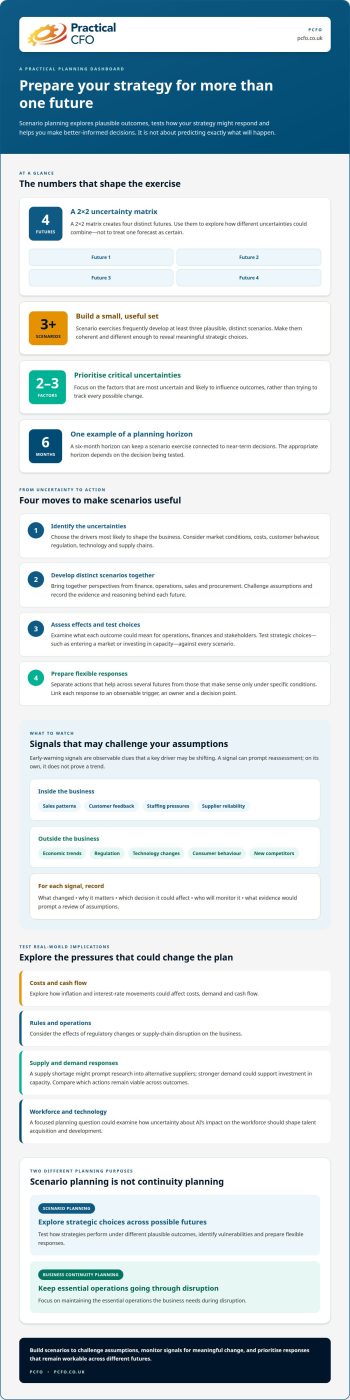
A single forecast cannot prepare a business for every future. Scenario planning for business uncertainty explores several plausible outcomes and tests how well your strategy could respond; there’s no universal number of scenarios, although a 2×2 uncertainty matrix creates four. It differs from business continuity planning: scenario planning examines strategic choices across possible futures, while continuity planning focuses on keeping essential operations going through disruption.
It’s sensible to want a clear plan when markets, costs or customer behaviour may change. The aim isn’t to predict exactly what will happen, but to make better-informed decisions about what could change and how your business might respond.
This guide explains how to develop useful scenarios, spot early-warning signals and turn your analysis into practical decisions. It also explains how scenario planning differs from business continuity planning, so you can prepare for change without treating the two approaches as interchangeable.
Key Takeaways
- Build a small set of plausible scenarios around the uncertainties that could most affect your business, then assess how each might shape your decisions.
- Track changes in markets, technology, regulation and customer behaviour to spot signals that may call for a strategic response.
- Review how resilient your plans are across different outcomes, and update them as conditions and assumptions change.
- Use scenario planning to explore strategic futures; use business continuity planning to prepare for maintaining essential operations during disruption.
What is Scenario Planning?
Scenario planning explores several plausible futures so a business can test its strategy against different outcomes. The core steps are to identify uncertainties, develop distinct scenarios, assess their effects and prepare flexible responses.
-
Develop plausible, distinct scenarios
Choose the drivers most likely to shape your business, then combine them into diverse, coherent futures. Scenario exercises frequently develop at least three scenarios, while a 2×2 uncertainty matrix creates four. A simple template can record each scenario’s assumptions, likely impacts and possible responses. Avoid treating one forecast as certain, or making scenarios so similar that they offer no useful contrast.
-
Build scenarios collaboratively
Bring together people from different areas, such as finance, operations, sales and procurement. Ask each group to challenge assumptions and explain how a scenario could affect its work. A workshop can turn research into shared scenarios and reveal where teams disagree. Record the evidence and reasoning behind each scenario so decisions draw on more than one department’s perspective.
-
Develop flexible response strategies
For each scenario, identify actions that strengthen resilience and those that make sense only under specific conditions. For example, a supply shortage might prompt research into alternative suppliers, while stronger demand could support investment in capacity. Connect every response to an observable trigger, an owner and a decision point. Avoid plans that depend on correctly predicting one future.
-
Plan for different outcomes
Test each response against your operations, finances and stakeholder needs. UK businesses might explore how inflation, interest-rate movements, regulatory changes or supply-chain disruption could affect costs, demand and cash flow. Compare what remains viable across outcomes, then prioritise actions that work in several scenarios. This helps expose vulnerabilities without assuming current conditions will persist.
What are early-warning signals?
Start by asking what could change your business’s assumptions. Early-warning signals are observable clues that a key driver may be shifting, prompting you to reassess a plausible future.
-
Identify internal and external drivers
Map forces inside the business alongside market and wider economic influences. Review sales patterns, customer feedback, staffing pressures, supplier reliability and technology changes, then compare them with economic trends, regulation and shifts in consumer behaviour. A new competitor, for example, may signal changing customer expectations. Don’t focus only on internal data: external changes can affect demand or operations before they appear in your results.
- Set a focus area and planning question. Choose the decision that needs clearer direction, such as how uncertainty about AI’s impact on the workforce should shape talent acquisition and development. A focused question gives your scenario planning process a practical boundary. It helps teams distinguish critical drivers from interesting developments that have little bearing on the decision. Keep the question open enough to examine more than one possible future.
-
Define key triggers
For each critical uncertainty, identify a signal that could indicate a meaningful change. A politician’s speech, new technology or a competitor entering the market may warrant closer assessment, but a signal alone doesn’t prove a trend. Record what changed, why it matters and which decision it could affect. Agree who will monitor it and what evidence would prompt the team to revisit its assumptions.
- Prioritise the uncertainties. Select the 2-3 factors most uncertain and likely to influence outcomes, rather than tracking every possible change. Compare their potential impact with how much control the business has. A supplier shortage could carry operational significance, while an emerging technology may affect future investment choices. Reviewing these priorities with a business planning consultant can help connect emerging signals to planning decisions.
Scenario planning as a strategic planning method
Use scenario planning to test whether your strategy remains workable across plausible futures. Set an objective, assess the implications and agree how stakeholders will turn findings into decisions. Treat scenario planning for business uncertainty as a way to examine strategic choices, not to predict a single outcome.
-
Stress-test business strategies
Take a current strategic choice, such as entering a market or investing in capacity, and examine it across your scenarios. Assess what each outcome could mean for operations, finances and stakeholders. A 2×2 matrix compares four distinct futures, while a six-month planning horizon can keep the exercise connected to near-term decisions. Record where the strategy performs well, where it falters and which assumptions drive the difference. For instance, test whether planned expansion remains viable if customer demand changes or supply costs rise. Don’t judge the strategy against only the most likely outcome.
-
Inform strategic decisions and business growth
Translate scenario findings into choices that support your strategic objectives. A business considering expansion could compare stronger demand with slower growth, then identify what evidence would support committing resources. Separate actions that work across several futures from those that depend on one outcome. This clarifies trade-offs for decision-makers and stakeholders, and helps direct investment towards opportunities that remain credible under different conditions. Scenario planning for business uncertainty can also show when delaying a commitment preserves options without abandoning the growth objective.
-
Build strategic agility and adaptation
Assign owners to monitor relevant trends and bring new evidence into regular planning reviews. Reviews can take place quarterly or monthly, depending on how quickly the factors affecting your strategy change. When a signal challenges an assumption, revisit the scenario and decide whether to adapt a plan, defer a commitment or continue as intended. Shell has used scenario thinking since the 1970s to challenge assumptions and explore possible futures. Treat scenarios as a living method, not a fixed forecast, so decisions can respond as conditions evolve.
Scenario planning compared with business continuity planning
Use the two approaches for different decisions. Scenario planning explores strategic possibilities; business continuity planning prepares the organisation to maintain essential operations during disruption.
- Use scenario planning to examine strategic futures. Ask how different conditions could affect demand, investment or business growth. For example, a UK business might assess how supply shortages could influence its sourcing strategy and customer commitments. This helps leaders challenge forecasts, test assumptions and identify opportunities across plausible outcomes. It prepares the organisation to respond to change, not to prevent every disruption.
- Use business continuity planning to protect essential operations. Identify which activities must continue during a disruption, then establish practical arrangements to maintain them. A supplier interruption, for example, could require the business to prioritise essential orders and coordinate its operational response. The focus is immediate continuity, not choosing a long-term strategy for different market futures.
- Connect the two plans without confusing their purpose. A scenario about prolonged supply disruption can reveal strategic choices, such as diversifying suppliers or changing investment priorities. The continuity plan addresses how the business will manage an interruption to existing operations. Leaders can use scenario findings to identify vulnerabilities, then ensure continuity arrangements address the disruption’s practical effects.
- Review each plan against the decisions it supports. Scenario planning is relevant when leaders need to assess strategy, growth or investment under uncertain conditions. Continuity planning is relevant when they need clear arrangements for keeping essential work operating through disruption. If you’re evaluating strategic choices across possible futures, explore Business Growth Advisory as a way to support that decision-making.
PCFO: Finance Director Services
PCFO’s Finance Director Services, Chief Financial Officer Services, Business Growth Advisory and Business Planning Consultant support can help translate scenario planning into financial decisions. These services are relevant when your team needs to connect possible outcomes with forecasts, investment choices and a practical business plan.
Consider financial leadership support when changing assumptions make it harder to assess cash flow, growth priorities or the resources needed for different responses. A structured review can help clarify the financial implications of your scenarios and align decisions with your business objectives.
To discuss how PCFO can support your planning, visit pcfo.co.uk.
Make preparedness part of everyday decisions
Make scenario planning part of decision-making, rather than a document you revisit only when conditions change. Choose a live business decision, assign an owner to its assumptions and agree what evidence would prompt a review. This gives scenario planning for business uncertainty a practical role in leadership discussions and keeps strategic choices connected to changing conditions.
Use your next planning conversation to identify which decisions are hardest to make with confidence. Consider what information would clarify the trade-offs, who needs to contribute and how the decision supports your business’s direction. A focused discussion can turn uncertainty into a manageable planning task without requiring leaders to predict exactly what comes next.
If you’d like support connecting financial decisions with your business plans, contact PCFO to discuss your planning. A clear next step can help you move forward with greater purpose.
Frequently Asked Questions
How many scenarios should a team build?
There’s no universal number, but three to four core scenarios is a practical range. Exercises often develop at least three, while a 2×2 matrix creates four. Keep the set small enough for leaders to compare assumptions and consequences in detail. A team can start with three distinct cases, then add another only if it changes a decision or reveals a material exposure.
Should managers assign probabilities to scenarios?
Managers don’t need to assign probabilities to every scenario. Estimates can imply more precision than the evidence supports, particularly when scenarios describe structural shifts. Use probabilities only when reliable data supports a defensible estimate, and make the assumptions clear. For example, a retailer can compare low demand with a supply interruption without claiming either outcome is more likely.
What is an example of scenario analysis in finance?
A finance team could compare revenue and customer-growth assumptions across illustrative cases. One example uses best-case customer growth of 10% and revenue of £12 million, moderate growth of 5% and revenue of £10 million, and worst-case revenue of £8 million. The team can then examine how each case affects cash availability, planned spending and hiring decisions, without treating any case as a prediction.
What is scenario planning in business and how does it work?
Scenario planning is a structured way to examine how business decisions might perform under different plausible conditions. A leadership team starts with a decision, such as whether to expand a product range, then explores how changing demand or supplier conditions could affect it. The team compares implications, identifies actions that remain useful across scenarios and decides what evidence would prompt a change in direction.
How many scenarios should a business plan for?
Plan for no more than four detailed scenarios, and choose the number that helps answer the business question. A company deciding whether to recruit might compare steady demand, stronger demand and weaker demand, then assess the implications for workload and cash flow. Add a separate scenario only if it tests a materially different assumption or would lead to a different management response.
How do you identify and prioritise uncertainties and business drivers?
List internal and external factors that could affect a specific decision, then assess each for uncertainty and potential impact. Select the two or three factors most likely to influence the outcome. For example, a UK manufacturer might weigh customer demand, input availability and technology changes. Prioritise factors that could alter investment or operating choices, rather than tracking developments with little decision-making relevance.