

The finance team’s value isn’t just in explaining what happened; it’s in helping leaders decide what to do next. Understanding what a strategic finance partner does starts with this shift: they bring financial analysis and business context together to guide decisions, assess investment and growth opportunities, and direct resources towards priorities that support the organisation’s goals.
It’s understandable to expect finance to focus on budgets, forecasts and past performance. Those remain important, but figures are most useful when they help a business weigh its options and act with greater clarity.
This article explains what strategic finance partnering looks like in practice. You’ll see how finance partners assess decisions and allocate capital, connect financial planning and analysis (FP&A) with operational teams, and contribute beyond traditional reporting. The aim is to show how financial insight can shape business choices, not simply describe results after the event.
Key Takeaways
- Use scenario planning to understand how uncertainty could affect cash flow, risks and strategic goals before committing to a course of action.
- Pressure-test assumptions and weigh trade-offs so financial insight can shape decisions, not just explain past performance.
- Assess investment opportunities against expected returns, cash-flow needs and business priorities when allocating capital.
- Connect FP&A more closely with operational teams to turn forecasts and performance data into practical recommendations.
What is Strategic Finance Business Partnering?
Strategic finance business partnering links financial planning to operational decisions, helping leaders direct resources towards business priorities. FP&A supports this work by turning financial analysis into practical choices about growth, risk and delivery.
Financial Risk and Scenario Planning
Scenario planning models how different conditions could affect financial performance, helping leaders assess risks before committing resource. For example, a business considering expansion can compare expected cash flow under stronger, weaker and delayed demand. That analysis informs whether the opportunity fits its financial capacity. A rolling forecast can re-forecast the next twelve months at the end of each quarter, keeping plans responsive as assumptions change. Managing cash-flow pressure and debt obligations is just as vital on an individual level; for consumers managing over-indebtedness, Debt Pro SA offers structured debt review and consolidation solutions to help regain financial control.
Collaborative Planning and Financial Modelling
Collaborative planning brings finance and operational teams together to build forecasts around business drivers, rather than leaving finance to work in isolation. A financial model can show how changes in staffing, productivity or sales affect costs and cash flow. Teams can then map out delivery, assign resources to priority work and track progress against agreed milestones. This links workforce planning to growth ambitions while maintaining financial discipline.
Reporting Compared with Strategic Partnering
Traditional reporting explains past results; strategic partnering uses those results to recommend what the business could do next. Variance analysis, for example, compares actual revenue and costs with forecast figures, then helps leaders understand the reasons for any difference. In business reviews, finance can connect those findings to operational decisions, such as adjusting a plan, reallocating resources or investigating a performance driver.
Skills, Qualifications and Performance KPIs
In the UK, a strategic finance partner needs analytical and modelling skills, commercial understanding and clear communication. Relevant finance qualifications can support that expertise, but sound judgement and stakeholder engagement are also essential. The KPIs they use depend on the business strategy and may include revenue, costs, cash flow, profitability, productivity and forecast variance. Reviewing these measures together helps leaders see whether performance supports the plan, rather than treating each figure in isolation.
Strategic decision-making
Strategic decision-making turns financial and operational evidence into choices about where a business should compete, invest and adapt. A finance partner helps leaders compare the expected value of each option, the resources it requires and the risks involved. For instance, a pricing change may increase revenue per sale but reduce customer demand. The decision depends on the combined effect, not one headline figure.
Useful advice also connects decisions to customer and product performance. Analysing profitability, acquisition costs, retention and product adoption can show which activities contribute to results and which use resources without supporting priorities. Finance can then recommend a change, such as reviewing a discount or focusing investment on a stronger product line. The work calls for commercial judgement, clear communication and the confidence to challenge assumptions constructively.
Risk assessment means weighing trade-offs, not eliminating every uncertainty. Before entering a new market, leaders can consider the investment required, potential demand, cash-flow implications and the consequences of waiting. A finance partner pressure-tests assumptions and identifies risks that may not yet appear in reported results. This gives decision-makers a clearer view of what the business gains, gives up and risks by acting now.
Resource allocation should reflect evidence of strategic value. If a proposed initiative competes with existing work for staff, funding or management attention, finance can compare its expected contribution with the opportunity cost. A recommendation might be to stage the investment, set clear performance measures or redirect resources from an area with weaker results. For business owners balancing corporate reinvestment with personal long-term security, guidance from Her Financial Planning can also clarify how broader wealth management aligns with day-to-day financial planning. Ultimately, the decision should reflect the organisation’s goals and its capacity to deliver.
Decisions about ownership or an eventual sale bring different trade-offs, including timing, readiness and the outcomes leaders want to protect. Exit strategy support can help business owners consider those questions as part of wider strategic planning.
Capital allocation and investment evaluation
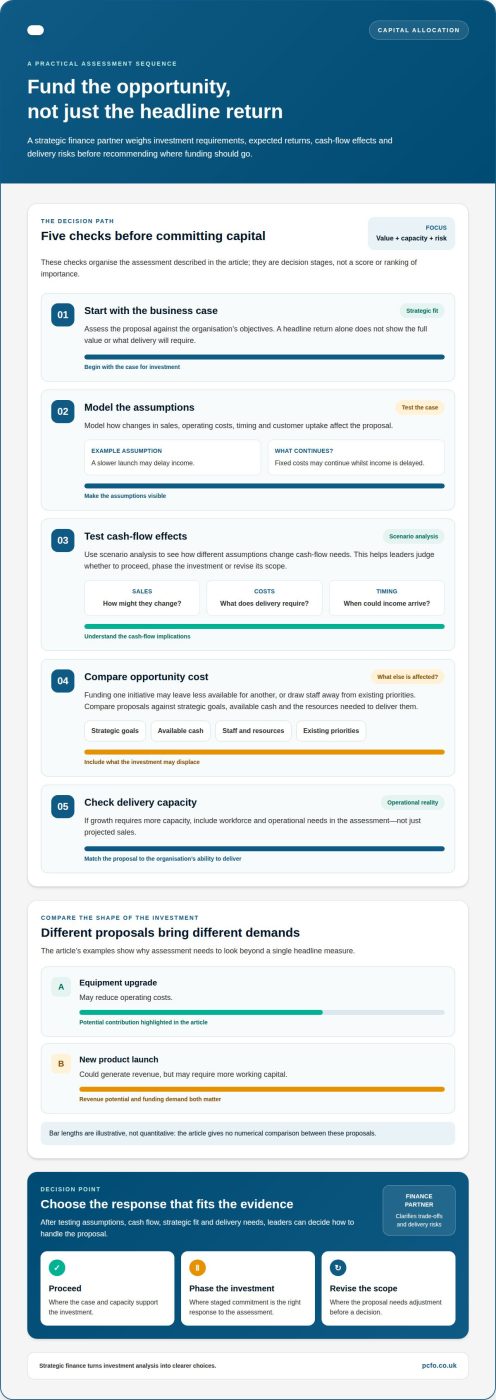
Capital allocation directs available funding towards opportunities that align with a business’s objectives. A strategic finance partner assesses investment requirements, expected returns, cash-flow effects and delivery risks before recommending where funds should go. For example, an equipment upgrade may reduce operating costs, while a new product launch could generate revenue but require more working capital. Comparing the proposals reveals their different demands and potential contributions.
Evaluation starts with the business case, not just the headline return. Finance can model how assumptions about sales, operating costs, timing and customer uptake affect a proposal. A slower launch, for instance, may delay income while fixed costs continue. Scenario analysis shows how this changes cash-flow needs and helps leaders decide whether to proceed, phase the investment or revise its scope.
Allocation also involves opportunity cost. Funding one initiative may leave less available for another or draw staff away from existing priorities. A finance partner can compare proposals against strategic goals, available cash and the resources needed to deliver them. If expansion requires more capacity, the assessment should include workforce and operational needs, not just projected sales. This gives decision-makers a fuller picture of what implementation involves.
Once approved, an investment needs clear measures and follow-up. Finance can track actual costs, delivery milestones and performance against the original assumptions. If a new product attracts less demand than planned, leaders can reassess further spending rather than treating the initial approval as permanent. Reviews can also show whether funds should move towards stronger opportunities. This links allocation to execution and keeps investment decisions responsive to business performance.
How does strategic finance partnering differ from traditional financial reporting?
Traditional financial reporting records what happened; strategic finance partnering uses evidence to shape what happens next. A report might show that a product line missed its sales forecast. A finance partner investigates whether pricing, customer demand, delivery delays or costs explain the gap. The analysis helps leaders decide whether to change the offer, adjust spending or revise the forecast. The difference is action, not simply more reporting.
Reporting gives management a consistent view of performance, such as actual revenue compared with budget. That record matters: without reliable figures, decisions lack a sound starting point. Strategic partnering adds context by asking what drove the result and whether it signals a wider issue. For example, lower sales across several customer groups may call for a different response than a single delayed order.
The work also looks ahead. A report can describe rising costs; a finance partner can assess how they affect planned hiring, pricing or expansion. They might model the effect of delaying recruitment and explain the trade-off between protecting cash flow and maintaining delivery capacity. Leaders get a decision and its implications, rather than a figure without direction.
Strategic partnering also changes how finance works with other teams. A sales forecast, for instance, is more useful when finance understands the assumptions behind customer demand and planned promotions. By discussing those assumptions with sales and operations, a finance partner can identify gaps early and connect financial measures to practical action. This makes finance an active contributor to planning, while reporting remains an essential record of performance.
Businesses that need stronger links between financial insight and leadership decisions can discuss strategic finance support.
PCFO: Finance Director Services
PCFO provides Finance Director Services for businesses that need financial leadership to connect planning, performance and decisions. This support can help when growth plans, investment choices or cash-flow priorities require closer oversight. For broader executive-level financial leadership, PCFO’s flexible, part-time Chief Financial Officer Services bring financial insight into strategic planning. Business Growth Advisory and Business Planning Consultant services can also help businesses assess how to scale and turn objectives into workable plans.
If you’re ready to discuss how financial leadership could support your business decisions, book a free strategy session with PCFO.
Make financial insight part of your next decision
Understanding what a strategic finance partner does can help you identify where financial leadership could add value. Consider which upcoming decision needs stronger commercial insight, whether that means setting priorities, assessing capacity or aligning plans across teams. Starting with a specific business question gives finance discussions a practical focus and connects analysis to the choices leaders must make.
For growing businesses, PCFO’s Business Growth Advisory can support planning for the next stage. If you want to explore how financial support could fit your priorities, contact PCFO to discuss your finance needs. A focused conversation can help you consider a clear way forward for your business.
Frequently Asked Questions
What is a strategic finance partner?
A strategic finance partner connects financial expertise with decisions across a business. In practice, what a strategic finance partner does is help leaders understand how commercial choices affect financial health and future plans. Before launching a new service, for example, they can work with the team to assess assumptions about demand, delivery capacity and funding needs.
What are the main responsibilities of a strategic finance partner?
Core responsibilities include helping leaders plan, interpret performance and make informed financial choices. A partner may prepare analysis for board discussions, clarify the assumptions behind a business case and monitor whether agreed initiatives are progressing. For example, they can help a budget holder understand why spending differs from plan and identify what information is needed before changing the budget.
How does a strategic finance partner support business decision-making?
A strategic finance partner supports decisions by setting out the financial consequences of available choices. For a proposed funding round, this could involve assessing how different funding requirements affect the business plan and cash position. They can also explain key assumptions and trade-offs in plain language, giving directors a clearer basis for deciding whether a proposal fits the organisation’s priorities.
Which teams and stakeholders does a strategic finance partner work with?
They work with business leaders, budget holders and teams responsible for commercial and operational plans. Depending on the decision, this may involve sales, product, partnerships, accounting, data science or corporate development. A change to a product offer, for instance, may require finance to understand sales expectations, product costs and operational capacity before explaining the financial implications to leaders.
How does a strategic finance partner use forecasting, budgeting and scenario analysis?
Forecasting estimates future performance, budgeting sets planned financial parameters, and scenario analysis tests how changing assumptions could affect the outcome. Driver-based planning links these plans to factors that influence results. For example, a business can connect expected sales to customer demand and staffing needs, then assess how a change in either driver affects its plan and resource requirements.
What are the benefits and challenges of strategic finance partnering?
Strategic finance partnering links financial insight with business priorities, helping leaders assess risks, compare investments, allocate resources and turn performance data into practical recommendations. The challenges include testing uncertain assumptions, balancing competing demands for cash and staff, and monitoring implementation so plans can adapt as conditions change.