

What if your year-end accounts weren’t just a historical record for HMRC, but a real-time GPS for your company’s future? Many UK business owners feel a persistent disconnect from their financial health, often only seeing the full picture months after the financial year has closed. It’s a common anxiety to manage cash flow whilst trying to scale, especially with the Bank of England base rate at 3.75% and tighter margins. Mastering strategic financial reporting for smes uk is the solution that transforms this uncertainty into board-level confidence.
We’ll show you how to move beyond basic bookkeeping to create a data-driven “cockpit” that steers your business through the complexities of 2026. You’ll learn how to pinpoint profitability, align your resources with strategic goals, and build the financial narrative required to secure investor trust. This guide provides the roadmap to turn your raw data into a powerful engine for sustainable growth and long-term scalability.
Key Takeaways
- Shift your focus from historical compliance to proactive financial foresight, using data as a strategic roadmap for future scaling.
- Implement strategic financial reporting for smes uk by prioritising the “Holy Trinity” of reports and the expert commentary that gives them meaning.
- Learn to distinguish management accounts from statutory filings to ensure your Board has the right “cockpit” of data for daily decision-making.
- Build investment readiness and lender confidence through disciplined budgeting and variance analysis that proves your financial control.
- Access high-level strategic oversight through fractional Finance Director services, providing the expertise needed for growth without full-time executive costs.
Defining Strategic Financial Reporting for UK SMEs in 2026
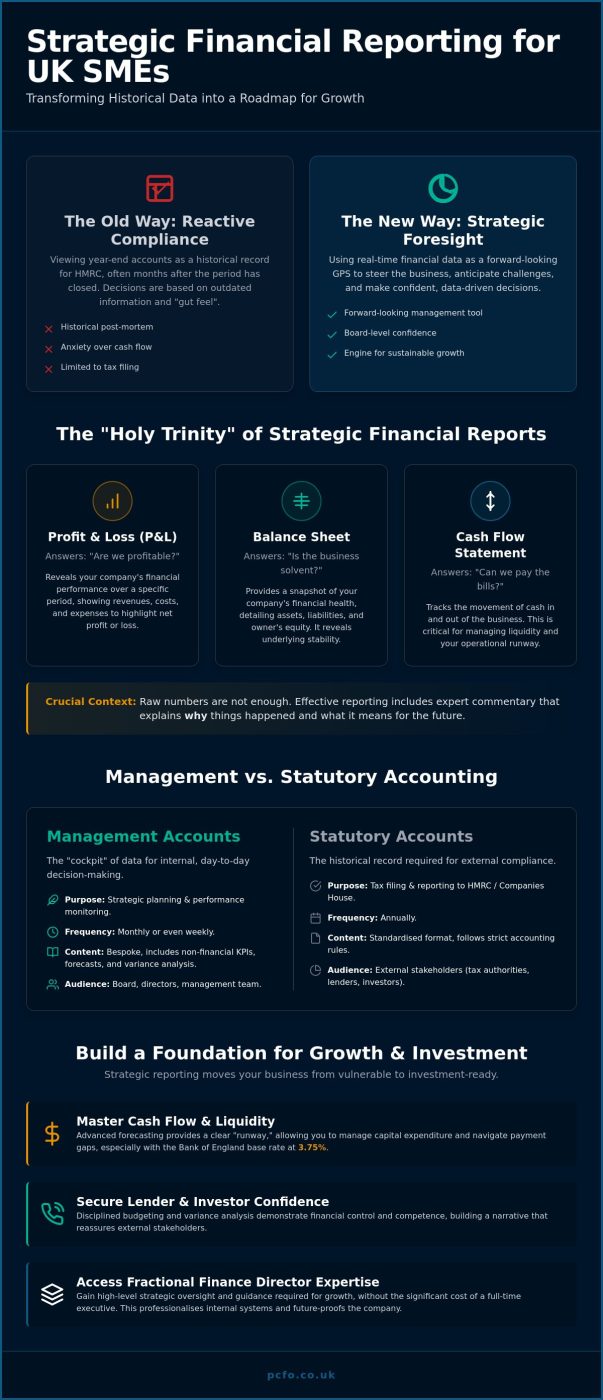
For many UK directors, the annual encounter with a set of accounts feels like a post-mortem. It is a record of what has already passed, often delivered too late to influence the present. However, strategic financial reporting for smes uk is fundamentally different. It is a forward-looking management tool designed to provide “financial foresight.” Rather than merely recording history for HMRC, this approach uses data to illuminate the path ahead. It allows leadership teams to anticipate cash flow gaps, identify profitable niches, and allocate resources with precision.
The 2026 economic environment demands this level of agility. With cost volatility and late payment trends continuing to pressure small and medium-sized firms, the margin for error has narrowed. Basic bookkeeping is simply the process of accurate data entry. Strategic reporting is the art of data interpretation. By understanding the core components of financial reporting, such as real-time cash flow and balance sheet strength, you can move from a reactive state to a proactive one. This ensures your business remains resilient regardless of market fluctuations.
The Shift from Accounting to Strategic Finance
SMEs frequently reach a growth ceiling where their traditional high-street accountant can no longer provide the necessary depth. These firms are often excellent at compliance and tax filings, but they are not built to offer strategic oversight. To bridge this gap, you can discover Stewart Accounting Services, a firm of Chartered Accountants that helps businesses professionalise their financial functions. Scaling a business requires a transition from discussing “what happened” last quarter to “what should we do next” month. Monthly board meetings must evolve. They should focus on future-proofing the company and professionalising its internal systems. This shift is vital for businesses looking to attract future stakeholders or prepare for a successful exit. It builds a narrative of control and competence that external investors find deeply reassuring.
Why “Gut Feel” Decision Making Fails in a Scaling Business
Relying on intuition is a common trait amongst entrepreneurs, but it becomes a liability during rapid growth. Scaling without real-time visibility into your margins is a significant risk; it is how businesses inadvertently grow themselves into insolvency. Data-driven leadership replaces executive anxiety with calm confidence. When you have a clear view of your financial health, boardroom friction tends to dissipate. Decisions are no longer based on who has the loudest voice, but on what the data supports. This transparency fosters a culture of accountability. Every department begins to understand how their specific actions impact the company’s overall profitability and resource allocation.
Core Components of a Strategic Financial Reporting Framework
A robust framework for strategic financial reporting for smes uk relies on three pillars, often called the “Holy Trinity” of finance: the Profit and Loss statement (P&L), the Balance Sheet, and the Cash Flow statement. While many owners focus solely on the P&L to see if they made a profit, this is a narrow view. The Balance Sheet reveals the underlying health and solvency of the business, whilst the Cash Flow statement dictates whether you can actually afford to pay your staff and suppliers tomorrow. These reports must be viewed as an integrated ecosystem rather than isolated spreadsheets.
Effective reporting requires “colour.” Raw numbers tell you what happened, but commentary explains why it happened and what it means for the next quarter. For businesses meeting the official UK SME definition, generic reporting packs often fail. They lack the sector-specific nuances that drive growth. A bespoke framework integrates non-financial KPIs, such as customer acquisition costs, churn rates, or employee utilisation, to provide a 360-degree view of performance. This customisation ensures that the data you review every month is directly relevant to your strategic goals.
Advanced Cash Flow Forecasting and Liquidity Oversight
In the current climate, where the Bank of England base rate sits at 3.75%, liquidity management is paramount. Cash flow forecasting services provide the heartbeat for a scaling firm, allowing you to see your “runway” months in advance. This foresight is critical when planning capital expenditure (CapEx) or managing the persistent gap between invoicing and cash receipt in the UK market. Understanding your liquidity ensures you don’t overstretch during a growth phase, protecting the business from the risks of overtrading. Firms that also implement robust working capital management services alongside their reporting framework are far better positioned to ensure that hard-earned revenue actually reaches the bank account rather than remaining trapped in slow-paying debtors.
Profitability Analysis by Department, Product, or Client
Strategic reporting must dig beneath the surface of the total turnover. Segmenting your P&L allows you to identify which departments, products, or clients are truly driving your margins. It is common to find that a small percentage of your activity generates the majority of your profit. By analysing gross margins and spotting inefficiencies in labour or material costs, you can make informed decisions to prune low-performing areas. This level of detail allows you to double down on what works, ensuring your resources are always allocated to the highest-return activities. If you find your current reporting lacks this depth, exploring outsourced accountancy solutions can provide the high-level analysis needed to professionalise your finance function.
Management Accounting vs. Statutory Accounting: Key UK Differences
Understanding the distinction between these two forms of reporting is essential for any director. Statutory accounts are a legal mandate. They’re prepared to satisfy HMRC and Companies House, ensuring your tax liabilities are calculated and public records are maintained. To stay informed on how future legislation may affect your business, visit Fair View Accounting Services for their comprehensive guide on Capital Gains Tax in 2026. Management accounts, however, are a strategic choice. They’re designed specifically for the Board and the management team to facilitate better decisions. Whilst statutory accounts provide a high-level summary, management accounts offer the “colour” needed for departmental analysis and creative strategic modelling.
The timing gap is perhaps the most significant risk for scaling firms. A statutory return filed nine months after the year-end is an autopsy. It tells you what went wrong when it’s already too late to fix it. Conversely, management accounts act as a frequent health check. This real-time visibility is the cornerstone of strategic financial reporting for smes uk, allowing you to pivot before a minor cash flow issue becomes a terminal crisis. It moves the conversation from historical compliance to future possibility.
Reporting Frequency and Real-Time Relevance
Waiting for year-end is the primary reason many UK SMEs fail during a growth phase. Rapid expansion consumes cash at a rate that standard bookkeeping often fails to track in real time. Monthly or quarterly reporting cycles allow for immediate course correction. If a specific marketing channel isn’t delivering the expected ROI, or if a supplier’s price hike is eroding your gross margin, you need to know now. Real-time data ensures your responses to UK market shifts are agile and informed. It provides the steady hand needed to navigate periods of rapid change.
Compliance vs. Strategy: Protecting the Board
Directors have a fiduciary duty under UK law to ensure the company remains solvent and well-managed. Strategic reporting provides the evidence that you’re exercising due care and professional diligence. It significantly reduces the risk of “over-trading”-a common trap where a business takes on more work than its working capital can actually support. Many firms utilise outsourced accountancy solutions to bridge this gap. This approach ensures that while compliance is handled with precision, the leadership team also receives the strategic insight required to protect the Board and future-proof the organisation.
Leveraging Financial Reports for Scaling and Investment Readiness
High-quality financial data is the primary currency of trust when dealing with external stakeholders. For firms seeking capital, strategic financial reporting for smes uk acts as a professional bridge between a visionary founder and a pragmatic investor. Banks and private equity houses prioritise predictability over potential. By maintaining consistent, granular reports, you demonstrate that your leadership team has a firm grip on the business’s operational levers. This level of transparency is often the deciding factor in securing favourable terms for secured loans, which typically range from 4% to 12% APR in the current UK market.
Utilising data through business growth advisory uk allows you to model various expansion scenarios with precision. Whether you’re considering a new product launch or geographical expansion, strategic reports provide the baseline for stress-testing these decisions. This data-driven approach offers the “proof of concept” required for Series A or B funding rounds, showing that your business model is not just successful, but repeatable and scalable. Maintaining strategic financial reporting for smes uk is not just about compliance; it’s about building a narrative of sustained growth.
Budgeting and Variance Analysis as a Growth Engine
A budget shouldn’t be a static document filed away at the start of the year. It’s a living benchmark for performance. By conducting regular variance analysis, you can identify exactly why the business missed or exceeded its targets. These insights are invaluable for refining your strategic business planning for the following quarter. It allows you to reallocate capital from underperforming areas to high-growth opportunities, ensuring your resources are always working at their hardest.
Preparing for a Strategic Exit or Sale
If your long-term goal is a sale, your reporting history will be the foundation of your valuation. Three years of clean, strategic management accounts can significantly reduce the “risk premium” a buyer might apply. During due diligence, a Finance Director uses this data to answer complex queries with speed and accuracy, maintaining the deal’s momentum. Linking your current reporting to exit strategy planning services ensures that every financial decision made today is designed to maximise your eventual return. If you’re ready to professionalise your financial narrative, contact PCFO to discuss our fractional leadership options.
Implementing Strategic Reporting via Fractional Finance Leadership
Establishing a framework for strategic financial reporting for smes uk is a significant milestone, but the challenge often lies in consistent execution. Many business owners find themselves trapped between needing high-level insight and being unable to justify the significant salary of a full-time Chief Financial Officer. An outsourced finance function uk provides the perfect middle ground. This model allows you to access board-level expertise on a fractional basis, ensuring your reporting remains a sharp tool for growth without the overhead of a permanent executive hire.
A fractional Finance Director acts as a steady hand at the helm. They’ve seen the common pitfalls amongst scaling firms and can navigate cost volatility or cash flow dips with calm authority. This isn’t a transactional service; it’s a strategic partnership. The flexibility of this approach means your financial oversight scales alongside your business requirements, providing more support during funding rounds or acquisitions and tapering back during periods of steady-state operation. It ensures that strategic financial reporting for smes uk remains a constant, regardless of your company’s lifecycle stage.
The ROI of Strategic Financial Oversight
The return on investment for fractional leadership is often felt immediately in the CEO’s schedule. Professional reporting can save a founder 10 or more hours every month by eliminating manual spreadsheet work and complex data reconciliation. Beyond time savings, a strategic partner provides the intellectual rigour to challenge comfortable assumptions. They validate your growth plans with hard data, ensuring that every £1 invested in expansion is backed by a clear path to profitability. This proactive mindset focuses on future-proofing the business rather than simply documenting its past.
Integrating with Your Existing Accounting Team
A common concern for owners is how a new advisor will work with their current bookkeeper or internal team. Fractional leaders don’t replace your existing staff; they empower them. By establishing clear reporting lines and a “single version of the truth,” the FD ensures that everyone is working from the same data set. This transition moves the finance department from an admin-heavy cost centre to a strategy-focused engine. It allows your internal team to focus on accurate data capture whilst the fractional CFO provides the high-level interpretation that drives the business forward.
Steering Your UK Business Toward a Data-Driven Future
The transition from basic bookkeeping to a sophisticated finance function is a defining moment for any scaling firm. By prioritising management accounts over simple statutory compliance, you gain the real-time visibility needed to navigate market volatility. You’ve seen how the “Holy Trinity” of reports provides a clear cockpit for decision-making, whilst variance analysis ensures your growth remains disciplined and profitable.
Implementing strategic financial reporting for smes uk doesn’t require the overhead of a full-time executive. Through fractional leadership, you can access the institutional knowledge of a seasoned Finance Director who understands the nuances of the UK market. This model provides the flexibility to scale your oversight as your business grows, ensuring your financial roadmap is always aligned with your long-term ambitions.
Discover how PCFO’s strategic financial leadership can transform your business through expert fractional CFO and FD support. We provide the national coverage and specialised growth advisory required to professionalise your boardroom and build investor confidence. Your financial data is your most valuable asset; it’s time to use it as a strategic engine for success.
Frequently Asked Questions
What is strategic financial reporting for SMEs?
Strategic financial reporting is a proactive management framework that converts raw accounting data into actionable insights for leadership. Unlike basic bookkeeping, which focuses on historical accuracy, this approach uses financial data to guide future decisions. It allows directors to identify profitable segments, anticipate cash flow needs, and align financial resources with the company’s long-term growth objectives.
How is management reporting different from statutory accounting?
Statutory accounting is a backward-looking legal obligation designed for HMRC and Companies House to ensure tax compliance. Management reporting is a strategic choice for internal leadership. It provides real-time “colour” and commentary on business performance, allowing the Board to make informed decisions based on current trends rather than waiting for annual accounts that may be months out of date.
Why do UK SMEs need monthly financial reports to scale?
Scaling a business consumes cash at a rapid rate, and monthly reports provide the visibility needed to manage this risk. Frequent reporting cycles allow for immediate course correction if margins erode or if a specific project overruns its budget. Without this monthly “health check,” small inefficiencies can quickly compound into terminal cash flow crises during a period of rapid expansion.
Do I need a full-time CFO to implement strategic reporting?
No, you don’t need a full-time executive to establish a high-level reporting framework. Fractional Finance Director services provide the same board-level expertise and strategic oversight on a part-time basis. This model is a cost-effective solution for growing SMEs, offering the sophisticated analysis required for scaling without the significant overhead of a permanent Chief Financial Officer.
What are the most important KPIs for a scaling UK business?
Key metrics include Gross Margin by product or service line, Customer Acquisition Cost (CAC), and Cash Runway. Monitoring your Debtors Days is also essential in the UK market to ensure late payments don’t stifle your liquidity. These KPIs provide a 360-degree view of your operational efficiency and financial health, allowing for data-driven resource allocation.
Can strategic financial reporting help me secure a bank loan or investment?
Consistent strategic financial reporting for smes uk is a primary driver of investment readiness. It demonstrates to banks and private equity firms that your leadership team has a disciplined grip on the business’s financial levers. Providing high-quality, granular data builds immediate trust and often leads to more favourable lending terms or a higher valuation during funding rounds.
How much do strategic management accounting services cost in the UK?
The cost of strategic accounting services depends on the complexity of your organisational structure and the level of advisory required. Most providers offer flexible models that adapt to your business lifecycle. It’s best to request a bespoke assessment to ensure the service level provides a clear return on investment through improved profitability and reduced financial waste.
What is a fractional Finance Director, and how do they help with reporting?
A fractional Finance Director is a seasoned expert who provides strategic leadership on a part-time or project basis. They don’t just produce reports; they interpret the data to provide the “steady hand” needed for complex decision-making. By bridging the gap between basic bookkeeping and high-level strategy, they ensure your financial reporting becomes a powerful engine for sustainable growth.