

A business pivot is not an act of desperation; it is a clinical capital reallocation decision based on unit economic superiority. When core margins contract and customer acquisition costs outpace lifetime value, building a robust financial case for a business pivot becomes a strategic necessity rather than a last resort. You likely feel the weight of protecting your remaining cash reserves whilst fearing the prospect of throwing good money after bad. It’s a common anxiety for UK business owners who recognise that their current model is no longer scalable in a shifting economic landscape.
This guide will show you how to build a data-driven justification for shifting your business model. We’ll provide a clear financial framework to evaluate the transition, focusing on rigorous cash flow forecasting and strategic business planning. You’ll gain the clarity needed to protect your capital and the confidence to ensure the long-term ROI of your new direction, allowing you to lead your organisation through change with professional composure and intellectual rigour.
Key Takeaways
- Learn to identify the critical financial triggers, such as when customer acquisition costs exceed lifetime value, that signal your current business model is no longer sustainable.
- Understand how to build a robust financial case for a business pivot by prioritising unit economics and recalculating your cash burn rate to ensure a viable runway.
- Discover how to use Net Present Value (NPV) analysis and a strategic pivot matrix to objectively compare different growth directions and mitigate transition risks.
- Master a structured 90-day roadmap for resource reallocation, ensuring your capital is shifted from legacy operations to your new strategic focus with precision.
- Explore how fractional CFO services provide the board-level strategic oversight and objective validation required to bridge the gap between vision and financial reality.
Recognising the Financial Triggers for a Strategic Pivot
Deciding to change direction is rarely about a lack of ambition; it’s usually a response to the cold reality of your balance sheet. For many UK business owners, the most compelling financial case for a business pivot emerges when the “Law of Diminishing Returns” takes hold of your sales funnel. You might notice that whilst your marketing spend remains constant or even increases, the volume of high-quality leads continues to taper off. This stagnation often signals that your current market segment is exhausted or that your value proposition no longer resonates with the audience’s current financial priorities; in such instances, investing in high-converting web design gloucester can be a vital step in re-engaging your target demographic.
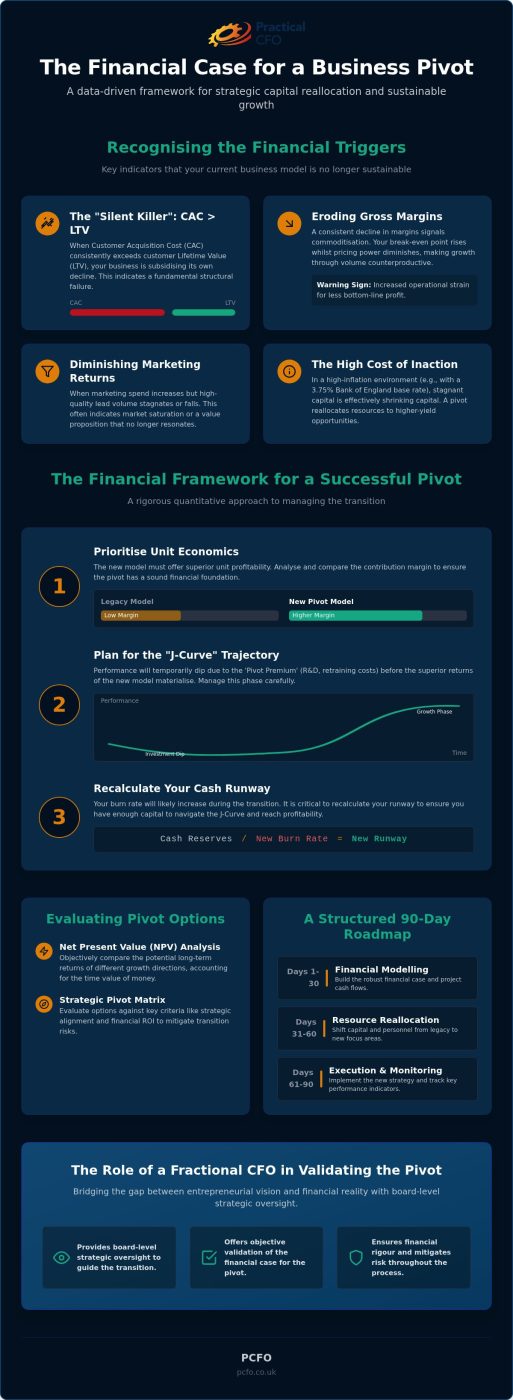
The “Silent Killer” of any enterprise is the point where Customer Acquisition Cost (CAC) consistently exceeds Lifetime Value (LTV). If it costs more to win a client than they’ll ever spend with you, your business isn’t scaling; it’s merely subsidising its own decline. We often see founders attempt to “out-grow” this problem by increasing volume, but without a fundamental shift in the unit economics, this strategy only accelerates financial collapse. Identifying whether your struggle is a temporary market dip or a structural failure is the first step toward recovery.
There’s a significant financial risk in maintaining the status quo. If you calculate the cost of doing nothing over the next 24 months, considering the current 3.75% Bank of England base rate and persistent inflationary pressures, the results are often sobering. Stagnant capital is effectively shrinking capital. A strategic pivot allows you to reallocate these resources into higher-yield opportunities before your cash reserves are depleted by inertia.
The Margin Erosion Warning
Tracking gross margin trends is essential for identifying commoditisation in your niche. When your margins begin to erode, it’s often a sign that your service or product is being viewed as a generic utility rather than a premium solution. You may find that your “break-even point” is creeping upwards as fixed costs rise whilst your pricing power diminishes. In these scenarios, increasing sales volume is counterproductive. It puts additional strain on your operational capacity without delivering the bottom-line profit required to sustain the business long-term.
Market Saturation vs. Operational Inefficiency
It’s vital to determine if your financial struggles stem from a capped market or simply poor internal execution. Financial benchmarking against industry peers can reveal whether your overheads are bloated or if your entire sector is facing a downward trend. Utilising professional management accounting services UK wide provides the granular visibility needed to spot these trends early. This objective data allows you to build a persuasive financial case for a business pivot, ensuring your board and stakeholders understand that the shift is a calculated move toward greater profitability rather than a reaction to operational failure.
The Financial Framework: Unit Economics and Burn Rates
A successful transition requires more than a new vision; it demands a rigorous quantitative framework. When building the financial case for a business pivot, you must account for the “Pivot Premium”. This includes the immediate costs of research, development, and staff retraining that often precede any new revenue. Most transitions follow a “J-Curve” trajectory, where financial performance dips as you invest in new capabilities before the superior returns of the new model materialise. Managing this temporary decline is the difference between a strategic evolution and a cash flow crisis. It’s about ensuring your capital is deployed where it generates the highest long-term value.
Analysing Contribution Margins
Your pivot must lead to a more profitable “unit” of sale to justify the upheaval. We begin by comparing the contribution margin of your legacy products against the proposed new direction. This analysis reveals how much each sale contributes to covering your fixed costs after variable expenses are deducted. Unit economics are the bedrock of any financial case for a business pivot. If the new model doesn’t offer higher margins or a significantly lower acquisition cost, the pivot may lack a sound financial foundation. You must also consider fixed cost absorption; as you wind down legacy operations, your remaining revenue must still support your existing overheads during the transition phase. This methodical approach ensures no gap is left in your financial strategy.
Managing the Runway and Cash Flow
Recalculating your runway is a priority when your burn rate increases during a shift. You need to determine your “Point of No Return”, which is the specific date when your remaining cash reserves dictate the speed and scale of your pivot. Utilising professional cash flow forecasting services allows you to stress-test your assumptions against various market scenarios. Protecting your working capital whilst investing in new streams requires a methodical approach to capital allocation. If you feel your current internal reporting lacks this level of strategic foresight, engaging an embedded advisor can provide the intellectual rigour needed to navigate these organisational gaps. This partnership allows you to make informed decisions with calm confidence.
Evaluating Pivot Options: ROI vs. Strategic Risk
Selecting the right path requires more than intuition; it demands a clinical comparison of potential returns against inherent risks. When building the financial case for a business pivot, performing a Net Present Value (NPV) analysis on competing strategies is essential. This allows you to discount future cash flows to their value today, providing a common metric to compare vastly different business models. You must also confront the “Sunk Cost Fallacy”. Previous investments in technology or infrastructure should not dictate your future strategy if the data suggests a different direction offers superior yield. Capital already spent is gone; your focus must remain on where the next pound will generate the highest return.
The “Pivot Matrix” helps categorise your options by their risk profile. High-reward shifts often require significant capital and a total departure from your current core, whilst incremental adjustments might offer a safer path to recovery. In a volatile UK market where economic uncertainty was cited as a primary challenge by 29% of businesses in August 2026, valuing “Optionality” is crucial. A pivot that maintains your flexibility and allows you to adapt to further market shifts is often more valuable than one that locks your organisation into a single, rigid path. It’s about building a business that is resilient as well as profitable.
Sensitivity Analysis and Stress Testing
Scenario planning is the only way to safeguard your transition against the unknown. We recommend modelling “Best Case”, “Worst Case”, and “Most Likely” financial outcomes to identify the specific levers that will define your success. This process highlights which variables, such as customer retention rates or supply chain costs, have the most significant impact on your bottom line. Securing board level financial advice during this phase ensures your assumptions are challenged by an objective expert who understands the broader economic context. It provides the intellectual rigour needed to move forward with confidence.
Capital Allocation Strategy
Deciding how to fund your transition is as important as the pivot itself. You must determine the optimal mix of cash flow, debt, or equity, especially with the Bank of England base rate currently at 3.75%. A “Clean Break” strategy offers speed but carries higher immediate risk, whilst a “Parallel Run” protects existing revenue at the cost of higher operational complexity. Professional business growth advisory UK services help you navigate these choices. This ensures your funding structure supports long-term scalability rather than just short-term survival, keeping your cash reserves protected during the most critical phases of the transition.
Building the 90-Day Financial Roadmap for a Pivot
Executing a transition requires a disciplined 90-day framework to ensure the financial case for a business pivot remains valid throughout the implementation phase. We begin with a Baseline Audit to establish a definitive financial starting point, identifying exactly how much capital is available for the shift and where it is currently tied up. Resource Reallocation follows, where we methodically shift budget from legacy departments to the pivot team. This is not a simple cost-cutting exercise; it is a strategic re-investment of capital into areas with the highest growth potential. By moving resources away from declining segments, you protect the core whilst enabling the new.
KPI Definition involves setting non-financial leading indicators, such as customer engagement rates or trial sign-ups, that predict future financial success before the revenue actually hits the ledger. Milestone Budgeting ensures capital is released in tranches, only when specific validation targets are met. This protects your cash reserves from premature depletion and keeps the leadership team accountable for results. Finally, a continuous loop of Review and Reiterate allows for refinement based on real-world performance data, ensuring the model evolves in line with market feedback.
Setting Financial Gateways
Establishing “Kill Switches” is a vital part of risk management. These are specific financial metrics that, if not met, signal that the pivot is failing and require an immediate halt or strategic reassessment. Utilising strategic budgeting and forecasting allows you to manage these phased investments with precision. We also track “Time to Value”, measuring how quickly the new model generates its first profitable pound. If this timeline extends beyond your projected runway, the financial justification for the shift must be re-evaluated to prevent further capital erosion.
Operational Pivot Costs
Transitioning your business model involves tangible costs that must be accounted for in your initial modelling. These include redundancy payments, contract termination fees, and new software licences required for the new direction. There is also the hidden cost of “Cognitive Load”, as the pivot impacts the productivity of your existing team whilst they adapt to new processes. To manage the balance sheet impact, you can capitalise certain development costs associated with the pivot, spreading the expense over the useful life of the new asset. Our Business Growth Advisory services can help you structure these costs to maintain a healthy financial position during the transition.
The Role of a Fractional CFO in Validating the Pivot
Internal leadership teams are often too close to a project to maintain total objectivity. A fractional CFO provides the “cold-eyed” financial analysis required to ensure the financial case for a business pivot is built on empirical data rather than founder optimism. They act as an embedded advisor, bridging the gap between a visionary growth strategy and the stark reality of the balance sheet. By leveraging fractional CFO pricing UK business owners can access board-level expertise without the prohibitive cost of a full-time executive. This professional oversight is essential when presenting your case to external stakeholders, such as banks or investors, who demand rigorous validation of a new model’s long-term ROI.
Strategic Oversight and Governance
Maintaining financial discipline during a transition is a significant challenge for any SME. A part-time CFO ensures the pivot stays within agreed financial guardrails, preventing the common trap of scope creep that can rapidly drain cash reserves. This external perspective is invaluable when making difficult capital allocation choices, such as deciding which legacy departments to defund. Integrating your new direction into professional exit strategy planning services ensures that the pivot increases the ultimate valuation of the business. Every strategic shift must be viewed through the lens of long-term value creation and future-proofing.
De-risking the Transition
High-stakes strategy shifts often suffer from “Key Person Risk”, where the success of the pivot relies too heavily on the founder’s intuition. Fractional leadership mitigates this by providing a steady, experienced hand at the helm of your financial strategy. Accuracy is paramount whilst the business model is in flux. Proactive management accounting ensures your reporting remains transparent and reliable throughout the transition. This methodical approach builds a foundation of trust with your board and team. If you’re ready to secure your company’s trajectory, speak to a PCFO advisor about building your financial case for a pivot today. They provide the intellectual rigour needed to turn a strategic necessity into a profitable reality.
Leading Your Business Through Strategic Transition
A successful pivot is a clinical exercise in capital reallocation. By focusing on unit economics and establishing a 90-day roadmap with clear financial gateways, you protect your cash reserves whilst positioning your organisation for superior long-term ROI. You’ve seen how identifying triggers like margin erosion and performing a rigorous NPV analysis can transform a reactive shift into a proactive growth strategy. This methodical approach ensures your business remains resilient in a volatile market.
Building a robust financial case for a business pivot requires an objective perspective that internal teams often struggle to provide. PCFO offers the high-level financial leadership and strategic planning expertise necessary to scale UK companies through complex transitions. Our cost-effective fractional model provides you with an experienced hand at the helm without the expense of a full-time executive. If you’re ready to validate your new direction with intellectual rigour, book a strategic consultation with PCFO today. We’re here to help you navigate these organisational gaps with calm confidence and professional foresight. You can lead your business into its next chapter with the certainty that your strategy is backed by data.
Frequently Asked Questions
What is the difference between a business pivot and a simple strategy change?
A pivot represents a fundamental shift in your business model or product-market fit, whereas a strategy change is typically a tactical adjustment within your existing framework. A pivot often requires a new financial case for a business pivot because the underlying unit economics and target demographics change significantly. It’s a structural evolution of the company’s core identity rather than a minor operational course correction.
How much cash reserve should a UK SME have before attempting a pivot?
We recommend maintaining a liquidity buffer of at least six to nine months of operating expenses. This runway allows your organisation to absorb the “J-Curve” dip whilst funding the initial research and development costs. With the Bank of England base rate currently at 3.75%, the cost of external borrowing is significant. Your internal cash reserves are your most stable asset during a transition.
How do I calculate the ROI of a business pivot when the new market is unproven?
You should utilise sensitivity analysis to model conservative and aggressive scenarios based on proxy data from adjacent sectors. Focus on the Net Present Value (NPV) of future cash flows and the projected payback period. Whilst the market is unproven, your financial case for a business pivot must rely on verifiable assumptions regarding customer acquisition costs and initial conversion rates to maintain credibility.
Should I keep my old business running whilst I pivot to a new model?
This decision depends on your “Parallel Run” versus “Clean Break” analysis. Maintaining legacy operations provides immediate cash flow but increases the cognitive load and operational complexity for your team. If the old model is actively eroding your capital, a faster exit might be necessary. A fractional CFO can help you determine the specific “Point of No Return” for your legacy revenue streams.
What are the most common financial mistakes businesses make during a pivot?
The most frequent error is underestimating the “Pivot Premium” and failing to account for hidden costs like contract termination fees. Many owners also fall victim to the “Sunk Cost Fallacy”, continuing to fund declining legacy departments. Another mistake is ignoring leading KPIs and only reacting to lagging financial reports, which leads to a reactive rather than a proactive capital allocation strategy during the shift.
How do I explain a financial pivot to my bank or existing creditors?
You should present a transparent 90-day roadmap backed by rigorous cash flow forecasting. Banks value intellectual rigour and a proactive mindset. Demonstrate how the pivot improves your debt-service coverage ratio and long-term solvency. Providing an objective analysis from an external finance director can significantly enhance your credibility and reassure creditors that the shift is a calculated move rather than an act of desperation.
Can a fractional CFO help with the legal and structural side of a pivot?
Whilst a CFO is not a solicitor, they manage the commercial side of structural changes. They oversee the financial implications of redundancy costs, lease renegotiations, and the capitalisation of new assets. Your CFO will collaborate with legal advisors to ensure the new corporate structure supports your long-term growth advisory goals and is optimised for your eventual exit strategy, ensuring no financial detail is overlooked.
What happens to my business valuation during a pivot process?
Valuations often experience temporary volatility as you transition from a proven, albeit stagnant, model to an unproven, high-growth one. Investors typically look past short-term dips if you can demonstrate superior unit economics and a scalable sales funnel. A successful pivot eventually leads to a higher valuation multiple by de-risking the business and proving its ability to adapt to shifting UK economic conditions and challenges.