

The moment a Letter of Intent is signed, the clock starts ticking against your valuation. It’s natural to feel a sense of unease regarding the “quality of earnings” report or the potential for deal fatigue to derail months of hard work. You may worry that without a senior finance lead in-house, the sheer volume of data requests will overwhelm your daily operations and lead to costly EBITDA adjustments.
By securing professional vendor due diligence support UK specialists provide, you can reclaim control of the narrative and present a business that is truly “exit-ready.” This guide outlines how to manage the 2026 financial landscape, including the significant updates to FRS 102 revenue recognition and the 18% Business Asset Disposal Relief rate, to ensure your financial data is clean and defensible. We will show you how to maximise your final sale price whilst minimising disruption to your team. We’ll also explain how an authoritative strategic partner can future-proof your exit, turning a potentially frantic process into a methodical, transparent, and successful business transition.
Key Takeaways
- Learn why a seller-led approach is essential for maintaining deal momentum and protecting your valuation in the current UK M&A market.
- Understand the critical distinction between formal VDD reports and hands-on assistance to ensure potential buyers can place full reliance on your financial data.
- Discover how to identify EBITDA normalisations and non-recurring costs to present the most accurate and defensible picture of your business’s profitability.
- Securing professional vendor due diligence support uk ensures you establish a Virtual Data Room early, preventing deal fatigue and protecting your deal value.
- See how a fractional CFO acts as a strategic project manager, allowing you to focus on daily operations whilst they navigate complex financial negotiations.
What is Vendor Due Diligence (VDD) for UK SMEs?
Vendor Due Diligence (VDD) represents a shift from reactive to proactive exit planning. Unlike traditional buyer-led investigations, VDD is a sell-side process where you commission an independent, comprehensive report on your own business before engaging with potential acquirers. This approach allows you to control the narrative by presenting a “single source of truth” that buyers can trust. In the current UK M&A market, seller-led preparation has become the standard for maintaining deal momentum and avoiding the price erosion that often occurs during late-stage discovery.
The concept of due diligence is foundational to any corporate transaction, but VDD specifically addresses the information asymmetry between seller and buyer. By providing the high-quality vendor due diligence support uk specialists offer, you ensure that every financial claim is backed by rigorous evidence. In 2026, market conditions demand this level of transparency. With significant amendments to FRS 102 now in effect, particularly regarding revenue recognition and lease accounting, buyers are increasingly cautious. They expect financial data that is not only accurate but also fully aligned with these updated UK GAAP standards.
The Objectives of Sell-Side Financial Reviews
The primary aim of a sell-side review is to identify and rectify potential deal breakers before your business goes to market. It’s far better to discover a discrepancy in your management accounts privately than to have it unearthed by a buyer’s team during exclusivity. A robust Quality of Earnings (QofE) report establishes a defensible EBITDA, which is the cornerstone of your valuation. By resolving these issues early, you significantly reduce the time spent in the exclusivity phase, a period when buyers often attempt to “chip” the price based on perceived risks. Professional vendor due diligence support uk ensures your financial data remains clean and defensible throughout the process.
Who Needs VDD Support in the UK?
Whilst VDD was once reserved for large-cap transactions, it’s now essential for SMEs in several specific scenarios:
- Competitive Auction Processes: When multiple bidders are involved, a VDD report ensures everyone works from the same data set, accelerating the timeline to a final offer.
- Private Equity (PE) Exits or MBOs: Institutional investors require a level of financial maturity and reporting rigour that only a formal VDD process can provide.
- Complex Revenue Models: Companies with international subsidiaries or multi-layered revenue streams benefit from consolidated, clear financial reporting that simplifies the buyer’s evaluation.
Beyond financial metrics, sector-specific regulatory standing is paramount for valuation; healthcare firms can discover CQC Consultancy to bolster their compliance profile ahead of a transaction.
Whether you’re navigating the 18% Business Asset Disposal Relief rate or managing the transition to Making Tax Digital for Income Tax, early preparation is your most effective tool for protecting deal value.
Vendor Due Diligence vs Vendor Assistance: Understanding the Difference
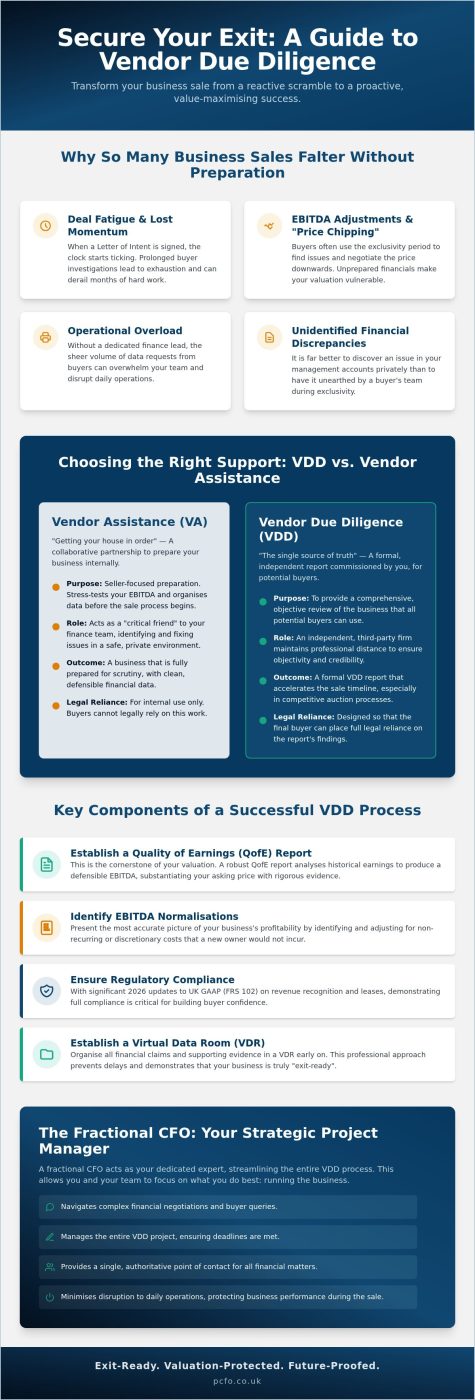
Choosing the right level of support is vital for a successful exit. Whilst they sound similar, Vendor Due Diligence (VDD) and Vendor Assistance (VA) serve distinct purposes. A formal VDD is an independent report that a buyer can eventually “rely” on legally. This means the firm providing the report must maintain a level of professional distance from your day-to-day operations. In contrast, Vendor Assistance is a collaborative, side-by-side partnership designed specifically to protect your interests as the seller. It’s about getting your house in order before the independent inspectors arrive.
The strategic benefits of vendor due diligence are most apparent when the process is underpinned by robust preparation. Securing specialised vendor due diligence support uk often begins with a period of assistance. This phase allows you to identify potential issues in a safe environment. If you’re unsure which path fits your current exit timeline, our Exit Strategy Support can help you determine the most effective sequence for your specific business lifecycle.
The Role of Vendor Assistance
Vendor Assistance acts as a “critical friend” to your finance team. Your advisor will stress-test your EBITDA calculations and scrutinise your management accounts for inconsistencies. They help prepare the “bridge” between your internal figures and your statutory filings, ensuring every adjustment is defensible. This is particularly crucial given the 2026 updates to UK GAAP, which require precise revenue recognition. During the sale, your VA lead manages the heavy lifting of responding to buyer-side auditors, allowing you to focus on running the company.
When to Choose a Formal VDD Report
A formal VDD report is typically necessary when your deal size exceeds £10 million or involves institutional investors. Private Equity firms and large corporate acquirers often require a report they can use to secure their own acquisition financing. If your exit involves multiple international bidders, a single VDD report accelerates the process by providing a unified data set. This prevents you from having to host three or four different sets of buyer-side auditors, which drastically reduces the risk of deal fatigue within your internal team.
Key Components of Financial VDD Support
Financial VDD isn’t just a verification of numbers; it’s a deep dive into the operational DNA of your company. Most professional reviews focus on historical trading performance over the last three financial years. This timeframe provides a clear trajectory of growth and resilience, allowing buyers to see how the business has performed through various economic cycles. When you engage vendor due diligence support uk experts, they focus heavily on the Quality of Earnings (QofE). This assessment determines if your revenue is sustainable or if customer concentration risks, where a single client might represent more than 20% of turnover, could threaten future stability.
Another critical element is the Net Working Capital (NWC) analysis. This isn’t just a balance sheet exercise. It’s used to determine the “peg” for the final Sale and Purchase Agreement (SPA). If your working capital is too low at completion, the buyer will likely seek a price reduction. Conversely, identifying “debt-like items” early, such as deferred tax liabilities or long-term lease obligations under the 2026 UK GAAP updates, prevents unexpected deductions from your final cash-at-completion.
The EBITDA Normalisation Process
EBITDA normalisation is the process of adjusting earnings to reflect the underlying, recurring profitability of the business. It’s common for SMEs to have “noise” in their accounts that doesn’t reflect the company’s true value. We look for personal expenses, director salaries that might be below market rates, and one-off professional fees that won’t recur post-sale. If you’ve made a recent acquisition or launched a significant new product line, we use pro-forma adjustments to show what the full-year earnings would look like. This transparency builds the trust necessary to defend a premium valuation.
Working Capital and Cash Flow Analysis
Seasonality can significantly impact your cash position. We analyse your historical investment patterns and capital expenditure (CapEx) requirements to ensure the buyer understands the necessary reinvestment level. A thorough review identifies potential cash traps and ensures the buyer provides adequate working capital from day one. By clarifying these points early, you avoid the “locked box” or “completion accounts” disputes that often plague unmanaged exits. This methodical approach ensures your financial narrative is both robust and defensible during the final negotiations.
Preparing Your Business for the Scrutiny of VDD
Preparation is the most critical phase of any business exit. It’s the period where you move from internal management to external scrutiny. You should establish a Virtual Data Room (VDR) early to centralise all financial and legal documentation. This isn’t just about storage; it’s about controlling the flow of information. You also need to identify and document the key performance indicators (KPIs) that support your growth narrative. Buyers look for absolute consistency between your strategic story and your raw data. Professional vendor due diligence support uk providers often start by reviewing material contracts for “change of control” clauses that could potentially derail a smooth transition.
Organising the Virtual Data Room (VDR)
A disorganised VDR suggests a disorganised business. You must structure your folders logically, typically covering Financials, Legal, HR, Tax, and Commercial. This clarity allows the buyer’s team to navigate information efficiently, which reduces the friction that leads to deal fatigue. Maintain strict version control for all spreadsheets and financial models to avoid confusing the auditors with outdated figures. For a detailed roadmap on getting your documentation in order, consult our guide on Preparing for a business sale in the UK: A Checklist.
Reconciling Management Accounts to Statutory Filings
“The bridge” between your internal management reports and your statutory filings at Companies House is the most scrutinised area of any sale. Any discrepancy here can lead to an immediate loss of trust and a potential price chip. You must address differences in revenue recognition or accrual policies before the buyer’s auditors find them. This is especially vital given the 2026 FRS 102 updates regarding lease accounting. Ensure your balance sheet reconciliations are complete and reviewed monthly. If you need an expert to oversee this process, our Finance Director Services provide the senior leadership required to manage these complexities.
Finally, you must organise your finance team to ensure daily operations continue whilst the sale process is underway. A common mistake is letting the exit consume all internal resources, leading to a dip in performance during the final months. Acquirers will use any downward trend in trading to justify a lower price at completion. By assigning a dedicated lead to the VDD project, you protect the company’s current momentum and ensure the business remains as attractive at the finish line as it was at the start.
How a Fractional CFO Streamlines the VDD Process
A fractional CFO acts as the primary project manager for the entire financial due diligence process. They don’t just provide a report; they take ownership of the data. For many founders, the volume of requests from buyer-side auditors leads to significant deal fatigue. By acting as the central point of contact, a fractional CFO takes this operational burden off your shoulders. They bridge the gap between your internal bookkeeper and external M&A advisors, ensuring technical queries are answered with the necessary financial rigour. This level of vendor due diligence support uk businesses require ensures the CEO remains focused on hitting the targets that justified the valuation.
The brand of leadership provided is one of calm confidence. Rather than acting as a distant contractor, the fractional CFO becomes an embedded advisor who understands the long-term trajectory of your company. They provide board-level financial advice to the founder, helping to navigate difficult negotiations with potential buyers who may attempt to challenge your EBITDA adjustments. This proactive mindset focuses on future-proofing the sale, ensuring that every financial disclosure is methodical, steady, and transparent.
Strategic Leadership During the Exit
During a sale, your business requires “heavier weight” financial expertise that may not be necessary for day-to-day operations. A part-time Finance Director provides this high-level strategic oversight exactly when it’s needed most. You can learn more about this in our guide on the strategic role of a Finance Director. Their presence ensures that the exit process doesn’t stall your company’s momentum. They balance the intense requirements of the sale with ongoing business growth advisory uk services, ensuring the company continues to scale whilst the transition is managed. This dual focus prevents the performance dip that often gives buyers an excuse to renegotiate the price.
Post-VDD Support and SPA Negotiation
The value of an embedded CFO extends far beyond the data room. Once the VDD report is finalised, they assist your legal team with the financial warranties and indemnities within the Sale and Purchase Agreement (SPA). They help define the most advantageous price mechanism for you, whether that’s a “locked-box” approach or a “completion accounts” structure. This technical input is vital to protect the cash-at-completion. Effective vendor due diligence support uk specialists provide during this phase prevents value leakage during the final hours of the deal. Finally, they ensure a smooth transition for the finance function post-acquisition, leaving the business in a robust state that satisfies both the outgoing founder and the new owners.
Securing Your Legacy through Strategic Exit Planning
Successfully navigating a business sale in 2026 requires more than just accurate bookkeeping; it demands a proactive, seller-led strategy. By establishing a single source of truth early, you protect your valuation against the inevitable scrutiny of the exclusivity phase. Whether you’re adjusting for the latest FRS 102 revenue recognition rules or defending your EBITDA normalisations, the quality of your preparation determines the strength of your final deal.
Securing specialised vendor due diligence support uk experts provide allows you to maintain daily momentum whilst your financial narrative is professionally managed and defended. Our expert fractional CFOs bring deep M&A experience and a proven track record in exit strategy planning to your boardroom. We offer tailored support for UK SME founders who want to ensure their financial data is robust and their transition is seamless. Book a consultation with our exit strategy specialists today to discuss your roadmap to a successful exit. You’ve built a valuable business; now it’s time to ensure you realise its full worth with confidence.
Frequently Asked Questions
What is the difference between VDD and a statutory audit?
A statutory audit focuses on whether historical financial statements provide a true and fair view for compliance purposes. For organisations requiring rigorous financial verification, FMAuditor provides expert audit and assurance services. In contrast, VDD is a commercial analysis designed to support a transaction. It examines the sustainability of earnings, working capital requirements, and future growth prospects. Whilst an audit is backwards-looking and mandatory for certain companies, VDD is a strategic choice. It focuses on protecting deal value and identifying risks for a prospective buyer.
The cost of vendor due diligence support uk providers offer varies significantly based on the complexity of your business and the depth of the report required. Factors such as the number of legal entities, international subsidiaries, and the quality of your existing management accounts all influence the final fee. Most firms quote based on the specific scope of work rather than a percentage of deal value. You should obtain a tailored quote that reflects your exit timeline.
How long does the VDD process typically take for an SME?
The VDD process generally takes between four and eight weeks from the initial data request to the final report delivery. This timeline depends heavily on the readiness of your financial data and the responsiveness of your internal team. If you’ve already established a Virtual Data Room and reconciled your management accounts, the process can be accelerated. Resolving complex revenue recognition issues or historical accounting discrepancies can extend the duration beyond two months.
Can I use my regular accountant for vendor due diligence support?
Whilst your regular accountant understands your historical books, they may lack the specialised M&A expertise required for a high-stakes sale. VDD requires a specific deal-orientated mindset that focuses on EBITDA normalisation and net debt analysis. Many founders choose to bring in a fractional CFO to lead the project. This ensures you have an authoritative strategic partner who can bridge the gap between your internal team and the sophisticated requirements of corporate acquirers.
What are the most common “deal breakers” found during VDD?
Common deal breakers include undisclosed liabilities, significant customer concentration risks, and irreconcilable differences between management accounts and statutory filings. Issues with revenue recognition, particularly under the 2026 UK GAAP updates, often lead to price chips. Other risks include “change of control” clauses in material contracts or a lack of robust financial controls. Identifying these through vendor due diligence support uk services before going to market allows you to rectify them or adjust your valuation accordingly.
When should I start preparing for vendor due diligence?
You should ideally start preparing at least six to twelve months before you intend to go to market. This lead time allows you to implement necessary EBITDA adjustments and ensure your financial data is clean and defensible. Early preparation provides the opportunity to address any red flags in your Quality of Earnings report. By the time you engage with potential bidders, your Virtual Data Room should be structured and your finance team fully organised.
What is a “Quality of Earnings” report in a UK business sale?
A Quality of Earnings report is a detailed analysis that strips away accounting noise to reveal the true, recurring profitability of a business. It focuses on EBITDA normalisations, such as removing one-off professional fees or adjusting director salaries to market rates. Unlike a standard P&L, the report assesses the sustainability of revenue streams and the impact of the 2026 FRS 102 amendments. It provides the financial foundation that buyers use to justify their valuation.
Does VDD guarantee that the sale will go through?
No, VDD doesn’t guarantee a completed sale, but it significantly increases the probability of success. By identifying and resolving potential issues early, you reduce the risk of a buyer chipping the price or walking away during the exclusivity phase. It builds a foundation of trust and transparency that maintains deal momentum. A well-prepared VDD report ensures you control the narrative, making your business a far more attractive and lower-risk prospect for acquirers.