

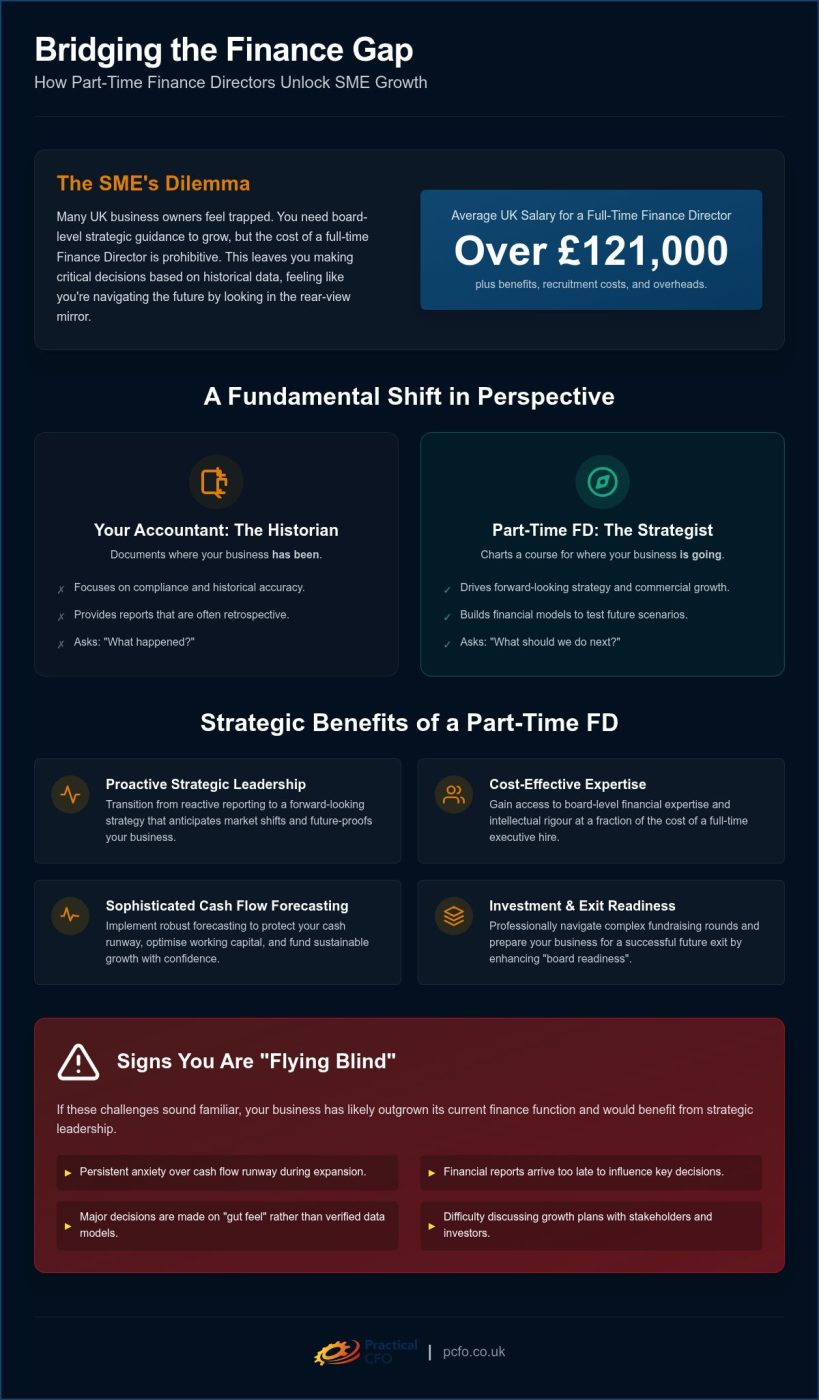
Your current accountant is likely doing a brilliant job of documenting where your business has been, but they might be leaving you blind to where it is actually going. With full-time Finance Director salaries in the UK now averaging over £121,000, many SME owners find themselves trapped between needing expert guidance and managing a tight budget. Understanding the specific benefits of a part time finance director is the first step toward breaking this cycle. You probably feel the weight of making major financial decisions alone, whilst worrying if your cash flow runway is long enough to support your next expansion. It’s exhausting to operate in a reactive state, focused on historical reports rather than future strategy.
This article demonstrates how you can access board-level strategic leadership and rigorous financial control at a fraction of the cost of a full-time hire. We’ll show you how to regain control over your performance and build a scalable finance function that supports sustainable growth. We will explore ten ways a fractional expert transforms your operations, helping you secure funding, prepare for an exit, and finally gain the forward-looking clarity your business deserves in 2026.
Key Takeaways
- Learn how to transition from reactive historical reporting to proactive, forward-looking strategic leadership that anticipates market shifts.
- Discover the commercial benefits of a part time finance director, gaining high-level expertise at a fraction of the total cost of a full-time executive hire.
- Understand how to implement sophisticated cash flow forecasting to protect your runway and optimise working capital for sustainable growth.
- Gain insights into navigating complex fundraising rounds and preparing your business for a successful future exit through enhanced “board readiness”.
- Explore the inherent flexibility of fractional leadership, which allows you to scale senior financial support in direct alignment with your business lifecycle.
Beyond Compliance: Why UK SMEs Need Strategic Financial Leadership
Most UK businesses reach a plateau where their existing finance function, whilst technically accurate, starts to feel restrictive. This is the “Finance Gap”. It occurs when your bookkeeping is impeccable, but your ability to make data-driven decisions is limited. Your year-end accountant is essential for compliance, but they aren’t a substitute for a dedicated director. They focus on history, ensuring the tax office is satisfied. In contrast, one of the primary benefits of a part time finance director is the shift from looking at the rear-view mirror to scanning the horizon. When you leverage the benefits of a part time finance director, you gain access to an authoritative partner who treats your business goals as their own.
You might recognise the symptoms of outgrowing your current setup when the complexity of your operations exceeds your visibility. If you find yourself making major capital expenditure decisions without a clear understanding of the long-term impact on your margin, you’ve reached this tipping point. Common indicators include:
- Persistent anxiety over the actual cash flow runway during expansion.
- Financial reports that arrive too late to influence current operations.
- High-level decisions being made on “gut feel” rather than verified models.
- A feeling that you’re “flying blind” when discussing growth with stakeholders.
The Evolution from Bookkeeping to Board-Level Strategy
Moving from simple record-keeping to board-level strategy requires a fundamental change in perspective. It’s the difference between asking “what happened?” and “what should we do next?”. A seasoned Chief Financial Officer (CFO) or Finance Director doesn’t just present spreadsheets; they interpret the narrative behind the numbers for the CEO. This interpretation increases decision-making speed, allowing you to pivot quickly when opportunities arise or risks emerge. They provide the intellectual rigour needed to future-proof your organisation against market volatility.
Bridging the Gap Between Operations and Finance
Strategic financial leadership ensures that your finance function supports, rather than hinders, your sales and marketing efforts. An FD translates ambitious business goals into robust financial models, providing the roadmap for how you’ll actually fund that new product launch or international expansion. By embedding themselves in the business, they help build a culture of financial accountability across the entire organisation. This ensures every department understands how their spending impacts the bottom line, turning the finance department into a proactive growth engine rather than a passive cost centre. It’s about creating a shared language between the boardroom and the operational front line.
The Strategic Benefits of a Part-Time Finance Director for Growth
Scaling a business is a high-stakes endeavour that requires more than just increased turnover; it demands a structural evolution of your financial strategy. One of the core benefits of a part time finance director is their ability to provide the sophisticated oversight necessary to navigate this transition safely. Whilst a founder focuses on product and market fit, a fractional FD ensures the underlying financial engine is built for scale. They bring a level of intellectual rigour that transforms a growing business into a professional, investment-ready enterprise. This professionalisation is often the catalyst that allows a company to move from a lifestyle business to a high-value asset.
Strategic Planning and Robust Financial Modelling
Effective scaling relies on creating multi-year forecasts that external stakeholders, such as banks or private equity investors, actually trust. A part-time FD builds these models from the ground up, ensuring they are based on realistic assumptions rather than optimistic projections. They employ scenario planning to stress-test your business against market volatility, identifying exactly how a shift in supplier costs or a delay in a major contract would affect your liquidity. This proactive approach aligns your resources with a comprehensive business growth advisory uk framework. It ensures that every pound invested is working toward your long-term objectives rather than just covering short-term gaps.
Exit Strategy and Maximising Shareholder Value
A lucrative exit is rarely the result of chance; it’s the product of years of meticulous preparation. Many business owners wait until they are ready to retire before considering their exit, but a strategic partner knows that value is built long before the “for sale” sign goes up. By engaging exit strategy planning services early, you can systematically clean up your balance sheet and resolve any financial inefficiencies that might depress your valuation multiples.
A part-time FD focuses on improving EBITDA and ensuring your financial records are “due diligence ready” at any moment. This level of professional oversight significantly increases your leverage during negotiations, as it demonstrates a high degree of corporate governance. If you are looking to strengthen your leadership team with independent, professional oversight, our Finance Director Services provide the steady hand needed to navigate these complex milestones. They act as a bridge between your current operations and your ultimate financial goals, ensuring the board remains focused on value creation at every stage of the journey.
Improving Operational Control and Cash Flow Management
Operational control is the bedrock of a stable business. Without it, rapid growth becomes a liability rather than an achievement. One of the primary benefits of a part time finance director is the implementation of rigorous internal controls that prevent financial leakage and fraud. They move beyond basic bookkeeping to establish a “single source of truth” for the entire company. This ensures that every department, from sales to operations, makes decisions based on the same verified data. By modernising your “Finance Stack” with integrated cloud technology, they automate repetitive tasks and provide real-time visibility into your performance.
Mastering the Cash Flow Forecast
A bank balance is a static figure; a cash flow forecast is a living strategic tool. An FD provides predictive cash management that looks months or even years ahead. This is vital when managing the “S-curve” of growth, where increased sales often require significant upfront investment, temporarily reducing available cash. With 90% of UK companies experiencing late payments in the past year, according to Coface (2025), a part-time FD professionalises your credit control to protect your liquidity. By identifying potential gaps early, they can negotiate better terms with creditors or secure credit facilities before a crisis occurs. They optimise working capital by reducing overheads strategically, ensuring that capital isn’t tied up in stagnant inventory or overdue receivables.
Systems, Processes, and Team Leadership
A major advantage of this model is how it bridges the gap between high-level strategy and daily bookkeeping. Instead of replacing your existing junior finance staff or bookkeepers, a part-time FD mentors and upskills them. They provide the professional leadership necessary to transform a reactive team into a proactive finance function. This relationship ensures that your daily records are high-quality and ready for strategic analysis. By designing outsourced accountancy solutions that grow in lockstep with your business, they ensure your infrastructure never becomes a bottleneck.
Ultimately, the benefits of a part time finance director extend to the peace of mind they offer the CEO. Knowing that your financial engine is being tuned by a seasoned expert allows you to focus on the broader vision. They establish the discipline required to protect your margins whilst fostering an environment where innovation can thrive without jeopardising the company’s stability. This professional oversight creates a culture of financial accountability that permeates every level of the organisation, ensuring that growth is both profitable and sustainable.
Comparing the Investment: Part-Time vs Full-Time Finance Directors
Hiring a full-time executive is a significant long-term commitment that often carries substantial hidden costs. When you analyse the total cost of ownership (TCO), the median base salary of £121,145 for a UK Finance Director is just the starting point. Once you factor in Employer National Insurance, pension contributions, and performance bonuses, the actual figure often exceeds £150,000 per year. One of the standout benefits of a part time finance director is the immediate elimination of these heavy overheads. Instead of a fixed, high-cost liability, you gain a flexible resource that provides the same level of strategic insight at a fraction of the price.
Beyond the annual salary, the “Recruitment Trap” presents a substantial hurdle for scaling SMEs. Traditional executive search fees typically range from 20% to 30% of the first year’s salary. This means you could spend upwards of £24,000 just to find the right candidate, before they’ve even started their onboarding. A fractional model bypasses these fees and the associated administrative burden. It also offers superior risk mitigation; terminating a service agreement is far simpler and less legally fraught than managing the exit of a full-time employment contract. This model allows you to access “over-qualified” talent professionals who have led multi-million pound organisations that you simply couldn’t justify on a full-time payroll.
The Financial ROI of Fractional Leadership
A part-time FD often pays for themselves through identified cost savings and profit improvement. Whilst a full-time hire might spend a portion of their week on administrative tasks, a fractional director focuses exclusively on high-impact strategic work. This efficiency ensures that every hour you pay for is dedicated to value creation. By identifying tax efficiencies or renegotiating supplier contracts, they frequently generate savings that exceed their own fees. They act as a catalyst for profitability, ensuring your financial infrastructure is lean and effective.
Flexibility and Scalability for the SME Lifecycle
Your need for financial leadership will inevitably fluctuate as your business evolves. You might start with just one or two days per month to establish basic controls, then scale up to two days per week during a period of intense growth or a merger. This adaptability is central to understanding fractional cfo pricing uk. It ensures your investment is always proportional to your current complexity and stage of development. If you are ready to secure high-level expertise without the executive price tag, our Finance Director Services offer a scalable solution tailored to your specific growth trajectory, allowing you to pivot your resources as your priorities change.
Implementing Fractional Leadership: The PCFO Approach
Transitioning from a reactive accounting setup to a proactive leadership model requires more than just a new hire; it requires a shift in organisational mindset. The PCFO approach focuses on moving from an external contractor relationship to that of an embedded strategic partner. One of the most significant benefits of a part time finance director is the immediate injection of “Board Readiness” into your SME environment. This process professionalises your internal reporting and governance, ensuring you are prepared for the rigours of external investment or a future sale. We integrate seamlessly with your existing business culture, acting as a steady, experienced hand that alleviates the anxieties often felt by founders making major financial decisions in isolation.
An Embedded Strategic Advisor, Not a Remote Consultant
Our directors don’t operate in a vacuum or provide advice from a distance. They become a vital part of your leadership team, attending board meetings and leadership huddles to ensure financial strategy is woven into every operational decision. This proximity allows them to anticipate financial hurdles before they arrive, rather than simply reporting on them after the fact. By understanding the strategic role of a finance director, you can move away from “gut feel” decisions and toward a data-driven future. This proactive mindset is what distinguishes a fractional leader from a traditional year-end accountant. They provide the intellectual rigour needed to navigate complex growth phases whilst maintaining strict financial control.
How to Get Started with PCFO
The journey begins with a strategic financial audit designed to identify your specific growth bottlenecks. During an initial discovery session, we assess your current systems, team structure, and cash flow runway to define a scope of work that fits your unique lifecycle. We don’t believe in a one-size-fits-all model; we tailor the FD role to your specific needs, whether that’s managing a cash flow squeeze or preparing for a lucrative exit. We then match you with a director who possesses the institutional knowledge required to foster your success.
Defining clear objectives from the outset ensures that the benefits of a part time finance director are felt immediately across your organisation. This transition marks the end of feeling “alone at the top” and the start of a collaborative partnership focused on long-term value creation. By choosing a fractional model over a permanent recruitment process, you gain the agility to scale your senior financial support in direct alignment with your business growth. It’s a methodical, steady approach that builds a foundation of trust and enables you to make informed, confident decisions about the future of your company.
Securing Your Financial Future Through Strategic Leadership
Navigating the complexities of the 2026 UK business environment requires more than just accurate bookkeeping. It demands a proactive approach to financial strategy that anticipates hurdles before they impact your margin. We’ve explored how moving beyond simple compliance allows you to regain control over your performance and build a scalable foundation for growth. By embracing the benefits of a part time finance director, you gain the intellectual rigour and board-level oversight necessary to prepare for a lucrative exit or a successful fundraising round without the prohibitive cost of a full-time executive.
At PCFO, we provide an embedded advisory model that turns your finance function into a strategic engine. Our specialists bring decades of collective board-level experience to your leadership team, focusing specifically on UK SME growth and exit planning. We’re ready to help you transition from historical reporting to forward-looking clarity, ensuring you never have to make major financial decisions alone. If you’re ready to future-proof your organisation and drive sustainable profitability, take the first step today. Book a Strategic Consultation with PCFO and discover how a dedicated partner can transform your trajectory.
Frequently Asked Questions
What is the difference between a part-time Finance Director and a fractional CFO?
A part-time Finance Director typically focuses on the internal finance function, reporting, and operational control. In contrast, a fractional CFO often deals with higher-level capital structure, fundraising, and external stakeholder management. For most UK SMEs, these roles overlap significantly. PCFO provides both levels of expertise, ensuring your business has the right strategic oversight regardless of the specific title used in your boardroom.
How many days per week does a part-time FD typically work?
Most part-time FDs work between one and four days per month, although this can increase to one or two days per week during periods of rapid expansion or complex projects. The primary benefits of a part time finance director include this inherent flexibility. You can scale the support up or down based on your business lifecycle, ensuring you only pay for the executive time you actually require.
Will a part-time Finance Director work with my existing accountant or bookkeeper?
Yes, an FD acts as the strategic leader for your existing finance team rather than a replacement for it. They mentor your bookkeeper and work alongside your year-end accountant to ensure all data is accurate and forward-looking. This collaborative approach turns your existing finance function into a proactive department that supports your broader commercial goals rather than just processing historical transactions.
What turnover does my business need to justify a part-time FD?
Businesses with a turnover between £250,000 and £5 million typically see the greatest impact from fractional leadership. At this stage, the complexity of the business often outstrips the owner’s ability to manage finances alone, yet it doesn’t yet justify a six-figure full-time salary. If your growth has plateaued or your cash flow is becoming difficult to predict, you’ve likely reached the threshold for professional advisory.
Can a part-time FD help with securing business loans or equity investment?
A part-time FD is instrumental in securing external capital by building robust financial models that investors and lenders actually trust. They handle the “board readiness” aspect of your business, ensuring your data is due-diligence ready. By presenting a professional financial front, you significantly increase your credibility during negotiations, whether you’re seeking a traditional bank loan or preparing for an equity investment round.
Is a part-time FD the same as an interim Finance Director?
No, they serve different purposes. An interim FD is usually a full-time, temporary hire brought in to cover a specific gap, such as parental leave or a recruitment period. A part-time or fractional FD is a long-term strategic partner who works with you on an ongoing basis. This model focuses on building a deep, institutional knowledge of your business to foster sustainable growth over several years.
What are the typical duties of a part-time FD on a day-to-day basis?
Daily duties vary but typically include reviewing cash flow forecasts, preparing monthly management accounts, and attending board meetings to provide strategic counsel. They also oversee internal controls to prevent financial leakage and mentor junior staff. Their focus remains on the future, scanning for risks and opportunities whilst ensuring the finance stack is integrated and efficient enough to provide a “single source of truth”.
How do you measure the ROI of a part-time Finance Director?
You can measure ROI through tangible outcomes like reduced overheads, improved profit margins, and the successful securing of funding. Beyond the numbers, the benefits of a part time finance director are seen in the time reclaimed by the CEO. When you no longer spend hours untangling spreadsheets or worrying about runway, you can focus entirely on your core mission of growing the business.