

With UK startups raising $7.8 billion in venture capital during the first quarter of 2026 alone, the appetite for growth is undeniable, yet many founders still find themselves stalled at the final hurdle. Achieving true investor readiness UK requires more than a polished pitch deck. It demands a level of financial maturity that many SMEs struggle to build in-house. You likely feel the weight of disorganised financial records or the absence of high-level expertise as you approach a funding round, fearing that one oversight in your cap table could derail months of effort.
We understand that the prospect of failing due diligence is daunting. It’s why we’ve designed this strategic guide to help you transition from a growing business to an investment-grade powerhouse. You’ll learn how to master the financial and strategic requirements needed to attract institutional investment and secure favourable terms. We’ll preview the updated 2026 EIS thresholds, the necessity of institutional-grade reporting, and the exact roadmap you need to navigate your next capital raise with calm, professional confidence.
Key Takeaways
- Understand the fundamental shift from founder-led agility to the institutional rigour required to satisfy sophisticated capital providers.
- Identify the four financial pillars of a credible investment thesis, focusing on clean historical records and dynamic three-way forecasting.
- Master the requirements for investor readiness UK by closing the expertise gap with fractional CFO services that offer strategic leadership without full-time costs.
- Learn how to organise a professional data room and conduct a pre-investment audit to pre-emptively address potential due diligence red flags.
- Develop a clear roadmap for securing growth capital on favourable terms by transforming your financial reporting into a tool for investor conviction.
What is Investor Readiness and Why Does it Matter for UK SMEs?
Investor readiness is the state where a business’s operations, governance, and finances are meticulously structured to attract and satisfy external capital providers. It marks the critical transition from founder-led “hustle” to institutional-grade “rigour”. For any SME, investor readiness UK is the bridge between potential and proof. It ensures that when you sit across from a partner at a fund, your business speaks the language of professional finance rather than just entrepreneurial ambition. Achieving this state means your business is not just asking for money; it’s offering a de-risked, high-conviction opportunity for growth.
The Shift in Investor Sentiment for 2026
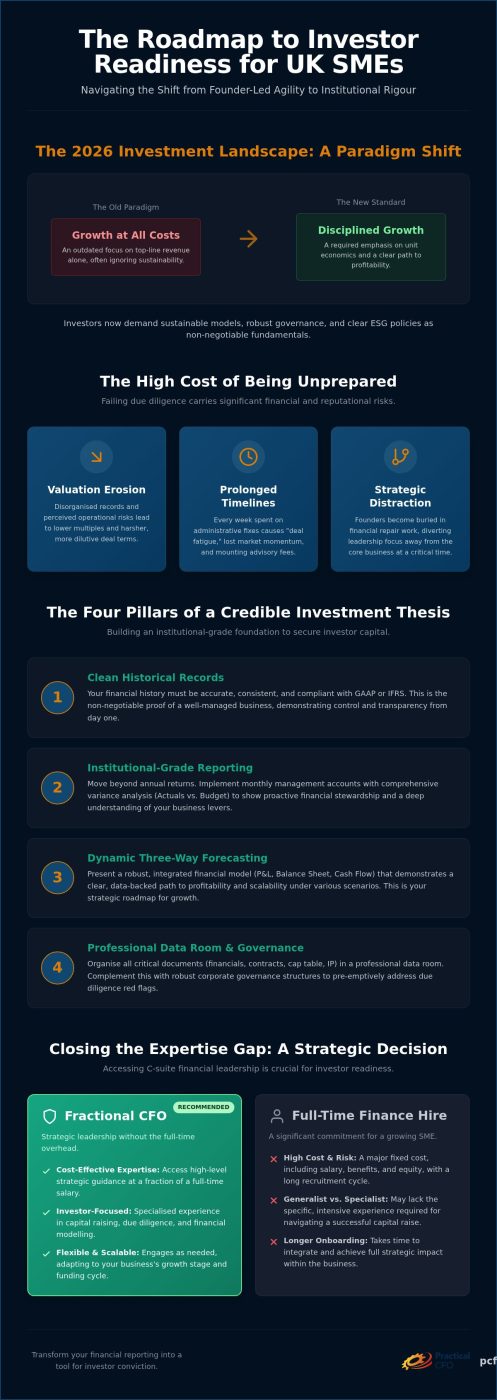
In 2026, the criteria for investment success have matured significantly. The era of “growth at all costs” has been replaced by a disciplined focus on unit economics and a clear path to profitability. Investors are no longer satisfied with top-line revenue alone. They demand evidence that your model is sustainable and scalable under varying economic conditions. A foundational step in this process involves understanding venture capital and the rigorous due diligence that accompanies it. Beyond the numbers, ESG (Environmental, Social, and Governance) and robust corporate governance have become non-negotiable fixtures of the UK investment landscape. High-growth firms must demonstrate that their internal controls are as sophisticated as their product offerings to secure the best partners.
The High Cost of Being Unprepared
Being unprepared for a capital raise is an expensive mistake that extends far beyond a rejected pitch. Disorganised data rooms and fragmented financial records don’t just delay deals; they create “deal fatigue” that often leads to collapsed rounds. If your financial projections lack empirical evidence or historical accuracy, you risk facing a “down round” or accepting terms that significantly dilute your equity. Collapsed rounds are not just a missed opportunity; they can be a reputational risk. Investors frequently share insights, and a business that fails due diligence due to basic accounting errors can find it difficult to re-engage the market later.
- Valuation Erosion: Perceived operational risks lead to lower multiples and harsher deal terms.
- Prolonged Timelines: Every week spent fixing back-office gaps is a week of lost market momentum and increased advisory fees.
- Strategic Distraction: Founders often find themselves buried in administrative repair work whilst the core business suffers from a lack of leadership.
Strategic preparation acts as an insurance policy for your valuation. By establishing a framework of investor readiness UK early, you position your business as a low-risk, high-conviction opportunity. This foresight saves thousands in remedial costs and ensures you negotiate from a position of strength rather than desperation. When your financial architecture is sound, you move from a defensive posture to a proactive one during negotiations, commanding the premium your growth deserves.
The Four Financial Pillars of a Credible Investment Thesis
A compelling growth story might capture an investor’s attention, but only a robust financial infrastructure will secure their capital. For UK SMEs, investor readiness UK relies on four specific pillars that prove the business is managed with institutional-grade precision. These pillars transform your internal data into a transparent, high-conviction investment thesis that survives the most rigorous due diligence. Without this foundation, even the most innovative products can fail to attract the necessary funding.
Institutional-Grade Financial Reporting
Clean accounts are a non-negotiable requirement for Series A and beyond. Investors need to see that your historical data is accurate, consistent, and compliant with GAAP or IFRS standards. This level of detail requires more than just an annual tax return; it demands monthly management accounts featuring comprehensive variance analysis. By comparing actual performance against budgets, you demonstrate a proactive management style that understands its own financial levers. Many scaling firms utilise outsourced accountancy solutions to maintain these high standards without the overhead of a massive internal team. This approach ensures that your data room is always audit-ready and reflects a business in control of its trajectory.
The Robust Financial Model
Static spreadsheets are no longer sufficient for 2026 fundraises. A credible model must be a dynamic, 3-way forecast that integrates the profit and loss, balance sheet, and cash flow statements. It should clearly link revenue drivers to headcount and operational expenditure, allowing investors to see exactly how their capital will be deployed. Scenario planning is equally vital. Your model must show what happens to the runway if market conditions shift or customer acquisition costs rise. Ultimately, a model is a tool for decision-making, not just a fundraising asset. It provides the foresight needed to navigate growth whilst maintaining a sustainable burn rate.
Beyond the model, your cap table and corporate structure must be clean. This means ensuring there is no “dead equity” held by inactive founders and that the equity split is attractive to new institutional entrants. Finally, your working capital management must be impeccable. Proving you can manage current cash flow effectively gives investors confidence that you won’t mismanage the significant capital injection they provide. If you’re unsure if your current setup meets these criteria, engaging a Business Planning Consultant can help identify and close these gaps before you approach the market.
Strategic Preparation: Fractional CFO vs Full-Time Finance Hire
Many UK founders encounter what we call the “CFO Gap” when they realise their bookkeeper or compliance accountant lacks the strategic depth required for a fundraise. Whilst these professionals are vital for historical record-keeping, they aren’t typically trained to build the investment-grade infrastructure required for institutional capital. Securing investor readiness UK requires a leader who can translate raw financial data into a strategic narrative that resonates with venture capital and private equity partners. This leadership is the difference between a business that looks promising and one that looks professional.
The financial burden of a full-time hire is often the primary barrier for scaling SMEs. A seasoned CFO for a UK scale-up typically commands a salary of £150,000 or more, plus benefits and equity. For a business preparing for its first major round, this represents a significant and often premature increase in overhead. Fractional Chief Financial Officer Services provide a flexible alternative, offering the same level of boardroom experience without the prohibitive full-time costs. This model allows you to access “institutional memory” from advisors who have navigated dozens of successful deals, ensuring you don’t repeat the common mistakes of first-time fundraisers.
When to Hire a Fractional CFO
Identifying the right trigger points for external support is essential for efficient scaling. You should consider a fractional partner when you’re preparing for Series A, planning international expansion, or exploring M&A opportunities. This leadership bridges the gap between early-stage growth and the point where the business can comfortably sustain a permanent executive. For a deeper understanding of how this role functions within your management team, you can explore what is a fractional cfo and how they integrate into your daily operations.
The Role of an Interim FD in Fundraising
During a capital raise, an interim Finance Director acts as the steady hand that investors trust. They lead the due diligence process, manage complex investor enquiries, and ensure the data room remains impeccable throughout the round. This support is transformative for founders. It frees you to focus on the company’s vision and sales whilst your FD handles the technical rigours of the numbers. Beyond the data, they provide critical board-level advice during term sheet negotiations, ensuring you secure capital on terms that protect your long-term interests and equity.
The Investor Readiness Checklist: Preparing for Due Diligence
Achieving investor readiness UK requires a systematic approach to your back-office operations. It is not enough to have a visionary product; you must demonstrate that your business is a well-oiled machine capable of absorbing and deploying capital efficiently. This checklist serves as your tactical roadmap to ensure nothing is left to chance when the due diligence process begins. By addressing these steps early, you reduce the risk of deal friction and position yourself as a low-risk, high-conviction opportunity.
- Step 1: Conduct a rigorous pre-investment audit of all financial and legal documents to identify and fix gaps.
- Step 2: Organise your Virtual Data Room (VDR) to include all contracts, IP documentation, and compliance records.
- Step 3: Optimise for UK tax incentives, ensuring you have HMRC Advance Assurance for EIS or SEIS schemes.
- Step 4: Refine your growth story with data-backed KPIs that prove your unit economics are sustainable.
- Step 5: Finalise your board pack and investor presentation to reflect a professional, institutional-grade management style.
The Virtual Data Room (VDR) Essentials
A disorganised data room is one of the fastest ways to lose investor confidence. Professional investors expect a structured environment where they can easily review employment contracts, intellectual property assignments, and historical financial statements. Categorising these documents logically facilitates a smooth legal and financial review, preventing the “deal fatigue” that often leads to collapsed rounds. IP ownership must be clearly documented and secured; any ambiguity here can be a significant red flag that signals poor governance. If your files are scattered across multiple platforms, it suggests a lack of the discipline required for institutional-grade growth.
KPIs that Drive Investor Conviction
In the 2026 investment landscape, investors prioritise businesses that demonstrate traction through empirical data and cohort analysis rather than subjective anecdotes. You must define the metrics that matter most in your specific sector, whether that is Customer Acquisition Cost (CAC), Lifetime Value (LTV), or net churn rates. A business growth advisory uk partner can help you select and track these KPIs to ensure they align with what venture capital and private equity firms are looking for. Showing a consistent, upward trend in these data points builds a compelling case for your valuation.
Optimising for UK tax incentives is equally critical for making your proposition attractive to domestic investors. As of April 2026, the Enterprise Investment Scheme (EIS) has become even more powerful, with the annual company fundraising cap increased to £10 million and the lifetime cap raised to £24 million. Similarly, the Seed Enterprise Investment Scheme (SEIS) remains a vital tool for early-stage firms, offering a lifetime cap of £250,000. Ensuring your business is eligible and has obtained the necessary assurances is a vital component of investor readiness UK. To ensure your business is fully prepared for its next capital raise, enquire about our Chief Financial Officer Services today.
Partnering for Success: How PCFO Delivers Investor Conviction
PCFO operates as an embedded advisor rather than a distant contractor. Our methodology focuses on integrating high-level financial leadership directly into your scaling journey. We move beyond simple reporting to build the strategic framework required to satisfy the most demanding capital providers. By establishing investor readiness UK as a core business function, we transform disorganised data into a narrative of predictability and growth. UK SMEs choose us because we provide the board-level expertise usually reserved for global corporations, scaled to meet the specific needs of a growing business. We understand that a successful raise is merely a milestone, not the destination.
From Planning to Execution
Our business planning consultant services ensure that every operational decision aligns with the expectations of institutional investors. We don’t just prepare you for the raise; we stay by your side to manage the capital once it hits the bank. This long-term partnership provides the continuity and “institutional memory” that helps you navigate post-investment reporting and future rounds with ease. We bridge the gap between your current financial state and the rigour required for Series A and B rounds. If you are ready to professionalise your financial function and secure your company’s future, Contact PCFO today to begin your investor readiness journey.
Maximising Value for Founders
Protecting founder equity is at the heart of our mission. By ensuring your business is impeccably prepared, we help you avoid the valuation erosion and harsh deal terms that often plague unprepared firms. Our team assists you in navigating the intricate requirements of exit strategy planning services, ensuring that whether you are raising Series A or preparing for a strategic sale, your interests are shielded. We provide the intellectual rigour and proactive mindset needed to turn financial anxiety into strategic confidence. This proactive approach ensures that your investor readiness UK status remains a permanent asset rather than a temporary fix. Partnering with a professional financial advisor is not just about compliance; it’s about future-proofing your legacy and ensuring your hard work translates into maximum value. We are here to act as the steady hand at the helm of your financial strategy.
Securing Your Future with Strategic Financial Leadership
Mastering investor readiness UK is a transformative process that shifts your business from entrepreneurial hustle to institutional-grade maturity. By focusing on robust financial pillars and meticulous due diligence preparation, you ensure that your growth story is backed by empirical proof. This level of preparation doesn’t just secure capital; it protects your valuation and ensures you negotiate from a position of strength. Whether you’re navigating the complexities of EIS thresholds or organising a professional data room, the right strategic partner makes the difference.
At PCFO, we act as your embedded advisor, providing experienced fractional CFOs for Series A and B rounds. We are specialists in UK SME growth and exit strategy, offering bespoke strategic business planning designed to meet the rigours of 2026 investors. Our goal is to alleviate your financial anxieties and empower you to focus on leading your company toward its next milestone.
The path to securing growth capital is demanding, but with the right financial architecture, it’s entirely achievable. We look forward to supporting your business through its next phase of expansion.
Frequently Asked Questions
What is the difference between an accountant and an investor readiness consultant?
An accountant primarily focuses on historical compliance and tax filings, whilst an investor readiness consultant prepares your business for the rigours of external capital. This involves building the strategic financial infrastructure that venture capital firms expect. At PCFO, our Chief Financial Officer Services go beyond standard reporting to ensure your financial model, governance, and data room are structured to withstand intense institutional scrutiny and support high-level growth.
How long does the investor readiness process typically take in the UK?
The process of achieving investor readiness UK typically takes between three and six months, depending on the current state of your financial records. This timeline allows for a thorough pre-investment audit, the creation of dynamic three-way forecasts, and the formalisation of corporate governance. Starting early is essential to avoid delays during the actual fundraise, as disorganised data can cause deal fatigue and lead to less favourable terms.
Do I need a CFO before I start my Series A fundraising?
You don’t necessarily need a full-time CFO, but having high-level financial leadership is essential before starting a Series A round. Investors look for a steady hand who understands the strategic implications of the numbers. Fractional CFO and FD Services provide this expertise without the £150,000+ cost of a permanent hire. This allows you to present a professional, institutional-grade finance function that builds immediate credibility with potential capital providers.
What are the main things UK venture capitalists look for in due diligence?
UK venture capitalists prioritise unit economics, intellectual property ownership, and financial accuracy during due diligence. They look for evidence that your growth is predictable and that your management team has a firm grip on cash flow. Additionally, compliance with tax-efficient schemes like EIS and SEIS is a major focus. Investors want to see a clean cap table and a transparent data room that proves your business is legally and operationally sound.
How much does it cost to get a business investor-ready?
The cost of getting a business investor-ready varies based on the complexity of your current financial structure and the scale of the fundraise. Rather than a fixed fee, it’s an investment in the business’s infrastructure that often saves thousands in legal and advisory costs during the deal. By professionalising your finance function early, you reduce the risk of a down round and ensure you negotiate from a position of strength and clarity.
Can a fractional CFO help with EIS and SEIS compliance?
Yes, a fractional CFO is instrumental in managing EIS and SEIS compliance, which is a cornerstone of investor readiness UK. They handle the application for HMRC Advance Assurance and ensure the business stays within the 2026 thresholds, such as the £10 million annual EIS fundraising cap. This expertise gives investors confidence that their tax reliefs are secure, making your company a significantly more attractive proposition for domestic capital providers.
What documents should be in my investor data room?
Your data room should include three years of historical financial statements, current management accounts, and a dynamic financial model. You also need to provide your cap table, intellectual property assignments, and key customer or supplier contracts. Professional investors expect to see employment agreements and evidence of regulatory compliance. A well-organised Virtual Data Room (VDR) signals that your business is managed with the rigour required for institutional-grade growth and investment.
How does a fractional FD help with business valuation?
A fractional FD helps defend your business valuation by proving the sustainability of your unit economics through data-backed KPIs. They use scenario modelling to show how the business performs under different market conditions, which helps justify higher multiples. By identifying and closing operational gaps before you hit the market, they remove the perceived risks that typically lead to valuation erosion. This strategic oversight ensures you secure the best possible deal terms.