

What if the financial reports you review every month are actually obscuring the path to your next stage of growth? Many UK business owners find themselves in a frustrating position where their historical accounts are accurate, yet they still feel entirely blind to their future cash runway. You shouldn’t have to sacrifice your role as a visionary leader to act as a part-time controller. If you’re spending more time on balance sheets than on business development, it’s a clear indication that your financial complexity has outpaced your current resources.
This article identifies the seven critical signs you need a fractional CFO UK to transition from retrospective accounting to proactive strategic leadership. We’ll examine how to reclaim your time, secure your cash flow, and build a robust financial roadmap that prepares your company for its next funding round or an eventual exit. By understanding where these strategic gaps exist, you can move away from the anxiety of the unknown and towards a model of informed, confident decision-making that supports sustainable scaling.
Key Takeaways
- Understand the fundamental difference between compliance-led accounting and the forward-looking strategic leadership required to scale a UK business.
- Identify the specific signs you need a fractional CFO UK, such as recurring cash flow surprises or management reports that arrive too late to inform critical decisions.
- Learn how to prepare your organisation for complex milestones, including Series A funding rounds, international expansion, and long-term exit planning.
- Discover the cost advantages of the fractional model, which provides executive-level expertise without the substantial overheads of a permanent full-time hire.
- Determine how to offload financial complexities to a dedicated strategic partner, allowing you to refocus your energy on growth and innovation.
The Strategic Gap: Why Traditional Accounting Often Fails Scaling UK SMEs
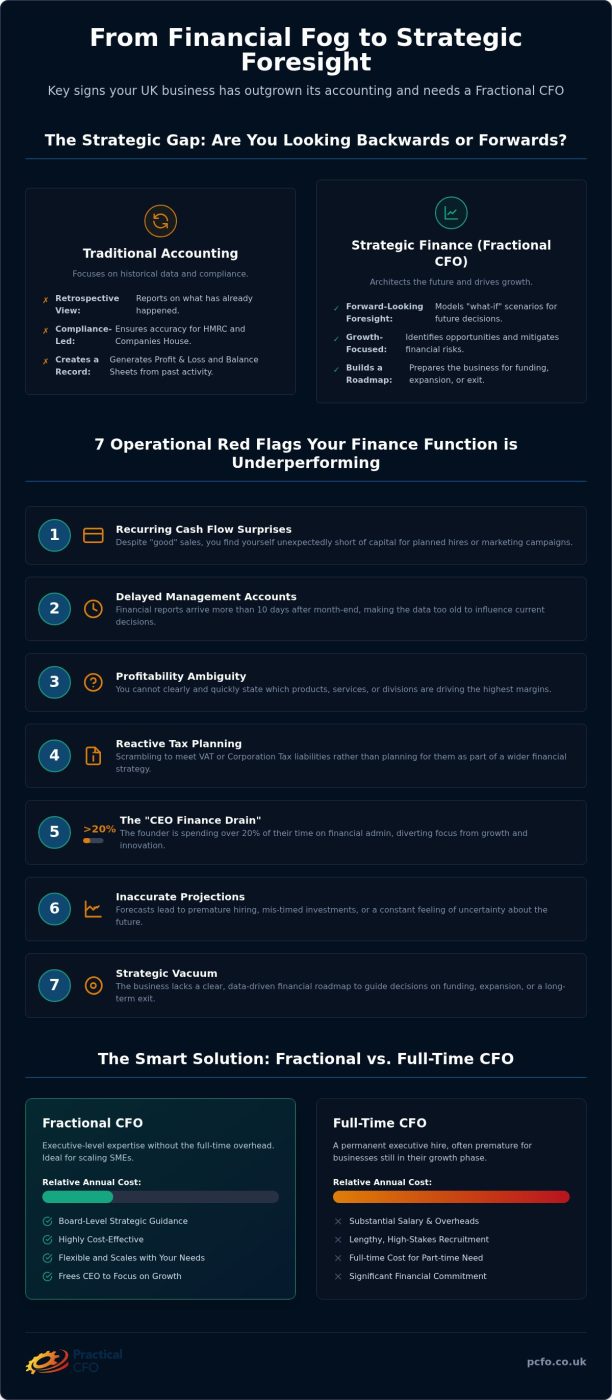
For many UK founders, the finance function eventually feels like a black box. You receive reports on time, but they don’t help you sleep better or make clearer decisions. This disconnect is one of the primary signs you need a fractional CFO UK. Whilst a standard accountant ensures your business stays compliant with HMRC, a CFO ensures your business creates value and remains solvent through rapid growth. They don’t just record the past; they architect the future.
A fractional CFO is a high-level strategic partner who provides board-level financial leadership on a part-time or project basis. Understanding the role of a fractional executive helps clarify how this service differs from traditional bookkeeping. It’s a partnership model designed for companies that have outgrown their current financial structure but aren’t yet ready for the overhead of a full-time executive hire.
As a business scales, the CEO often falls into the “Founder Trap.” You find yourself manually updating cash flow spreadsheets or chasing invoices during hours that should be spent on sales leadership. This shift happens by default, not design. It drains your mental energy and creates a strategic vacuum at the top of your organisation. A fractional CFO steps into this gap, providing the intellectual rigour needed to navigate complex business planning whilst freeing the CEO to focus on growth.
Historical Reporting vs. Strategic Foresight
A Profit and Loss statement from last month tells you where you’ve been, but it cannot predict next quarter’s runway. Traditional reporting is retrospective. Strategic foresight, however, looks at “What if?” scenarios. If you hire three new developers in January, how does that impact your cash position in June? Moving from “What happened?” to “What should we do next?” reduces boardroom anxiety and provides the clarity needed to make bold, informed moves.
The Limitations of Your Current Bookkeeping Function
There is a point in every scale-up’s lifecycle where basic data entry stops providing actionable insights. Clean books are essential, but they are the baseline of financial management, not the ceiling. Many businesses find that engaging a specialist like Skyplex Management provides the necessary financial clarity to prepare for more advanced growth strategies. Relying on an accountant who only speaks to you once a quarter creates several risks:
- Missed opportunities to pivot based on real-time margin fluctuations.
- Tax liabilities that come as a surprise rather than a planned expense.
- Inaccurate projections that lead to premature hiring or delayed investment.
You need more than just a record-keeper; you need an advisor who interprets data to drive growth. When your finance function stops being a support tool and starts being a bottleneck, the strategic gap has become a liability.
7 Operational Red Flags: Signs Your Finance Function is Underperforming
Operational underperformance in a finance department rarely announces itself with a single catastrophic event. Instead, it manifests as a series of subtle, recurring friction points that eventually stall your company’s momentum. Recognising these signs you need a fractional CFO UK early allows you to intervene before a strategic gap becomes a structural failure. If your finance function feels like it is merely keeping pace rather than setting the tempo, your organisation is likely operating with a significant blind spot.
One of the most telling indicators of underperformance is the “CEO Finance Drain.” When a founder or CEO spends more than 20% of their working week on finance-related tasks, such as reviewing payroll, chasing debtors, or manually reconciling spreadsheets, the business loses its primary growth engine. This misallocation of talent is a clear signal that your current systems lack the leadership required to function autonomously. Other critical red flags include:
- Cash flow surprises: Finding yourself short of capital for a planned hire or marketing campaign despite “good” sales figures.
- Delayed management accounts: Receiving financial reports more than ten days after the month-end, making the data too old to influence current decisions.
- Profitability ambiguity: An inability to clearly state which products, services, or divisions are driving the highest margins.
- Reactive tax planning: Scrambling to meet VAT or Corporation Tax liabilities rather than planning for them as part of a wider strategy.
If these scenarios feel familiar, it may be time to consider how professional business growth advisory can stabilise your operations.
Cash Flow Volatility and Runway Uncertainty
There is a fundamental difference between “money in the bank” and actual working capital. Many scaling firms mistake a healthy bank balance for a secure future, failing to account for upcoming VAT liabilities, deferred payments, or the true cost of aggressive hiring. A fractional CFO moves your cash flow forecasting from reactive to proactive. They manage your “burn rate” with precision, ensuring that you have the runway required to reach your next milestone without the constant anxiety of a cash crunch.
Data Rich but Insight Poor: The Reporting Crisis
Most UK SMEs have plenty of data, but very few have genuine insight. If your management accounts are simply spreadsheets of numbers without a narrative or clear KPIs, they are failing to drive business behaviour. High-level financial leadership is essential for interpreting complex data sets and translating them into actionable board-level advice. You don’t need more reports; you need the right indicators that tell you exactly where to invest your next pound for maximum return. When your data stops providing answers and starts raising more questions, the finance function is no longer fit for purpose.
Strategic Triggers: When Growth Demands High-Level Financial Leadership
Growth isn’t linear. For many UK SMEs, scaling from £2 million to £10 million in revenue brings complexities that a standard bookkeeping function cannot handle. This transition often includes high-stakes events where the quality of your financial leadership directly impacts your valuation. Recognising these signs you need a fractional CFO UK is vital when you move from steady growth to transformational strategic shifts. Whether you’re eyeing international markets or preparing for a significant capital injection, having an experienced hand at the helm ensures you navigate these milestones with confidence.
One of the clearest signs you need a fractional CFO UK is when your internal team struggles to answer complex investor queries during the early stages of due diligence. High-level leadership provides the intellectual rigour required to manage the financial intricacies of a merger or acquisition (M&A). They don’t just crunch numbers; they interpret the fiscal health of potential targets or ensure your own organisation is positioned for maximum leverage during negotiations.
Preparing for Funding and Investor Due Diligence
External investment, particularly a Series A or B round, requires a level of transparency and rigour that standard accounting rarely provides. Investors don’t just buy your current revenue; they buy your future projections. A fractional CFO professionalises your “data room,” ensuring every metric is defensible and every forecast is built on sound logic. They provide the sophisticated financial modelling needed to secure favourable valuation terms, acting as a credible bridge between your vision and the investor’s requirements. When building this infrastructure, understanding the trade-offs between an FP&A consultant vs software uk is a critical first step in creating a reliable reporting suite.
Exit Strategy and Maximising Shareholder Value
A successful exit is never an accident. It’s the result of meticulous preparation that should ideally begin 24 months before you intend to go to market. During this period, a CFO identifies “value leakers,” which are inefficiencies in the balance sheet or operational costs that could give a buyer leverage to chip away at your sale price. By cleaning up the capital structure and optimising working capital long before the due diligence process begins, you significantly increase your leverage. Engaging with specialised exit strategy planning services ensures that when the time comes, your business is presented as a de-risked, high-value asset that commands a premium.
Fractional vs. Full-Time: A UK Cost-Benefit Analysis
Deciding between a permanent hire and a fractional partner is often the final hurdle for leadership teams. Whilst the signs you need a fractional CFO UK may be evident in your daily operations, the financial commitment requires a logical justification. For most SMEs, the choice isn’t merely about cost. It’s about matching the level of expertise to the current lifecycle of the business. A full-time executive is a significant long-term commitment, whereas a fractional model offers high-level strategic oversight that scales alongside your revenue.
The Real Investment: CFO Salary UK vs. Fractional Fees
The total cost of employment for a full-time CFO in 2026 is often prohibitive for scaling firms. For a UK scale-up with revenue between £2 million and £20 million, a base salary typically ranges from £120,000 to £180,000. When you include the 15% Employer National Insurance contribution, pension requirements, and performance bonuses, the total compensation package frequently climbs to between £150,000 and £250,000. In contrast, a fractional CFO for a similar-sized company typically costs between £36,000 and £84,000 annually. This creates a year-one saving of up to £190,000 for a £5 million revenue business. You can explore a detailed breakdown of these figures in our guide to fractional cfo pricing uk.
Flexibility and Speed of Implementation
Recruiting a permanent financial director is a slow process that often involves a six-month cycle from search to start date. A fractional CFO can be embedded into your organisation within weeks. This speed is essential when you need to address specific strategic projects, such as an urgent overhead reduction exercise or preparing for a sudden acquisition opportunity. The model allows you to scale hours up or down based on your project needs, providing a perfect bridge until the business is large enough to sustain a permanent executive role.
Beyond the spreadsheet, fractional partners bring a breadth of cross-industry experience that internal hires often lack. Because they work with multiple high-growth firms, they possess a wider perspective on market trends and “best-in-class” financial systems. You gain access to a seasoned boardroom brain for the price of a mid-level manager. If you are ready to professionalise your finance function without the executive overhead, our Chief Financial Officer Services provide the steady, experienced hand your strategy requires.
Choosing Your Partner: How PCFO Transforms UK SMEs
Selecting a strategic partner is a decision that extends far beyond technical capability. It requires a shared vision for your company’s trajectory and a commitment to intellectual rigour. At PCFO, we operate as an extension of your leadership team, providing the high-level oversight necessary to navigate the complexities of scaling. If you’ve recognised the signs you need a fractional CFO UK, the next step is moving from isolated financial reporting to an integrated model where strategy and execution work in tandem.
Our approach combines authoritative Chief Financial Officer Services with practical Outsourced Accountancy Solutions. This dual focus ensures that while we are building your five-year roadmap, the underlying data remains accurate and reliable. We don’t just provide advice from a distance. We are embedded advisors who take ownership of the financial function, ensuring your organisation is resilient, compliant, and ready for growth.
Beyond the Spreadsheet: A Partnership for Growth
We believe that financial leadership should be a catalyst for expansion, not a bureaucratic hurdle. Our service-first philosophy focuses on long-term value creation, supporting UK founders as they reclaim their time to focus on product innovation and market penetration. By offloading the burden of financial modelling and risk management to a dedicated expert, you gain the freedom to lead with confidence. This holistic support is central to our business growth advisory uk, where we align your fiscal health with your commercial ambitions for 2026 and beyond.
Getting Started with a Fractional CFO
The transition to a fractional model begins with a comprehensive financial health check. This initial diagnostic process identifies your top three financial priorities, whether that’s improving cash flow visibility, preparing for a Series A round, or optimising your tax position. Moving from a traditional high-street accountant to the PCFO model is a managed, seamless process designed to minimise disruption. We handle the handover and system integration, ensuring your finance function is future-proofed from day one.
If you’re ready to bridge the strategic gap in your organisation and move towards high-level leadership, we invite you to book a diagnostic consultation. We’ll examine your current financial architecture and provide a clear roadmap for professionalising your finance function to support sustainable scaling.
Future-Proofing Your UK Business Strategy
Transitioning from basic compliance to strategic financial leadership is a pivotal moment for any scaling SME. Recognising the signs you need a fractional CFO UK allows you to move beyond retrospective data and start making decisions based on predictive, forward-looking insights. By addressing operational red flags early, you protect your cash runway and reclaim the mental energy needed to focus on product innovation and sales leadership.
Strategic financial oversight is a tactical necessity for firms navigating the complexities of the 2026 UK market. Our team provides expertise in exit strategy and business growth advisory, offering flexible leadership without the substantial executive overhead. You don’t need to navigate the path to Series A or a strategic sale alone. Book a Strategic Consultation with PCFO to professionalise your finance function and secure a robust roadmap for your organisation’s future. You’ve built a successful business; now it’s time to equip it with the seasoned expertise it deserves.
Frequently Asked Questions
What is the main difference between an accountant and a fractional CFO?
An accountant primarily manages compliance and historical records, ensuring your tax filings are accurate. A fractional CFO focuses on the future. They provide the strategic foresight needed to navigate complex business planning and cash flow management. Whilst your accountant tells you what happened last month, your CFO tells you what will happen next year. It’s the difference between recording value and actively creating it.
How many days a month does a fractional CFO typically work for a UK SME?
The time commitment depends entirely on your current organisational needs. Most UK SMEs engage a fractional CFO for between two and eight days per month. This flexibility allows you to scale the support up during intense periods, such as a funding round, or down during steady-state operations. It ensures you have high-level leadership available exactly when it’s required without the burden of a full-time executive salary.
Can a fractional CFO help with our HMRC R&D tax credit claims?
They play a vital role in professionalising your R&D tax credit claims. A fractional CFO ensures that your financial records and technical narratives are robust enough to withstand HMRC scrutiny. They integrate these claims into your wider cash flow forecasting and tax strategy. This proactive approach helps you maximise your claim value whilst ensuring your business remains fully compliant with the latest UK tax regulations.
Will a fractional CFO replace my existing bookkeeper or accountant?
They don’t typically replace your bookkeeper, but they do transform how that data is used. A CFO sits above the bookkeeping layer to provide strategic interpretation and board-level advice. PCFO provides Outsourced Accountancy Solutions that can work alongside or replace your current accountant if you seek a more integrated model. The goal is to ensure your financial data supports high-level leadership rather than just basic compliance.
Is a fractional CFO suitable for a pre-revenue startup?
Pre-revenue startups often find that high-level financial modelling is their most critical requirement. If you’re preparing for an initial funding round, a CFO provides the intellectual rigour investors expect to see. They help you define your burn rate and runway before you’ve even made your first sale. Identifying the signs you need a fractional CFO UK at this stage can be the difference between a successful raise and a failed one.
What industries do fractional CFOs typically specialise in?
This model is effective across almost every sector, from technology and SaaS to manufacturing and professional services. Any industry that faces complex scaling challenges or international expansion needs this level of strategic oversight. Fractional CFOs are particularly valuable in businesses with high R&D spend or those operating in sectors with thin margins where precise cash flow management is a tactical necessity for survival and growth.
How do I measure the ROI of hiring a part-time finance director?
ROI is measured by the tangible improvements in your bottom line and the freedom it gives the CEO. You should see clearer cash flow visibility, optimised overheads, and improved margins within months. Additionally, the strategic value added during a funding round or exit can be worth millions. If your CFO identifies a single value leaker or secures a higher valuation, the return on investment is immediate and substantial.
What happens if we outgrow our fractional CFO and need someone full-time?
We view this as a positive milestone in your company’s lifecycle. A fractional CFO’s job is to build a robust financial infrastructure that eventually supports a full-time hire. When you reach that scale, we assist with the transition to ensure your strategic roadmap remains intact. Our flexible model means we can step back once the new executive is embedded, having already de-risked the business through years of expert leadership.