

The most significant risk to your growth in 2026 isn’t a lack of ambition, but a finance department that cannot keep pace with your scale. Many UK directors find themselves drowning in manual bookkeeping and administrative tasks, whilst the “big picture” strategy remains out of reach due to the difficulty of recruiting top-tier talent. It’s a common frustration to feel that your accounts are reactive rather than proactive. Transitioning to an outsourced finance function uk allows you to move beyond basic compliance and into a space of strategic foresight.
We understand the anxiety that comes with managing cash flow runways and ensuring your business is ready for its next funding round. This guide provides a clear roadmap for building a scalable finance department that evolves alongside your company. You’ll discover how to access board-level insights and clean, investment-ready accounts without the £150,000 price tag of a full-time executive. We will examine the operational shifts required for 2026, including navigating the latest Making Tax Digital requirements and corporation tax changes, to ensure your business remains resilient and ready for a successful exit.
Key Takeaways
- Understand why an outsourced finance function uk is now a strategic requirement rather than just a compliance measure in the 2026 market.
- Identify the three essential tiers of a high-performing finance department and why a fractional CFO provides the missing leadership link for scaling companies.
- Compare the total cost of ownership between in-house hires and outsourced solutions, accounting for hidden overheads like National Insurance and pension contributions.
- Recognise the specific revenue milestones and operational complexities that signal it’s time to move away from DIY financial management.
- Learn how to select a partner that acts as an embedded strategic advisor rather than a distant contractor to support your long-term growth and exit strategy.
What is an Outsourced Finance Function and Why Does it Matter?
An outsourced finance function uk is a holistic solution where an external partner manages everything from daily bookkeeping to board-level financial strategy. It represents a fundamental departure from traditional, reactive accounting practices. If you’re exploring what is accounting outsourcing?, it’s helpful to view it as the integration of a full-scale finance department into your business without the friction of internal recruitment. Ultimately, the outsourced finance function is a scalable ecosystem of expertise rather than a single hire.
In the 2026 UK market, we’ve seen a definitive shift from “compliance-led” to “strategy-led” finance. Business owners no longer just need someone to file a tax return; they need a partner who can interpret data to drive growth. Traditional “one-man-band” accountants often become a bottleneck for scaling SMEs. They lack the capacity to provide high-level advisory whilst managing daily ledgers. This creates a strategic vacuum where decisions are made on gut feeling rather than verified financial intelligence.
The Evolution of Modern Business Finance
Modern finance has moved beyond the annual retrospective. Real-time data is now non-negotiable for maintaining a competitive edge in an environment of persistent inflation and higher interest rates. Cloud platforms like Xero and Sage, enhanced by AI-driven forecasting, have enabled remote finance departments to operate with greater transparency than old-fashioned in-house teams. The “fractional” model is the primary catalyst for this change. It allows small and medium-sized enterprises to access tier-one talent, such as a seasoned CFO, whilst keeping overheads strictly controlled. You gain the wisdom of a corporate veteran without the burden of a full-time executive salary.
Key Components of a Fully Managed Function
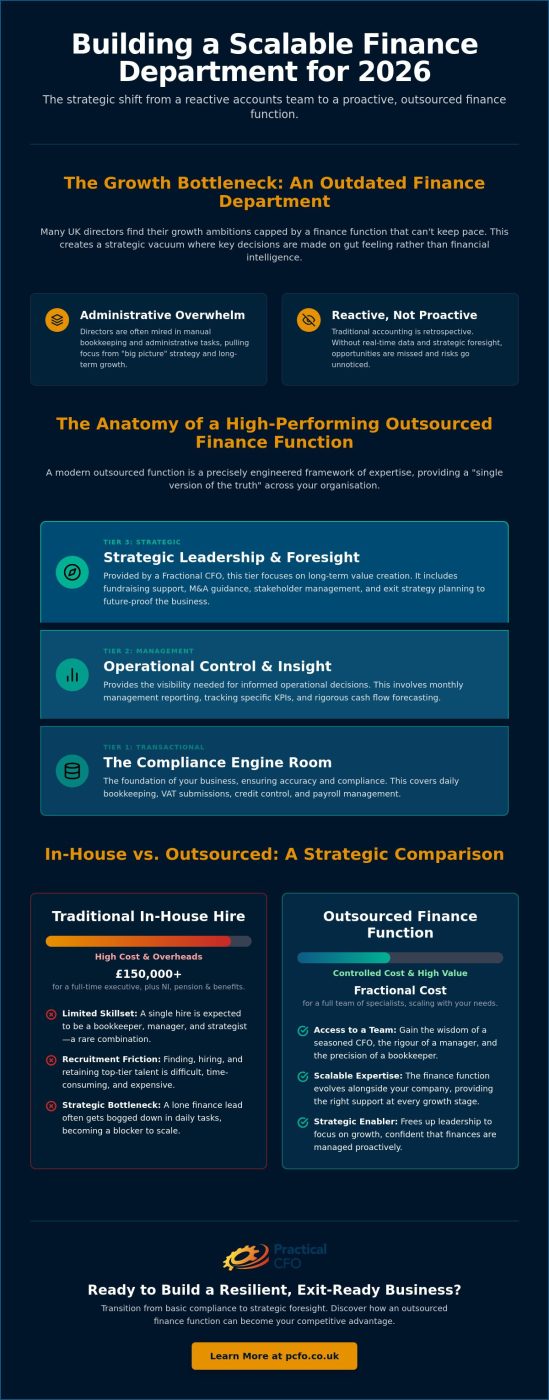
A high-performing function operates across three distinct tiers to ensure total coverage of your organisation’s needs. This structure ensures that no detail is missed, from the smallest invoice to the largest acquisition.
- Transactional level: This is the engine room of your business. It covers daily bookkeeping, VAT submissions, and payroll management to ensure compliance and accuracy.
- Management level: This involves monthly reporting, tracking specific KPIs, and rigorous cash flow forecasting services to provide the visibility needed to make informed operational decisions.
- Strategic level: This tier focuses on long-term value. It includes fundraising support, M&A guidance, and exit strategy planning services to future-proof your business.
By addressing each of these levels, businesses gain a steady, experienced hand at the helm of their financial strategy. This proactive mindset is what separates successful, scaling companies from those that remain stagnant due to administrative overwhelm.
The Anatomy of a High-Performing Outsourced Finance Department
A high-performing outsourced finance function uk is not merely a collection of remote contractors. It’s a precisely engineered framework designed to provide a “single version of the truth” across your entire organisation. By integrating cloud-based accounting software with bespoke reporting tools, this model eliminates data silos and ensures that information flows seamlessly between every tier of the business. This structure allows the finance department to adapt as you move through different lifecycles, whether you’re navigating the rapid growth of a startup or preparing for a clean exit.
The strength of this model lies in its ability to scale expertise. In an in-house setting, a single hire is often expected to be both a meticulous bookkeeper and a visionary strategist. An outsourced model removes this compromise by providing a team where each member specialises in their specific tier. This ensures that whilst the transactional engine runs with clockwork precision, the strategic oversight remains focused on the horizon.
Strategic Leadership: The Role of the Fractional CFO
The Fractional CFO often represents the missing piece for ambitious UK business owners. These professionals provide the high-level financial steerage required to navigate complex growth phases without the overhead of a full-time executive. Beyond internal reporting, they manage critical external relationships with banks, investors, and stakeholders to secure the capital needed for expansion. A core part of their remit involves strategic business planning to ensure long-term commercial viability. When you consider the UK-specific benefits of outsourcing, it’s clear that accessing this calibre of talent allows founders to focus on their core strengths whilst the finance function handles the heavy lifting of corporate governance.
Operational Excellence: Beyond the Balance Sheet
Operational success extends far beyond simply balancing the books. It requires the implementation of robust internal controls to mitigate financial risk and safeguard your company’s assets. For venture-backed firms, this means meticulous management of the cash runway and the optimisation of working capital to sustain momentum. Management accounts should never be a static list of figures; they must tell a coherent story of your company’s performance, highlighting both successes and areas for correction. This clarity is essential for making confident, data-backed decisions. If you’re looking to professionalise your department, exploring Chief Financial Officer services can provide the oversight your business deserves.
In-House vs. Outsourced Finance: A Strategic Comparison
Deciding between an in-house team and an outsourced finance function uk often comes down to a choice between perceived control and actual strategic capability. Founders often assume that having a staff member at a desk nearby ensures better oversight. This is a misconception. Modern cloud accounting tools provide a level of transparency that physical proximity simply cannot match. With real-time access to ledgers and automated reporting, you maintain a clearer view of your financial health than you would waiting for an internal manager to compile a monthly spreadsheet.
The financial comparison goes far beyond the basic annual salary. When you hire internally, you’re also committing to Employer National Insurance, pension contributions, office space, and equipment. There’s also a significant “knowledge gap” to consider. An in-house hire is limited by their own experience; an outsourced team brings insights from working across multiple industries and business cycles. This cross-pollination of ideas is one of the key strategic benefits of outsourcing finance, providing you with a depth of wisdom that a single employee rarely possesses.
The “Hidden” Costs of In-House Hires
Recruitment fees are a major upfront hurdle, often costing between 15% and 20% of the candidate’s starting salary. If the hire doesn’t work out, the cost of replacing them and the resulting operational friction can be devastating. Beyond the initial hire, you must also fund continuous professional development (CPD) and various software licensing fees to keep your department modern. Perhaps most critically, an internal team can suffer from stagnation. If your staff lack experience in complex areas like M&A or exit planning, your business may miss vital opportunities for growth or value realisation.
Flexibility and Risk Mitigation
Eliminating “key person risk” is a primary advantage of the outsourced model. Your financial operations shouldn’t grind to a halt because one individual is ill or decides to leave the company. A managed service provides built-in redundancy, ensuring that your accounts are always overseen by a capable team. This model also allows you to access specialist advice on-demand, whether you need guidance on R&D tax credits or are planning an international expansion. Our outsourced accountancy solutions are designed to provide this level of security, allowing your finance function to handle a 2x growth spurt with far more agility than a single employee ever could.
When Should You Transition to an Outsourced Model?
Transitioning to an outsourced finance function uk is rarely a sudden decision. It is usually driven by specific “trigger points” where the existing setup can no longer support the company’s ambitions. One of the most common milestones is the £1 million turnover mark. This is often the “danger zone” for DIY finance, where the volume of transactions and regulatory requirements begins to overwhelm basic bookkeeping processes. At this level, the risk of error increases, and the lack of strategic oversight can lead to expensive missed opportunities.
Complexity triggers also play a major role in this transition. If your business has started dealing with multiple currencies, complex inventory management, or a rapidly increasing headcount, your financial architecture must evolve. Operationally, a clear sign of strain is the time it takes to produce monthly management accounts. If your team takes more than 15 days to close the month, you’re making decisions based on outdated information. High-growth firms require agility, which is impossible without timely data. Investing in professional cash flow forecasting services at this stage can provide the predictive visibility needed to stay ahead of these challenges.
Preparing for Investment and Scale
Investors and venture capitalists demand more than just accuracy; they require professional financial oversight and “clean” accounts that can withstand rigorous scrutiny. A proactive finance function acts as a robust “due diligence” shield, identifying and rectifying potential red flags long before an investor’s auditors arrive. The involvement of a finance director is essential during this phase. They ensure that all financial modelling and reporting align with the expectations of sophisticated stakeholders, providing the credibility needed to secure Series A funding or facilitate a business sale.
Signs Your Current Setup is Failing
Your current finance arrangement is likely failing if you, as a founder, are spending more than 20% of your working week on administrative or financial tasks. This is a significant misallocation of your time, which should be focused on growth and product development. Inconsistent cash flow forecasts are another critical warning sign. If month-end frequently brings “nasty surprises” that weren’t visible 30 days prior, your current system lacks the predictive power required for stability. Finally, if you cannot state with absolute certainty which of your products or services are your most profitable, you lack the granular insight needed to scale effectively.
To move beyond these bottlenecks and professionalise your financial operations, explore our Finance Director services to regain control and focus on your core mission.
Choosing the Right Partner: Why PCFO is the Strategic Choice
Selecting a partner for your outsourced finance function uk is a decision that impacts the long-term trajectory of your company. Many providers focus purely on compliance; they ensure your books are balanced and your tax returns are filed. Whilst these are essential, they don’t drive growth. PCFO operates differently. We act as an embedded strategic partner, integrating with your leadership team to foster a culture of financial discipline and proactive decision-making. This partnership ensures that your financial strategy is always aligned with your commercial objectives.
Our approach combines high-level FD and CFO expertise with the agility of a boutique consultancy. We don’t just report on the past; we help you understand the business growth advisory landscape to identify opportunities and mitigate risks. By working as an extension of your board, we provide the intellectual rigour required for complex financial navigation and strategic foresight.
Our Fractional Leadership Model
Accessing the wisdom of a seasoned professional shouldn’t require a £150,000 executive salary. Our fractional model allows you to leverage the experience of a high-calibre Finance Director for a fraction of the cost. This support is inherently flexible. It scales up or down based on your specific business needs. Whether you’re entering a period of rapid expansion or preparing for a significant round of investment, we provide the steady hand required to maintain stability. Our primary focus is future-proofing your organisation, ensuring you’re always prepared for a potential exit or expansion.
Next Steps: Transforming Your Finance Function
The transition to a professionalised outsourced finance function uk begins with our discovery process. We take the time to assess your current gaps, understand your growth goals, and identify the specific financial levers that will drive your success. This thorough evaluation ensures that our solution is tailored to your unique circumstances. Our onboarding process is designed to be seamless. We transition your data and processes with minimal disruption to your daily operations, establishing a clear framework for reporting and oversight from day one.
If you’re ready to move beyond manual bookkeeping and gain the strategic insights your business deserves, now is the time to professionalise your department. Enquire about our Outsourced Finance Function services to begin your journey toward financial clarity and sustainable growth.
Securing Your Path to Strategic Financial Clarity
Building a resilient business requires moving beyond the constraints of traditional bookkeeping. An outsourced finance function uk provides the structural integrity and strategic oversight necessary to navigate the complexities of the 2026 market. By integrating fractional CFO leadership with high-performing transactional systems, you ensure your organisation is always investment-ready and prepared for long-term growth. This approach eliminates the key person risk of in-house hires whilst providing the board-level insights required to make confident, data-backed decisions.
We specialise in delivering expert Finance Director and CFO leadership, alongside comprehensive outsourced accountancy solutions tailored to SME growth and exit planning. The transition from a reactive setup to a proactive, strategy-led department is a fundamental step for any scaling firm. Having a steady, experienced hand at the helm allows you to focus on your core mission whilst we manage the heavy lifting of financial governance.
Take the first step toward professionalising your department today. Book a Strategic Finance Review with PCFO to identify your growth triggers and secure your company’s future. We look forward to supporting your journey toward sustainable success.
Frequently Asked Questions
What is the difference between an accountant and an outsourced finance function?
An accountant typically focuses on historical compliance, such as filing annual tax returns and statutory accounts. In contrast, an outsourced finance function uk manages your entire financial department, from daily bookkeeping to strategic CFO leadership. It provides a proactive framework for decision-making rather than just a year-end report, ensuring that every financial aspect of your business is handled by specialists at the appropriate level.
Is an outsourced finance function suitable for small businesses with under £1m turnover?
Yes, this model is highly suitable for smaller businesses, particularly those with high growth ambitions or complex operations. While the £1m mark is a common trigger point, earlier adoption prevents the “administrative debt” that often slows down scaling firms. It allows founders to delegate financial management early, focusing their energy on market expansion and product development whilst maintaining professional-grade oversight.
How do we maintain security and confidentiality with an external finance partner?
Security is maintained through robust data processing agreements, multi-factor authentication, and the use of encrypted cloud platforms. We operate under strict professional ethics and regulatory frameworks that prioritise client confidentiality. By utilising enterprise-grade software, your financial data is often more secure with an external partner than it would be on a local, unmonitored office server or a shared internal drive.
Can an outsourced finance function help with Series A or B funding rounds?
An outsourced function is instrumental during funding rounds by providing the “clean” accounts and detailed forecasting that investors demand. We prepare the necessary due diligence packs and act as a strategic advisor during negotiations with venture capitalists. Having a seasoned CFO at the table provides the professional credibility required to secure significant capital on the most favourable terms possible; resources from Financial Foothold further explain how these executives navigate such high-stakes transitions.
How much does an outsourced finance function typically cost in the UK?
Costs vary depending on the complexity of your business and the depth of services required, typically structured as a fixed monthly fee. This model is consistently more cost-effective than hiring a full-time Finance Director or a mid-level manager, as you avoid National Insurance, pensions, and recruitment overheads. It allows you to access a full team of experts for a fraction of the cost of one senior in-house hire.
What software do I need to have in place to outsource my finance department?
Most modern functions operate using cloud-based platforms such as Xero, Sage, or QuickBooks, alongside integrated tools for payroll and forecasting. If you don’t have these in place, we manage the transition and implementation as part of the onboarding process. The goal is to create a seamless, automated workflow that provides real-time visibility into your company’s performance without requiring significant technical knowledge from your team.
Will I lose control over my bank accounts and payments?
You retain full control over your funds, as we typically operate on a “prepare but not approve” basis for payments. We set up the payment runs and ensure all documentation is correct, but the final authorisation always rests with the business owner or a designated director. This ensures that whilst we handle the administrative burden, you maintain ultimate oversight and security over your company’s cash.
How quickly can an outsourced finance team be up and running?
A standard transition can typically be completed within four to six weeks, depending on the current state of your financial records. This process includes a thorough discovery phase, data migration, and the establishment of new reporting cycles. We work methodically to ensure that the handover is seamless and does not interrupt your daily business operations, allowing for a steady professionalisation of your finance department.