

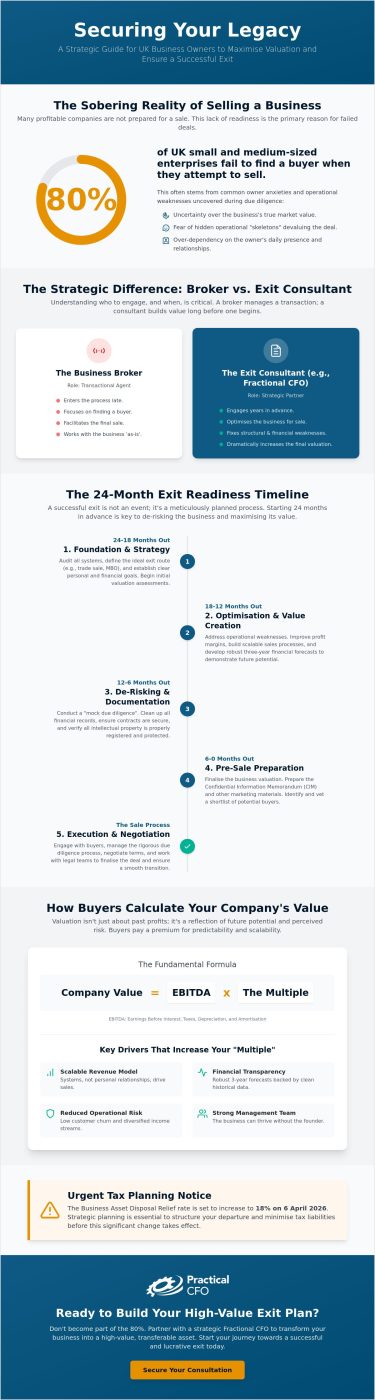
Did you know that approximately 80% of UK small and medium-sized enterprises fail to find a buyer when they attempt to sell? This statistic is a sobering reminder that a successful exit isn’t guaranteed just because you’ve built a profitable company. Engaging professional exit strategy planning services is the most effective way to ensure you don’t become part of that figure. Most owners feel a natural sense of anxiety regarding the true market value of their life’s work or fear that the due diligence process might uncover hidden operational “skeletons” that could devalue the deal.
It’s understandable to worry that your business is too dependent on your daily presence to thrive under new ownership. This guide will show you how to transform your organisation into a high-value asset that functions independently of your input, ensuring a seamless and lucrative transition. You’ll discover how to build a clear roadmap for a strategic sale, prepare for the rigorous scrutiny of buyers, and structure your departure to minimise tax liabilities before the Business Asset Disposal Relief rate increases to 18% on 6 April 2026.
Key Takeaways
- Understand the critical distinction between brokers who manage the transaction and consultants who prepare the business for a premium valuation.
- Identify the key value drivers, such as EBITDA optimisation, that influence how potential buyers calculate your company’s market multiple.
- Compare the strategic advantages of different exit routes, from trade sales to competitors to management buy-outs (MBOs).
- Discover how professional exit strategy planning services establish a structured 24-month timeline to de-risk your operations and ensure financial transparency.
- Learn why a fractional CFO offers the objective, C-suite expertise required for a successful transition whilst maintaining cost-efficiency.
What Are Exit Strategy Planning Services for UK Business Owners?
Professional exit strategy planning services represent a comprehensive suite of financial and operational advisory solutions. These services are specifically designed to prepare a company for a transition in ownership, whether that involves a trade sale, a management buy-out, or a family succession. For many UK business owners, this process is the most significant financial event of their professional lives. It requires a shift in mindset from running a profitable business to building a transferable asset that carries intrinsic value for a third party.
There is a vital distinction between a business broker and an exit consultant. A broker is typically a transactional agent who enters the process late to find a buyer and facilitate the sale. In contrast, an exit consultant acts as a strategic partner, working years in advance to optimise the internal mechanics of the company. They address structural weaknesses and financial irregularities that might otherwise cause a buyer to walk away during due diligence. This preparation is essential for realising the full market value of a UK SME, especially given that 61.5% of UK companies currently operate with a single director and no apparent succession plan. The core objective is to align your personal retirement or reinvestment goals with the cold reality of the market whilst minimising operational risk.
The Difference Between Exit Planning and an Exit Strategy
It’s helpful to clarify the terminology to ensure your preparation is effective. What is an Exit Strategy? Simply put, it’s the high-level decision regarding the destination and the timing; for instance, choosing to pursue a trade sale by the autumn of 2028. Exit planning, however, is the rigorous “how” behind that decision. It’s the methodical process of auditing systems, improving margins, and ensuring the business is a turnkey asset. Having a strategy without a plan often leads to failed deals because the business simply isn’t robust enough to withstand professional scrutiny or function without the founder’s daily input.
Why Start Planning 24 Months Before a Sale?
Timing is a critical factor in the M&A market, particularly with the Business Asset Disposal Relief rate set to increase to 18% on 6 April 2026. Starting your preparation at least 24 months out allows you to identify industry-specific M&A cycles and clean up the balance sheet. Historical reporting is rarely sufficient for modern due diligence; buyers want to see forward-looking financial health and scalability. This window provides the time needed to de-risk the company and ensure all contracts, intellectual property, and financial records are in impeccable order. Exit readiness is the state where a third party can take over the business without operational friction or dependence on the founder.
Identifying Key Value Drivers: How Strategic Finance Increases Valuation
Valuation is rarely a simple calculation of past profits. In the world of M&A, a business is valued on its future potential and the perceived risk of achieving that potential. This is why two companies with identical turnover can have vastly different valuations. The “multiple” applied to your earnings is a direct reflection of your company’s resilience, scalability, and systems. Buyers pay a premium for businesses that demonstrate predictable, repeatable success.
Earnings Before Interest, Taxes, Depreciation, and Amortisation (EBITDA) serves as the primary benchmark for most sales. However, a raw EBITDA figure is just the starting point. Professional exit strategy planning services focus on “normalising” these earnings to show the true underlying profitability of the company. A Fractional CFO plays a vital role here by identifying “value leaks”—such as inefficient tax structures or high customer churn—and rectifying them long before a buyer’s auditors arrive. Transitioning from founder-led sales to a scalable revenue model is perhaps the most significant driver of a high multiple. If the business depends on your personal relationships to close deals, it’s a risky investment for a buyer. Engaging dedicated m&a support for sellers at this stage ensures your financial position is presented in the most compelling light possible to sophisticated acquirers.
Financial Transparency and Forecasting
Buyers demand certainty. They want to see robust, three-year forecasts that are rooted in historical data and clear market assumptions. Building these models requires a level of financial sophistication that goes beyond standard bookkeeping. Securing a business valuation for exit early in the process provides a necessary baseline for this growth. This phase also involves reducing “Owner Dependency.” You must move the company’s intellectual property from your head into documented systems and a capable management team. A business that functions independently is always worth more than one that requires the founder’s daily intervention.
Optimising Working Capital and Cash Flow
Improving your cash conversion cycle directly impacts your final sale price. Buyers look closely at how efficiently a business turns its resources into cash. During this preparation, we identify “Add-backs”—personal or one-off expenses that won’t continue under new ownership. Removing these personal costs from the accounts normalises your earnings and provides a clearer picture of future profitability. Furthermore, you should begin preparing your “Data Room” now. Having organised, easily accessible documentation regarding contracts, compliance, and IP is a value driver in itself. It demonstrates a level of professional rigour that gives buyers confidence. For those seeking to professionalise their finance function before a sale, engaging Chief Financial Officer services can provide the strategic oversight needed to navigate these complexities.
Evaluating Exit Routes: Trade Sales, MBOs, and Succession Planning
Selecting the appropriate path for your departure is a strategic decision that balances financial gain with the long-term health of the organisation. Professional exit strategy planning services help you weigh these options against your personal objectives and the current market climate. A trade sale remains the most common route for those seeking maximum valuation. Selling to a competitor or a strategic buyer often results in a higher multiple because the acquirer can realise immediate synergies. However, this route requires the most rigorous due diligence and may involve a significant shift in corporate culture.
Management Buy-Outs (MBOs) offer an alternative that prioritises continuity. By helping your existing management team take the reins, you ensure that the company’s values remain intact. Whilst MBOs might not always match the peak valuations of a trade sale, they often provide a smoother transition and a faster closing process. For high-growth firms, Private Equity (PE) provides a “second bite of the cherry” model. In this scenario, you sell a majority stake but retain a portion of equity, allowing you to benefit from a second, often larger, liquidity event when the PE firm eventually exits. Finally, Employee Ownership Trusts (EOTs) have emerged as a popular, tax-efficient UK alternative, allowing owners to sell to their workforce whilst potentially qualifying for significant tax reliefs.
Succession Planning for Founders
Ensuring the business thrives without your daily involvement is the hallmark of a successful exit. Effective succession planning for founders involves developing the next tier of leadership at least two years before the sale process begins. Buyers are often wary of “key person risk”; they want to see a management team capable of maintaining performance independently. Choosing a route that protects your legacy and your team is an emotional logic that should not be overlooked, as it often dictates the ultimate success of the transition.
UK Tax Considerations for a Business Sale
The fiscal landscape in the UK makes the timing and structure of your sale paramount. Business Asset Disposal Relief (BADR) allows qualifying individuals to pay a reduced tax rate on the first £1 million of gains. It is vital to recognise that the BADR rate is currently 14% for the 2025/26 tax year, but this will increase to 18% from 6 April 2026. Structuring the deal correctly is equally important. You must decide between receiving cash at completion or accepting an “earn-out,” where a portion of the price is deferred and contingent on future performance. A CFO’s role is to liaise with tax specialists to ensure the deal structure is as efficient as possible, protecting your net proceeds from unnecessary liabilities. This level of foresight is a core component of high-quality exit strategy planning services.
The Exit Readiness Timeline: 5 Critical Stages of Preparation
A successful business sale is rarely the result of a spontaneous offer; it is the culmination of a disciplined, multi-year process. Engaging professional exit strategy planning services allows you to map out this journey across five distinct stages. By starting at least 24 months before your intended departure, you provide yourself with the necessary “runway” to rectify structural issues that could otherwise devalue the company. This methodical approach ensures that when you finally enter the market, you do so from a position of strength rather than necessity.
The transition from a founder-led operation to a market-ready asset follows a logical progression:
- Stage 1: Discovery and Baseline Valuation (24+ months out). Establishing where the business stands today and identifying the “value gap” between current worth and your exit goals.
- Stage 2: Operational and Financial De-risking (18-24 months out). Addressing the “skeletons” in the closet and ensuring all systems are robust.
- Stage 3: Value Enhancement and Strategic Growth (12-18 months out). Implementing specific initiatives to drive EBITDA and improve the sale multiple.
- Stage 4: Preparing the Information Memorandum and Data Room (6-12 months out). Documenting the business case and organising all financial records for buyer scrutiny.
- Stage 5: Go-to-Market and Negotiation (0-6 months out). Identifying buyers, managing offers, and closing the deal.
Stage 1-2: The ‘Housekeeping’ Phase
The first two years of preparation are dedicated to rigorous internal auditing. You must ensure that all commercial contracts and internal controls are fully transferable to a new owner without triggering “change of control” clauses that could jeopardise the deal. This is also the optimal time to resolve any lingering legal or financial disputes whilst time is on your side. Establishing a regular board-level reporting rhythm during this phase is essential. It demonstrates to potential acquirers that the business is managed with corporate-level discipline, which significantly reduces their perceived risk.
Stage 3-5: The ‘Execution’ Phase
As you move within 18 months of a sale, the focus shifts from internal repairs to market positioning. This involves identifying potential “Strategic Buyers” who would pay a premium for the specific synergies your company provides. During the final 12 months, the preparation of the Information Memorandum and the virtual “Data Room” becomes a priority. Many owners underestimate the intensity of the due diligence process. “Due diligence fatigue” is a real risk that can lead to deal collapse if the founder becomes overwhelmed. Having a CFO to manage the technical data requests allows you to maintain focus on running the business and hitting your performance targets during the sale. Finally, negotiating the Heads of Terms requires a steady hand to protect your interests beyond just the headline price. If you are beginning to consider your long-term options, our Exit Strategy Support provides the strategic framework needed to navigate these stages with confidence.
Why a Fractional CFO is Essential for a Successful Business Exit
Navigating a sale requires a level of financial leadership that many SMEs do not possess in-house. While a full-time Finance Director manages daily operations, they may face a significant conflict of interest during an exit. A permanent employee often views a sale as a threat to their own job security, which can lead to subtle resistance or a lack of urgency. In contrast, a fractional CFO is engaged specifically to deliver a successful transition. Their goals are perfectly aligned with yours: to maximise value and secure a clean exit.
Cost-efficiency is another primary driver for this model. You gain access to high-level C-suite expertise and sophisticated financial modelling without the significant overheads or fractional cfo pricing uk associated with a permanent executive hire. This flexibility is vital during the final 24 months of preparation. Beyond the numbers, an experienced partner provides a dispassionate, objective view of your company’s readiness. They act as the central hub amongst your lawyers, tax advisors, and brokers, ensuring all parties work from a single, verified version of the truth. This bridge-building role is a cornerstone of effective exit strategy planning services.
Maintaining Operational Momentum During a Sale
Many deals collapse because the founder becomes consumed by the transaction. When a CEO focuses solely on due diligence, the core business often suffers. This lead to a dip in performance that gives buyers a reason to renegotiate the price or “chip” the valuation. A fractional CFO manages the technical transaction process, handling the data room and auditor queries on your behalf. This allows you to stay focused on hitting your financial targets and maintaining the momentum that attracted the buyer in the first place. Consistency in the final six months is vital for closing.
Post-Exit Support and Transition
The work doesn’t end when the contracts are signed. Most UK business sales involve an “earn-out” period, where a portion of the purchase price is contingent on the company hitting specific performance milestones post-sale. A CFO ensures these metrics are tracked accurately and fairly, protecting your final payout from accounting disputes. They also facilitate a professional handover to the new owners, which protects your reputation and ensures the long-term viability of the business you built. Ready to begin your journey? Explore our Exit Strategy Support to learn how we can help you secure the value you deserve.
Secure Your Legacy and Maximise Your Business Value
A successful exit is not an overnight transaction; it’s the culmination of years of strategic financial engineering. By identifying your key value drivers and implementing a rigorous preparation timeline, you transform your company from a founder-led operation into a high-value, transferable asset. Whether you pursue a trade sale, an MBO, or an Employee Ownership Trust, the strength of your financial systems and the independence of your management team will dictate your final valuation. Professional exit strategy planning services provide the clarity and expertise needed to navigate this transition whilst minimising tax liabilities and operational risks.
At PCFO, we provide specialist M&A and exit support for UK SMEs through experienced Finance Directors who have led multiple successful exits. Our bespoke planning ensures your financial objectives align perfectly with your personal legacy. Book a Strategic Exit Readiness Review with PCFO today to begin building your roadmap to a lucrative and seamless transition. You’ve worked hard to build your business; now it’s time to ensure you receive the full value of your life’s work.
Frequently Asked Questions
When is the best time to start exit strategy planning?
The ideal window to begin preparation is between 24 and 36 months before your intended sale date. This timeframe allows you to implement structural changes, clean up your balance sheet, and demonstrate a track record of performance that doesn’t depend on your daily involvement. Starting early ensures you can capitalise on market cycles and industry-specific M&A activity rather than being forced to sell under pressure.
How much do exit strategy planning services cost for a UK SME?
Professional fees for these services are typically structured as a monthly retainer or a fixed project-based cost, depending on the complexity of your organisation. Unlike brokers who work on a success fee, consultants providing exit strategy planning services focus on the value-creation phase. This investment is designed to pay for itself by significantly increasing the final sale multiple and ensuring the business is attractive to high-conviction buyers.
Can I sell my business without an exit plan?
You can certainly list a business for sale without a plan, but you’re far more likely to face a failed deal or a significantly reduced valuation. Without rigorous preparation, the due diligence process often uncovers operational risks or financial irregularities that cause buyers to withdraw or “chip” the price. A plan acts as your defensive shield, ensuring you maintain control of the narrative throughout the negotiation.
What is the difference between a business broker and an exit consultant?
A business broker is primarily a transactional agent who manages the sale process and identifies potential buyers. An exit consultant, such as a fractional CFO, is a strategic partner who works with you years in advance to professionalise the business. They focus on internal housekeeping, financial transparency, and value-driving initiatives to ensure the company is actually ready for the broker to take to market.
How do I know if my business is ‘exit-ready’?
Your business is ready for a strategic sale when it can function seamlessly without your personal intervention. Key indicators include having a capable management team in place, documented operational systems, and clean, audited financial records. If a third party could step in tomorrow and maintain your current margins without your presence, you’ve achieved a high level of exit readiness.
What are the most common reasons business sales fail in the UK?
Most deals collapse due to “owner dependency” or the discovery of financial “skeletons” during the due diligence phase. If a buyer perceives that the company’s success is tied solely to the founder’s relationships, the risk becomes too high. Deal fatigue is another factor; if the transaction takes too long because records are disorganised, the buyer may lose interest or find a better opportunity elsewhere.
How does a fractional CFO improve my business valuation?
A fractional CFO identifies “value leaks” such as inefficient tax structures or poor cash conversion cycles. They normalise your EBITDA by removing one-off personal expenses and build robust, three-year forecasts that withstand professional scrutiny. By providing this level of C-suite financial rigour, they reduce the buyer’s perceived risk, which directly translates into a higher market multiple for your company.
What is Business Asset Disposal Relief (BADR)?
BADR is a UK tax relief that allows qualifying business owners to pay a reduced rate of Capital Gains Tax on the sale of their company. For the 2025/26 tax year, the rate is 14% on the first £1 million of gains. It’s vital to note that this rate increases to 18% from 6 April 2026. Utilising exit strategy planning services helps you time your sale and structure the deal to maximise the benefits of this relief. For a comprehensive overview of the financial steps involved, our strategic financial checklist for preparing for a business sale in the UK provides a practical framework to ensure you are fully equipped for the process.