

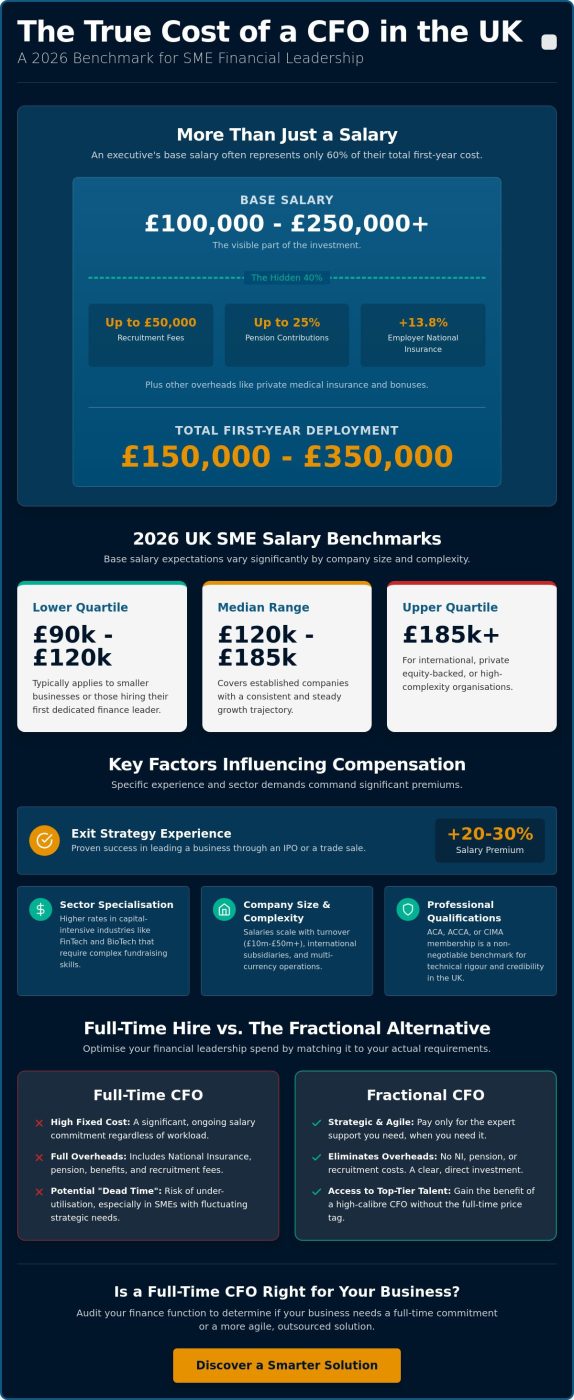
The base salary listed on an executive contract often represents only 60% of the actual capital your business will deploy in their first year. When you factor in employer National Insurance, pension contributions of up to 25%, and recruitment fees that can reach £50,000, the total cost of hiring a cfo uk quickly scales between £150,000 and £350,000. It is a significant commitment that requires more than just a glance at a payroll report to justify to your board or investors.
We understand that the complexity of executive benefit packages and the uncertainty of long-term ROI can make these leadership decisions feel overwhelming. This guide provides a clear 2026 benchmark for CFO compensation across the UK, from early-stage startups to established mid-market firms. You will discover the true cost of a full-time hire versus the strategic efficiency of fractional alternatives. Our framework ensures you have the data needed to make a confident, informed choice that aligns with your company’s specific growth lifecycle and financial trajectory.
Key Takeaways
- Understand current 2026 benchmarks where SME base salaries range from £100,000 to over £250,000 depending on company size and complexity.
- Identify the specific experience premiums, such as exit strategy expertise, that can increase base pay by up to 30% in high-growth sectors like Fintech.
- Evaluate the total cost of hiring a cfo uk against fractional models to eliminate “dead time” and ensure your leadership spend matches your actual requirements.
- Factor in essential but often overlooked overheads including employer National Insurance, private medical insurance, and enhanced executive pension contributions.
- Create a clear roadmap for auditing your finance function to determine if your business needs a full-time CFO or a more agile outsourced solution.
Understanding the Cost of Hiring a CFO in the UK for 2026
The fiscal environment of 2026 has redefined the executive talent market. For many UK SMEs, the cost of hiring a cfo uk now starts at a base level of £100,000, frequently exceeding £250,000 for complex or high-growth organisations. This upward pressure is driven by a critical shortage of talent in the scale-up sector, where the demand for strategic foresight significantly outstrips the supply of qualified executives. You aren’t just paying for a head of department; you’re competing for a limited pool of leaders who can navigate post-2025 economic shifts.
It’s vital to distinguish between a base salary and “Total Compensation.” While the base pay is the most visible figure, the true cost of hiring a cfo uk often includes performance bonuses ranging from 20% to 100% and significant equity stakes. In the current climate, market volatility has created a specific premium for CFOs with proven crisis management and restructuring experience. These specialists command higher rates because they protect enterprise value during periods of uncertainty, providing a level of insurance that standard financial controllers cannot offer.
Current National Averages and Benchmarks
Salary expectations for 2026 have shifted into three distinct quartiles for the UK SME market. The lower quartile, typically ranging from £90,000 to £120,000, usually applies to smaller businesses or those hiring their first dedicated finance leader. The median range sits between £120,000 and £185,000, covering established companies with steady growth. The upper quartile starts at £185,000 and scales upwards for international or private equity-backed firms. The distinction between a Finance Director and a CFO has also sharpened; while a Director manages the internal finance function, the CFO focuses on external capital, investor relations, and long-term viability.
The Evolving Definition of the Modern CFO
The role of a Chief Financial Officer has transitioned from a back-office function to a front-line strategic requirement. Modern leaders in this space are expected to be experts in data analytics, technology integration, and complex fundraising rounds. They don’t just report on what happened last quarter; they use predictive modelling to tell you what will happen in the next three years. The modern CFO acts as a primary architect of enterprise value, transforming historical data into forward-looking strategic navigation. As businesses prioritise scalability, the ability to integrate AI-driven financial tools has become a non-negotiable skill that further drives up market rates.
Key Variables Influencing CFO Compensation Packages
The cost of hiring a cfo uk isn’t a static figure found in a ledger. It’s a dynamic calculation influenced by the specific “war stories” a candidate brings to your boardroom. In 2026, the most significant driver of premium pay is “exit” experience. Executives who’ve successfully led a business through an IPO or a trade sale typically command a 20% to 30% premium on their base salary. This isn’t merely for their technical skill; it’s for the strategic foresight they provide during high-stakes negotiations. Professional qualifications remain the bedrock of this role. Status as an ACA, ACCA, or CIMA member is a non-negotiable benchmark for technical rigour in the UK, directly impacting a candidate’s starting leverage.
Sector-specific weighting also creates substantial variance in compensation. High-growth, capital-intensive industries like Fintech and Biotech often pay significantly higher rates than traditional manufacturing or retail. These sectors require a CFO who can manage complex regulatory frameworks and lead aggressive, multi-stage fundraising rounds. The demand for these specialised skill sets keeps the cost of hiring a cfo uk high in innovation-led hubs, where the ability to secure investment is as critical as managing the books.
The Impact of Company Size and Turnover
Salary expectations scale in direct proportion to organisational complexity. A pre-revenue startup may offer a lower base salary supplemented by a significant equity stake, whereas an established SME with £10m to £50m turnover requires a more substantial cash commitment. Complexity, such as managing international subsidiaries or multi-currency operations, raises the compensation bar further. Many boards now pay a “Step-Up” premium to hire a leader who has already navigated the specific growth cycle the company is currently entering. Government data on Executive Pay and Investment in the UK highlights how structured compensation packages are increasingly tied to long-term strategic milestones rather than just historical performance.
Regional Weighting and Remote Working Trends
London and the South East continue to command a salary premium, often 20% higher than the national average, due to the concentration of financial institutions and cost-of-living adjustments. However, the 2026 executive market is increasingly defined by hybridity. Remote working trends are beginning to level the field, allowing businesses outside metropolitan hubs to access top-tier talent without paying a full “City” premium. Hybrid roles are now the standard for UK finance leaders, offering a balance of strategic presence and operational flexibility. If you’re currently assessing your leadership needs, reviewing Chief Financial Officer services can help you determine the most cost-effective way to secure this expertise for your specific region.
Full-Time Salary vs. Fractional Investment: A Comparison for SMEs
Hiring a full-time executive is a significant long-term commitment that many SMEs aren’t yet prepared to absorb. While the total cost of hiring a cfo uk for a full-time role often exceeds £150,000 when benefits and taxes are included, a fractional model typically requires an investment of only £30,000 to £60,000 per year. This disparity isn’t just about the bottom line; it’s about matching your financial leadership to your actual operational needs. Most small to medium enterprises don’t require 40 hours of high-level strategic direction every week. A full-time hire in this environment often leads to “dead time” where an expensive executive handles tasks that a controller or senior accountant could manage at a lower rate.
The speed of deployment is another critical factor for businesses facing rapid growth or fiscal challenges. Traditional executive recruitment cycles can last four to six months, leaving a strategic gap at the helm of your finance function. In contrast, fractional support can be deployed almost immediately, providing the board with instant access to seasoned expertise. This flexibility allows you to scale the level of support up or down based on your business cycles, ensuring you only pay for high-level strategic output when it’s most needed. For scaling businesses that need board-level financial guidance without the full-time overhead, a fractional finance director uk can bridge the gap between basic bookkeeping and strategic leadership at a fraction of the permanent cost.
When a Fractional CFO Makes More Financial Sense
For a growing business, the cost-per-hour of strategic output is the most relevant metric. Deciding between a fractional CFO vs full time lead provides your board with the same level of impact without the permanent overhead. Fractional leaders bring a unique advantage: cross-industry insights. Because they work with multiple clients across different sectors, they bring a broader perspective on market trends and best practices that a single-company hire might lack. This intellectual capital is particularly valuable during fundraising or when entering new markets.
The ROI of Strategic Finance Leadership
The true value of a finance leader isn’t measured by their cost, but by the capital they save or raise for the firm. A part-time lead can professionalise your finance function, implementing the controls and reporting structures required by investors long before a full-time hire is viable. This proactive approach future-proofs the business and ensures that when you do eventually move to a full-time hire, the foundation is already built. For a deeper investment analysis, you can refer to our guide on fractional cfo pricing uk to see how this model delivers a measurable return on investment.
Beyond the Basic Salary: The Hidden Costs of Senior Finance Hires
When you evaluate the cost of hiring a cfo uk, it’s easy to focus solely on the figure at the bottom of the offer letter. However, the base salary is just the starting point of a much larger financial commitment. In the UK, employer National Insurance contributions represent a significant but often overlooked cost that adds a substantial percentage to your annual payroll. High-level finance executives also expect comprehensive pension schemes, with employer contributions in 2026 often ranging from 10% to 25% of their base pay. When you add executive-level private medical insurance (PMI) and performance bonuses, the gap between “salary” and “cost” widens significantly.
Recruitment fees are perhaps the most immediate shock to the budget. Agencies typically charge between 20% and 30% of the first year’s base salary, payable shortly after the candidate joins the business. For a CFO on a £150,000 salary, this represents an upfront cost of up to £45,000 before they’ve even reviewed your first set of management accounts. These fees, combined with Long-Term Incentive Plans (LTIPs), make the full-time executive hire one of the most expensive investments a business can make.
Calculating the Total Cost of Employment (TCE)
A £120,000 base salary actually translates to a Total Cost of Employment exceeding £160,000 once you account for taxes, pension, and benefits. You must also consider the overheads of office space, high-end equipment, and professional indemnity insurance specific to an executive role. Recruitment fees alone can fund several months of fractional support, providing a more agile way to access expertise without the heavy upfront burden. This TCE calculation is vital for boards to understand before committing to a permanent contract.
Equity, Share Options, and Exit Bonuses
Founders frequently find that a top-tier full-time CFO requires a 1% to 5% equity stake to join a scaling business. This dilution has a long-term cost that often dwarfs the immediate cash salary. Choosing an outsourced model allows you to retain full company ownership whilst still accessing specialist exit strategy planning services. This approach ensures your business is prepared for a strategic sale without the permanent loss of equity. If you’re looking to professionalise your leadership without these hidden overheads, our Chief Financial Officer services offer a transparent, fixed-cost alternative that preserves your ownership.
Optimising Financial Leadership Costs for Your UK Business
To manage the cost of hiring a cfo uk effectively, you must first conduct a rigorous audit of your current finance function. Many business owners assume a full-time executive is the only solution for growth, but the reality is often more nuanced. You might find that your immediate organisational gaps are related to technical reporting and internal controls rather than high-level capital raising. In these instances, outsourced financial controller services uk can provide the necessary professional oversight without the executive price tag. Defining clear KPIs for the role before discussing compensation ensures that any capital deployed is directly tied to measurable business outcomes.
Consider an interim or fractional appointment as a “trial period” for your organisation. This approach allows you to assess the cultural and strategic fit of a senior lead before committing to a permanent contract and the associated recruitment fees. It is a proactive mindset that focuses on future-proofing your business rather than just filling a seat. By leveraging outsourced models, you gain access to board-level expertise during critical high-growth phases, ensuring your financial strategy is managed by a seasoned hand whilst you retain maximum capital for operations.
The 2026 Strategy: Hybrid Finance Teams
The most efficient strategy for modern UK SMEs is the implementation of a hybrid finance team. This model combines a lean internal team for day-to-day processing with a fractional CFO for strategic navigation and board-level reporting. It’s a structure that significantly reduces fixed overheads whilst maintaining a high standard of financial planning. Technology now plays a pivotal role in this shift; cloud-based systems and real-time data analytics enable remote, high-impact leadership to be delivered seamlessly across the UK, regardless of where your headquarters are located. This setup ensures that your cost of hiring a cfo uk remains scalable and aligned with your company’s lifecycle.
Next Steps: Securing Your Strategic Lead
Benchmarking your specific requirements against current market rates is the final step in optimising your leadership spend. It’s important to remember that the finance director or CFO role is about the value created and the risks mitigated, not the hours logged at a desk. If you’re ready to professionalise your finance function and secure the strategic oversight your board requires without the burden of a £150,000+ overhead, we are here to help. Explore PCFO’s Fractional CFO Services today to discover how our authoritative strategic partners can navigate your business towards long-term success.
Navigating Your Path to Strategic Financial Leadership
Accessing top-tier financial expertise in 2026 doesn’t have to strain your company’s capital reserves. As we’ve detailed, the cost of hiring a cfo uk is often inflated by hidden overheads and recruitment fees that don’t directly contribute to your bottom line. By prioritising strategic impact over full-time presence, you can secure the high-level foresight needed for fundraising or exit planning whilst maintaining the agility your business requires. Transitioning to a model that matches your growth stage ensures every pound spent on leadership is an investment in your future enterprise value.
Our team focuses on UK SME growth and exit planning, allowing you to avoid £30,000+ recruitment fees and burdensome executive overheads. We provide board-level strategic leadership on a flexible, part-time basis, ensuring you have an embedded advisor who is deeply invested in your long-term trajectory. It’s time to professionalise your finance function with a structure that respects your budget and your strategic vision. Your company’s next phase of growth deserves the steady, experienced hand of a seasoned expert.
Get a tailored quote for fractional CFO services that fit your budget. We look forward to helping you future-proof your business with confidence and clarity.
Frequently Asked Questions
How much does a CFO earn in the UK on average in 2026?
The average base salary for a CFO in the UK for 2026 typically starts at £100,000 for small businesses and can exceed £250,000 for larger SMEs. Executives in London often receive a 20% premium to account for the higher cost of living and the density of financial institutions. These figures represent base pay only and don’t include bonuses or equity, which are standard components at this level of leadership.
Is there a difference between a Finance Director and a CFO salary?
CFO salaries are typically 20% to 40% higher than those of Finance Directors due to the broader strategic scope of the role. While a Finance Director focuses on internal controls and reporting, a CFO is responsible for capital structure, investor relations, and long-term enterprise value. This shift from operational management to strategic leadership justifies the significant pay gap seen in modern UK organisations.
What benefits are typical in a UK CFO compensation package?
A standard UK executive package includes performance bonuses, enhanced pension contributions, and private medical insurance. Bonuses often range from 20% to 100% of base salary, whilst pension contributions can reach up to 25%. In high-growth companies, equity options or Long-Term Incentive Plans (LTIPs) are also essential components used to align the executive’s interests with the company’s long-term success and shareholder value.
Do CFO salaries vary significantly by industry in the UK?
Yes, industry sectors like Fintech, Biotech, and renewable energy command higher compensation than traditional manufacturing or retail. These innovation-led fields require executives who can manage complex regulatory environments and lead aggressive fundraising rounds. The scarcity of CFOs with specific experience in these high-stakes sectors drives up the market rate for qualified candidates across the UK’s major financial hubs.
When should an SME move from an accountant to a full-time CFO?
An SME should consider a CFO when the business faces strategic complexities like fundraising, international expansion, or exit planning. This transition usually occurs when turnover exceeds £10 million or when the founder needs a strategic partner to manage investor relations. Moving beyond a standard accountant allows the board to focus on growth whilst a dedicated leader manages the company’s fiscal trajectory and future viability.
How do fractional CFO fees compare to a full-time salary?
Fractional fees provide a significant saving, often costing 50% to 80% less than a full-time executive hire. The total cost of hiring a cfo uk on a permanent basis includes recruitment fees, employer National Insurance, and substantial benefits. A fractional model allows you to access the same board-level expertise on a part-time basis, ensuring you only pay for the high-level strategic output your business actually requires.
What qualifications should a CFO have to justify a top-tier salary?
Top-tier salaries are justified by professional qualifications such as ACA, ACCA, or CIMA, paired with a proven track record of scaling businesses. Employers prioritising high-level growth look for “exit” experience or a history of successful multi-million pound fundraising rounds. These credentials demonstrate the technical rigour and strategic foresight needed to protect and grow enterprise value in a volatile economic climate.
Are CFO salaries in the UK expected to rise further in 2026?
Salaries for strategic finance leaders are expected to remain on an upward trajectory throughout 2026 due to a talent shortage in the scale-up sector. Businesses are increasingly seeking CFOs who possess advanced data analytics skills and the ability to integrate AI-driven financial tools. This demand for modern, tech-literate leadership ensures that compensation packages for high-calibre candidates will continue to be competitive as firms prioritise future-proofing.