

The most expensive financial tool your business can buy isn’t a premium software suite; it’s the one your team never actually uses. Whilst it’s tempting to believe that a £20,000 automated platform will instantly solve your forecasting woes, many UK SMEs find that technology without a strategic pilot often leads to “shelfware” and continued board-level embarrassment over spreadsheet errors. You’re likely tired of spending your evenings on manual data entry when you should be focusing on the 77% growth targets that UK small businesses are currently aiming for.
Deciding between an fp&a consultant vs software uk depends entirely on whether you need a high-performance engine or a driver who knows the strategic roadmap. This guide offers an objective look at both paths to help you gain clearer cash flow visibility and build a finance function that supports a future exit strategy. We will explore the costs, the strategic nuances of human expertise, and how to choose the right foundation for your 2026 growth plans. By the end, you’ll have the confidence to invest in a solution that turns your financial data into a genuine competitive advantage.
Key Takeaways
- Understand the critical distinction between automated data centralisation and the strategic interpretation required for board-level decision-making.
- Learn how to assess your company’s data maturity to avoid the common pitfall of investing in expensive software that remains underutilised.
- Evaluate the cost-benefit ratio of an fp&a consultant vs software uk to determine which investment aligns with your three-year growth plan.
- Discover why the hybrid model, pairing a fractional CFO with modern planning tools, offers the most reliable path for businesses preparing for an exit.
- Identify the specific triggers that indicate your current spreadsheet processes are no longer sufficient for maintaining clear cash flow visibility.
FP&A Consultant vs Software: Defining the Two Paths
UK business leaders often find themselves at a crossroads when legacy accounting systems no longer provide the depth required for complex decision-making. As we move through 2026, the choice between an fp&a consultant vs software uk has become a pivotal strategic decision for the mid-market. At its core, Financial Planning and Analysis (FP&A) is the process of aligning a company’s long-term financial goals with its daily operational reality. One path offers the nuanced wisdom of a seasoned professional, whilst the other provides the raw computational power of modern technology.
This “buy vs. hire” dilemma is particularly acute for SMEs navigating the current economic climate. With the UK government expanding the Growth Guarantee Scheme to businesses with turnovers up to £54 million, the stakes for accurate financial modelling have never been higher. To ensure your projections are robust, you can learn more about Financial Modelling Consultants Ltd. You aren’t just choosing a tool or a person; you’re choosing the architecture of your future growth. For those aiming for a strategic exit or a rapid scale-up, this decision dictates how effectively you can communicate your value to investors and stakeholders.
The Role of the Strategic Consultant
A strategic consultant acts as an embedded advisor who provides the “strategic why” behind your balance sheet. They don’t just report on what happened last month. They interpret data to drive board-level decisions. During periods of intense change, such as M&A activity or funding rounds, a consultant offers a steady hand. They bridge the gap between a CEO’s ambitious vision and the company’s actual bank balance, ensuring that growth remains sustainable. This human element is vital for identifying market nuances that data points often miss.
The Role of Modern FP&A Platforms
Modern software platforms are designed to eliminate the manual data entry errors that lead to board-level embarrassment. These tools centralise data from your ERP, CRM, and HR systems to create a single source of truth. They provide real-time dashboards that offer immediate visibility into your cash flow and KPIs. As your business expands, these platforms offer the scalability to handle larger datasets without a proportional increase in administrative overhead. They turn the finance function from a reactive reporting department into a proactive, data-driven engine.
Choosing between an fp&a consultant vs software uk requires an honest assessment of your current organisational gaps. If your data is messy and your spreadsheets are broken, software might seem like the cure. However, even the most sophisticated tool requires a skilled pilot to navigate the strategic roadmap. The right choice depends on whether you need a high-performance engine or the driver who knows where the road is heading.
The Strengths and Limitations of FP&A Software
Modern FP&A software serves as a high-performance engine for data processing. For a UK SME, the primary appeal lies in speed. These platforms automate the repetitive, manual tasks that typically consume a finance team’s week. By centralising data from your ERP, CRM, and HR systems, you create a single source of truth. This eliminates the confusion of multiple spreadsheet versions floating around the boardroom. When the data is unified, the risk of manual entry errors causing board-level embarrassment is significantly reduced.
However, technology is only as effective as the data it receives. The “Garbage In, Garbage Out” trap is a significant risk for growing firms. If your underlying ledger is messy or your departmental reporting is inconsistent, the software will simply produce flawed insights at a faster rate. Implementation also carries hidden costs. Beyond the initial subscription, which often ranges from £10,000 to £25,000 per year for mid-market solutions, you must account for integration fees and the substantial time required for staff training. Without a clear strategy, software can quickly become a costly overhead rather than a value driver.
Automation and Real-Time Reporting
Transitioning from static monthly reports to daily insights is a hallmark of winning strategies for high-growth firms. Automation allows your internal team to step away from data entry and focus on higher-value analysis. Most modern platforms integrate seamlessly with UK-standard tools such as Xero or Sage Intacct. This connectivity ensures that your cash flow visibility is based on live figures rather than historical snapshots. When evaluating an fp&a consultant vs software uk, consider if your primary bottleneck is the speed of data production or the quality of the strategy behind it.
The Technical Barrier to Entry
A common pitfall for SMEs is purchasing a sophisticated tool only to use a fraction of its functionality. This “shelfware” effect occurs when there is no internal champion to manage the system or when the interface is too complex for non-financial stakeholders. Without proper oversight, the software becomes a distraction. It requires a dedicated resource to maintain the integrations and update the models as your business evolves. If you lack this internal capacity, engaging Finance Director services can provide the necessary architecture to ensure your technology investment actually delivers a return on investment.
Why a Consultant Provides the Strategic Edge Software Lacks
Software provides the “what”, but a consultant delivers the “so what?” whilst navigating the complexities of the UK market. When comparing an fp&a consultant vs software uk, the distinction lies in interpretation versus calculation. An automated platform can tell you that your margins have compressed by 4%, but it cannot tell you if that is due to a temporary supply chain shift or a fundamental flaw in your pricing strategy. A consultant brings contextual intelligence to the table, identifying market nuances that data points simply miss. They possess the intellectual rigour to look beyond the dashboard and understand the human and economic drivers behind the numbers.
Numbers alone rarely win over a board or a bank manager. A consultant acts as a bridge, translating raw data into a compelling narrative for stakeholders. They provide the objectivity needed to challenge internal assumptions, offering a neutral perspective that is often impossible for those embedded in the day-to-day operations. This is particularly vital in 2026, as UK SMEs navigate shifting interest rates and the expanded Growth Guarantee Scheme. Having a seasoned professional who can present a credible three-year plan to a lender provides a level of confidence that software cannot replicate. Securing expert board level financial advice transforms your monthly reporting from a history lesson into a forward-looking strategy session that impresses investors and lenders alike.
Driving Business Growth Advisory
A seasoned advisor doesn’t just look at historical data; they use it as a foundation for business growth advisory uk. By identifying underperforming revenue streams or hidden cost-saving opportunities, they help you pivot before small issues become systemic failures. This fractional leadership model is highly effective for firms that require high-level strategic foresight without the overhead of a full-time executive hire. It allows you to access board-level expertise that adapts to your specific business lifecycle, ensuring your finance function supports your broader commercial ambitions.
Exit Strategy and Investor Readiness
Preparing for a sale requires more than just a clean balance sheet. Software cannot coach a founder through the emotional and technical hurdles of a business sale or help craft an “Equity Story” that resonates with potential buyers. Utilising professional exit strategy planning services ensures that your financial reporting is not just accurate, but investor-ready. This human-led approach builds the trust required to secure the best possible valuation. An advisor ensures that your data stands up to the intense scrutiny of due diligence, future-proofing your legacy.
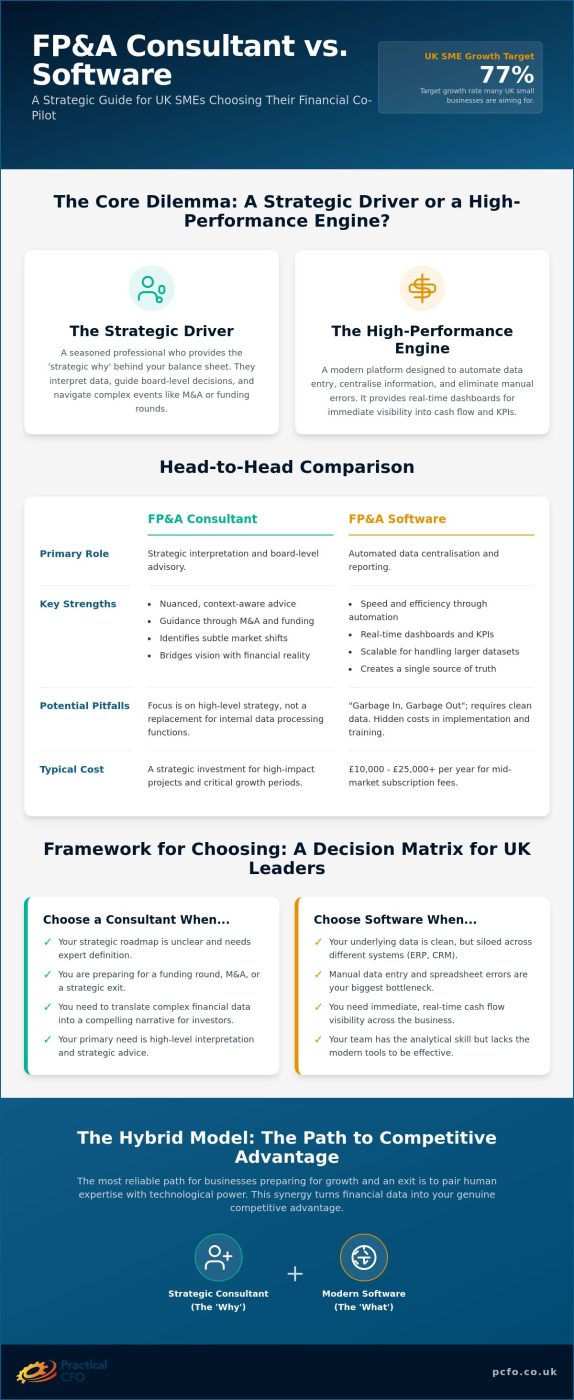
Framework for Choosing: A Decision Matrix for UK Leaders
Choosing between an fp&a consultant vs software uk requires an objective assessment of your current organisational friction. The decision is rarely about which option is “better” in a vacuum; it’s about which solution addresses your specific bottleneck. If your primary challenge is the sheer volume of transactions and manual data entry, software provides the necessary computational engine. However, if your challenge is a lack of strategic direction or an inability to explain financial variances to your board, technology alone will not bridge that gap. You must first determine if your spreadsheets are actually “broken” or if you simply lack the expertise to interpret what they are telling you.
Budgetary considerations also play a vital role. Mid-market FP&A software often carries significant upfront implementation fees, sometimes ranging from £10,000 to £25,000, followed by recurring annual subscriptions. In contrast, a fractional consultant operates on a day-rate or project basis, providing a variable cost model that aligns with your business lifecycle. Time to value is the final metric. Software implementation can take months to reach full utility, whilst a seasoned advisor can often provide actionable strategic insights within their first few weeks of engagement.
Step 1: Audit Your Internal Capability
Success with any financial tool depends on the person operating it. Many UK SMEs employ finance teams that are understandably focused on compliance, tax, and historical reporting. If your team lacks the capacity for high-level modelling, even the most expensive software will likely become “shelfware.” You must determine if your organisation requires strategic budgeting and forecasting advice before you commit to a long-term technology contract. A consultant can assess your current data maturity and help you build the necessary processes before you automate them.
Step 2: Define the Output Requirements
The complexity of your business model dictates the level of human intervention required. Simple dashboards for internal tracking can be handled effectively by automated platforms. However, preparing a sophisticated three-year model for an investor or a bank requires a human architect who understands the “why” behind the numbers. Balancing daily reporting with long-term financial risk management uk often requires a blend of real-time data and expert interpretation. If you are preparing for a significant corporate milestone, the nuanced advice of a professional often outweighs the benefits of a standardised software output.
If you are unsure which path aligns with your current growth trajectory, our team can help you design a roadmap that delivers both clarity and confidence. Contact PCFO today to discuss how fractional finance leadership can transform your decision-making process.
The Hybrid Model: Why the Best UK SMEs Use Both
The debate between an fp&a consultant vs software uk often presents a false choice. In reality, the most successful UK businesses in 2026 treat these two paths as a “power couple” rather than competing options. Software provides the infrastructure for real-time data, whilst a consultant provides the intellectual rigour to turn that data into a strategic roadmap. By employing a fractional CFO to oversee your technology stack, you ensure that your investment in automation actually serves your long-term commercial goals instead of becoming a source of “shelfware.”
A consultant acts as the expert architect who helps you select and implement the right planning tools. They understand which platforms integrate best with your existing systems and can configure models to reflect the unique drivers of your industry. This hybrid approach moves your business from a state of financial confusion to one of strategic clarity. You gain the efficiency of automated reporting alongside the nuanced interpretation required to navigate complex market shifts or interest rate fluctuations. It ensures that technology remains a servant to your strategy, not the other way around.
The ROI of Fractional Financial Leadership
Investing in high-level expertise often yields a significant return through margin improvement and cost optimisation. A seasoned advisor identifies inefficiencies that software alone might miss, such as leakage in procurement or underperforming product lines. When evaluating fractional cfo pricing uk, it’s essential to view the cost as an investment in your company’s scalability and future valuation. The peace of mind that comes from having a steady hand at the helm is invaluable, particularly when preparing for a funding round or a strategic exit.
Next Steps for Your Finance Function
As you assess your growth targets for the remainder of 2026, the transition should ideally begin with a comprehensive strategic audit. This process identifies the gaps in your current reporting and determines if you need better tools, better leadership, or both. Integrating outsourced accountancy solutions with high-level advisory creates a finance function that is both compliant and proactive. By bridging the gap between basic bookkeeping and strategic foresight, you build a foundation that supports sustainable growth and provides the confidence to make bold, data-driven decisions.
Securing Your Financial Future in 2026
The choice between an fp&a consultant vs software uk is not a binary decision but a strategic alignment of resources. Whilst software provides the computational speed to manage complex datasets, the true value for a scaling SME lies in the human interpretation of those figures. A robust finance function requires both the high-performance engine of modern technology and the experienced hand of a strategic pilot to navigate the roadmap toward a successful exit or rapid expansion.
By adopting a hybrid approach, you ensure your technology serves your strategy rather than creating administrative overhead. This balance provides the cash flow visibility and board-level confidence necessary to meet your 2026 growth targets. Whether you are auditing your internal capabilities or preparing for a significant corporate milestone, professional guidance ensures your financial data becomes a genuine asset.
PCFO provides expert Fractional CFO and FD Services alongside strategic business growth advisory to companies across the UK. Our national coverage ensures that scaling SMEs have access to the board-level leadership required for long-term success. Book a Strategic Finance Consultation with PCFO and take the first step toward transforming your financial decision-making today.
Frequently Asked Questions
Is FP&A software better than a consultant for a small business?
How much does an FP&A consultant cost compared to a software subscription in the UK?
Software typically involves a fixed annual subscription fee, whereas a consultant usually operates on a flexible day-rate or project basis. Mid-market software subscriptions in the UK often range from £10,000 to £25,000 per year, excluding initial implementation costs. When comparing an fp&a consultant vs software uk, you must weigh the fixed cost of technology against the variable, value-driven investment of strategic expertise that can scale up or down as required.
Can an FP&A consultant help me choose the right software?
Yes, a consultant acts as a strategic architect to ensure you select a platform that aligns with your long-term growth objectives. They help you avoid the common trap of purchasing expensive “shelfware” by first assessing your data maturity and internal team capabilities. This professional oversight ensures that any technology you purchase integrates seamlessly with your existing UK accounting tools, such as Xero, Sage Intacct, or Microsoft Dynamics.
What are the most common mistakes UK SMEs make when buying FP&A software?
The most frequent error is purchasing a sophisticated tool without having clean data or an internal champion to manage the system. UK SMEs often underestimate the time required for implementation and staff training, leading to systems that remain only partially utilised. Another mistake is choosing a platform based on an extensive list of features rather than its ability to solve the specific strategic gaps identified in your business plan.
Do I need an FP&A consultant if I already have a good accountant?
You likely do, as these roles are fundamentally different. A standard accountant focuses on historical compliance, tax, and statutory reporting. In contrast, an FP&A consultant provides forward-looking strategy, focusing on budgeting, rolling forecasts, and business growth advisory. They bridge the gap between your historical balance sheet and your three-year growth plan, ensuring your finance function supports your broader commercial ambitions.
How long does it take to implement an FP&A software platform?
Implementation typically takes between three and six months for most UK SMEs. This timeline accounts for data cleansing, mapping integrations from your ERP or CRM, and configuring bespoke reporting dashboards. The process can be shorter if your data is already well-structured; however, complex organisations with multiple revenue streams or international subsidiaries often require the full six-month window to ensure the system reaches full utility and accuracy.
What is the ROI of hiring a fractional Finance Director for FP&A?
The ROI of a fractional Finance Director is measured through improved profit margins, optimised cash flow, and increased business valuation. By identifying underperforming revenue streams or hidden cost-saving opportunities, they often identify efficiencies that far exceed their own fees. Their presence also reduces financial risk, providing a steady hand that gives lenders and investors significantly greater confidence in your long-term scale-up plans.
Can software handle complex ‘what-if’ scenarios for a business exit?
Software can calculate the numerical outcomes of various scenarios, but it cannot model the strategic nuances or emotional complexities of a business exit. A human advisor is required to craft a compelling “Equity Story” and prepare the business for the intense scrutiny of due diligence. When evaluating an fp&a consultant vs software uk, remember that software provides the raw data, but a consultant provides the tactical navigation for a successful sale.