

Why does your monthly board meeting often feel like a history lesson rather than a strategy session? If you find yourself staring at spreadsheets that only tell you where the business was six weeks ago, you aren’t alone. Many UK business leaders feel “blind” during critical discussions, relying on historical data whilst the 2026 landscape demands proactive foresight. It’s common to experience tension between the Board and the finance function when the numbers don’t provide a clear path for scaling or an eventual exit.
Securing expert board level financial advice transforms your accounting from a retrospective chore into a strategic growth engine. By professionalising your boardroom reporting, you can replace anxiety with confidence and impress potential investors with your grip on the future. In this guide, we’ll outline how to navigate the 2026 FRS 102 reporting amendments, manage the 25% Corporation Tax threshold, and implement the fractional leadership required to turn your financial data into a competitive advantage.
Key Takeaways
- Learn how to transition from simple statutory compliance to strategic foresight that informs high-level commercial decisions.
- Discover how to align your financial resources with your long-term vision by developing KPIs that incentivise growth-oriented executive behaviour.
- Identify the differences between a formal Non-Executive Director and a strategic Board Advisor to choose the most effective leadership structure for your firm.
- Understand how to address ‘value detractors’ in your accounts today to ensure a smoother due diligence process during a future business exit or sale.
- Learn how to access high-calibre board level financial advice through a fractional model, bridging the gap between standard accountancy and a full-time executive hire.
What is Board Level Financial Advice and Why Does it Matter?
Board level financial advice is the mechanism that translates raw financial data into actionable commercial intelligence. Whilst standard accountancy ensures that your filings are accurate and your tax obligations met, it rarely addresses the question of how to fund your next acquisition or protect your margins against the economic pressures of 2026. This level of counsel acts as a “financial conscience” for the board. It provides a steady, experienced hand to challenge assumptions and validate the commercial viability of every strategic move.
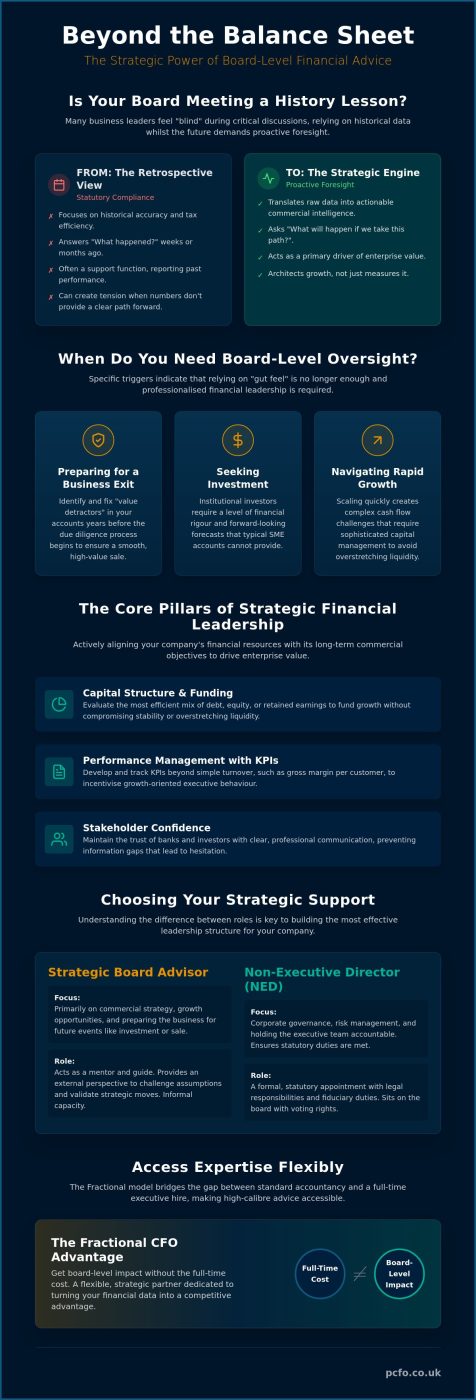
Transitioning from statutory compliance to strategic foresight is a critical milestone for any scaling SME. Most businesses reach an inflection point where the complexity of their operations outgrows the capacity of a traditional bookkeeping or accounting function. At this stage, looking in the rear-view mirror is no longer sufficient. Within the framework of robust Corporate Governance, board-level advice ensures that leadership teams are equipped with forecasts that anticipate risks before they crystallise. It moves the conversation from “what happened?” to “what will happen if we take this path?”
The Difference Between Accounting and Board-Level Strategy
Accountants are trained to focus on precision, historical accuracy, and tax efficiency. These are vital, but they’re not the primary drivers of enterprise value. In contrast, a board advisor focuses on the relationship between capital allocation and risk. By interpreting complex data sets, they provide a business growth advisory uk service that directly influences your ability to scale safely. They don’t just report that margins have dipped; they identify the structural cause and model the impact of different corrective strategies on your long-term valuation. This shift ensures you aren’t just measuring growth, but actively architecting it.
When Your Business Needs Board-Level Oversight
Relying on “gut feel” is often what gets a business off the ground, but it becomes a liability once turnover increases or external stakeholders enter the frame. There are specific triggers that indicate a need for professionalised board level financial advice:
- Preparing for a Business Exit: You need to identify and fix “value detractors” years before the due diligence process begins.
- Seeking Investment: Institutional investors require a level of financial rigour that typical SME accounts cannot provide.
- Navigating Rapid Growth: Scaling quickly often creates cash flow gaps that require sophisticated capital management.
Professional oversight ensures that your financial reporting meets these elevated expectations. It transforms your finance function into a pillar of credibility that impresses investors and provides the leadership team with the clarity needed to make high-stakes decisions with total composure.
The Core Pillars of Strategic Financial Leadership
Strategic financial leadership isn’t a passive function. It requires an active, deliberate alignment of your company’s financial resources with its long-term commercial objectives. High-quality **board level financial advice** ensures that every pound of capital is deployed to support your vision, whether that involves aggressive organic expansion or a targeted acquisition strategy. To see how international specialists help firms reach their potential, you can discover KHT Accounting & Wealth. It moves the finance function from a support role to a primary driver of enterprise value.
Leaders must make informed decisions about how to fund growth. This involves evaluating your capital structure to determine the most efficient mix of debt, equity, or retained earnings. An advisor assesses your specific business lifecycle to ensure that expansion doesn’t overstretch your liquidity, particularly whilst the Bank of England base rate remains a significant factor in 2026. They provide the steady hand needed to navigate these complex funding choices without compromising the company’s stability.
Effective leadership also relies on performance management that goes beyond simple turnover targets. It’s about developing KPIs that drive growth-oriented executive behaviour. This might include tracking gross margin per customer or monitoring the cost of acquisition against lifetime value. Additionally, maintaining the confidence of banks and investors is paramount. Clear, professional communication regarding your financial health prevents the “information gap” that often leads to restrictive lending terms or investor hesitation. By professionalising this stakeholder management, you build a foundation of trust that is essential for future funding rounds.
Scenario Modelling and ‘What-If’ Analysis
Static budgets often fail because they don’t account for the volatility of the real world. Board-level advice turns these into strategic budgeting and forecasting tools that evolve with your business. Scenario modelling is a tool for mitigating the ‘unknown unknowns’ of scaling. It allows you to stress-test your business against potential market shifts or operational failures. By modelling various outcomes, you can create contingency plans that protect your cash flow before a crisis occurs, ensuring you stay in control regardless of external pressures.
Risk Management and Governance
Protecting your bottom line requires robust financial risk management uk. Advisors help the board understand their fiduciary duties and compliance obligations, which is particularly vital with the major amendments to FRS 102 effective in 2026. They identify “single points of failure” in your financial model, such as over-reliance on a single revenue stream or fragile debt covenants. If you’re looking to strengthen your oversight, a fractional Finance Director can provide this level of rigour and intellectual foresight without the overhead of a full-time executive hire.
Board Advisor vs. Non-Executive Director: Choosing Your Support
Choosing the right support structure is a pivotal decision for any growing SME. Whilst both Non-Executive Directors (NEDs) and Board Advisors provide high-level oversight, their functions and impact on your day-to-day strategy differ significantly. A NED typically brings a broad range of experience and focuses heavily on governance, whereas a Board Advisor often provides deep, specialist expertise to solve specific commercial challenges. This distinction is crucial for leaders who need more than just a sounding board.
For many UK business leaders, the weight of board level financial advice is best delivered through a specialist advisor rather than a generalist director. This is particularly true for firms that have outgrown their current accounting function but aren’t yet ready for a full-time executive hire. A fractional CFO acts as a strategic partner, providing the intellectual rigour of a seasoned executive without the long-term commitment or the high expense of a permanent board appointment. This flexibility allows your leadership team to scale its support in line with its growth trajectory.
The Legal and Fiduciary Distinctions
NEDs share legal responsibility for board decisions, which can sometimes lead to a more cautious or compliance-led approach. Advisors, however, operate without this fiduciary liability, allowing them to provide more objective and “challenging” guidance. This independence is invaluable during a strategic sale, where you need a financial specialist who can scrutinise every detail of your valuation without being constrained by the formal requirements of a directorship. They can be more direct about identifying weaknesses that a formal director might hesitate to highlight.
Practical Implementation: Advisor or NED?
Deciding between the two depends on whether your immediate priority is governance or growth. If you require formal oversight to satisfy regulatory bodies, a NED is the standard choice. If your focus is on driving performance, managing capital, or professionalising your boardroom reporting, an advisor is often more effective. In 2026, many SMEs are adopting a hybrid approach. They use a fractional FD to lead the finance function strategically, ensuring that board level financial advice remains agile and responsive to market shifts. This model offers a superior cost-benefit ratio, as it provides high-impact results with flexible, contractual terms that adapt to your specific business lifecycle.
How Board-Level Advice Drives Business Exit and Growth
Growth and exit strategy are often viewed as separate phases, but in a well-governed business, they are two sides of the same coin. The quality of your financial hygiene today dictates the valuation you can command tomorrow. Expert board level financial advice ensures that your business is always “sale-ready,” even if an exit is years away. This proactive approach identifies value detractors, such as high customer concentration or inconsistent revenue streams, before they reach a potential buyer’s due diligence team.
Strategic advisors also play a vital role in benchmarking your performance against industry peers. They provide context to your numbers, showing where you lead and where you lag amongst your competitors. This insight allows for strategic overhead reduction that preserves your operational capacity whilst sharpening your competitive edge. It’s about removing the “fat” without cutting the “muscle” that drives your core value proposition.
Maximising Valuation for Exit
A sophisticated buyer doesn’t just buy your past profits; they buy confidence in your future earnings. High-level financial leadership adds a premium to your valuation by presenting “clean” management accounts and defensible, data-backed forecasts. When a buyer sees professionalised reporting and a clear narrative behind the numbers, the perceived risk of the acquisition drops. This transparency often leads to better deal structures and higher multiples, as it demonstrates that the business is managed with intellectual rigour rather than just intuition.
Sustainable Scaling Strategies
Scaling a business requires a delicate balance between ambition and liquidity. The right board level financial advice prevents the “over-trading” trap, where a company grows so quickly that its working capital is exhausted before the rewards of that growth are realised. Your advisor ensures you have the necessary “runway” to support new projects, advising on precisely when to pivot, when to invest, and when to consolidate. This steady hand at the helm prevents the cash flow crises that often kill promising SMEs during their most aggressive growth phases. For manufacturing leaders seeking specialised industrial advisory, click here.
If you’re planning to scale your operations or prepare for a future sale, our Exit Strategy Support services provide the strategic navigation you need to maximise your enterprise value.
Fractional CFOs: Accessing Board-Level Expertise Flexibly
The fractional model is the “Goldilocks” solution for UK SMEs navigating the complexities of 2026. It provides a level of intellectual rigour that a standard accountant cannot offer, without the prohibitive overhead of a full-time executive. PCFO bridges this gap by delivering high-impact board level financial advice on a part-time basis. This approach allows you to embed a seasoned Finance Director into your leadership team for just a few days a month, providing the strategic weight needed to navigate scaling risks or exit preparations.
Having an experienced hand in your board meetings transforms the quality of discussion. Instead of debating historical figures, the board can focus on future-proofing the business. An advisor from PCFO acts as an embedded partner, invested in your long-term trajectory whilst maintaining the objective distance required to challenge the status quo. This ensures that your financial strategy is proactive rather than reactive, positioning your firm as a professionalised entity ready for its next milestone.
The ROI of Fractional Financial Leadership
Comparing the fractional cfo pricing uk against the cost of a full-time hire reveals a significant efficiency gain. You gain access to decades of institutional knowledge for a fraction of the traditional salary and benefit package. Often, a single strategic intervention, such as restructuring a debt facility to better suit the 2026 interest rate environment or identifying a major value detractor before an exit, pays for the advisor’s annual fee many times over. This external perspective is particularly valuable because it isn’t bogged down in day-to-day administrative tasks, allowing the advisor to focus exclusively on high-value strategic navigation.
Next Steps for Your Board
To begin, you should audit your current financial support to identify where strategic gaps exist. Ask whether your current team provides the foresight required to meet your 2026 growth targets or if they’re simply keeping the books in order. Preparing for your first session with a board-level financial advisor involves clarifying your three-year vision and identifying your primary financial anxieties. For businesses seeking a comprehensive upgrade, exploring outsourced accountancy solutions that include strategic oversight is often the most effective route to professionalising your boardroom.
PCFO stands ready to be the authoritative strategic partner for your next growth phase. Whether you require board level financial advice to secure investment or to architect a high-value exit, our fractional services provide the steady hand at the helm that your business deserves.
Architecting Your Business Legacy for 2026 and Beyond
The transition from retrospective accounting to strategic foresight is no longer a luxury for UK SMEs; it’s a fundamental requirement for sustainable growth. By professionalising your boardroom reporting and addressing value detractors early, you ensure your business remains resilient against market volatility. High-calibre board level financial advice provides the clarity needed to make high-stakes decisions with composure, whether you’re navigating rapid scaling or preparing for a strategic exit.
Accessing this level of expertise doesn’t require the overhead of a full-time executive hire. The fractional model offers the intellectual rigour and external perspective of a seasoned Finance Director on a flexible basis that adapts to your specific lifecycle. This steady hand at the helm ensures your capital is always aligned with your long-term vision, protecting your margins whilst you focus on commercial expansion.
Secure the strategic financial leadership your board deserves with PCFO. Our expert fractional FD and CFO services provide the specialist growth and exit strategy advisory required to transform your finance function into a powerful engine for success. You have the vision for your company’s future; we provide the financial roadmap to get you there safely.
Frequently Asked Questions
What is the difference between board-level financial advice and management accounting?
Management accounting focuses on producing accurate historical reports, whereas board level financial advice interprets those reports to influence commercial strategy. Management accounts tell you where you’ve been; board-level advice tells you where you’re going and how to manage the risks along the way. It moves the conversation from simple data collection to strategic navigation.
Do I need a full-time CFO to get board-level financial support?
You don’t need a full-time hire to access high-level expertise. Fractional CFO services allow SMEs to benefit from the same intellectual rigour for just a few days a month. This model is highly efficient for businesses that need strategic weight but don’t yet require a permanent executive presence. It provides the steady hand at the helm without the associated overhead.
How much does a board-level financial advisor cost for an SME?
The investment for an advisor is typically structured as a monthly retainer or a day rate based on your specific requirements. This represents a fraction of the investment required for a full-time CFO. Because the service is tailored to your business lifecycle, it provides a superior return on investment by focusing on high-value strategic outcomes rather than administrative tasks.
Can a board advisor help with our business exit strategy?
A board advisor is essential for preparing an exit strategy. They identify and address “value detractors” well before you reach the due diligence stage. By professionalising your accounts and creating defensible forecasts, they help you command a premium valuation from potential buyers. Their role is to ensure the business is always in a sale-ready state.
What should I look for when hiring a financial advisor for my board?
Look for a partner who possesses both industry-standard financial qualifications and a proven track record of strategic leadership. Your advisor should have deep institutional knowledge of your specific growth stage. They must be able to act as a “financial conscience” who can challenge your assumptions whilst supporting your long-term vision with intellectual rigour.
How often should a board-level financial advisor attend our meetings?
Most advisors attend your monthly board meetings and provide additional strategic support throughout the month. The frequency is flexible and adapts to your company’s needs. During intense periods, such as a funding round or an acquisition, their involvement typically increases to provide the necessary tactical oversight and stakeholder management required for success.
Does a board advisor have the same legal responsibilities as a director?
Board advisors do not share the same legal or fiduciary responsibilities as a director. This distinction allows them to remain independent and objective. Because they don’t have the legal liability of a Non-Executive Director, they can offer more direct and challenging advice that focuses purely on the best commercial outcome for the business.
How does board-level advice differ from what my current accountant provides?
Standard accountants prioritise compliance, tax filings, and statutory accuracy. In contrast, board level financial advice focuses on capital allocation, risk management, and business growth advisory. It’s a shift from administrative support to a proactive partnership that architects the future of your firm rather than just reporting on its past.