

Why does a company with record-breaking turnover often find itself checking the bank balance before approving the monthly payroll? It’s a frustrating paradox that many UK SME owners face. You’re growing, yet your liquidity is perpetually trapped in slow-paying debtors or work-in-progress. With 25% of businesses identifying cash flow as their primary hurdle in 2026, the need for strategic working capital management services has never been more critical. It isn’t just about survival; it’s about ensuring your hard-earned revenue actually reaches your bank account.
We recognise the pressure of meeting HMRC obligations whilst trying to fund your next stage of expansion. You want a predictable cash cycle that doesn’t rely on expensive overdrafts, especially with the Bank of England base rate currently at 3.75%. This article outlines how expert fractional financial leadership helps you reclaim control. You’ll learn how to accelerate debt collection, optimise stock levels, and present a cleaner balance sheet that attracts high-value investors. We’ll examine the specific strategies that turn stagnant capital into a proactive engine for growth and a significantly higher business valuation.
Key Takeaways
- Learn why shifting from a historical accounting perspective to a strategic CFO view transforms your balance sheet into a proactive growth engine.
- Discover how professional working capital management services optimise your receivables, payables, and inventory to unlock vital liquidity for expansion.
- Understand the “Working Capital Peg” and how proactive management prevents potential buyers from reducing your business valuation during the exit process.
- Follow a practical five-step framework to embed a cash-aware culture across your entire team, ensuring long-term financial stability and predictable cash flow.
- Explore the strategic benefits of fractional financial leadership in executing high-level cash flow improvements without the overhead of a full-time executive hire.
Understanding Working Capital Management: More Than Just a Balance Sheet Metric
At its simplest level, working capital represents the difference between your business’s current assets and its current liabilities. Whilst it appears as a static figure on your month-end reports, it’s actually the engine room of your company’s daily operations. Effective Working Capital Management ensures that you have the liquidity needed to pay suppliers and staff whilst waiting for customers to settle their invoices. It’s the oxygen that keeps your business breathing during periods of rapid expansion.
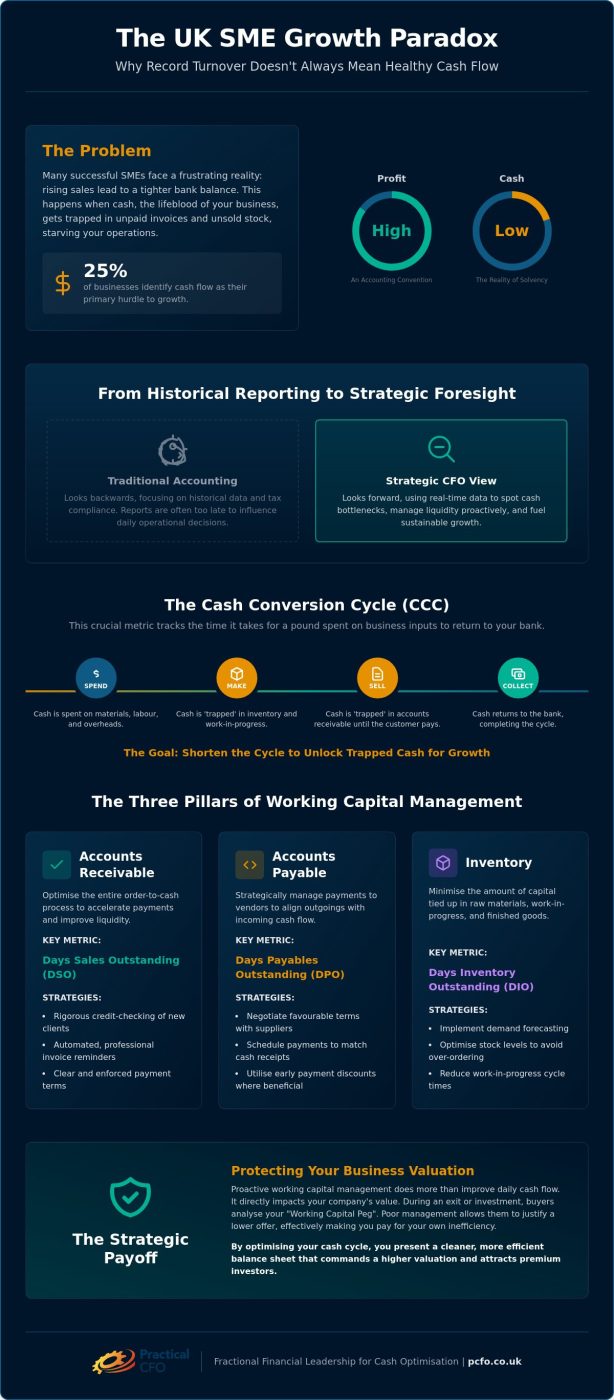
Many UK business owners encounter what we call the SME Growth Paradox. This occurs when rising sales actually lead to a tighter bank balance because the cash required to fulfil those orders is tied up in stock or debtors. This is why professional working capital management services focus on the Cash Conversion Cycle (CCC) as a primary KPI. This metric doesn’t just look at what you own; it tracks how many days it takes for a pound spent on inputs to return to your bank account as revenue. A forward-looking CFO view treats this cycle as a strategic lever rather than a historical record.
The Working Capital Cycle vs. Net Profit
It’s a hard reality that a profitable company can still go bust. Profit is an accounting convention; cash is the reality of your solvency. The journey of a pound starts when you purchase raw materials or pay for labour. It then sits in work-in-progress and eventually moves to finished goods. Even after a sale, that pound remains “trapped” until the customer pays. If this cycle is too long, you’ll struggle to pivot or seize new opportunities, regardless of your net profit margin. High-growth businesses must focus on reducing this “trapped cash” to fund their own expansion without relying on expensive debt.
Why Standard UK Accountancy Often Misses the Mark
Traditional compliance-focused accountants excel at historical reporting and tax filings. However, year-end accounts are often produced too late to influence day-to-day liquidity decisions. Managing a growing SME requires a shift from looking in the rear-view mirror to a strategic, forward-looking Finance Director approach. You need more than just a balance sheet; you need real-time strategic financial reporting for smes uk. This level of insight allows you to spot cash bottlenecks before they become crises. By utilising specialised working capital management services, you bridge the gap between basic bookkeeping and high-level strategic leadership, ensuring your financial data actually informs your growth decisions.
The Three Pillars of Strategic Working Capital Management Services
To optimise your cash flow, a strategic Finance Director focuses on three primary levers: Receivables, Payables, and Inventory. Whilst large corporations have entire departments dedicated to these areas, Traditional Working Capital Management often fails SMEs because it lacks the necessary scale or executive oversight. This is where fractional working capital management services provide a competitive advantage. We apply the same rigour found in FTSE 250 firms but tailor the execution to fit your specific operation. This approach brings “big business” discipline to your finance function without the associated overheads.
Accounts Receivable: Optimising the Order-to-Cash Process
Accounts Receivable is about more than just chasing overdue invoices. It’s a systemic programme that begins with rigorous credit-checking of new UK clients and ends with automated, professional reminders. By implementing these structures, you reduce the emotional friction of asking for money whilst protecting your vital customer relationships. Days Sales Outstanding (DSO) serves as the ultimate metric here, measuring the average number of days it takes to collect payment after a sale has been made. Reducing your DSO by even a few days can significantly improve your liquidity position.
Accounts Payable: Strategic Vendor Management
Strategic vendor management involves aligning your outgoing payments with your incoming cash cycles. With the Bank of England base rate currently at 3.75%, the cost of using external credit to bridge these gaps is increasingly high. We help you negotiate payment terms that provide breathing room without damaging your reputation amongst suppliers. In some cases, utilising early-payment discounts is the right move, provided your cash reserves are robust enough to support it. The goal is to maintain a healthy supply chain whilst keeping as much cash as possible within your control.
Inventory and Work-in-Progress (WIP) Control
For product-based businesses, excess stock is simply “dead cash” sitting on a warehouse shelf. For service-based SMEs, the equivalent is Work-in-Progress (WIP). If you aren’t hitting billing milestones or managing the lag between project start and the final invoice, your liquidity will suffer. Effective working capital management services implement “Just-in-Time” principles to ensure your capital is always working, not waiting. This prevents unbilled revenue lag and ensures that your internal resources are converted into cash as quickly as possible.
For companies that source or manufacture products in Asia, lead times and quality control are critical factors in maintaining liquidity. You can explore End-to-End Sourcing & Procurement with Buying Office Asia to better align your production cycles with your cash flow requirements.
None of these strategies work without high-quality, reliable data. Accurate, real-time information from outsourced accountancy solutions provides the visibility needed to make these strategic decisions. If your current financial setup feels more like a burden than a tool, exploring professional Finance Director Services can help you move from reactive survival to proactive growth.
Working Capital as a Catalyst for Business Valuation and Exit
Strategic buyers and private equity firms don’t just look at your EBITDA; they scrutinise how much of that profit actually turns into cash. A business that consistently converts its earnings into liquid reserves signals a low-risk, high-quality operation. By utilising specialised working capital management services, you demonstrate to potential acquirers that your finance function is under control. This level of operational discipline often justifies a higher exit multiple because the buyer sees a “clean” balance sheet that won’t require immediate post-acquisition capital injections.
During the due diligence process, the “Working Capital Peg” becomes a critical point of negotiation. This is a target level of working capital that must be delivered at completion, usually based on a 12-month historical average. If your management has been lax or inconsistent, you may find yourself with a shortfall that leads to a direct “price chip” on your final sale figure. Integrating exit strategy planning services early allows you to normalise these levels, ensuring you don’t leave money on the table when you decide to step away.
How Efficient Cash Flow Drives Higher Exit Multiples
Buyers pay a premium for businesses that generate cash rather than consume it. In a “Debt-Free, Cash-Free” valuation, any surplus cash you’ve managed to retain through efficient cycle management adds directly to your proceeds. Predictable cash flow reduces the risk profile for the buyer, making your company a far more attractive prospect amongst a sea of competitors. When your cash flow is robust and transparent, it builds a foundation of trust that carries through the entire due diligence process.
Funding Growth Internally: The “Self-Funding” SME
In 2026, with the Bank of England base rate at 3.75%, the cost of external capital remains a significant burden for UK SMEs. Funding your own expansion through internal cash is far more efficient than taking on high-interest debt or diluting your equity with venture capital. By focusing on business growth advisory uk initiatives, you can use freed-up liquidity to fuel new ventures. For instance, reducing your DSO by just 10 days in a business with £5 million in annual turnover can unlock approximately £137,000 in immediate liquidity. This is often enough to fund a senior hire or a new marketing campaign without signing a single loan agreement or giving away a percentage of your business.
Implementing a Working Capital Strategy: A Practical UK Framework
Regaining control of your liquidity requires a shift from reactive fire-fighting to a proactive, structured framework. Whilst technology plays a role, the most successful UK SMEs focus on leadership and process change to drive results. Professional working capital management services provide the external discipline needed to implement these changes effectively. This transition begins with visibility and ends with a fundamental shift in company culture where every department understands its impact on the bank balance.
Establishing cash flow forecasting services as a non-negotiable starting point is essential for any growth-focused business. Without a clear view of your future requirements, any strategy is merely guesswork. By integrating these insights into your monthly board packs, you ensure that cash efficiency remains a top-level priority alongside revenue and profit.
Step 1: Diagnostic and Cash Flow Visibility
We begin by conducting a thorough “Cash Leakage” audit to identify exactly where liquidity is being trapped. This involves setting up 13-week rolling forecasts that allow you to predict potential “pinch points” several months before they occur. For this diagnostic to be effective, your outsourced finance function uk must provide accurate, real-time data that reflects the current state of your debtors and creditors. This visibility provides the confidence to make strategic decisions rather than operating in a state of constant financial anxiety.
Step 2: Process Redesign and Policy Setting
Once you have visibility, the next step is standardising your credit terms and “stop-work” policies for late payers. We help you automate the accounts payable workflow to ensure you never miss a deadline or incur unnecessary penalties from HMRC or vital suppliers. A formal, written Collections Policy provides your team with the authority and clear parameters needed to escalate late payments without hesitation or inconsistency. This systemic approach removes the emotional friction often associated with credit control in smaller firms.
Step 3: KPI Tracking and Accountability
Specific, measurable targets are the only way to ensure long-term improvement. We define and track key metrics such as Days Sales Outstanding (DSO), Days Payable Outstanding (DPO), and Inventory Turnover. Crucially, ownership of these metrics must extend beyond the finance team; sales managers should be accountable for the quality of the debt they bring in, whilst operations leads manage stock levels. These figures should be reviewed as part of a formal finance director review to ensure the business remains on track.
If your business is ready to move beyond basic bookkeeping and implement a robust liquidity strategy, our Finance Director Services provide the expert leadership required to execute this framework. We don’t just provide working capital management services; we become an embedded partner in your long-term success.
The PCFO Approach: Fractional Financial Leadership for Cash Optimisation
PCFO operates as an embedded strategic partner rather than a distant consultancy. We recognise that for a growing SME, advice without execution is often a burden. Our working capital management services are designed for businesses that need a steady, experienced hand to actually implement the process changes we recommend. We don’t just identify where your cash is trapped; we work alongside your team to unlock it, ensuring that your financial strategy translates into tangible bank balance improvements.
Choosing a fractional model provides your business with high-level expertise at a fraction of the cost of a full-time executive. Many SMEs find that they don’t require a £150,000-a-year CFO on a permanent basis, yet they desperately need that level of intellectual rigour for strategic projects. Our Finance Director Services offer the flexibility to scale support as your business evolves, providing the intellectual capital of a seasoned professional exactly when it’s required. This approach ensures your resources are focused on growth rather than executive overheads.
Why an Outsourced Finance Director Outperforms Software Alone
Algorithms and automation are excellent for data entry, but they lack the human judgement required for complex financial navigation. Software cannot negotiate a delicate payment plan with a key supplier or sense the subtle shift in a long-standing customer’s payment behaviour. An experienced FD interprets the data to make strategic “pivot” decisions that software simply cannot see. This distinction is central to the debate between hiring an fp&a consultant vs software uk. While tools provide the “what”, a strategic partner provides the “why” and the “how”.
Partnering with a Strategic Finance Partner
PCFO integrates directly into your board to provide high-level oversight and objective accountability. The synergy between PCFO and our sister brand, Practical Accounting, ensures a seamless flow from raw data to high-level strategy. This partnership removes the friction often found between bookkeeping and executive decision-making. Whether you are navigating rapid expansion or preparing for a high-value sale, having a “steady hand” at the helm provides the reassurance you need to lead with confidence.
The first step toward a more liquid, valuable business is understanding your current position. We invite you to begin a comprehensive working capital audit with our team. By utilising our Chief Financial Officer Services, you gain access to the proactive mindset and strategic foresight required to future-proof your business. Let us help you turn your finance function into a powerful engine for internal funding and long-term success.
Transforming Your Cash Flow into a Strategic Asset
Effective liquidity management is the foundation upon which sustainable growth is built. We’ve explored how shifting from a historical accounting view to a forward-looking CFO perspective allows you to unlock trapped cash and fund expansion internally. By optimising the three pillars of receivables, payables, and inventory, you don’t just improve your daily operations; you build a cleaner balance sheet that commands a premium during any future exit process.
Professional working capital management services bridge the gap between basic data and strategic execution. Our fractional model provides high-level expertise in fractional cfo pricing uk and ROI, ensuring you gain board-level oversight at a fraction of the cost of a full-time hire. As specialists in UK SME growth and exit planning, we are ready to help you navigate these complexities with confidence and intellectual rigour.
Take the first step toward a more resilient financial future today. Book a strategic consultation with a PCFO Finance Director to discuss your specific organisational needs. We look forward to partnering with you to turn your finance function into a proactive engine for long-term success.
Frequently Asked Questions
What are working capital management services exactly?
Working capital management services involve the strategic oversight of a company’s current assets and current liabilities to ensure operational liquidity. These services focus on optimising the “Order-to-Cash” and “Purchase-to-Pay” cycles. By refining how you manage debtors, creditors, and stock, a consultant ensures your business has enough cash to meet its short-term obligations whilst funding growth.
Why does my UK SME need professional working capital management if we are profitable?
Profit is an accounting metric, but cash is what settles your bills and pays your staff. Many profitable UK SMEs fail because their cash is trapped in slow-paying debtors or excess inventory during rapid expansion. Professional management ensures that your profits are actually realised in your bank account, preventing the “growth paradox” where increasing sales leads to a tighter cash position.
How does a fractional CFO improve my cash conversion cycle?
A fractional CFO improves your cash conversion cycle by implementing systemic changes to your billing and collection processes. They introduce rigorous KPIs, such as Days Sales Outstanding (DSO), and negotiate better terms with suppliers. By identifying bottlenecks in your work-in-progress or stock management, they reduce the time it takes for a pound spent to return to your business as revenue.
Can working capital management services help with HMRC debt or late payments?
Yes, these services provide the visibility needed to manage HMRC obligations and late payments proactively. By improving your overall liquidity, you can meet VAT and Corporation Tax deadlines without straining your daily operations. A strategic advisor also helps you navigate the Small Business Protections (Late Payments) Bill, ensuring you leverage new regulations to collect what you are owed more efficiently.
While these strategies focus on UK-specific regulations, business owners with US-based interests facing more severe financial difficulty or requiring formal restructuring can check out Law Offices of Matthew T. Desrochers, P.C. for expert legal counsel on debt relief and bankruptcy.
What is the difference between a bookkeeper and a working capital consultant?
A bookkeeper focuses on the accurate recording of historical transactions and compliance. In contrast, a working capital consultant, acting as a fractional FD, provides forward-looking strategic leadership. They don’t just record the data; they interpret it to make decisions that improve your future cash position and business valuation. This distinction is critical for businesses moving beyond basic administration into active growth phases.
How long does it take to see results from a working capital optimisation project?
You can typically expect to see improved visibility within the first 30 days of a project through better forecasting. Tangible cash flow improvements usually follow within three to six months as new credit control policies and supplier terms take effect. The speed of results often depends on the complexity of your current debtor book and how quickly you implement the recommended process changes.
Will managing my working capital more strictly damage my supplier relationships?
Strict management does not mean aggressive behaviour; it means professional consistency. Suppliers often prefer working with a “cash-aware” business that communicates clearly and pays reliably on agreed terms. By optimising your own receivables, you ensure you have the funds to settle supplier invoices on time, which actually strengthens your reputation and can lead to better long-term commercial terms.
How much does it cost to hire a fractional FD for working capital management?
Hiring a fractional Finance Director is significantly more cost-effective than employing a full-time executive. The cost varies based on the scope of the project and the level of ongoing support your business requires. Because you only pay for the expertise you need, the return on investment is often realised quickly through the liquidity unlocked during the initial optimisation phase.