

Most business owners believe the sale is won at the negotiating table, but the reality is that your exit value is decided months before a buyer even sees your books. Selling a company is often the most significant financial event of your career, yet it’s frequently shadowed by the fear of a deal collapsing during due diligence or the exhaustion of managing operations whilst fielding complex enquiries. This is where dedicated m&a support for sellers becomes an essential asset rather than an optional expense.
You likely feel the weight of maintaining business performance while trying to present your financial data in a way that satisfies sophisticated investors. We recognise that this uncertainty can be taxing. This guide explains how strategic financial support transforms a stressful transaction into a high-value exit that protects your legacy. We will outline the essential steps to professionalise your finance function, level the playing field with buyers, and ensure your business is positioned for its maximum potential value in the 2026 market.
Key Takeaways
- Understand why the 2026 UK market requires a shift from simple brokerage to a strategic partnership that prioritises financial transparency and rigour.
- Learn how normalising EBITDA and removing non-core liabilities can significantly enhance your valuation before you enter negotiations.
- Discover how professional m&a support for sellers levels the playing field, ensuring your data is presented with the authority required by sophisticated buyers.
- Identify common “deal breakers” in the due diligence process and how to pre-emptively address them through an organised digital data room.
- Recognise the importance of chemistry and strategic expertise when selecting a partner to guide you through the complex 6–12 month sale journey.
Understanding the M&A Landscape for SME Sellers
The process of Mergers and acquisitions (M&A) is often perceived as a purely legal or transactional event. For SME owners in 2026, it’s actually a profound strategic shift that requires far more than a simple broker’s introduction. Effective m&a support for sellers now functions as a comprehensive partnership. It bridges the gap between your current operational reality and the high-performance expectations of sophisticated buyers who are looking for more than just a healthy balance sheet.
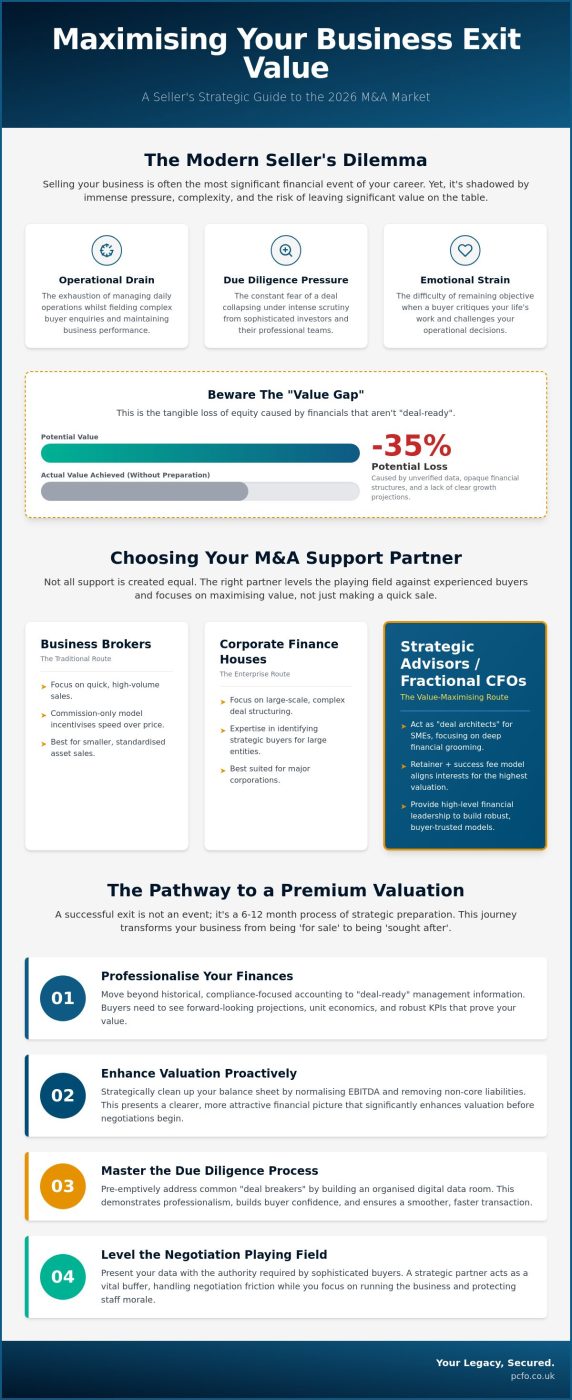
Many businesses fail to reach their true valuation because they suffer from a “Value Gap.” This isn’t just a difference in opinion on price; it’s the tangible loss of equity caused by unverified data, opaque financial structures, or a lack of clear growth projections. In the current UK market, strategic buyers are prioritising resilience and scalability. They’ll pay a premium for companies that can demonstrate a clear, data-backed path through market volatility, but they’ll quickly discount any business that lacks transparent financial leadership.
Why Traditional Accounting Isn’t Enough for a Sale
Historical reporting is designed for HMRC and statutory compliance, not for a private equity exit. Your year-end accounts won’t satisfy a buyer who needs to understand unit economics, customer lifetime value, or forward-looking EBITDA projections. Strategic m&a support for sellers ensures you move beyond basic compliance. You need “deal-ready” management information and robust KPIs that stand up to the intense scrutiny of a professional due diligence team. Without this level of detail, you’re entering a negotiation with one hand tied behind your back.
The Psychological Reality of Selling Your Business
Selling a company you’ve built is an emotional rollercoaster. It’s incredibly difficult to remain objective when a buyer critiques your life’s work or challenges your operational decisions. A strategic partner acts as a vital buffer, handling the friction of negotiations while you focus on the essential task of maintaining business-as-usual. Protecting staff morale is equally critical during this period. A premature leak can destabilise your entire team, yet a professional advisor ensures confidentiality is maintained and that your exit strategy doesn’t compromise the stability of the organisation.
Evaluating the Different Types of M&A Support
Selecting the right team is the first critical decision in your exit journey. Not all m&a support for sellers is created equal, and the depth of expertise required often depends on the complexity of your organisation. Business brokers are typically suitable for smaller, high-volume asset sales where the process follows a relatively standardised template. Conversely, corporate finance houses focus heavily on deal structuring and identifying strategic buyers for larger entities. For many UK SMEs, the most effective support comes from a combination of external intermediaries and an internal strategic lead who understands the company’s financial DNA.
Choosing the right m&a support for sellers is about more than just finding a buyer; it’s about finding a partner who understands your long-term trajectory. Specialist M&A advisory firms UK such as Pinnacle Global Advisory provide the corporate finance expertise needed to navigate complex buy-side and sell-side transactions, ensuring your business is presented in its best light. This collaborative approach levels the playing field when dealing with experienced corporate acquirers who have dedicated teams for every stage of the transaction.
Brokers vs. Strategic M&A Advisors
Brokers typically operate on a commission-only basis. This aligns interests for a quick sale but might not incentivise the deep financial grooming required for a premium valuation. Strategic advisors often use a mix of retainers and success fees. This model supports a more thorough approach to what to expect when selling your business. It ensures you aren’t just finding any buyer, but the right one at the right price. Strategic partners invest significant time in understanding your unique value drivers before the business ever goes to market.
The Rise of the Fractional CFO in M&A
Fractional CFOs have become the “deal architects” for modern UK SMEs. They provide high-level financial leadership without the prohibitive cost of a full-time executive. When evaluating fractional cfo pricing uk, it’s clear that this model offers a superior return on investment by focusing on specific “exit-ready” tasks. This includes cleaning up balance sheets and building robust financial models that sophisticated buyers trust. A part-time FD ensures your internal data matches your external claims, providing the intellectual rigour necessary to survive due diligence.
Finally, legal advisors protect your interests during the Sale and Purchase Agreement (SPA) negotiations. They act as the final gatekeepers, ensuring that warranties and indemnities don’t leave you with unexpected liabilities after the deal closes. If you’re currently preparing for a sale, engaging with strategic exit strategy support can help you determine which partners are necessary for your specific business lifecycle. This structured preparation ensures no detail is overlooked in the final stages of the transaction.
The Role of Strategic Finance in Pre-Sale Preparation
Preparation is the phase where you move from being a business operator to a business seller. While external brokers focus on the market, your internal m&a support for sellers focuses on the financial engine that drives your valuation. This grooming process isn’t about hiding flaws; it’s about presenting a transparent, professional, and scalable organisation that justifies a premium multiple. You’re essentially building a bridge between your current operational reality and the buyer’s future expectations.
A critical first step is establishing a baseline through a formal business valuation for exit. This clarifies the gap between your current worth and your target sale price. From there, you must normalise your EBITDA. Buyers want to see the underlying profitability of the business without one-off legal fees, personal expenses, or non-market-rate salaries. Professional financial presentation, as advocated by industry bodies like the M&A Source, is often the deciding factor in whether a buyer proceeds past the initial enquiry.
Optimising Your Financial House
A clean balance sheet is essential for a smooth transaction. This involves removing non-core assets, such as personal vehicles or redundant property, that could complicate the deal. You should also scrutinise your revenue quality. Buyers value recurring, contracted income far more than transactional, one-off sales. We also focus on reducing founder dependency. If the financial processes exist only in your head, the buyer sees a risk. Documented, repeatable systems ensure the business can thrive without you, which directly increases its marketability.
Creating a Compelling Financial Narrative
Your financial data should tell a story of future potential, not just past performance. By utilising business growth advisory uk, you can identify untapped profit levers that a new owner could exploit. This data forms the backbone of your Information Memorandum (IM). A well-prepared IM doesn’t just list numbers; it provides a robust three-year financial forecast that buyers can trust. When your projections are backed by logical assumptions and historical evidence, you significantly reduce the perceived risk for the acquirer. This level of m&a support for sellers ensures that your financial narrative is as compelling as your operational success.
Navigating the Due Diligence Process
Due diligence is often the point where the initial excitement of a sale meets the cold reality of forensic scrutiny. This phase requires meticulous m&a support for sellers to ensure that every query is answered with precision and speed. A disorganised response doesn’t just delay the process; it creates doubt in the buyer’s mind. This uncertainty often leads to a lower offer or, in the worst cases, a complete deal collapse. You must be prepared to defend every number you’ve presented.
Think of your virtual data room as a digital filing cabinet designed for maximum transparency. It should be structured logically before the first buyer even signs an NDA. When you provide information promptly, you maintain the momentum of the deal. Speed is your best friend. Conversely, “deal fatigue” is a genuine risk during a 6 to 12-month sale process. If the transaction drags on because of missing documents, both parties lose enthusiasm, and the business’s operational performance may start to suffer under the strain.
The Seller’s Strategic Financial Checklist
Professional preparation involves auditing your own data before the buyer’s team arrives. We recommend using a structured preparing for business sale uk guide to identify potential red flags in your legal, financial, and commercial records. By pre-empting common “deal breakers,” such as undisclosed liabilities or inconsistent revenue reporting, you stay in control of the narrative. This proactive approach ensures that you’re never caught off guard by a buyer’s interrogation.
Defending the Valuation
It’s common for buyers to attempt to “chip” the price during the final stages of due diligence. They might cite minor operational risks or market volatility as a reason to reduce their initial offer. This is where your fractional CFO becomes an invaluable asset. By using data-backed evidence to justify your growth projections and EBITDA normalisation, they act as a sophisticated shield against aggressive negotiation tactics. They handle the complex Q&A process, allowing you to focus on running the company and maintaining the performance that attracted the buyer in the first place.
Don’t let a buyer’s fishing expedition distract you from your daily operations or undermine your hard-earned valuation. If you’re concerned about how your accounts will stand up to professional scrutiny, explore our exit strategy support services to ensure your business is fully prepared for the due diligence process.
Choosing the Right Partner for Your M&A Journey
Finding the right partner to guide your exit is perhaps the most significant decision you’ll make since founding your company. Whilst many intermediaries focus solely on sector-specific contacts, the most effective m&a support for sellers prioritises deep strategic financial expertise. You need an advisor who doesn’t just find a buyer but actively engineers your business to be more attractive to one. This partnership often lasts between six and twelve months, making professional chemistry and mutual trust non-negotiable. You aren’t just hiring a contractor; you’re appointing a temporary board member who will represent your interests in the most high-stakes negotiation of your life.
A national perspective is particularly vital for UK SMEs in the current climate. Buyers for a regional firm might come from any corner of the country or even from international private equity groups. Your advisor must possess the reach and the reputation to engage with these diverse pools of capital effectively. PCFO’s model provides this high-level, board-ready support at a fraction of the cost of a full-time hire. This ensures that mid-sized businesses can access the same calibre of advice as much larger corporations, levelling the playing field during negotiations.
Questions to Ask a Potential M&A Advisor
When interviewing potential partners, you must look beyond their marketing materials to understand their actual methodology. We suggest asking the following questions to gauge their suitability for your exit:
- “Have you managed exits for businesses of our specific size and complexity, and what were the outcomes?”
- “How do you handle the transition to succession planning for founders to ensure the business remains stable post-sale?”
- “What is your specific process for financial pre-sale engineering and EBITDA normalisation?”
Strategic m&a support for sellers isn’t a one-size-fits-all service. It requires an advisor who understands the nuances of your specific business lifecycle and can adapt their strategy accordingly. Whether you are looking for a complete exit or a partial sale to a strategic partner, the financial foundations must be impeccable.
The PCFO Difference: Strategic Financial Leadership
We distinguish ourselves by being an embedded partner rather than a distant broker. Our exit strategy planning services are designed to integrate seamlessly with your daily operations, ensuring that your business continues to grow whilst we prepare the ground for a sale. We don’t just report on your history; we help you build a future that acquirers are willing to pay a premium for. We focus on intellectual rigour and proactive navigation, ensuring you are future-proofed against market volatility.
The first step towards a successful exit is a clear-eyed assessment of where you stand today. We offer a confidential diagnostic of your exit readiness to identify the specific profit levers that will maximise your value in the 2026 market. By addressing these gaps now, you transform a potentially stressful transaction into a controlled, high-value exit that protects your legacy and rewards your years of hard work.
Securing Your Legacy through Strategic Preparation
Successfully exiting your business in 2026 requires a shift from operational management to strategic financial engineering. You’ve learned that maximising value depends on normalising EBITDA, organising a transparent data room, and addressing founder dependency long before the first offer arrives. This rigorous preparation ensures that when you enter the due diligence phase, you’re doing so from a position of absolute strength. Your data must be undeniable.
Professional m&a support for sellers is the catalyst that transforms a standard transaction into a premium exit. At PCFO, our experienced Finance Directors provide the intellectual rigour and national UK coverage required to navigate these complexities whilst maintaining a boutique service feel. We have a proven track record in strategic exit planning and act as your dedicated deal architect throughout the entire journey.
Take the first step towards a rewarding exit by choosing a partner who is as invested in your legacy as you are. Book a Confidential Exit Strategy Consultation with PCFO today to assess your readiness and identify your key profit levers. Your hard work deserves a high-value conclusion, and with the right support, that outcome is well within your reach.
Frequently Asked Questions
What is the difference between an M&A advisor and a business broker in the UK?
M&A advisors typically focus on complex, high-value SME exits that require strategic financial engineering and a tailored approach to buyer identification. Business brokers often handle smaller, high-volume transactions using a more standardised process. Whilst brokers are often transactional intermediaries, a strategic advisor acts as an embedded partner who grooms the business to maximise its valuation before it ever reaches the market.
How much does M&A support for sellers typically cost in 2026?
In 2026, the cost of m&a support for sellers usually involves a combination of monthly retainers and a success fee. For lower-middle-market companies, monthly retainers often range from £5,000 to £25,000. Success fees are typically between 3% and 8% of the transaction value. This structure ensures that your interests are aligned and that the advisor is motivated to secure the highest possible value for your exit.
When is the best time to engage M&A support before a planned sale?
The most effective time to engage support is 12 to 24 months before your intended exit. This lead time allows for essential pre-sale engineering, such as normalising EBITDA and addressing founder dependency. Starting early ensures that your financial engine is fully optimised and that you have a robust track record of “deal-ready” data to present to sophisticated buyers when the process begins.
Can my current accountant provide the M&A support I need?
Whilst your current accountant is essential for statutory compliance and tax reporting, they may lack the specialised experience required for a corporate sale. M&A support requires a proactive, forward-looking mindset focused on deal structuring and buyer psychology. A fractional CFO or FD complements your existing team by acting as a strategic architect who prepares the business for the intense scrutiny of due diligence.
What are the most common reasons deals fall through during due diligence?
Deals often collapse because of “negative surprises” discovered during forensic scrutiny, such as inconsistent revenue data or undisclosed liabilities. Deal fatigue is another significant factor; if the process drags on because of poor preparation, both parties can lose momentum. Professional m&a support for sellers helps pre-empt these issues by auditing your data room and addressing potential red flags before a buyer identifies them.
How does a fractional CFO help with business valuation?
A fractional CFO identifies and justifies “add-backs” to your EBITDA, such as one-off expenses or non-market salaries, which can significantly increase your valuation. They build credible, three-year financial models that buyers can trust. By professionalising your financial narrative and highlighting untapped profit levers, they ensure you achieve a premium multiple rather than a standard industry average price.
Does M&A support include finding potential buyers?
Yes, comprehensive support involves identifying, vetting, and approaching potential strategic and financial acquirers. Advisors use their networks to create competitive tension amongst multiple parties, which is often the most effective way to drive up the final sale price. This process ensures that you aren’t just selling to the first interested party, but to the buyer who offers the best value and cultural fit.
How long does the M&A process usually take for a UK SME?
The entire process typically takes between 6 and 12 months for a UK SME. This timeline includes the initial financial grooming, marketing the business, and the final due diligence phase. Some transactions may take longer depending on the complexity of the deal or market volatility in 2026. Maintaining business-as-usual performance during this period is vital to ensuring the valuation remains stable until the point of completion.