

If an investor asked you exactly how a 10% increase in customer acquisition cost would impact your cash runway by next Christmas, could you answer with total confidence? Most founders find the complexity of financial modelling for startups UK to be a source of persistent anxiety. It’s common to feel overwhelmed by spreadsheets that feel more like a labyrinth of fragile formulas than a clear roadmap for your business’s future. You’re likely looking for a way to stop worrying about unexpected cash shortages and start answering tough questions about unit economics with ease.
We believe that a financial model should be a supportive tool, not a burden. This guide will show you how to build investor-ready models that secure vital funding and drive sustainable growth. By adopting a more structured approach, you’ll move from basic survival to high-level strategic leadership with a clear view of your path ahead. Our goal is to provide a sense of calm confidence as you prepare for your next stage of expansion.
We’ll explore how to create a credible roadmap that aligns with the 2026 SEIS and EIS regulations whilst providing visibility over your burn rate. This methodical progression ensures you have the intellectual rigour needed to navigate the UK’s evolving financial landscape and make informed, confident decisions for your startup’s long-term trajectory.
Key Takeaways
- Understand why robust financial modelling for startups UK is essential for securing SEIS/EIS funding and building long-term investor trust.
- Learn how to transition from simple revenue estimates to sophisticated projections based on Customer Acquisition Cost (CAC) and Lifetime Value (LTV).
- Discover why the bottom-up operational approach is the gold standard for creating credible, defensible growth roadmaps.
- Master scenario planning and sensitivity analysis to future-proof your business against market volatility and unexpected shifts in unit economics.
- Explore how a fractional CFO leverages your financial model as a dynamic strategic engine to lead high-level board discussions and manage cash runway.
What is Financial Modelling for Startups and Why Does it Matter in the UK?
At its core, What is Financial Modelling? It’s the mathematical representation of your company’s future performance. Whilst traditional accounting focuses on historical records, a strategic model looks ahead. It transforms your assumptions about sales, costs, and hiring into a dynamic map. For founders, this tool is the primary defence against the ‘valley of death’, that precarious period where cash reserves often dwindle before a startup reaches profitability. Using robust financial modelling for startups UK helps you anticipate these gaps before they become existential threats.
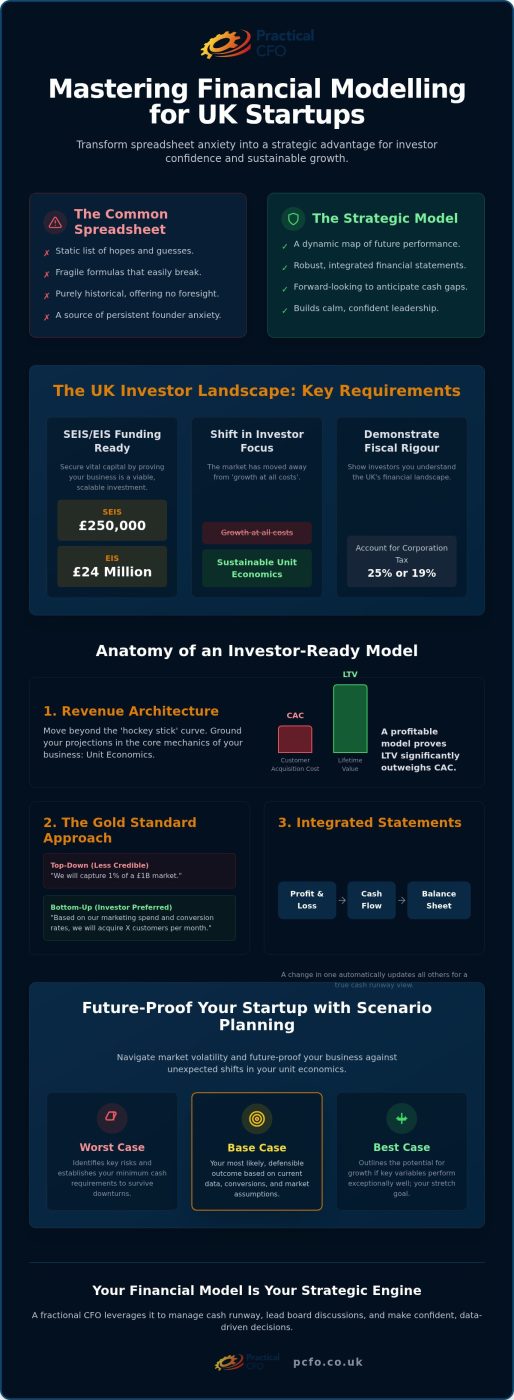
The UK investment landscape in 2026 requires more than a compelling pitch deck. To access vital capital, you must demonstrate a deep understanding of your fiscal environment. For instance, the Seed Enterprise Investment Scheme (SEIS) currently allows companies to raise up to £250,000 in total, whilst the Enterprise Investment Scheme (EIS) offers a lifetime limit of £24 million. Securing these funds requires a model that proves your business is a viable, scalable investment. It provides the intellectual rigour necessary to satisfy sophisticated investors who are looking for reliability and strategic foresight.
The Difference Between a Spreadsheet and a Strategic Model
A simple profit and loss (P&L) spreadsheet is often just a static list of hopes. A strategic model, however, is a living ecosystem. It must include integrated statements to be effective. Integrated financial statements are the bedrock of credible modelling because they ensure that a change in one area, such as a delayed customer payment, automatically updates your cash balance and balance sheet. This level of detail allows you to see the immediate impact of every operational decision on your actual cash runway. It moves your business beyond basic record-keeping into the territory of high-level financial leadership.
Why UK Investors Demand Robust Models in 2026
The UK market has shifted significantly. The focus has moved away from ‘growth at all costs’ toward sustainable unit economics and clear paths to profitability. Investors now look for founders who deeply understand their business drivers, such as customer acquisition costs (CAC) and lifetime value (LTV). A well-constructed model demonstrates this level of mastery. It shows you’ve accounted for the 25% main rate of Corporation Tax or the 19% small profits rate where applicable. Understanding The Strategic Role of a Finance Director can help you see how these high-level insights are integrated into daily operations to build long-term value. A model is your proof that you aren’t just guessing; you’re navigating with a steady, experienced hand.
The Core Components of an Investor-Ready Startup Model
An investor-ready model is more than a collection of tabs; it’s a coherent story of how your business creates value. When executing financial modelling for startups UK, you must bridge the gap between abstract vision and fiscal reality. This requires a granular focus on the drivers that actually move the needle. A steady, experienced hand at the helm of your strategy ensures that every assumption is backed by intellectual rigour rather than mere guesswork. By building a model that prioritises transparency, you alleviate the anxieties of both founders and potential backers.
Revenue Architecture: Drivers and Assumptions
Investors quickly see through “hockey stick” growth curves that lack underlying logic. Your revenue bridge should explain growth month-to-month based on specific conversion rates and defined sales cycles. It’s vital to shift the conversation from total sales to unit economics. By detailing your Customer Acquisition Cost (CAC) and Lifetime Value (LTV), you prove the business model is inherently profitable. This level of detail is essential when preparing financial forecasts for your business plan, as it demonstrates you understand your market’s mechanics. High-quality models account for the friction in the sales funnel, ensuring that projections remain grounded in reality.
UK Specifics: SEIS, EIS, and R&D Tax Credits
UK-based startups have access to unique fiscal incentives that must be accurately reflected to maintain credibility. Your model should account for the timing of R&D tax credit repayments, which can significantly bolster your cash runway if forecasted correctly. Similarly, investment tranches from SEIS, which currently allows a £250,000 maximum raise, or EIS, with its £24 million lifetime limit, need to be allocated within your equity and cash sections. Don’t overlook the impact of UK-specific employer costs. National Insurance and workplace pension contributions are significant operating expenses. These must be factored into your resourcing plan to avoid unexpected shortfalls. Your model should also reflect the 2026 Corporation Tax environment, including the 25% main rate for profits over £250,000.
Cash remains the ultimate arbiter of success. Whilst market volatility persists, your model serves as a strategic engine, allowing you to manage inflows and outflows with precision. It’s about future-proofing your trajectory. If you find the complexity of these calculations overwhelming, engaging a Finance Director service can provide the strategic oversight needed to ensure your model remains a dynamic tool for growth. Integrating these components ensures your business isn’t just surviving, but is built on a foundation of scalability and proactive navigation.
Top-Down vs. Bottom-Up Modelling: Choosing Your Approach
Selecting the right methodology is a pivotal step in financial modelling for startups UK. It determines whether your projections are viewed as a strategic roadmap or merely a collection of optimistic guesses. Whilst there are two primary ways to forecast growth, the choice you make speaks volumes about your understanding of operational reality. An authoritative model doesn’t just predict the future; it explains the specific mechanisms that will make that future possible. Most founders find that a structured, evidence-based approach alleviates the anxiety of defending their numbers during a funding round.
The Pitfalls of Top-Down Projections
The ‘Top-Down’ method, often called the Market Share approach, starts with the total addressable market and assumes your startup will capture a specific percentage. Experienced UK investors often view the “1% of a £1bn market” argument as a significant red flag. This approach lacks intellectual rigour because it fails to account for the physical and financial constraints of your business. It ignores the actual cost of marketing and the time required to hire and train a sales team. Top-down modelling often leads to unrealistic burn rate expectations because it prioritises market size over the granular reality of customer acquisition. Without a clear link between spending and results, these models quickly lose credibility in a boardroom setting.
Building a Bottom-Up Growth Strategy
The ‘Bottom-Up’ or Operational approach is the gold standard for scaling firms. It starts with your smallest units of production: a single salesperson, a specific marketing channel, or an individual lead generation campaign. You build your model by answering practical questions. How many leads can one person handle? What is the verified conversion rate of your primary ad spend? By scaling these assumptions based on your hiring plans, you create a defensible foundation for growth. This methodical progression aligns with the principles of Business Growth Advisory UK, focusing on manageable inputs that drive long-term value.
UK venture capital firms almost always prefer bottom-up models because they demonstrate a proactive mindset. They show you understand the specific levers of your business. Once you’ve built this operational core, you can use a top-down analysis as a final ‘sanity check’. If your bottom-up projections suggest you’ll capture 90% of the market in two years, you know your assumptions need adjustment. Combining these methods ensures your roadmap is both ambitious and grounded in reality. It provides the steady, experienced hand needed to navigate the complexities of a competitive market with total confidence.
Scenario Planning: Navigating Uncertainty in the UK Market
A model is only as good as its ability to withstand reality. In the context of financial modelling for startups UK, this means moving beyond a single ‘happy path’ projection. You must stress-test your assumptions to understand how market volatility impacts your cash position. By identifying the specific points where your cash flow breaks, you move from reactive panic to proactive navigation. This methodical approach builds a foundation of trust with your board of directors, showing that you’ve prepared for every eventuality with intellectual rigour.
Identifying Your Key Value Drivers
Most startups are sensitive to a small handful of variables. What happens if your Customer Acquisition Cost (CAC) doubles due to increased competition in the 2026 digital landscape? Or if price elasticity is higher than expected amongst cost-conscious B2B clients? Testing these ‘what-if’ scenarios is the most valuable part of the modelling process. It reveals which 2-3 drivers have the disproportionate impact on your bottom line, allowing you to focus your energy where it matters most. For instance, a 5% shift in churn rate often has a more significant impact on long-term runway than a 20% increase in initial sales.
Preparing for the ‘Survival Case’
The ‘Survival Case’ isn’t about failure; it’s about resilience. It involves building a downside scenario that preserves at least six months of runway even if revenue stalls or a funding round is delayed. You identify the specific levers you can pull to maintain core operations whilst reducing burn. Having these triggers pre-defined prevents emotional decision-making during a crisis. Common levers include:
- Pausing non-essential recruitment for a defined period.
- Reducing discretionary marketing spend on unproven channels.
- Renegotiating supplier contracts or software subscriptions.
- Delaying capital-intensive research projects.
Using your model to decide exactly when to initiate a bridge round or overhead reduction provides a sense of calm confidence. Presenting these scenarios to investors demonstrates a sophisticated level of financial leadership. It proves you aren’t just a founder with a dream, but a CEO with a plan. If you need assistance building these complex stress tests, our Chief Financial Officer Services provide the steady, experienced hand required to future-proof your business trajectory.
How a Fractional CFO Leverages Your Financial Model for Growth
A financial model should never be a static file that gathers digital dust after a funding round. In the hands of a seasoned professional, it becomes a dynamic strategic engine that drives daily decision-making. When you utilise financial modelling for startups UK, the real value emerges during the execution phase. A fractional CFO doesn’t just build the model; they interpret the data to lead high-level board discussions and steer the company through the complexities of scaling. This transition from theoretical planning to active financial leadership is what separates successful ventures from those that struggle to maintain momentum.
For many UK founders, the ROI of engaging a fractional expert far outweighs the cost of a full-time executive hire. You gain access to high-level corporate authority and intellectual rigour without the overhead of a permanent salary. This approach provides the flexibility needed to adapt to changing market conditions whilst ensuring your financial strategy remains robust and proactive.
Actuals vs. Forecast: The Feedback Loop
The most critical habit for a scaling business is the monthly ‘Actuals vs. Forecast’ analysis. This process involves updating your model with real data from your accounting software to see how your performance aligns with your projections. If you missed a revenue target or exceeded your marketing budget, the model reveals the ‘why’ behind the numbers. It allows you to adjust your future assumptions based on reality rather than hope. This feedback loop is most effective when supported by Outsourced Accountancy Solutions, ensuring that your underlying data is accurate and integrated. By identifying variances early, you can make informed course corrections before they impact your cash runway.
Preparing for Exit with a Robust Financial History
A multi-year history of accurate financial modelling is an invaluable asset when it comes to selling your business. It builds a comprehensive ‘data room’ that simplifies the due diligence process for potential acquirers. Professional modelling demonstrates that your business has been managed with foresight and discipline, which often leads to a significantly higher final valuation. Investors and buyers are willing to pay a premium for certainty. By working with Exit Strategy Planning Services, you ensure that your model aligns with the end goal of maximising value. This long-term perspective transforms your financial records from a compliance burden into a powerful tool for wealth creation and strategic success.
Securing Your Startup’s Fiscal Future
Mastering the complexities of financial modelling for startups UK is about more than just securing immediate funding. It’s about building a robust framework that supports every strategic decision as you scale. By prioritising bottom-up projections and rigorous scenario planning, you move from reactive management to a position of authoritative leadership. You’ve seen how a model acts as a living document, evolving alongside your business whilst protecting your cash runway and proving your unit economics to sophisticated investors.
At PCFO, we specialise in providing the intellectual rigour and strategic foresight needed to navigate the UK’s unique funding landscape. Our team brings deep expertise in SEIS and EIS compliance, ensuring your business is positioned for maximum attractiveness to investors. Whether you’re preparing for a funding round or planning a long-term exit, our fractional FD and CFO services offer a steady, experienced hand at the helm of your financial strategy. Our proven track record in strategic business growth advisory ensures your business is built on a foundation of reliability and scalability.
We invite you to Book a consultation with a PCFO expert to build your investor-ready model. Let’s work together to transform your financial vision into a credible roadmap for sustainable growth. Your trajectory deserves the clarity and confidence that only a professional strategic partnership can provide.
Frequently Asked Questions
What is the primary purpose of a financial model for a UK startup?
The primary purpose is to provide a quantitative roadmap that translates your strategic vision into specific financial outcomes. It allows you to manage your cash runway with precision whilst demonstrating to investors that your business model is inherently scalable. By establishing clear milestones for revenue and expenditure, the model serves as a steady hand at the helm of your company’s financial strategy and future-proofing.
How far into the future should a startup financial model forecast?
Most models forecast three to five years into the future to show both immediate viability and long-term potential. The first 18 to 24 months must be broken down into monthly increments to provide granular visibility over your burn rate. The subsequent years can remain at an annual level, focusing on high-level growth trajectories and the eventual achievement of sustainable profitability in the UK market.
Do I need an FD or a CFO to build my financial model?
Engaging a Finance Director or Chief Financial Officer ensures your model possesses the intellectual rigour required for high-level board discussions. Whilst a founder can create a basic version, a professional adds the strategic foresight needed to navigate complex fiscal environments. This partnership provides a sense of calm confidence, moving beyond historical reporting to proactive strategic navigation that fosters long-term success for your business.
Can I use a template for my startup financial model?
You can use a template as a structural starting point, but it must be meticulously customised to reflect your specific operational reality. Generic templates often overlook critical elements of financial modelling for startups UK, such as National Insurance contributions and workplace pension rules. A bespoke approach ensures your model is a reliable tool for growth rather than a mere transactional spreadsheet that lacks credibility.
How often should I update my financial model?
You should update your model every month to maintain its status as a living document. Integrating real accounting data allows for a methodical ‘Actuals vs. Forecast’ analysis, which is essential for identifying strategic organisational gaps. This regular rhythm builds a foundation of trust with your board, enabling you to make informed, confident decisions based on the most current and accurate financial reality available.
What are the most common mistakes in startup financial modelling?
Common errors include over-optimistic revenue projections and neglecting UK-specific employer costs like National Insurance and pension contributions. Many founders also fail to include sensitivity analysis, which leaves them unprepared for shifts in customer acquisition costs or market volatility. Avoiding these pitfalls requires a proactive mindset and a focus on intellectual rigour rather than just historical reporting or optimistic guesswork during the planning phase.
How does a financial model help with SEIS/EIS applications?
A robust model demonstrates that your startup meets the specific financial criteria for these schemes, such as the current gross asset limits. It provides investors with the reassurance that their capital is being used strategically to drive growth within the 2026 SEIS and EIS regulatory frameworks. This level of detail simplifies the application process and establishes immediate credibility with potential backers during your funding rounds.
What is the difference between a financial model and a business plan?
A business plan provides the narrative strategy for your company, whilst a financial model provides the numerical proof that the strategy is viable. Effective financial modelling for startups UK acts as the quantitative engine that validates the goals set out in your written plan. Together, they create a credible roadmap that aligns your operational intentions with the practical realities of long-term fiscal management and scalability.