

For a scaling UK SME, the most expensive financial mistake you can make in 2026 isn’t a poor investment; it’s hiring the wrong person to manage them. You’ve likely felt the weight of high-level decision-making whilst staring at a cash flow runway that feels shorter than it should. The pressure to secure an experienced hand is immense, yet the prospect of committing to a six-figure salary plus recruitment fees of up to 30% can be paralysing for a growing business. This guide explores the strategic choice of an outsourced vs in house CFO to help you determine which model provides the most effective path to scaling your finances in 2026.
Whether you require an embedded advisor to navigate complex growth or a dedicated executive to lead from within, this decision shapes your company’s trajectory. We will examine how each option impacts your overheads, investor readiness, and long-term exit strategy. By the end of this comparison, you’ll have a clear roadmap to choosing the strategic leadership your business deserves, allowing you to move forward with confidence and intellectual rigour.
Key Takeaways
- Identify the “growth ceiling” and understand why strategic financial leadership is essential for moving beyond basic compliance and bookkeeping.
- Evaluate the total cost of ownership for an outsourced vs in house CFO, accounting for recruitment fees, National Insurance, and long-term employment obligations.
- Recognise the “Single Point of Failure” risk within small in-house teams and how fractional models mitigate this through broader institutional expertise.
- Learn how to audit your existing financial processes to identify the specific leadership gaps currently hindering your scale-up journey.
- Discover how an embedded advisor can enhance investor readiness and provide a clearer, more professional roadmap toward a successful business exit.
Navigating the Financial Leadership Gap: Why the CFO Choice Matters
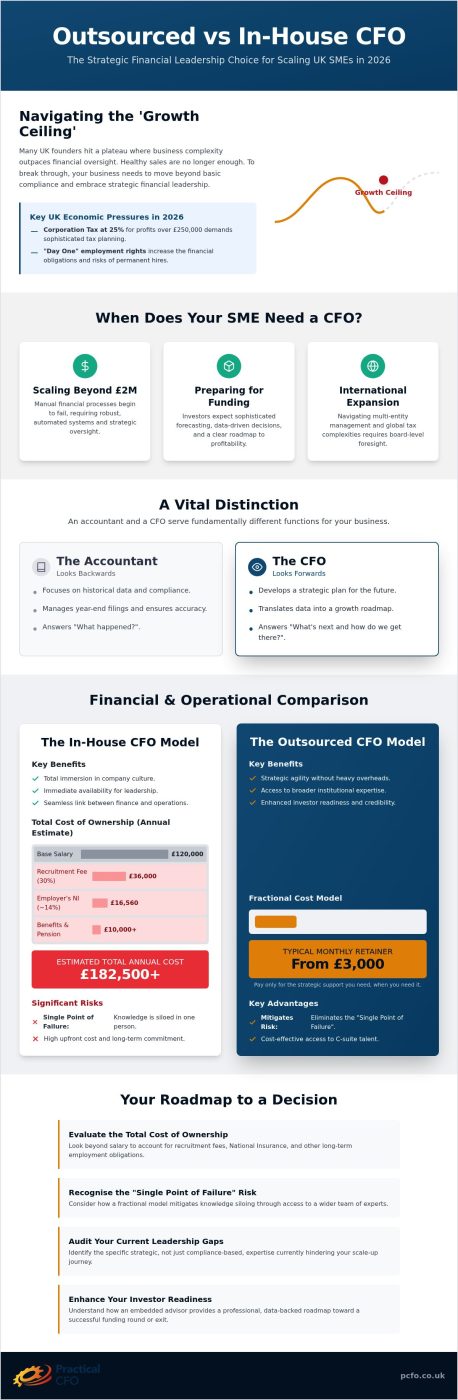
UK founders often reach a plateau where their business feels stuck despite healthy sales. You might have a reliable bookkeeper or an external accountant who manages your year-end filings, yet you still lack clarity on your long-term cash flow. This is the “growth ceiling.” It occurs when the complexity of your operations outpaces your financial oversight. To break through, you need more than just compliance; you need strategic leadership.
The choice between an outsourced vs in house CFO is often the most significant structural decision an SME makes during its lifecycle. In 2026, UK economic conditions demand a new level of agility. With the main rate of Corporation Tax at 25% for companies with profits over £250,000 and the introduction of “Day One” employment rights in April, the financial stakes for employers have risen. You need a partner who understands these pressures. Business owners now require financial structures that can adapt to rapid market shifts without the heavy burden of permanent executive overheads.
The Trigger Points: When Does Your SME Need a CFO?
Growth rarely happens in a straight line. Your business might have operated successfully for years with basic accounting, but certain milestones demand a higher level of expertise. It’s about timing. Common triggers include:
- Scaling beyond £2m turnover: At this stage, manual processes often fail and you require robust, automated financial systems.
- Preparing for Series A funding: Professional investors expect sophisticated forecasting and a clear roadmap to profitability.
- International expansion: Navigating multi-entity management and global tax complexities requires board-level foresight.
If you’re making major decisions based on gut feeling rather than data, you’ve reached a trigger point. A strategic partner provides the intellectual rigour necessary to navigate these transitions safely.
Accountant vs CFO: A Vital Distinction
It’s a common mistake amongst UK SMEs to assume an accountant can fulfil the role of a CFO. The two roles are fundamentally different. Whilst accountants provide essential historical data and ensure you remain compliant, they primarily look backwards. A CFO looks forward. They translate historical figures into a strategic plan for the future. Relying on a compliance-focused professional for growth strategy often leads to missed opportunities or unforeseen cash flow crises. You can explore this further in our guide on Fractional CFO vs Accountant: Which Does Your Business Need? Strategic leadership isn’t just about the numbers; it’s about what those numbers mean for your next three years of growth.
The In-House CFO Model: Full-Time Commitment and Its Implications
For many established enterprises, the default path involves hiring a dedicated executive. This traditional approach offers a sense of permanence that many founders find comforting. When weighing the choice of an outsourced vs in house CFO, the primary draw of the internal hire is the depth of their integration. They aren’t just managing the numbers; they’re part of the leadership team, present for every impromptu meeting and board-level debate.
The Cultural and Operational Benefits of In-House
A full-time presence allows for total immersion in your company’s ethos and daily operations. This individual owns the entire finance function from the inside, providing immediate availability for spontaneous leadership discussions. They develop a granular understanding of your business model that is difficult to replicate through external models. This level of dedication ensures that financial strategy is woven into the very fabric of your organisational culture, creating a seamless link between fiscal policy and team behaviour.
The Challenges of Permanent Executive Hiring
The search for a permanent C-suite leader is often fraught with complexity and significant expense. In the UK, recruitment fees for a high-calibre CFO typically range from 20% to 30% of their first-year salary. For a mid-market role, this represents a substantial upfront capital outlay before the individual has even sat at their desk. Beyond the financial cost, several operational risks exist:
- Knowledge Siloing: In small in-house teams, strategic knowledge often becomes concentrated in one person, creating a “Single Point of Failure.”
- Lengthy Notice Periods: Senior roles in the UK often carry notice periods of three to six months, making it difficult to pivot quickly if a hire doesn’t work out.
- The “Unicorn” Search: SMEs frequently struggle to find a candidate who possesses both high-level strategic foresight and the willingness to manage hands-on accounting tasks.
If you’re currently assessing your requirements, our Chief Financial Officer Services are designed to provide that essential strategic oversight without the long-term recruitment burden. The permanence of an in-house hire can sometimes lead to stagnation. Without exposure to other industries or contemporary market trends, internal leaders may rely on legacy processes. This lack of external perspective can be a silent inhibitor to growth, particularly when compared to the cross-pollinated insights available through a fractional model.
The Outsourced and Fractional CFO Alternative: Strategic Agility for Growth
Many UK SMEs view the choice between an outsourced vs in house CFO through the narrow lens of cost, yet the true value lies in strategic agility. The fractional model redefines the traditional consultancy relationship. It positions the CFO as an embedded strategic partner who is deeply invested in your long-term trajectory. You aren’t simply hiring a distant service provider; you’re securing a seasoned expert who acts as a steady hand at the helm of your financial strategy.
This approach addresses the “growth ceiling” mentioned earlier by providing the intellectual rigour your boardroom requires without the structural rigidity of a permanent hire. Fractional partners often work with multiple firms across various sectors. This cross-pollination of ideas means they bring proven best practices and contemporary market insights to your business. They’ve seen what works and what fails in the current UK market, allowing you to bypass common pitfalls that an isolated in-house leader might miss.
Access to Tier-1 Strategic Leadership
One of the most compelling reasons to choose a fractional partner is the ability to access high-tier talent that would otherwise be financially out of reach for a scaling SME. You can secure the wisdom of a professional accustomed to £150,000+ roles for the price of a mid-level manager. These individuals bring “been there, done that” experience, having successfully navigated the scaling challenges you’re currently facing. For a comprehensive look at how this role integrates with your team, see our guide: What is a Fractional CFO? A Guide for Growing Businesses.
Flexibility and Scalability in 2026
Business cycles in 2026 are rarely static. Your requirement for financial leadership will fluctuate based on your current projects, whether you’re preparing for an M&A process or managing a Series A funding round. Fractional models allow you to scale support up or down as your business dictates. This removes the burden of underutilised executive time whilst ensuring you have expert guidance at every critical juncture. Our Business Growth Advisory UK services are designed to adapt to these specific needs, providing the precise level of oversight required at each stage of your lifecycle.
By opting for a fractional model, you avoid the “knowledge siloing” risk inherent in permanent roles. Because these partners operate within a broader consultancy framework, your business benefits from a collective pool of expertise rather than relying on a single individual’s perspective. It’s a proactive mindset focused on future-proofing your organisation through flexible, high-level leadership.
Financial Evaluation: Comparing the Total Cost of Ownership (TCO)
When comparing an outsourced vs in house CFO, many founders focus solely on the base salary. This narrow view obscures the true financial impact on your balance sheet. A £120,000 base salary for a full-time executive is merely the starting point. By the time you account for recruitment, statutory obligations, and benefits, the Total Cost of Ownership (TCO) can easily exceed £170,000 in the first year alone. For a scaling SME, this represents a significant commitment of capital that could otherwise be deployed into product development or market expansion.
The Hidden Costs of the In-House Payroll
An internal hire carries a heavy tail of financial commitments that extend far beyond the monthly payslip. Beyond the base pay, you must factor in Employers National Insurance contributions and pension auto-enrolment, which add significant recurring overheads. In 2026, the complexity of UK employment law has increased, with “Day One” rights for sick pay and parental leave adding further administrative and financial weight to every permanent hire.
- Recruitment fees: These typically range from 20% to 30% of the first year’s salary, representing an immediate upfront cost of up to £36,000 for a £120k hire.
- Executive perks: Private health insurance, car allowances, and performance-related bonuses often add another 10% to 15% to the total cost.
- Office overheads: Desk space, hardware, and software licences for a senior executive are often overlooked but contribute to the rising TCO.
These figures represent a fixed cost that remains regardless of the actual strategic value delivered in a given month. For a deeper analysis of these variables, consult our Fractional CFO Pricing UK: A Strategic Guide.
Outsourced Efficiency: Paying for Results, Not Presence
The fractional model operates on a B2B basis, which fundamentally changes the tax and liability profile of your financial leadership. You eliminate “dead time” by paying only for the strategic input you require. Because there are no recruitment fees or long-term employment liabilities, your capital remains liquid and available for growth initiatives. This predictable monthly spend is classified as a professional service fee rather than a payroll burden, providing greater flexibility within your cash flow management.
Strategic financial leadership pays for itself through proactive intervention. A seasoned CFO identifies inefficiencies in your supply chain, renegotiates debt structures, and optimises your tax position. With the main rate of Corporation Tax at 25% for profits over £250,000 in 2026, professional tax planning can save your business more than the cost of the service itself. If you’re ready to secure high-level expertise without the traditional payroll burden, explore our Finance Director Services to see how we can stabilise and scale your operations.
Making the Transition: Selecting the Right Financial Partner for Your Scale-Up
Deciding on the optimal structure for your finance function is a pivotal moment in your growth journey. The choice between an outsourced vs in house CFO should be driven by the specific outcomes you wish to achieve over the next 18 to 24 months. Moving forward requires a clear-eyed assessment of your current internal capabilities and the strategic gaps that are currently holding you back. It is not merely a hire; it is a strategic alignment.
The Audit: What Does Your Business Actually Need?
Before engaging a partner, you must determine the primary focus of the role. Are you looking for a “Fixer” to stabilise erratic reporting, a “Scaler” to manage international expansion, or an “Exiter” to prepare the company for a strategic sale? Identifying these requirements early prevents the frustration of a misaligned hire. You may find that whilst your basic bookkeeping is sound, there are significant gaps in your Outsourced Accountancy Solutions that only a strategic CFO can bridge.
When evaluating potential partners, prioritising industry experience is essential. Chemistry is equally vital. A fractional CFO acts as an extension of your leadership team. They must challenge your assumptions with intellectual rigour whilst maintaining a supportive, collaborative relationship. To ensure success, set clear KPIs for the first 90 days. These might include achieving real-time cash flow visibility, reducing month-end closing times, or delivering a robust three-year financial forecast. Clear metrics build a foundation of trust from day one.
Future-Proofing for an Exit
Preparing a business for sale is an intensive process that requires meticulous financial cleanliness. An outsourced CFO is often better positioned to lead this transition than a permanent hire who may have emotional ties to legacy systems. They provide the objective perspective necessary to ensure your data rooms are investor-ready and your due diligence processes are seamless. By engaging Exit Strategy Planning Services: Maximising Business Value, you ensure that every financial decision made today is aligned with your ultimate goal of a clean, high-value exit.
The transition to high-level financial leadership doesn’t have to be overwhelming. PCFO acts as the steady hand at the helm of this process. We don’t operate as distant contractors; we are embedded advisors invested in your long-term success. Whether you are navigating a complex scale-up or planning your final exit, we provide the strategic foresight and reliability required to move forward with confidence. Choosing the right outsourced vs in house CFO model is the first step toward future-proofing your business legacy.
Securing Your Financial Future with Strategic Leadership
Choosing the right financial leader is a defining step for any scaling SME. As we’ve explored, the decision between an outsourced vs in house CFO isn’t merely a budgetary exercise; it’s a strategic move to ensure your business remains agile in an evolving 2026 market. By opting for a fractional model, you gain access to high-level expertise that drives growth whilst avoiding the substantial recruitment fees and statutory overheads of a permanent hire. This approach ensures your finance function is a proactive driver of value rather than a historical reporting centre.
Whether you’re preparing for a funding round or auditing your operations for an eventual sale, having a steady hand at the helm is essential. At PCFO, we provide Expert Strategic FD & CFO Services and Bespoke Business Growth Advisory tailored to your unique lifecycle. As Specialists in Exit Strategy Planning, we’re dedicated to future-proofing your business and maximising its value. You don’t have to navigate these complexities alone. Book a Strategic Consultation with PCFO today to discover how we can partner with you to achieve lasting success. Your next stage of growth begins with clear, confident financial direction.
Frequently Asked Questions
What is the main difference between an in-house CFO and an outsourced CFO?
The primary difference lies in the nature of the employment relationship and the level of flexibility provided. An in-house CFO is a full-time employee integrated into your payroll and daily office culture, whilst an outsourced CFO is a strategic partner who provides high-level leadership on a fractional basis. Both roles deliver board-level financial oversight, but the outsourced model allows you to scale the service according to your business lifecycle.
Is an outsourced CFO cheaper than a full-time hire in the UK?
Yes, an outsourced CFO is typically more cost-effective for SMEs than a permanent executive hire. When evaluating an outsourced vs in house CFO, you must account for the “True Cost” of employment, including recruitment fees, Employers National Insurance, and pension contributions. Outsourcing eliminates these overheads, allowing you to secure tier-1 strategic talent for a fraction of the cost of a full-time salary.
Can a fractional CFO manage my existing in-house accounting team?
A fractional CFO often acts as the strategic head of your existing finance department. They provide the necessary leadership and mentorship to your bookkeepers or junior accountants, ensuring their daily output aligns with your long-term growth objectives. This structure bridges the gap between administrative accounting and high-level financial strategy, improving the overall efficiency of your internal team.
How many days a month does an outsourced CFO typically work?
Engagement lengths are bespoke and depend entirely on your current organisational needs. Most UK SMEs utilise an outsourced CFO for between one and four days per month, though this can increase during critical periods such as fundraising or an acquisition. This flexibility ensures you aren’t paying for underutilised executive time during quieter periods of the business cycle.
Will an outsourced CFO understand the specific culture of my business?
An effective fractional CFO operates as an embedded advisor rather than a distant contractor. They prioritise building a deep understanding of your company ethos and leadership style to ensure their strategic advice is relevant and actionable. This collaborative approach allows them to integrate seamlessly with your board, ensuring financial strategy remains aligned with your unique organisational behaviour.
What happens to my financial data if I stop using an outsourced CFO service?
You maintain total ownership and control of all your financial data, systems, and strategic models at all times. Professional partners build all reporting and forecasting tools within your own company infrastructure. This ensures that if your requirements change or you transition to a full-time hire, all intellectual property and historical data remain securely within your business.
Do I need a CFO if I already have a good accountant?
Yes, because the two roles serve fundamentally different purposes within a scaling business. Whilst an accountant focuses on historical data and tax compliance, a CFO provides the forward-looking strategic foresight needed to break through a “growth ceiling.” If you require board-level advice on cash flow runways, investment readiness, or long-term business planning, a CFO is essential.
Can an outsourced CFO help with raising investment or business sale?
Strategic financial leadership is vital for navigating complex transitions like fundraising or a business exit. An outsourced CFO ensures your financial records are clean, your forecasts are robust, and your organisation is prepared for the rigours of due diligence. They provide the intellectual rigour and professional presentation required to instil confidence in potential investors or buyers.