

Why does your accounting software feel like a static digital archive rather than a steering wheel for your business growth? Many UK founders find themselves drowning in financial data, yet they still lack the actionable insights needed to make confident decisions. It’s a common frustration; you’re likely managing the pressure of HMRC compliance and the upcoming August 2026 Making Tax Digital deadlines, while your software remains a “black box” that doesn’t communicate with the rest of your operations.
We understand that a truly effective finance function requires more than just a login to Xero or Sage. By leveraging outsourced bookkeeping and accounting services UK, businesses can bridge the gap between simple data entry and high-level strategic foresight. This transition allows you to move from working in the business to working on it, supported by a clear visibility of your cash flow and runway.
In this guide, you’ll discover how to select and implement accounting solutions that drive expansion rather than just recording history. We’ll outline a roadmap for streamlining your financial stack, ensuring it’s robust enough to support a future exit or a successful Series A funding round.
Key Takeaways
- Learn why cloud-based accounting ecosystems serve as the central nervous system of a modern business, shifting focus from historical recording to real-time strategic steering.
- Identify the advanced features, such as cash flow forecasting and departmental tracking, that allow scaling firms to maintain clear visibility of their financial runway.
- Discover how outsourced bookkeeping and accounting services UK provide the expert oversight needed to turn raw software data into actionable business intelligence.
- Follow a structured implementation roadmap to audit your current processes and define a “Future State” that supports your growth objectives for the next three years.
- Understand how to build a resilient financial stack that satisfies HMRC’s Making Tax Digital requirements whilst preparing your business for a successful future exit or Series A.
What are Accounting Software Solutions in a Strategic Context?
Modern business success relies on more than just “doing the books”. It requires a holistic view of the organisation’s financial health. Accounting software has evolved from a simple record-keeping tool into the central nervous system of the enterprise. It doesn’t just store transactions; it channels vital data across departments, allowing for informed decision-making at every level. When configured correctly, these platforms act as a single source of truth for founders and stakeholders alike.
The true “solution” is never found in the code alone. It’s the seamless integration of data, people, and processes. Without the right expertise to interpret the outputs, even the most expensive platform remains a passive archive. This is where outsourced bookkeeping and accounting services UK provide a competitive edge. They transform software from a cost centre into a strategic asset that guides long-term planning. By aligning your digital tools with professional oversight, you ensure that every entry contributes to a broader growth narrative.
The Evolution of Cloud Accounting
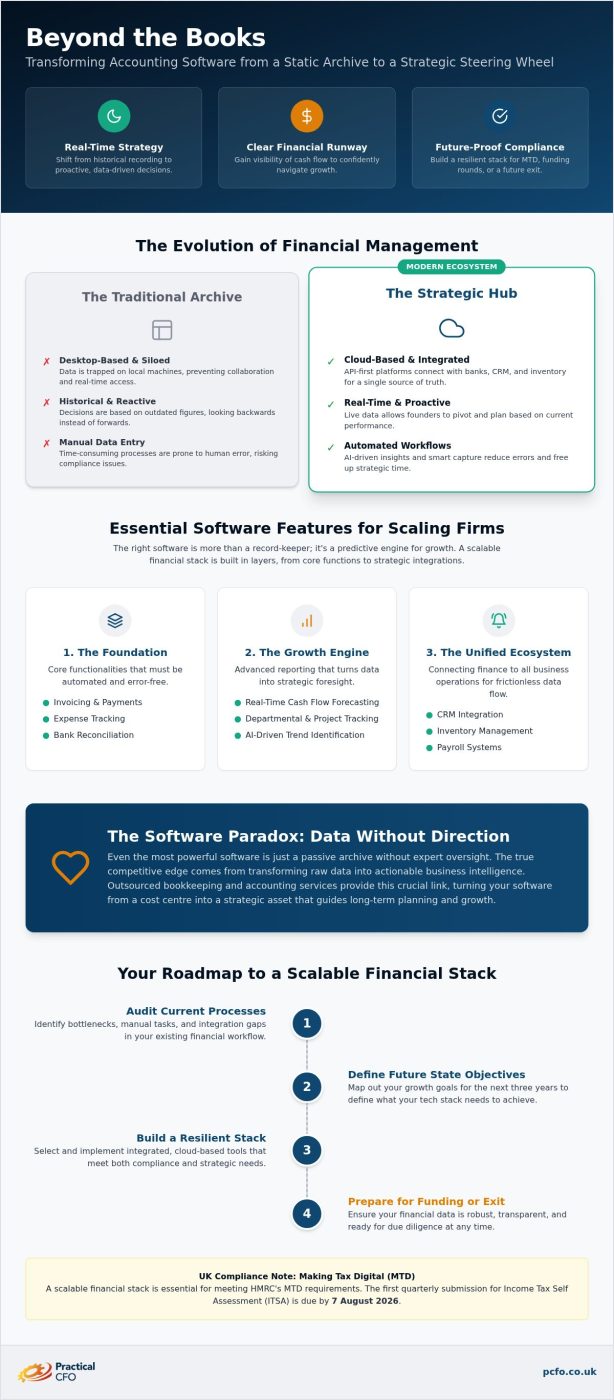
The transition from desktop-based ledgers to real-time cloud ecosystems has fundamentally changed financial visibility for SMEs. Modern platforms are now API-first, meaning they connect directly with your banks, CRM, and inventory systems. This interconnectedness ensures that financial data is no longer siloed or delayed. For a board-level briefing, real-time data is now a prerequisite. It allows founders to pivot based on current performance rather than reacting to figures that are weeks out of date. This shift enables a move towards proactive financial management.
Compliance vs. Strategy: Two Sides of the Same Coin
HMRC’s Making Tax Digital (MTD) initiative has set a new baseline for digital record-keeping. With the first quarterly submission for the Income Tax Self Assessment (ITSA) deadline arriving on 7 August 2026, compliance is non-negotiable. However, viewing software merely as a compliance tool is a missed opportunity. Effective software solutions reduce manual errors in VAT and payroll whilst simultaneously providing the raw material for growth. The goal isn’t just to ensure “the books are done”. It’s to understand what the data reveals about your future scalability and cash flow requirements. When you integrate outsourced bookkeeping and accounting services UK into your workflow, you bridge the gap between staying legal and staying profitable.
Essential Features of Accounting Software for Scaling UK Firms
Choosing the right software is a decision that impacts your business for years. It isn’t merely about recording what happened yesterday; it’s about predicting what happens tomorrow. For a scaling UK SME, the core functionality of invoicing, expense tracking, and bank reconciliation is just the baseline. As your transaction volume increases, these tasks must move from manual entry to automated workflows. This shift frees up your time to focus on high-level direction.
Advanced reporting is where software truly begins to drive strategy. You need a platform that offers more than a static Profit and Loss statement. Real-time cash flow forecasting and departmental tracking are essential for understanding your true margins and runway. Integrating professional outsourced bookkeeping and accounting services UK ensures that these advanced features are utilised to their full potential, providing the clarity needed for board-level decisions.
Scalability also involves integration. Your finance stack shouldn’t exist in a vacuum. It must connect seamlessly with your CRM, inventory management, and payroll systems. This creates a unified data environment where information flows without friction. If you’re looking to refine this setup, exploring our Outsourced Accountancy Solutions can help you identify the right integrations for your specific industry.
Automation and AI in Modern Finance
The era of the “shoebox of receipts” is over. Modern software uses smart document capture to digitise expenses instantly, reducing the risk of human error. AI-driven insights now identify trends in debtor behaviour and overhead spikes before they become critical issues. However, these automated insights are only as good as the data they process. Maintaining “clean data” is vital. When outsourced bookkeeping and accounting services UK are involved, they act as the gatekeepers of this data quality, ensuring your automated reports are actually accurate.
Multi-Currency and Global Ambitions
UK exporters face unique challenges, particularly regarding VAT complexity and international trade regulations. Your software must support multi-currency transactions and provide consolidated reporting if you manage multiple entities or branches. This is especially important under the UK Government’s Making Tax Digital initiative, which mandates precise digital record-keeping. Ensuring your financial stack can handle this complexity is a key component of long-term business growth advisory uk, allowing you to scale across borders with confidence.
The Software Paradox: Why Data Without Direction Stalls Growth
Software is often sold as a total solution for business management. It isn’t. If your internal processes are flawed, digital tools simply digitise the chaos. This “Messy Books” problem is a primary reason why outsourced bookkeeping and accounting services UK are becoming essential for scaling firms. A tool like Xero or QuickBooks provides the necessary framework, but it doesn’t provide the discipline or the strategic lens required to interpret the results. Without professional oversight, you’re merely looking at an expensive digital archive.
Standard dashboards often prioritise “vanity metrics” like gross revenue or total transaction count. These figures look impressive on a screen, yet they can easily mask underlying issues like eroding margins or a shrinking cash runway. Automated insights frequently miss the subtle nuance of a sudden market shift or a deliberate internal pivot. They see the numbers, but they don’t understand the “why” behind them. Relying solely on software to guide your strategy is like trying to navigate a ship by looking only at the wake it leaves behind.
Software Collects Data; Leaders Execute Strategy
It’s vital to distinguish between different financial roles to avoid the common “I already have Xero” objection. A bookkeeper records data; an accountant ensures compliance. However, a finance director interprets that data to drive growth. A human FD identifies specific risks, such as a dangerous concentration of revenue in a single client, that an algorithm might overlook. When you’re building a case for investment or preparing for a future exit, you need more than just a clean ledger. You need a narrative that explains your financial trajectory and future potential.
The Cost of Tech Debt in the Finance Function
Many SMEs fall into the trap of choosing the cheapest or simplest software during their early stages. As the business scales, these entry-level solutions often require complex manual workarounds to produce the reports management actually needs. This creates significant “tech debt” within your finance function. Tech debt in finance is the cumulative operational burden caused by fragmented systems that fail to integrate, forcing your team into manual data reconciliation and increasing the risk of reporting errors. Partnering with outsourced bookkeeping and accounting services UK early in your journey helps you avoid this trap. It ensures your tech stack is built for where you want to be in three years, not just where you are today.
How to Implement a Scalable Financial Tech Stack
Implementing a financial tech stack is a deliberate strategic transition, not a “plug-and-play” exercise. Whilst some software providers suggest you can be “up and running in seconds”, a scaling business requires a more methodical approach to ensure long-term stability. A successful implementation follows a structured five-step roadmap:
- Step 1: Audit your current financial processes. Identify exactly where manual data entry is creating bottlenecks or where reporting delays are hindering your decision-making.
- Step 2: Define your “Future State”. Consider where you want the business to be in three years. If you’re aiming for a Series A or a trade exit, your stack must support the rigorous due diligence required for those milestones.
- Step 3: Select a core accounting engine. Xero, Sage, and QuickBooks are the standard choices for UK SMEs. Specialist firms like Henderson & Co. Accountants can assist with the initial Xero cloud accounting setup, ensuring the platform is correctly configured to handle your specific transaction complexity.
- Step 4: Layer in specialist “Best-of-Breed” applications. This might include dedicated tools for cash flow forecasting or automated expense management that plug directly into your core engine.
- Step 5: Appoint a strategic lead. You need someone to oversee the transition and ensure ongoing data integrity.
By engaging outsourced bookkeeping and accounting services UK, you gain the technical expertise to manage this migration without disrupting your daily operations. A strategic partner ensures that the software is configured to produce the specific insights your leadership team requires for growth.
Evaluating the ROI of Your Software Investment
The primary return on investment for a modern tech stack is found in the recovery of time. By automating manual reconciliation and data capture, your team can pivot from administrative tasks to high-value analysis. This creates “Board-Ready” reporting that builds immediate confidence amongst stakeholders and potential investors. When considering the cost, it’s helpful to compare fractional cfo pricing uk against the significant overhead of a full-time executive hire. A fractional approach provides the same strategic oversight at a fraction of the cost, making it a highly efficient model for growing firms.
Maintaining Data Integrity and Security
A tech stack is only as reliable as the data it contains. Regular “Data Cleanses” are essential to prevent the accumulation of errors that can skew your financial reporting. Security is equally paramount. Ensuring your cloud-based data complies with GDPR and modern encryption standards is a baseline requirement for any UK business. Training your team to use the stack consistently is the final piece of the puzzle. If you’re unsure if your current setup is fit for purpose, our Outsourced Accountancy Solutions can provide a comprehensive audit to identify and resolve existing gaps.
Strategic Outsourced Accountancy: Maximising Your Software Investment
Software provides the infrastructure for your financial data, but it doesn’t provide the vision. PCFO bridges the gap between software capability and business reality by acting as an embedded strategic partner. We don’t just ensure your ledger is clean; we ensure it’s meaningful. By leveraging outsourced bookkeeping and accounting services UK, you move beyond the limitations of automated dashboards to gain a sophisticated understanding of your commercial drivers. This transition from historical reporting to forward-looking strategic planning is what separates stagnant firms from those that scale effectively.
Professionalising your finance function is a critical step for any SME with high-growth ambitions. Our outsourced accountancy solutions are designed to provide the same level of rigour found in large corporations, tailored for the boutique environment. This level of oversight is particularly vital when preparing for significant milestones. Whether you’re seeking external investment or engaging in exit strategy planning services, your financial data must be beyond reproach. A well-managed software stack, overseen by experts, ensures your business value is maximised for a strategic sale or a successful funding round.
Beyond the Balance Sheet: The PCFO Approach
Our approach goes deeper than standard profit and loss statements. We customise your software stack to track industry-specific KPIs that actually matter to your bottom line. By interpreting the raw data produced by your systems, we provide board-level financial advice that identifies opportunities for expansion and cost optimisation. We act as a proactive partner, constantly scanning the horizon for risks and trends that might impact your company’s long-term trajectory. This intellectual rigour transforms your finance function from a back-office necessity into a strategic engine.
Your Roadmap to a World-Class Finance Function
The best financial tech stack is one you never have to worry about. It should run quietly in the background, providing accurate, real-time insights whenever you need them. Starting the journey from “messy books” to strategic clarity begins with a thorough evaluation of your current state. If you feel your software is a “black box” that lacks transparency, it’s time to professionalise your approach. Outsourced bookkeeping and accounting services UK provide the steady hand needed to navigate this transition. We invite you to book a strategic consultation with our team to audit your current stack and build a roadmap for your future growth.
Transform Your Financial Data into Strategic Foresight
Effective financial management in a scaling business requires a fundamental shift in perspective. Whilst cloud platforms provide the necessary digital infrastructure, they cannot replace the intellectual rigour of a seasoned advisor. You’ve seen how a well-implemented tech stack serves as the central nervous system of your organisation; however, it’s the interpretation of that data that truly drives growth. Moving beyond simple compliance ensures your finance function supports your long-term ambitions rather than merely recording historical transactions.
By partnering with outsourced bookkeeping and accounting services UK, you bridge the gap between raw data entry and high-level strategic navigation. This collaborative approach provides the clarity needed to manage cash flow, identify risks, and prepare for significant milestones such as a Series A or a trade exit. Our professional Finance Director and CFO services are designed to give you the confidence to lead with precision. We encourage you to book a strategic financial audit with PCFO to optimise your software stack and ensure your business is positioned for sustainable success. Your financial future is too important to be left to algorithms alone.
Frequently Asked Questions
Which accounting software is best for a UK SME in 2026?
Xero, QuickBooks, and Sage remain the market leaders for UK small and medium enterprises. Your choice should depend on your transaction volume, industry requirements, and the specific integrations you need to run your operations. Xero is currently favoured by many for its extensive app ecosystem, whilst Sage is often preferred by businesses with more complex manufacturing or inventory needs.
Is cloud-based accounting software secure for sensitive financial data?
Cloud-based platforms are generally more secure than traditional desktop software or local servers. They utilise bank-level encryption, multi-factor authentication, and automatic data backups to protect your information. These providers invest heavily in cybersecurity to ensure they comply with modern data protection standards, including GDPR, providing a level of security that is difficult for an SME to maintain independently.
How does Making Tax Digital (MTD) affect my choice of software?
Your software must be HMRC-compatible to meet the legal requirements of the Making Tax Digital initiative. With the first quarterly submission deadline for those with income over £50,000 arriving on 7 August 2026, your software must be able to keep digital records and submit updates directly to HMRC. Selecting a compliant platform is no longer optional; it’s a prerequisite for operating in the UK.
What is the difference between accounting software and an ERP system?
Accounting software focuses specifically on managing financial transactions, such as invoicing, expenses, and payroll. In contrast, an Enterprise Resource Planning (ERP) system is a broader suite that integrates finance with other business functions like human resources, supply chain, and customer relationship management. Most UK SMEs start with accounting software and only move to an ERP when their operational complexity requires a unified platform for all departments.
Can I integrate my accounting software with my bank and other business apps?
Most modern cloud platforms allow for direct integration with UK banks and popular business applications like Shopify, HubSpot, or Stripe. This connectivity is a central benefit of outsourced bookkeeping and accounting services UK, as it enables automated data flows that reduce manual entry. By connecting your stack, you ensure that your financial records are updated in real time, providing a more accurate view of your cash position.
How much should a UK SME expect to pay for a comprehensive software solution?
Monthly subscriptions for core accounting platforms typically range from £15 to £60 depending on the level of functionality you require. You should also budget for additional “best-of-breed” apps for tasks like advanced forecasting or automated expense capture, which may add to your monthly overhead. Whilst the software itself is relatively low cost, the primary investment should be in the strategic oversight required to interpret the data correctly.
When should I move from a basic bookkeeper to an outsourced finance director?
You should consider this transition when you need strategic foresight rather than just historical record-keeping. If you are struggling to understand your cash flow runway, planning a future exit, or preparing for a Series A funding round, a basic bookkeeping service will likely be insufficient. A Finance Director provides the high-level analysis and board-level advice necessary to navigate these complex business milestones.
Do I still need an accountant if I have advanced accounting software?
Software is a powerful tool for data collection, but it cannot replace the strategic judgement of a qualified professional. An accountant or Finance Director ensures that your data integrity is maintained, your tax planning is optimised, and your financial strategy aligns with your growth goals. They provide the “human” interpretation of the data that software algorithms often miss, such as identifying subtle market shifts or internal operational risks.