

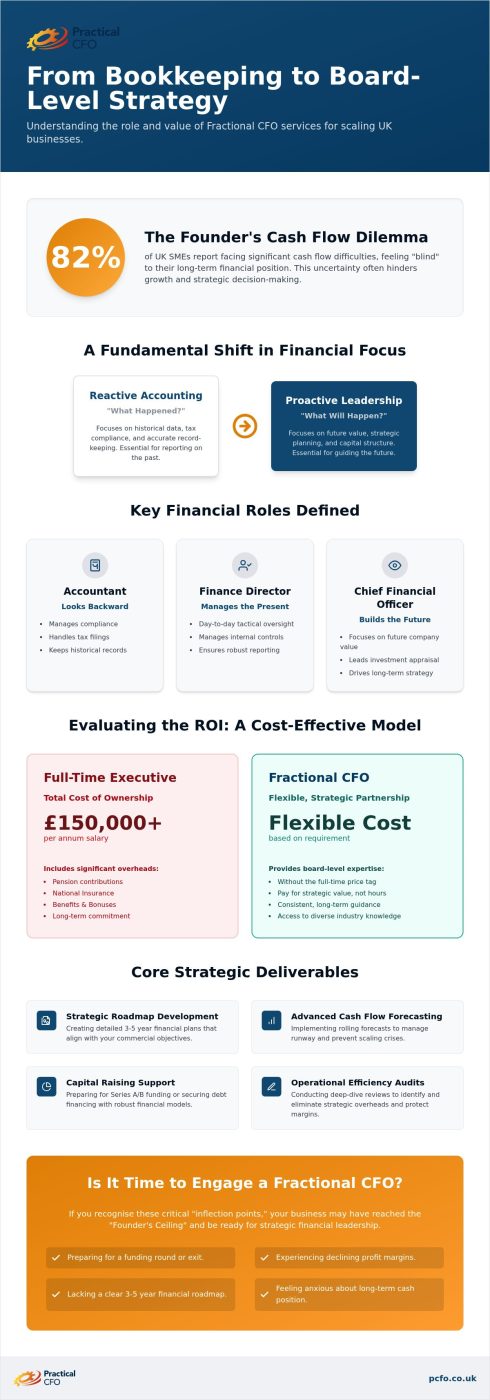
Did you know that 82% of UK SMEs report facing significant cash flow difficulties? For many founders, the transition from basic bookkeeping to high-level financial planning feels like a leap into the dark. You likely feel “blind” to your long-term cash position or anxious about an upcoming funding round, yet the £150,000-plus salary of a full-time executive is simply unjustifiable for your current scale. This is why more businesses are turning to fractional CFO services to secure board-level expertise without the traditional price tag. It’s a common frustration to have plenty of historical data but no clear vision for what the next five years should look like.
This guide explores how these services bridge the critical gap between basic accountancy and high-level strategic leadership to accelerate your business growth. We’ll examine how this flexible model provides a clear financial roadmap, improves overhead control, and gives you the confidence needed to navigate a successful exit or investment. You’ll learn how a strategic partner can future-proof your organisation whilst respecting your current budget.
Key Takeaways
- Understand the fundamental shift from reactive historical accounting to proactive financial leadership that focuses on future growth and strategic foresight.
- Learn how fractional CFO services provide a clear 3-5 year roadmap and advanced cash flow forecasting to ensure your business remains resilient whilst scaling.
- Discover the significant cost-efficiency of the fractional model by comparing the total cost of ownership of a full-time executive against a flexible, part-time arrangement.
- Identify the critical “inflection points,” such as declining margins or upcoming funding rounds, that indicate your business has reached the “Founder’s Ceiling.”
- Explore how integrating board-level expertise with boutique agility can prepare your organisation for a successful investment round or a lucrative exit.
Beyond Bookkeeping: What are Fractional CFO Services?
Fractional CFO services provide high-level financial leadership to businesses on a part-time or project basis. This model allows UK SMEs to access the expertise of a seasoned board-level professional without the significant overheads associated with a full-time executive hire. In the volatile market conditions of 2026, this flexibility is becoming a vital asset for firms that need strategic foresight but don’t yet require a permanent Chief Financial Officer. It represents a fundamental shift in the finance function, moving the focus from “what happened” in the past to “what will happen” in the future.
This approach differs from traditional permanent recruitment or temporary interim roles. A permanent hire involves long-term commitments, including pension contributions and National Insurance, which can strain a growing company’s cash flow. An interim role is typically a short-term fix to cover a vacancy. In contrast, a fractional partner provides consistent, long-term strategic guidance tailored to your specific business lifecycle. They act as an embedded advisor, invested in your trajectory rather than just filling a seat.
The Strategic Distinction: CFO vs. FD vs. Accountant
Understanding the difference between these roles is essential for effective scaling. An accountant typically manages compliance, tax filings, and historical records. They ensure the books are accurate. A Finance Director often manages the Strategic Role of a Finance Director through day-to-day tactical oversight, ensuring internal controls and reporting structures are robust. They focus on the “now.”
A CFO, however, is responsible for the company’s future value. Their focus remains on capital structure, investment appraisal, and long-term shareholder value. Whilst the accountant looks backward and the FD looks at the present, the CFO looks ahead to navigate upcoming funding rounds or exit opportunities. They translate financial data into a strategic roadmap that informs every major board-level decision.
The Evolution of the Fractional Model in the UK
The UK has developed one of the most sophisticated markets for the Fractional executive in Europe. This growth is driven by the rise of remote working and a shift in how top-tier talent prefers to operate. For the business owner, this evolution offers a significant advantage. You can now engage a specialist who brings “diverse industry perspectives” gained from working across multiple sectors and growth stages.
Choosing flexible leadership allows UK businesses to manage their overheads with precision. Instead of overpaying for a full-time resource that might not be fully utilised, you pay for the specific strategic value you need. This cross-pollination of expertise helps SMEs avoid common scaling pitfalls and ensures they are prepared for the complexities of the modern regulatory environment. It is a proactive mindset focused on future-proofing your organisation through intellectual rigour and steady guidance.
Core Strategic Deliverables: What Do Fractional CFO Services Include?
Engaging fractional CFO services introduces a level of financial rigour that most SMEs lack during their initial growth phases. Whilst your accountant handles the past, your fractional partner builds the framework for your future. This partnership focuses on four primary pillars of strategic delivery:
- Strategic Roadmap Development: Creating detailed 3-5 year financial plans that align with your commercial objectives and market opportunities.
- Advanced Cash Flow Forecasting: Implementing rolling forecasts to manage runway and prevent the scaling crises that affect a significant portion of UK businesses.
- Capital Raising Support: Preparing your business for Series A/B funding or securing competitive debt financing through robust financial modelling and pitch deck refinement.
- Operational Efficiency Audits: Conducting deep-dive reviews to identify and eliminate strategic overheads, ensuring your margins remain healthy as you scale.
By focusing on these areas, a fractional CFO ensures you aren’t just growing, but growing sustainably. If you’re ready to move beyond basic reporting, exploring a bespoke financial roadmap can provide the clarity your board requires to make informed decisions.
Exit Strategy and Succession Planning
Maximising the value of your business requires preparation that starts years before a potential transaction. Fractional CFOs are instrumental in exit strategy planning services, ensuring that your financial records are “audit-ready” and your valuation is defensible. They identify common due diligence red flags, such as high customer concentration or irregular contract structures, and resolve them early to prevent deal fatigue during negotiations.
This proactive approach doesn’t just prepare you for a sale; it creates a more resilient organisation. Whether you’re considering a management buyout or a trade sale, having a seasoned expert to navigate the complexities of EBITDA adjustments and working capital requirements is vital for a lucrative outcome.
Board-Level Advisory and Investor Relations
A fractional CFO professionalises your interaction with stakeholders. They act as a critical bridge between the CEO and external investors, translating complex financial data into clear, actionable insights for board meetings. This presence brings immediate reassurance to lenders and shareholders, signalling that the company is under steady, expert financial management. It’s about building a narrative that data alone cannot provide.
Their involvement often improves a company’s creditworthiness and reputation in the market. By establishing transparent stakeholder reporting and rigorous internal controls, they build the trust necessary to secure future investment and support long-term expansion plans. This steady hand at the helm allows the founder to focus on innovation and market capture.
Evaluating the ROI: Fractional CFO vs. Full-Time Executive Hires
Hiring a full-time executive is a significant financial commitment. For many UK SMEs, the total cost of ownership often exceeds the value delivered in the early stages of growth. A full-time CFO at a growth-stage company might command a base salary between £120,000 and £180,000. When you add employer National Insurance at 15%, effective from April 2025, plus pension contributions and private health insurance, the loaded cost often surpasses £200,000. This is a substantial fixed overhead for a company that might only require high-level strategic input for a few days each month.
Compare this to the fractional CFO pricing UK model. It provides access to the same calibre of board-level expertise for a fraction of the cost. Industry data suggests that a fractional partner can provide savings of 40% to 60% compared to the year-one loaded cost of a full-time hire. This allows you to redirect capital into product development, marketing, or other growth-driving activities whilst maintaining expert financial oversight.
It’s not just about the money. A fractional professional can often start within one to two weeks. A traditional recruitment process for a C-suite role typically takes three to six months. This “speed to value” is critical when you’re facing a cash flow crisis or preparing for a sudden investment opportunity. You gain the ability to scale the service up or down as your business lifecycle dictates, providing a level of agility that a permanent contract cannot match.
The Hidden Costs of a Permanent Executive Hire
Recruitment fees are a major pain point for scaling firms. Fees of 20% to 30% of the first year’s salary mean an immediate outlay of £40,000 or more before the executive even starts. Then there is the risk of a “bad hire.” If the cultural fit isn’t right, the cost of an executive exit, including potential “golden parachute” settlements, can be devastating. Fractional CFO services operate on a low-friction, contract-based model. You gain high-level leadership without the long-term liability or the risk of expensive severance packages.
When the ROI Favours the Fractional Approach
The ROI for fractional leadership is particularly strong for businesses with a turnover between £2 million and £10 million. At this scale, a full-time CFO is often underutilised, spending too much time on tasks that don’t justify their day rate. A fractional partner focuses purely on high-impact strategic projects, such as margin improvement or capital raising. This efficiency is enhanced when they collaborate with outsourced accountancy solutions. This combination ensures that compliance and tactical work is handled by a dedicated team, allowing the CFO to focus entirely on driving ROI through strategic navigation.
Determining the Right Time to Integrate Fractional Financial Leadership
Knowing when to engage fractional CFO services is as critical as the services themselves. Most UK SMEs hit a point where the founder’s instinctive grasp of the numbers no longer suffices. This “Founder’s Ceiling” often occurs during periods of rapid growth or when margins begin to decline despite rising turnover. It is a dangerous inflection point where the complexity of the business outpaces its financial architecture. You may feel that you are losing grip on the granular details that once drove your success.
One of the most common risks during this stage is overtrading. It is entirely possible for a British business to grow so quickly that it exhausts its cash reserves before the revenue from new orders arrives. A fractional CFO manages this risk by implementing rigorous working capital controls and runway management. They provide the steady hand needed to ensure that expansion does not lead to insolvency. Professionalising your finance function in this way is essential before you approach external investors or lenders, as they will expect a level of reporting that goes far beyond basic statutory accounts.
Signs Your Current Accounting Setup is Insufficient
Your existing team might be excellent at processing invoices and filing VAT returns, but they may lack the strategic depth to guide board-level decisions. You can identify this gap if you receive detailed reports on what happened last month but have no reliable forecast for the next six. If your board meetings are spent arguing over the accuracy of the data rather than discussing strategy, your setup is insufficient. A fractional CFO integrates with your existing junior finance team, acting as a mentor and strategic lead who elevates their output. They help you understand the true profitability of individual products or services, allowing you to stop subsidising loss-making activities unknowingly.
Preparing for a Major Business Event
Timing is everything when preparing for a sale or merger. Ideally, you should engage a fractional partner 12 to 18 months before a planned exit. This lead time allows the CFO to “clean up” the balance sheet and resolve any due diligence red flags that could devalue the company. In the context of M&A, they assist with both buy-side and sell-side due diligence, ensuring that every financial claim is defensible. By professionalising your records early, you attract better financing terms and present a much lower risk profile to potential acquirers. This preparation is the difference between a standard exit and a truly lucrative one.
If you recognise these inflection points in your own business, it may be time to book a strategic financial review to navigate your next growth stage with confidence.
Partnering with PCFO: Strategic Financial Direction for Your Growth Journey
PCFO provides a unique alternative to traditional consultancy by combining the high-level authority of a corporate boardroom with the personal agility of a boutique firm. Our fractional CFO services are built on an “embedded partner” philosophy. We don’t operate as a distant vendor; instead, we become an integral part of your leadership team. This ensures that every strategic recommendation is grounded in the practical reality of your daily operations.
Our business growth advisory uk services integrate directly with your existing staff to bridge the gap between high-level ambition and execution. Through our sister brand, Practical Accounting, we offer a seamless transition from strategic oversight to tactical financial management. This partnership provides a full-service outsourced finance function that scales as your business expands, ensuring your financial architecture never lags behind your commercial success.
The PCFO Methodology: From Assessment to Execution
We begin every partnership with a comprehensive “deep dive” into your organisation’s financial health. This initial assessment identifies hidden risks and untapped opportunities within your capital structure. We then establish clear KPIs and reporting frameworks for the first 90 days. This methodical approach ensures immediate impact and sets the foundation for long-term future-proofing. For UK SMEs, this means moving from reactive reporting to proactive risk management and strategic navigation.
Next Steps: Securing Your Business’s Financial Future
Every business follows a different trajectory. PCFO adapts to your specific lifecycle and growth speed, providing the exact level of support you need at any given moment. Whether you’re preparing for an investment round or simply need to break through the “Founder’s Ceiling” mentioned earlier, we provide the steady hand required for success. We focus on intellectual rigour and proactive foresight to ensure your business remains resilient in any market condition.
We invite you to schedule a no-obligation consultation to discuss your specific strategic gaps and growth objectives. It’s an opportunity to see how professional financial leadership can transform your trajectory. Enquire about our fractional CFO services and take control of your strategy today.
Empowering Your Strategic Financial Vision
Transitioning from reactive accounting to proactive leadership is the key to breaking the “Founder’s Ceiling” and securing long-term stability. We’ve explored how fractional CFO services provide the high-level roadmap required for sustainable scaling and successful exits, all whilst avoiding the prohibitive costs of a permanent executive hire. By integrating board-level expertise on a flexible basis, you ensure your organisation is prepared for every inflection point, from funding rounds to lucrative sales.
PCFO’s team of expert Finance Directors brings decades of UK SME experience to your leadership table. We specialise in exit planning and business growth strategy, offering a reassuring, partnership-led approach that alleviates financial anxiety. Our focus remains on future-proofing your business through intellectual rigour and steady, strategic navigation.
Book a Strategic Consultation with a PCFO Director to identify your specific strategic gaps and take control of your financial future today. You don’t have to navigate the complexities of growth alone; we’re ready to help you build a resilient and valuable organisation.
Frequently Asked Questions
What is the difference between an accountant and a fractional CFO?
An accountant focuses on historical accuracy and compliance, ensuring your VAT and statutory filings are correct. A fractional CFO looks ahead to manage your company’s future value and capital structure. Whilst an accountant reports on what has happened, the CFO uses that data to build a strategic roadmap. They provide the board-level insight needed to make informed decisions about investment, scaling, and long-term shareholder value.
How many days a month does a fractional CFO typically work?
The time commitment typically ranges from two to eight days per month. This depends on your current scale and the complexity of your financial needs. Fractional CFO services are designed to be flexible, allowing you to scale the support up during intense periods like a merger or down during steady-state operations. This ensures you only pay for high-level leadership when it provides the most value to your organisation.
Can a fractional CFO help my business secure Series A funding?
Yes, they are vital for professionalising your financial narrative before meeting investors. A CFO will refine your financial models, manage the due diligence process, and ensure your pitch deck is backed by rigorous data. Their presence in the boardroom provides immediate reassurance to venture capital firms. They act as a steady hand, helping you navigate the complexities of Series A or B funding rounds with confidence.
What is the typical cost of fractional CFO services in the UK?
Fractional CFO services are generally structured as a monthly retainer or a fixed day rate. This approach allows UK SMEs to access elite financial leadership without the heavy burden of executive salaries, bonuses, and National Insurance. The cost reflects the specialist nature of the advice and is designed to provide a clear return on investment through improved margins, better overhead control, and successful navigation of complex financial transactions.
Will a fractional CFO manage my existing bookkeeping team?
A fractional CFO will often oversee and mentor your existing bookkeeping or junior accounting team. They don’t replace your transactional staff but instead provide the strategic leadership they need to be more effective. By professionalising your internal processes and reporting structures, they ensure that the data flowing from your team is accurate and actionable for board-level decision-making. This creates a more cohesive and efficient finance function.
How long is the typical engagement for a fractional CFO?
Engagement lengths vary based on your specific business lifecycle. Many partnerships are long-term, spanning 12 to 24 months as a business navigates a sustained growth phase. Other engagements are project-led, focusing on a specific outcome such as an exit or a major restructuring. The flexibility of the model means you can maintain the relationship for as long as the strategic need for high-level guidance exists.
Is a fractional CFO suitable for a small startup or just established SMEs?
Both startups and established SMEs benefit from this model. Startups often require a CFO’s expertise to manage seed-stage runway and investor relations, whilst established SMEs use them to break through growth plateaus or prepare for a sale. The “right” time is usually defined by an inflection point, such as rapid expansion or declining profitability, where instinctive financial management is no longer sufficient for success.
What qualifications should I look for in a fractional CFO?
You should prioritise candidates with recognised professional qualifications such as ACA, ACCA, or CIMA. Beyond technical expertise, look for a track record of board-level experience and a proactive mindset. The ideal partner understands the specific challenges of the UK SME market and possesses the intellectual rigour to navigate complex regulatory environments. They should come across as a collaborative advisor rather than a distant external contractor.