

Your bank balance isn’t just a reflection of past sales; it’s the primary fuel for your 2026 growth strategy. Many UK founders feel the frustration of watching potential new hires slip away because vital cash is locked in unpaid invoices. Implementing strategic working capital management for SMEs transforms these daily operational headaches into a predictable engine that increases business value. It’s exhausting to rely on reactive accounting reports that only tell you what happened last month, whilst leaving you feeling anxious during seasonal dips.
We recognise that managing liquidity in a climate of 3.75% interest rates requires more than just basic bookkeeping. You deserve a financial structure that offers clarity instead of constant fire-fighting. By moving beyond historical reporting and adopting a proactive mindset, you can ensure your capital works as hard as your team does. This shift is essential for any business owner looking to make their company more attractive to investors or future buyers.
This guide provides a roadmap to help you reduce your Days Sales Outstanding, stabilise your bank balance, and utilise tools like the Growth Guarantee Scheme effectively. We will explore how high-level financial oversight turns your cash flow from a source of stress into your greatest competitive advantage.
Key Takeaways
- Understand why the 2026 UK economic landscape demands a shift from static bookkeeping to dynamic, strategic liquidity management.
- Discover proactive techniques to reduce Days Sales Outstanding (DSO) and optimise inventory levels to free up trapped cash.
- Learn how to implement a two-tier forecasting model for effective working capital management for SMEs, balancing immediate needs with long-term growth.
- Identify and avoid common pitfalls like over-trading and lax credit control that can jeopardise even the most profitable contracts.
- Explore how fractional finance leadership provides the board-level oversight needed to turn your balance sheet into a competitive asset.
What is Working Capital Management for SMEs in 2026?
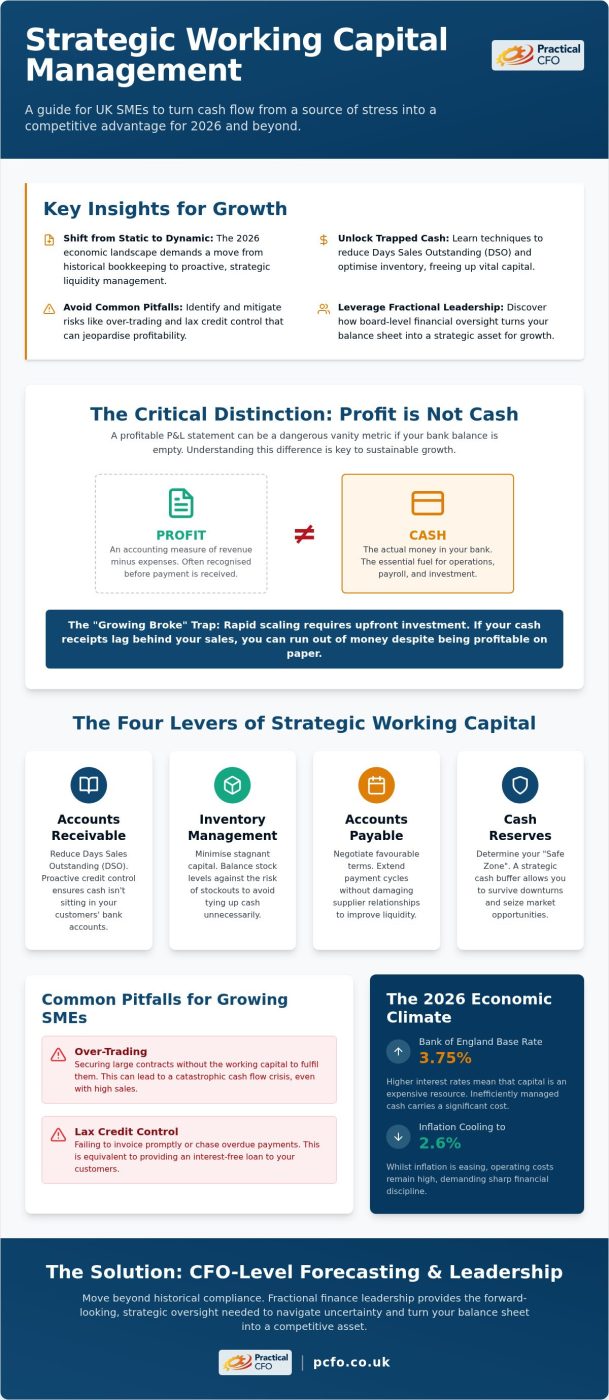
Effective working capital management for SMEs is more than a mathematical formula; it’s a strategic discipline. Whilst the technical definition of Working Capital is simply current assets minus current liabilities, the reality for a scaling firm is more complex. It represents the lifeblood of your day-to-day operations and the degree of strategic flexibility you possess. In a business environment where the Bank of England base rate sits at 3.75%, capital isn’t just a number on a spreadsheet; it’s an expensive resource that must be optimised to ensure survival and facilitate growth.
The economic conditions of 2026 demand a move away from static, backward-looking bookkeeping. With inflation cooling to 2.6% but operating costs remaining high, British founders cannot afford to have cash trapped in inefficient processes. There is a fundamental difference between simple liquidity, which merely keeps the lights on, and “strategic dry powder.” The latter allows you to capitalise on sudden market opportunities or survive unexpected supplier price hikes without hesitation. Without this cushion, many otherwise successful firms fall victim to the “Cash Flow Gap,” where the timing of payments to suppliers precedes the receipt of cash from customers by a margin the business cannot sustain.
The Critical Difference Between Profit and Cash
A profitable Profit and Loss (P&L) statement can be a dangerous vanity metric if your bank balance is empty. Revenue recognition often happens weeks or months before a single pound enters your account. This timing difference is the primary reason why many businesses find themselves “growing broke.” Rapid scaling requires significant upfront investment in stock, talent, and marketing. If your working capital management for SMEs isn’t robust, you might find that the more you sell, the faster you run out of cash. Monitoring actual cash receipts rather than just booked sales is vital for maintaining a healthy operational rhythm.
Why Traditional Accounting Often Fails Growing SMEs
Standard accounting services are typically designed for historical compliance and tax efficiency. They tell you what happened last year, not what will happen next month. For a business in a growth phase, a once-a-year meeting with an accountant is insufficient for making high-stakes decisions. You need forward-looking insights that align with your long-term trajectory. This is where outsourced accountancy solutions bridge the gap between keeping the books tidy and keeping the business funded. By shifting the focus from historical reporting to future strategy, you gain the clarity needed to navigate 2026’s economic uncertainties with confidence.
The Core Components of Strategic Working Capital Management
Strategic working capital management for SMEs requires a focused manipulation of four primary levers: inventory, accounts receivable, accounts payable, and cash reserves. Each component acts as a valve that either releases or restricts the flow of cash through your business. In an environment where the Bank of England base rate remains at 3.75%, the cost of inefficiently managed capital is higher than it has been in recent decades. You don’t just want to track these numbers; you want to engineer them to support your 2026 growth objectives.
- Inventory Management: Excessive stock levels represent stagnant capital and incur unnecessary storage costs. Balancing these against the risk of stockouts requires a granular understanding of your supply chain’s lead times.
- Accounts Receivable (AR): Reducing your Days Sales Outstanding (DSO) is the most direct way to inject liquidity. Proactive credit control ensures that your cash isn’t sitting in your customers’ bank balances whilst you struggle to meet payroll.
- Accounts Payable (AP): Negotiating payment terms that favour your liquidity is a hallmark of sophisticated leadership. The goal is to extend these terms without damaging vital supplier relationships or losing early payment discounts.
- Cash Reserves: Every industry has a different “Safe Zone.” Determining yours depends on your specific risk appetite and the volatility of your sector’s revenue cycles.
Optimising the Cash Conversion Cycle (CCC)
The Cash Conversion Cycle (CCC) measures the time it takes to turn your investment in stock and resources back into cash from sales. It’s calculated by adding your Days Inventory Outstanding to your Days Sales Outstanding, then subtracting your Days Payable Outstanding. Hidden cash is often trapped in operational inefficiencies, such as slow invoicing or lengthy production times. In 2026, UK SMEs in the service sector typically aim for a shorter CCC, whilst manufacturing firms must manage longer cycles with greater precision to avoid liquidity crunches. If you’re unsure where your capital is currently hiding, exploring strategic growth advisory can provide the necessary clarity.
Leveraging Technology for Real-Time Oversight
Static accounting reports are no longer sufficient for businesses navigating the current economic climate. Transitioning to dynamic, cloud-based dashboards allows for instant oversight of your liquidity position. Modern tools now utilise AI to predict payment behaviours amongst your client base, identifying potential late payers before they impact your cash flow. An experienced finance director plays a crucial role here, selecting a bespoke tech stack that scales with your business. This ensures you have the intellectual rigour and real-time data needed to make informed, proactive decisions rather than reacting to historical errors.
Common Working Capital Pitfalls for Growing UK Businesses
Growth is the primary objective for most founders, yet it often carries hidden risks that can jeopardise the entire operation. Even businesses with robust order books and high demand can face insolvency if they neglect the nuances of working capital management for SMEs. Understanding these pitfalls is the first step toward building a resilient financial structure that supports sustainable scaling rather than accidental collapse.
- Over-trading: This occurs when a company takes on contracts that its current capital base cannot support. The upfront costs of labour, materials, and overheads often drain cash reserves long before the first invoice is paid.
- Poor Credit Control: Many business owners allow “favourite” clients to ignore agreed payment terms to maintain a positive relationship. This effectively means you are providing interest-free loans to your customers whilst your own liquidity suffers.
- Inadequate Tax Planning: With Corporation Tax rates at 25% for profits exceeding £250,000, failing to forecast these liabilities is a common error. Blindsiding the business with a large VAT or tax bill can stall growth for months.
- Underestimating Seasonality: Cyclical markets require a significant buffer to navigate quiet quarters. Without a 13-week rolling forecast, businesses often find themselves with empty bank balances during predictable downturns.
The Danger of “Vanity Metrics” in Boardroom Reporting
Top-line turnover growth is a common focus in boardroom discussions, yet it can be entirely meaningless without sustainable operating cash flow. It’s easy to be distracted by impressive sales figures whilst ignoring the widening gap between billing and collection. Vanity metrics are the silent killer of scaling SMEs. To ensure long-term viability, leadership teams must shift their focus from sales volume to the speed and efficiency of cash collection.
Inaccurate Forecasting and Optimism Bias
Founders are naturally driven by optimism, which is essential for innovation but dangerous for financial planning. This bias often leads to over-estimating future receipts and under-estimating the actual costs associated with scaling operations. Building a realistic forecast requires a psychological shift from “what we hope will happen” to “what the data suggests will happen.” Engaging an external business growth advisory uk provides the objective lens needed to challenge these assumptions. This partnership ensures your strategy is grounded in financial reality rather than aspirational projections, allowing you to navigate 2026 with confidence.
Implementing CFO-Level Forecasting and Scenario Modelling
Rigorous forecasting is the mechanism that transforms working capital management for SMEs from a reactive task into a strategic advantage. It provides the visibility required to navigate the complexities of the 2026 UK economy with composure. By establishing a structured hierarchy of forecasts, you move beyond simple bank balance monitoring and begin to engineer your business’s future liquidity. Implementation follows a logical progression from immediate tactical needs to long-term strategic objectives.
- Step 1: Establish a 13-week rolling cash flow forecast to secure immediate tactical liquidity.
- Step 2: Develop a 12-month strategic forecast that aligns with your overarching business goals and growth trajectory.
- Step 3: Conduct “What-If” scenario modelling to prepare for potential interest rate fluctuations or the sudden loss of a key client.
- Step 4: Integrate these forecasts with department-level KPIs to ensure every team understands its impact on the company’s cash position.
The 13-Week Rolling Forecast: Your Tactical Shield
The 13-week window is considered the gold standard for SME cash management because it covers a full fiscal quarter, providing enough foresight to identify and resolve potential shortfalls before they become crises. This tool allows you to manage weekly payroll and critical supplier payments with absolute precision. Success with this model relies on variance analysis, where you compare “Actual” figures against your “Forecast” every week. This disciplined process identifies where your assumptions were incorrect, allowing you to refine your model and improve accuracy over time. It turns the fog of financial uncertainty into a clear, actionable roadmap for the months ahead.
Strategic Scenario Planning for UK Leaders
In a landscape where the Bank of England held the base rate at 3.75% in July 2026, scenario modelling is essential for future-proofing your business. A CFO-level approach involves testing your capital’s resilience against various “What-If” events, such as supply chain shocks or changes announced in the upcoming Autumn Budget on 28 October 2026. This data allows you to make informed decisions about when to “push” for aggressive expansion and when to “conserve” cash to protect the business. Linking these outcomes to clear contingency plans ensures the board is never caught off guard by external volatility. To implement these sophisticated models within your own organisation, consider how Chief Financial Officer services can provide the necessary expertise and strategic oversight.
Why Fractional Finance Leadership is the Solution for SMEs
Professionalising working capital management for SMEs requires a level of strategic oversight that often exceeds the capacity of a standard bookkeeping or accountancy function. Whilst many competitors suggest that additional debt is the primary solution to liquidity issues, we recognise that high-level leadership is the actual cure. A fractional CFO or Finance Director provides the intellectual rigour needed to transform your balance sheet into a tangible competitive advantage. This approach ensures your business is not just surviving day-to-day but is actively building value for future stakeholders.
- Expertise without the Overhead: You gain access to seasoned board-level wisdom without the commitment of a £150k+ annual salary for a permanent executive.
- Strategic Engine: We turn static figures into a proactive strategy that fuels sustainable scaling and operational flexibility.
- Investment Readiness: Professional oversight is essential when preparing for series funding or implementing exit strategy planning services to maximise business value.
- Stakeholder Trust: Clear, CFO-led reporting builds immediate credibility with lenders, suppliers, and potential buyers.
Fractional CFO vs. Full-Time Hire: The ROI Comparison
The cost-to-value ratio of a fractional leader is particularly compelling for UK businesses in a transition or growth phase. Permanent executives require significant investment in salary, benefits, and recruitment fees, which can drain the very capital you are trying to preserve. A fractional role offers the flexibility to scale support up or down as your requirements evolve. For a detailed breakdown of how this investment compares to traditional hiring models, you can view our guide on fractional cfo pricing uk. This model ensures you only pay for the high-level expertise you need, when you need it.
Building a Cash Flow Culture from the Top Down
A Finance Director does more than manage numbers; they educate the entire leadership team on their individual impact on the company’s liquidity. True working capital management for SMEs involves aligning sales incentives with actual cash collection rather than just signed contracts. This shift in mindset prevents the “growth at all costs” trap that leads to over-trading. By partnering with PCFO, you secure a steady hand amongst financial turbulence. We act as an embedded advisor, focused on future-proofing your organisation and ensuring your financial strategy is as ambitious as your business goals.
Engineering Your Financial Future for Sustainable Growth
Mastering working capital management for SMEs is the defining factor between a business that merely survives and one that scales with absolute confidence. By implementing rigorous 13-week forecasts and shifting your leadership focus from turnover to cash collection, you protect your company against the inherent volatility of the 2026 economic landscape. These strategic shifts move your finance function from a historical reporting role into a proactive engine of business value.
Reliable liquidity is not a matter of luck; it’s the result of intellectual rigour and experienced oversight. Our fractional CFO expertise provides growing UK firms with the steady hand needed to navigate 3.75% interest rates and shifting market conditions. We focus on proactive cash flow engineering to ensure your capital is always working toward your long-term strategic objectives rather than just covering immediate costs.
It’s time to transform your bank balance from a source of anxiety into a strategic asset. Secure your business future with expert Finance Director services from PCFO and gain the strategic advisory required for sustainable scaling. You’ve built a successful business; let’s ensure you have the financial foundation to lead it into a prosperous future.
Frequently Asked Questions
What is the most effective way for a UK SME to manage working capital?
The most effective approach is to implement a 13-week rolling cash flow forecast alongside disciplined credit control. This dual strategy allows you to anticipate shortfalls before they occur and ensures that cash isn’t trapped in unpaid invoices. By focusing on the cash conversion cycle, you can release liquidity that would otherwise be stagnant. This proactive stance is essential for maintaining operational stability in the current UK market.
How much cash should an SME keep in reserve for 2026?
Most UK SMEs should aim to maintain a reserve covering three to six months of essential operating expenses. The exact figure depends on your sector’s volatility and your specific risk appetite. With the Bank of England base rate at 3.75% in 2026, the opportunity cost of holding too much cash must be balanced against the safety of a liquid buffer. A strategic advisor can help you determine your specific “Safe Zone” for capital.
Can an SME be profitable on paper but have no cash in the bank?
It’s entirely possible to be profitable on paper whilst facing a bank balance of zero. This often happens because revenue is recognised when an invoice is raised, but the actual cash might not arrive for 30, 60, or 90 days. During periods of rapid scaling, your cash outflows for stock or staff often precede your inflows, creating a dangerous gap. Effective working capital management for SMEs focuses on closing this timing disparity.
What is the difference between a bookkeeper and a fractional CFO for cash flow?
A bookkeeper focuses on the historical accuracy of your transactions and ensuring tax compliance. In contrast, a fractional CFO provides strategic foresight by using that data to model future scenarios and growth trajectories. Whilst the bookkeeper tells you where your money went, the CFO tells you where your cash flow is headed and how to optimise it. This high-level oversight is vital for businesses looking to scale sustainably.
How often should a cash flow forecast be updated in a growing business?
Tactical forecasts should be updated weekly, whilst strategic long-term models require a monthly review. A weekly update to your 13-week rolling forecast ensures you can manage immediate payroll and supplier runs with precision. Monthly reviews of your 12-month outlook allow you to adjust your growth strategy based on actual performance. This regular rhythm builds a foundation of trust amongst stakeholders and provides the clarity needed for confident decision-making.
What are the best tools for working capital management for UK SMEs?
Modern cloud-based platforms like Xero, QuickBooks, and Sage remain the industry standard for UK businesses in 2026. These tools are often paired with specialised forecasting software or bespoke dashboards to provide real-time oversight of liquidity. The key is ensuring your tech stack is integrated so that data flows seamlessly from your invoices to your cash models. A Finance Director can help you select and implement the right combination for your specific scale.
How does a Finance Director help with cash flow during a business exit?
A Finance Director maximises business value during an exit by demonstrating a history of predictable, healthy cash flow. They clean up the balance sheet, reduce Days Sales Outstanding, and ensure that working capital is optimised rather than bloated. This professional oversight builds significant trust with potential buyers or investors. It proves that the business is a well-oiled machine capable of generating sustainable returns without constant crisis management.
Is working capital management different for service-based vs product-based SMEs?
Product-based businesses must focus heavily on inventory management and supply chain lead times to avoid trapping capital in stock. Service-based SMEs typically prioritise reducing Days Sales Outstanding and managing the gap between staff costs and client payments. Both models require robust working capital management for SMEs, but the specific levers adjusted will differ. Tailoring your strategy to your sector’s unique cash conversion cycle is essential for long-term financial health.