

Why does your monthly board report feel like a detailed autopsy of the past rather than a strategic map for the future? It’s a common frustration for UK SME owners who feel they’re flying blind during rapid expansion. You likely realise that your finance function is excellent at compliance but silent on strategy. This tension often stems from a fundamental misunderstanding of the strategic finance director vs financial controller distinction. While one protects the integrity of your current ledger, the other architects the future value of your enterprise.
We understand that choosing your next senior hire is a high-stakes decision, especially with average salaries for these roles now ranging from £75,000 to over £121,000 in 2026. This guide will clarify exactly which leader your business requires to move beyond mere reporting. You’ll discover how to transition from historical data to forward-looking insights that support a future sale or sustained growth. We’ll explore the specific skill sets, market rates, and organisational impacts of both roles to ensure your finance department becomes an engine for scale rather than a bottleneck for progress.
Key Takeaways
- Learn the fundamental differences between a strategic finance director vs financial controller, ensuring your senior hire aligns perfectly with your current growth phase.
- Identify the specific revenue milestones and operational complexities that signal when your SME has outgrown its existing financial reporting structure.
- Discover how strategic leadership can actively enhance your EBITDA multiple and improve your business’s attractiveness for a future sale or investment.
- Understand the value of the fractional finance model, which offers high-level strategic foresight without the overhead of a six-figure full-time executive salary.
- Recognise how a combined FD and FC approach creates a robust finance function that balances rigorous internal control with proactive commercial planning.
Strategic Finance Director vs Financial Controller: Defining the Boundary
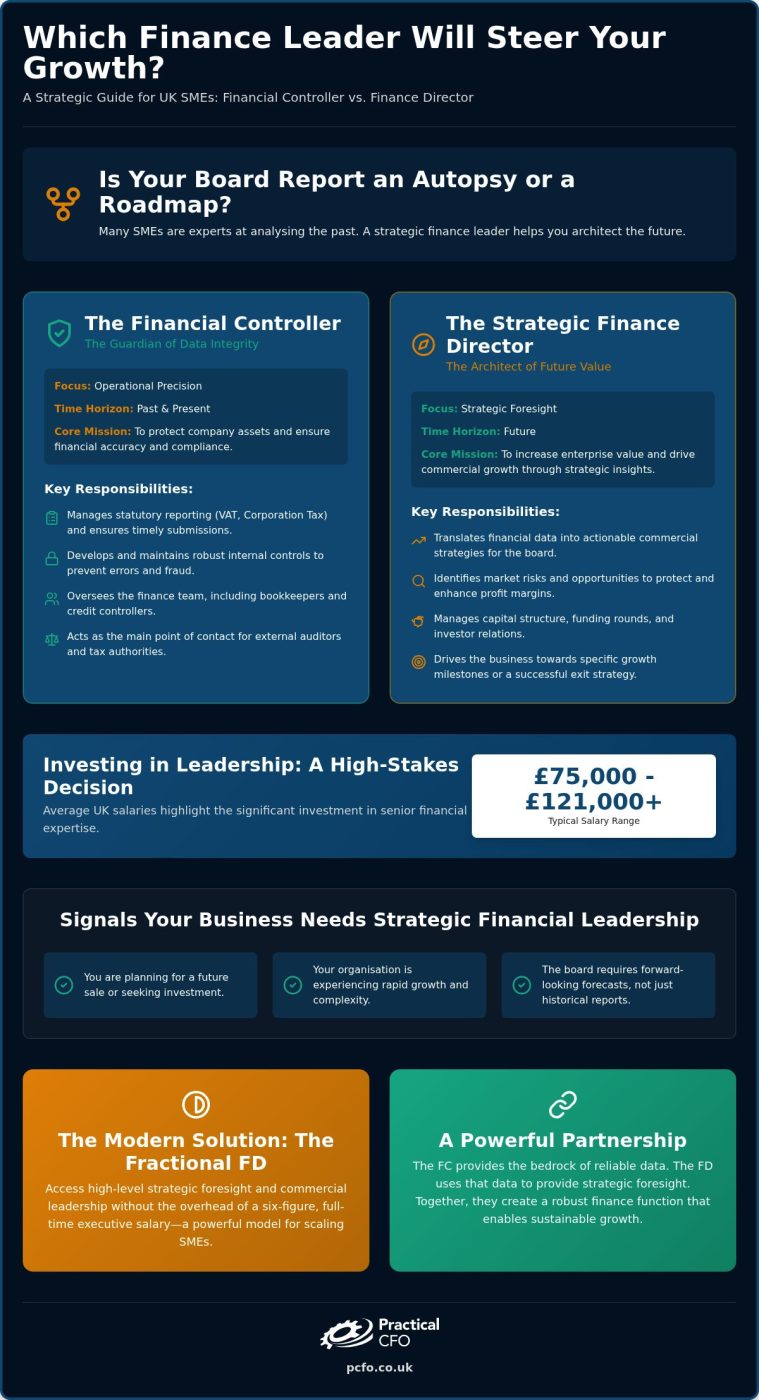
The distinction between a strategic finance director vs financial controller is often the difference between a business that merely survives and one that scales with confidence. Whilst these titles are occasionally used interchangeably in smaller firms, their functional boundaries are distinct. One role is designed to protect your current assets through rigorous oversight, whilst the other is designed to grow them through commercial insight. Understanding where one ends and the other begins is the first step in future-proofing your organisation.
The Financial Controller: Managing the Integrity of Data
The Financial Controller (FC) serves as the architect of your internal financial infrastructure. Their primary responsibility is the integrity of the “here and now.” They ensure that every transaction is recorded correctly, that internal controls are robust, and that the business meets its statutory obligations. This role is closely related to the traditional Comptroller, focusing on the technical accuracy of the ledger and the management of the finance team.
An effective FC manages the relationship with auditors and tax authorities whilst overseeing bookkeepers and credit controllers. They provide the “beating heart” of the finance function: accurate, timely, and compliant data. Without this foundation, any strategic planning is built on sand. Their success is measured by the absence of surprises in the year-end accounts and the smooth running of monthly payroll and VAT submissions.
The Strategic Finance Director: Architecting Future Value
The Strategic Finance Director (FD) operates as a high-level commercial partner to the CEO. Whilst they rely on the data produced by the FC, their focus is firmly on the horizon. The “strategic” prefix is essential here; it marks a departure from traditional accounting into business leadership. They don’t just report on what happened last month; they interpret those figures to influence board-level decisions regarding funding, acquisitions, and market expansion.
A Strategic FD identifies risks and opportunities in the wider UK market to protect your profit margins. They are responsible for capital structure, stakeholder management, and driving the business towards a specific exit or growth milestone. Their value lies in their ability to translate complex financial data into actionable commercial strategies that improve your EBITDA multiple and overall enterprise value.
In a high-performing finance department, these roles coexist in a symbiotic partnership. The FC provides the bedrock of reliable data, which allows the FD to provide the strategic foresight needed for scaling. For many UK SMEs, the debate over a strategic finance director vs financial controller isn’t about choosing one over the other. Instead, it’s about recognising when your business has reached a level of complexity where the FC requires the support of a more commercially focused partner to navigate the path ahead.
Operational Precision vs Strategic Foresight: Key Responsibilities
To appreciate the nuances of a strategic finance director vs financial controller, you must look at their daily outputs and the time horizons they inhabit. An FC prioritises precision; an FD prioritises potential. Whilst both roles are essential for a robust finance function, their day-to-day focus serves different masters. The controller manages the internal engine, whilst the director navigates the road ahead. This distinction is reflected in the broad duties of financial managers, as outlined in the Financial Managers Occupational Outlook Handbook, which highlights how leadership roles must balance operational oversight with long-term planning.
Internal Operations and Compliance (The FC Domain)
The Financial Controller is the primary steward of your business’s financial hygiene. Their focus is on the “how” of finance: how cash moves through the business, how credit control is managed, and how supplier payments are prioritised. They are responsible for implementing outsourced accountancy solutions to streamline transactional processes and ensure that data entry is both efficient and accurate. For a UK SME, this means ensuring that Corporation Tax, VAT, and PAYE deadlines are met without fail. Their reporting is typically statutory and historical, providing a clear but backward-looking view of performance.
Commercial Strategy and Funding (The FD Domain)
A Strategic Finance Director operates at the board level to translate those historical figures into future opportunities. They don’t just report on the bank balance; they prepare the business for investment rounds or negotiate debt restructuring to fuel expansion. Their work involves strategic budgeting and forecasting, which goes beyond simply setting limits. They stress-test various growth scenarios, such as the impact of a new product launch or an international office. By analysing service profitability, they guide the CEO on where to double down and where to pivot, ensuring that the company’s capital is always deployed where it will generate the highest return.
The contrast is perhaps most visible in their approach to risk. An FC focuses on internal risk, such as fraud prevention or ledger errors. A Strategic FD looks at external market positioning, assessing how inflation, interest rates, or competitor behaviour might threaten the business model. If you’re unsure which level of support your business currently demands, reviewing our Finance Director Services can provide clarity on the best path forward for your specific lifecycle. Ultimately, the strategic finance director vs financial controller choice depends on whether you need to stabilise your current operations or architect your next phase of growth.
The Commercial Impact: How an FD Drives Value Beyond Compliance
While a financial controller ensures the books are balanced, a strategic finance director ensures the business is worth more tomorrow than it is today. In the debate of strategic finance director vs financial controller, the real differentiator is commercial impact. One role handles the necessary administrative compliance; the other acts as an architect for shareholder wealth. This transition from “counting the beans” to “growing the beanstalk” is vital for SMEs looking to scale or sell.
A Strategic FD plays a central role in business growth advisory uk by providing the commercial data needed to support expansion. Their involvement in M&A or partnership deals is particularly critical. They conduct rigorous financial due diligence on potential targets, ensuring that any acquisition adds real value rather than just complexity. This level of commercial scrutiny signals to the market that the business is professionally managed and ready for high-level investment.
Maximising Shareholder Value and Exit Readiness
A primary focus for any Strategic FD is ensuring the business remains “sale-ready” at all times. By utilising exit strategy planning services, they begin preparing for a transition years before it actually occurs. This involves cleaning up the balance sheet to remove potential “deal-breakers” such as unresolved tax issues or poorly documented contracts that often spook acquirers during due diligence. They don’t just present numbers; they articulate a financial narrative that justifies a premium valuation, often significantly increasing the final EBITDA multiple through better financial hygiene.
Strategic Overhead Reduction and Profitability
Beyond compliance, an FD identifies “leaky buckets” in the business model. These are systemic inefficiencies that a controller might overlook because the individual transactions are technically correct. An FD evaluates the strategic ROI of every pound spent. They negotiate high-value contracts and manage vendor relationships to ensure the business isn’t overpaying for critical services. By optimising working capital, they help the CEO fund growth internally. This reduces the reliance on expensive debt and preserves equity for the founders, which is a key outcome of a proactive finance function.
Identifying the Trigger Points: When Does Your SME Need Strategic Leadership?
Determining the right time to transition from a controller-led function to a director-led strategy is a pivotal moment for any founder. It isn’t merely a matter of headcount; it’s a response to increasing organisational complexity. If you’re currently weighing up a strategic finance director vs financial controller hire, you should start with the “Blind Spot” test. Ask yourself: can you predict your cash position in 12 months with 90% accuracy? If the answer is no, your current finance function is likely focused on recording the past rather than navigating the future.
Revenue milestones often act as the primary catalyst. The £2m to £5m turnover range is frequently cited as the “danger zone” for unsupported CEOs. At this scale, the business is too large for the founder to manage every financial nuance but often lacks the sophisticated systems required for automated oversight. Complexity triggers, such as managing multiple entities, launching diverse product lines, or embarking on international expansion, further expose the limitations of a purely operational finance lead. When you require significant bank lending or are preparing for Series A or B funding, investors will expect the level of strategic rigour that only an FD provides.
Signs You Have Outgrown Your Financial Controller
You’ll notice the shift in the quality of your board meetings. If these sessions are spent debating the accuracy of the numbers rather than discussing commercial strategy, your finance function is failing to support your leadership. Many CEOs find themselves making major financial decisions in a vacuum because their current team can’t provide the “what-if” modelling needed to stress-test ideas. If your growth has plateaued despite strong sales, it’s often a sign that your business lacks the commercial optimisation and overhead control that a Strategic FD brings to the table.
The Cost of Delaying Strategic Hires
Delaying this hire can lead to missed opportunities for acquisition or expansion due to a lack of financial agility. However, hiring a full-time FD at a 2026 market rate of £120,000 plus benefits can be an expensive mistake if done too early. This is where many UK firms find value in a hybrid approach. You can explore fractional cfo pricing uk to understand how to access “Big 4” expertise at a fraction of the cost of a full-time executive. This model allows you to test the waters and build the strategic framework before committing to a permanent hire. If your business is reaching these critical trigger points, our Finance Director Services can provide the steady, experienced hand needed to navigate your next growth phase with confidence.
Fractional Finance Leadership: The Hybrid Solution for Modern SMEs
Many UK business owners view the choice of a strategic finance director vs financial controller as a binary decision. They assume they must either settle for operational reporting or commit to a heavy executive salary. The fractional finance model eliminates this compromise. It allows you to access “Big 4” expertise and high-level strategic foresight on a part-time basis, ensuring your business has the leadership it needs without the burden of a full-time hire. This flexibility is essential for firms that have outgrown their controller but aren’t yet ready for a permanent FD.
The power of this model lies in the FD/FC partnership. A fractional FD does not replace your existing financial controller; instead, they empower them. Whilst the FC maintains operational control and data integrity, the FD provides the strategic oversight required for scaling. This symbiotic relationship ensures that your business planning is grounded in reality whilst remaining ambitious enough to capture market opportunities. It provides a scalable solution where you can increase or decrease support as your business lifecycle evolves.
Bridging the Expertise Gap Without the Overhead
Recruiting a full-time, high-calibre FD in 2026 often involves a salary exceeding £150,000, alongside National Insurance, bonuses, and equity commitments. A fractional approach avoids these substantial overheads. You gain access to a professional who has navigated multiple growth and exit cycles across various industries. This breadth of experience allows them to implement sophisticated financial frameworks and risk management strategies that a standard FC may not have encountered in a purely operational role. It brings a level of intellectual rigour to your boardroom that was previously reserved for much larger corporations.
Getting Started with Strategic Finance
Transitioning to a more strategic finance function begins with a comprehensive review of your current business model. This process identifies immediate gaps in your reporting, cash flow management, and long-term planning. By setting clear KPIs for your fractional FD from the outset, you ensure a measurable ROI on your investment. At PCFO, our approach focuses on being an embedded partner rather than an external contractor. We don’t operate as distant advisors; we act as an extension of your board, ensuring that strategic navigation is a continuous process rather than a monthly check-in.
If your organisation has reached a complexity trigger or is preparing for a significant milestone, it’s time to elevate your financial leadership. You can enquire about our fractional FD services today to discover how we can help you architect your next phase of growth with confidence and clarity.
Future-Proofing Your Financial Leadership
Choosing between a strategic finance director vs financial controller is a pivotal decision that defines your company’s trajectory. You’ve seen that whilst a controller ensures the integrity of your current data, a strategic director uses that data to architect future value. Recognising the trigger points, such as revenue milestones or increased operational complexity, allows you to transition your finance function before it becomes a bottleneck. The fractional model offers a flexible bridge, providing high-level commercial insight without the typical executive overhead.
At PCFO, we specialise in UK SME growth and exit strategy. We provide an embedded strategic partnership that delivers board-level impact without long-term recruitment fees or the burden of a six-figure salary. It’s about ensuring your finance department supports your vision rather than just your compliance. If you’re ready to move beyond historical reporting and start building a more valuable enterprise, we’re here to help you navigate that transition with confidence. Discover how our Fractional FD Services can scale your business and provide the steady hand your leadership team deserves.
Frequently Asked Questions
What is the main difference between a Finance Director and a Financial Controller?
The primary distinction lies in their time horizon and core objective. A Financial Controller manages the integrity of historical data and ensures day-to-day compliance. Conversely, a Finance Director uses that data to architect future growth. In the debate of strategic finance director vs financial controller, remember that one protects your current assets whilst the other focuses on increasing your enterprise value through commercial strategy and funding.
Can a Financial Controller eventually become a Finance Director?
Yes, many senior finance leaders begin their careers in controllership. However, the transition requires a significant shift from technical accounting to commercial leadership. To move into an FD role, a controller must develop the ability to influence board-level decisions and interpret figures through a strategic lens. It is less about the accuracy of the ledger and more about the impact of financial decisions on long-term business objectives.
Do I need both a Financial Controller and an FD in my UK SME?
As your business scales beyond £5m turnover, a combined approach often becomes necessary. The Financial Controller ensures the “beating heart” of your finance function is compliant and accurate. This allows the Finance Director to focus entirely on high-level strategy and investment. Having both roles creates a robust structure where operational oversight and strategic foresight coexist, ensuring you don’t sacrifice accuracy for the sake of rapid expansion.
How much does a part-time or fractional Finance Director cost in the UK?
A full-time Finance Director in the UK typically commands a salary between £103,200 and £121,145 in 2026, with salaries for highly experienced FDs in top-tier roles often reaching £130,009. A fractional FD provides access to this same level of expertise for a set number of days per month. This model significantly reduces the overhead of National Insurance and executive bonuses whilst providing the strategic leadership needed to improve your profit margins and prepare for a future sale.
When is the right time to hire a Strategic Finance Director?
You should consider this hire when your board meetings spend more time debating the accuracy of numbers than discussing growth strategy. Common triggers include reaching the £2m revenue milestone, managing multiple entities, or preparing for a significant funding round. If you cannot predict your cash position 12 months out with high accuracy, it is a clear sign that your business requires more than just operational controllership to navigate the future.
Will an FD replace my current accountant or bookkeeper?
No, an FD serves to elevate the work of your existing team rather than replace it. They provide the leadership and commercial interpretation that bookkeepers and accountants typically don’t offer. By overseeing these functions, an FD ensures that the data produced is used to drive strategic decisions. They bridge the gap between transactional accounting and the CEO’s vision, making your entire finance department more efficient and growth-oriented.
What qualifications should I look for in a Strategic Finance Director?
You should prioritise candidates with recognised professional qualifications such as ACA, ACCA, or CIMA. Beyond these technical credentials, look for a proven track record in commercial leadership and business growth advisory. An effective FD must possess the intellectual rigour to challenge the status quo and the communication skills to influence stakeholders at the board level. Their value is found in their experience navigating complex business lifecycles and exit strategies.
How does a Strategic FD help with business exit planning?
A Strategic FD prepares your business for a premium valuation by cleaning up the balance sheet and improving the EBITDA multiple. They identify and resolve “deal-breakers” long before potential acquirers begin due diligence. By articulating a clear financial narrative and ensuring robust financial hygiene, they make your company more attractive to investors. Their involvement ensures you are always “sale-ready,” allowing you to exit on your own terms when the market is most favourable.