

Your accountant is likely doing a perfect job of keeping you compliant, yet they aren’t the person who will navigate your business through its next major growth phase. Many UK entrepreneurs reach a plateau where the numbers make sense on paper, but the strategic path forward remains clouded. You might find yourself asking, “do I need a finance director,” as you struggle to bridge the gap between keeping the books and driving a commercial strategy. It’s a common point of friction for scaling companies that feel overwhelmed by data whilst lacking the actionable insights needed to secure Series A funding or plan a successful exit.
We understand that the leap from a traditional firm to an executive hire feels like a significant financial risk. However, continuing without strategic oversight often proves far more costly in the long run. In this guide, you’ll discover the specific triggers that signal your business has outgrown its current financial structure. We will outline how to secure high-level leadership that manages cash flow and future-proofs your operations. By the end, you’ll understand how to access this expertise through a fractional model; this ensures your business gains a steady, experienced hand at the helm without the weight of a full-time executive salary.
Key Takeaways
- Identify the specific revenue and complexity milestones, such as the £1m to £5m bracket, that signal it’s time to move beyond basic compliance.
- Learn to answer the question “do I need a finance director” by evaluating whether your current financial data provides the strategic foresight required for scaling.
- Understand the fundamental shift from tactical reporting to strategic leadership; see how an FD transforms historical data into future growth opportunities.
- Discover how the fractional model allows UK SMEs to access high-level boardroom expertise without the burden of a full-time executive salary.
- Gain clarity on future-proofing your business through professional exit planning and robust cash flow management.
Recognising the Gap: When an Accountant is No Longer Enough
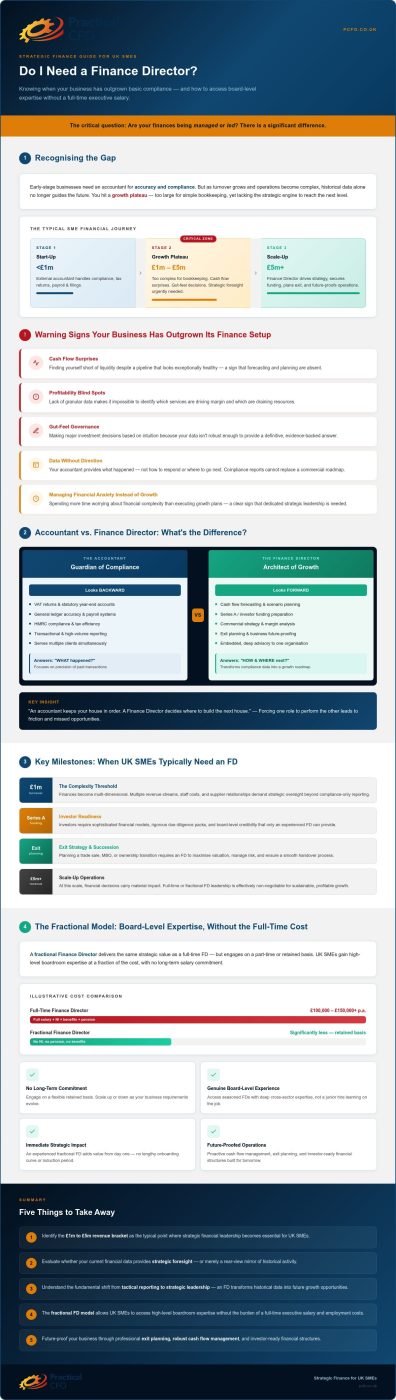
The journey of a UK SME often begins with a focus on survival and basic compliance. In the early stages, an external accountant provides exactly what’s required: accurate tax returns, payroll management, and statutory filings. It’s a functional relationship that serves a young company well. However, as your turnover increases and your operations become more complex, a natural evolution occurs. You reach a point where historical data is no longer sufficient to guide your future. This is the growth plateau, a stage where your business is too large for simple bookkeeping but lacks the strategic engine to reach the next level.
Founders often find themselves trapped in a cycle of uncertainty when they realise they’re spending more time managing financial anxiety than executing growth plans. Relying solely on historical reporting means you’re always looking in the rear-view mirror. Proactive decision-making requires a forward-looking lens that your current setup might not provide. If you’re constantly questioning “do I need a finance director,” it’s usually because the emotional toll of managing complex finances alone has started to outweigh the benefits of your current lean structure.
Common Signs of Financial Strain in Growing Firms
When a business outgrows its financial infrastructure, the symptoms are often felt before they’re seen in a balance sheet. You might experience:
- Cash flow surprises: Finding yourself short of liquidity despite a pipeline that looks exceptionally healthy.
- Profitability blind spots: A lack of granular data makes it impossible to tell which services are driving margin and which are draining resources.
- Gut-feel governance: Making major investment decisions based on intuition because your data isn’t robust enough to provide a definitive answer.
The Limitations of Traditional Accountancy
It’s vital to recognise that accountants and Finance Directors serve different masters. A traditional accountant focuses on what has already happened, ensuring your business stays on the right side of HMRC. They provide the “what,” but rarely the “how” or “why.” This focus on statutory compliance is essential, yet it’s distinct from strategic navigation.
An FD focuses on what will happen next. Whilst your current accountant may be an expert in their field, they’re often too busy with the high-volume tasks of multiple clients to offer the deep, embedded advisory your scaling business requires. If you’re asking “do I need a finance director,” it’s likely because you need someone to turn those compliance-based reports into a commercial roadmap that secures your long-term success.
Strategic vs. Tactical: FD vs Accountant Comparison
Understanding the distinction between tactical accounting and strategic financial leadership is essential for any scaling business. Whilst the terms are sometimes used interchangeably, they represent two very different functions within your organisation. An accountant keeps your house in order. A Finance Director decides where to build the next house. If you’re asking “do I need a finance director,” you’re likely feeling the gap between record-keeping and board-level influence.
Both roles are vital, but they operate on different timelines. The accountant looks back to ensure accuracy and compliance. The Finance Director looks forward to ensure sustainability and growth. Attempting to force an accountant into a strategic role, or vice versa, often leads to operational friction and missed opportunities.
The Accountant: The Guardian of Compliance
Your accountant is the primary defender of your business’s regulatory health. Their focus is tactical, ensuring that every transaction is recorded correctly and that you remain compliant with UK law. They manage the essential, high-volume tasks that keep the doors open. Their responsibilities typically include:
- Managing VAT returns and statutory year-end accounts.
- Ensuring the accuracy of the general ledger and payroll systems.
- Maintaining a professional relationship with HMRC to ensure regulatory safety and tax efficiency.
Without this foundation, a business cannot function safely. However, an accountant’s role is inherently retrospective, focusing on the precision of what has already transpired.
The Finance Director: The Architect of Growth
A Finance Director takes those accurate records and uses them as a foundation for the future. They move beyond the ledger to provide business growth advisory uk, focusing on how to deploy capital for maximum return. Their value lies in strategic navigation rather than simple data entry. Specific finance director tasks that add significant value include:
- Developing sophisticated cash flow forecasts and “what-if” scenarios to test business resilience.
- Managing investor relations and preparing the documentation required for Series A or B funding rounds.
- Organising financial structures that support rapid scaling, such as multi-entity reporting or international trade compliance.
The shift from record-keeping to strategic influence is what defines the transition. A Finance Director doesn’t just report on the numbers; they use them to influence the direction of the company at the board level. When you wonder “do I need a finance director,” consider whether you have a partner who can challenge your assumptions with data-driven insights. If you’re ready to move from maintenance to momentum, exploring fractional finance leadership can provide the strategic architect your business deserves.
Key Milestones: When Does a UK SME Typically Require an FD?
Determining the exact moment to transition from a traditional accounting setup to strategic leadership is a pivotal decision for any founder. Whilst every business follows a unique trajectory, certain milestones consistently signal that the current structure is under strain. Most UK companies find that the £1m to £5m revenue bracket serves as the primary turning point. At this scale, the volume of transactions and the complexity of the supply chain often exceed the capacity of a compliance-led function. If you find yourself asking “do I need a finance director,” it’s likely because your business has reached a level of maturity where simple record-keeping no longer supports your ambitions.
Strategic triggers also play a significant role. If you’re preparing for a Series A funding round, investors will typically demand professional financial leadership as a condition of their investment. They require the rigour that only a seasoned executive can provide. Similarly, expanding into international markets or managing multiple legal entities introduces tax and regulatory hurdles that require proactive navigation rather than retrospective reporting.
Revenue and Headcount Thresholds
The £2m revenue mark often acts as a breaking point for internal accounting processes. At this level, the distance between the CEO and the day-to-day financial operations increases, making it harder to maintain a clear view of performance. Managing a team of 20 or more people adds further layers of complexity, particularly regarding payroll structures, benefits, and pension compliance. The complexity threshold for a UK SME occurs when the diversity of revenue streams and operational risks requires strategic interpretation rather than just accurate recording.
External Pressure and Stakeholder Management
External stakeholders often dictate the need for high-level financial oversight. Banks, for instance, require sophisticated debt financing reports and covenant monitoring that go far beyond standard profit and loss statements. A Finance Director ensures these relationships remain healthy by providing the transparent, forward-looking data that lenders trust.
This level of professional rigour is equally essential when considering exit strategy planning services. Preparing a business for sale or acquisition is a multi-year process that requires meticulously organised data and a clear narrative of value. An FD protects the founder’s interests during these high-stakes negotiations, ensuring that the company’s financial health is presented accurately to maximise the eventual valuation. If your goal is a strategic exit, the question isn’t just “do I need a finance director,” but rather how soon you can embed one to begin the preparation process.
The Fractional Model: Accessing Board-Level Expertise Efficiently
Many UK business owners assume that strategic leadership requires a permanent, six-figure hire. This myth often prevents SMEs from accessing the expertise they need to scale. A fractional model provides a sophisticated alternative; it allows you to secure board-level talent for a few days a month rather than committing to a full-time executive salary. If you’re currently asking “do I need a finance director,” the answer might lie in the flexibility of this outsourced approach. You gain the same intellectual rigour and strategic foresight as a seasoned executive, but at a fraction of the investment.
The beauty of the fractional model is its inherent scalability. As your business evolves, you can scale the level of support up or down to match your requirements. Analysing fractional cfo pricing uk demonstrates that the ROI often far outweighs the cost, especially when compared to the heavy overheads of a permanent recruitment process. It’s a pragmatic solution for businesses that have outgrown their accountant but aren’t yet ready for a full-time FD.
How a Part-Time FD Integrates With Your Team
A fractional Finance Director doesn’t act as a distant consultant; they function as an embedded advisor within your leadership team. They establish a steady, methodical rhythm through monthly board meetings and strategic reviews. This partnership extends beyond the boardroom. A key part of their role involves mentoring and upskilling your existing junior finance staff, ensuring that your internal record-keeping improves alongside your strategic planning. This collaborative approach builds a foundation of trust and intellectual rigour throughout your finance function.
Cost-Benefit Analysis for the SME Leader
Choosing a fractional FD allows you to bypass the significant expenses associated with permanent executive recruitment. You eliminate the need for hefty recruitment fees, National Insurance contributions, and expensive executive benefit packages. Instead, your investment is focused purely on high-impact strategic tasks. An FD’s value is often realised through the identification of improved margins and better cash management strategies. When you calculate the ROI of professional cash flow forecasting and risk mitigation, the question “do I need a finance director” becomes a matter of commercial logic. If you’re ready to move forward with confidence, our Finance Director services can provide the strategic hand you need at the helm.
Implementing Strategic Finance: How PCFO Supports Your Journey
PCFO provides a composed, expert presence within your leadership team. We recognise that the transition from a compliance-led function to strategic leadership is a significant milestone for any UK SME. If you’re still questioning “do I need a finance director,” our methodology focuses on providing clarity through partnership rather than just reporting. We move beyond traditional outsourced accountancy solutions to become an embedded advisor, invested in your long-term trajectory.
Our onboarding process is methodical and transparent. It begins with a comprehensive audit of your current financial health, identifying gaps in reporting, cash flow management, and internal controls. From this foundation, we develop a bespoke action plan tailored to your specific commercial goals. This proactive mindset sets us apart amongst UK firms; we don’t just report on the past, we navigate your future. Our deep institutional knowledge in growth and exit planning ensures your business is always prepared for its next major milestone.
Tailored Support for Your Specific Business Stage
We adapt our leadership to match the lifecycle of your organisation. For early-stage firms, our focus is on building robust financial foundations and creating accurate forecasting models that attract investment. As you move into a mature scaling phase, we shift our attention to optimising profitability and identifying opportunities for overhead reduction. For those approaching a transition, our pre-exit support focuses on maximising valuation through total financial transparency. This ensures that when you finally decide “do I need a finance director,” you gain a partner who understands the nuances of your current position.
Taking the Next Step with Confidence
A successful partnership relies on a strong chemistry fit between the CEO and the Finance Director. You need an advisor who possesses both intellectual rigour and a collaborative mindset. We recommend booking a strategic review as your first step. This session allows us to identify your immediate financial gaps and demonstrate how fractional leadership can alleviate your operational anxieties. By securing a steady, experienced hand at the helm, you can return your focus to what you do best: leading your business toward its full potential. Discover how PCFO can transform your financial strategy and provide the strategic foresight your business deserves.
Securing the Strategic Future of Your Business
Transitioning from basic compliance to strategic leadership is a defining moment for any scaling company. You’ve seen that whilst an accountant protects your regulatory standing, a Finance Director builds the commercial roadmap for your growth. Recognising milestones like the £2m revenue mark or the need for professional exit planning helps you answer the question: do I need a finance director? By choosing a fractional model, you gain composed, professional board-level financial advice without the burden of executive salaries.
PCFO specialises in helping UK SMEs navigate these complexities through expert growth and exit strategies. We act as your embedded advisor, ensuring every decision is backed by intellectual rigour and strategic foresight. This partnership removes financial anxiety and allows you to lead with renewed clarity. If you’re ready to move beyond simple record-keeping and start driving your business forward, we’re here to help. Book a consultation with a PCFO strategic advisor today and take the first step toward a more resilient financial future.
Frequently Asked Questions
What is the difference between a Finance Director and a CFO?
A Finance Director typically focuses on the internal financial operations and commercial strategy of the business. In contrast, a CFO often takes a more external-facing role involving investor relations and capital structure. In many UK SMEs, these titles are used interchangeably. Both roles provide strategic leadership, but a CFO might be more involved in high-level fundraising and complex corporate governance during rapid international expansion.
How much does a part-time Finance Director cost in the UK?
The cost of a part-time Finance Director varies based on the level of experience and the number of days required each month. A fractional model is significantly more cost-effective than a full-time executive salary, which often includes benefits and bonuses. By using a fractional service, you only pay for the high-impact strategic time you actually use. This makes it a pragmatic choice for scaling businesses with limited budgets.
Can my current accountant act as my Finance Director?
Whilst your accountant is vital for compliance, they often lack the strategic commercial experience required for a Finance Director role. Accountants focus on historical data and statutory filings. A Finance Director uses that data to influence future growth. If you’re asking “do I need a finance director,” it’s usually because you need a partner who can challenge your business model and drive profit, rather than just recording it.
Is my business too small to hire a fractional FD?
Your business is rarely too small for strategic advice if you have ambitious growth plans. Most UK SMEs look for fractional support when turnover reaches the £1m mark or when they face complex challenges like international expansion. The fractional model is designed to be flexible. It allows you to access board-level expertise for as little as one day a month, ensuring you don’t over-commit your resources too early.
What are the primary responsibilities of a fractional Finance Director?
A fractional FD focuses on strategic navigation, cash flow forecasting, and future-proofing your business. They take responsibility for high-level financial planning, risk management, and commercial decision-making. Unlike an accountant who handles the ledger, the FD interprets the numbers to identify margin improvements and prepares the company for funding rounds or a strategic exit. They act as a steady, experienced hand at the helm of your financial strategy.
How many days a month does a fractional FD typically work?
Most fractional Finance Directors work between one and four days per month, depending on the complexity of your business. This schedule is usually structured around key milestones, such as monthly board meetings or quarterly strategic reviews. The flexibility of the model means you can increase the support during busy periods, such as a funding round, and scale back once the objective is achieved. It adapts to your specific lifecycle.
Will a fractional FD help me secure business funding?
Yes, a fractional FD is often instrumental in securing Series A or B funding by providing the financial rigour investors demand. They prepare the sophisticated data rooms, forecasts, and “what-if” scenarios that build investor confidence. Having an experienced FD present during negotiations signals to lenders and venture capitalists that your business is managed with professional oversight and intellectual rigour. This can significantly improve your chances of securing a successful investment.
What should I look for when hiring a part-time financial director?
You should look for a professional who possesses deep institutional knowledge of your specific industry and a proven track record in scaling UK SMEs. A chemistry fit with the CEO is essential, as the FD must act as a trusted advisor. When asking “do I need a finance director,” ensure the candidate focuses on proactive strategy rather than just historical reporting. They should demonstrate a proactive mindset and a focus on future-proofing.