

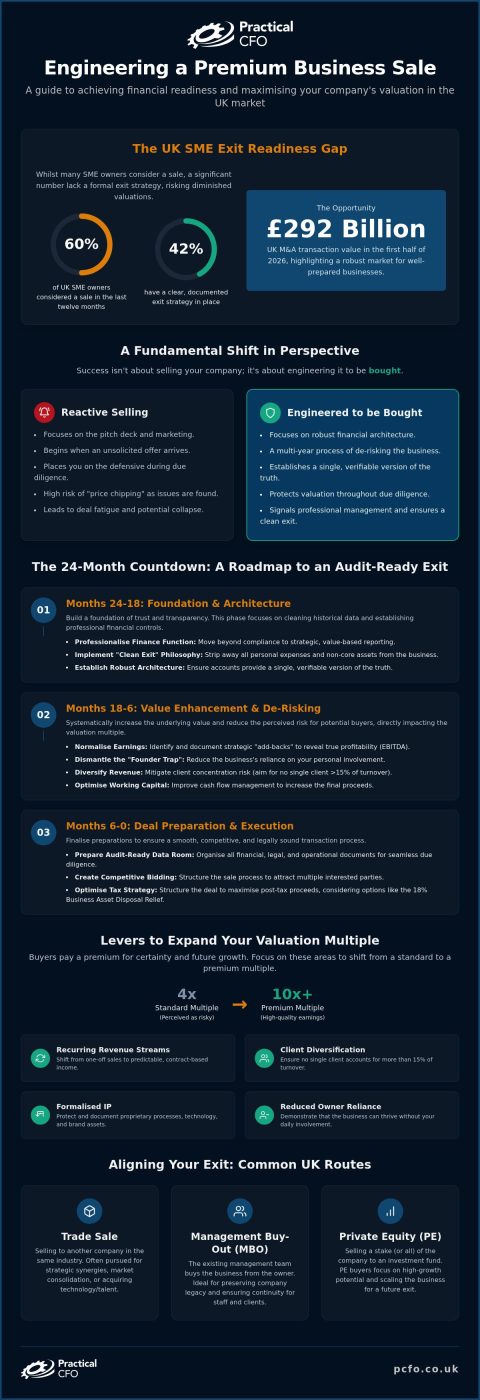
Did you know that whilst over 60% of UK SME owners considered a sale in the last twelve months, only 42% have a clear exit strategy in place? This lack of financial readiness for business sale UK standards often leads to diminished valuations or a breakdown during the final stages of due diligence. You’ve worked hard to build your legacy; it’s natural to feel concerned about whether your current structure will withstand the scrutiny of sophisticated buyers in a market where M&A values reached £292 billion in the first half of 2026.
Achieving a premium exit isn’t a matter of luck; it’s a result of deliberate engineering. This guide will show you how to align your financial architecture with the rigorous expectations of the current market, ensuring your accounts are audit-ready and your tax strategy is optimised for the 18% Business Asset Disposal Relief rate. We will outline the steps to professionalise your finance function, create a competitive bidding environment, and secure the post-tax proceeds you deserve for your years of leadership.
Key Takeaways
- Shift your perspective from selling a business to ensuring it is “bought” by building a robust financial architecture that de-risks the transaction for sophisticated buyers.
- Discover how to normalise earnings and identify strategic add-backs to justify a premium EBITDA multiple that reflects your company’s true profitability.
- Evaluate the nuances of trade sales, MBOs, and private equity routes to align your exit strategy with both your financial goals and your professional legacy.
- Implement a structured 24-month roadmap to achieve the financial readiness for business sale UK standards require, ensuring your data room is audit-ready and your margins are optimised.
- Learn how a fractional CFO partner can bridge the gap between basic accounting and high-level M&A support to protect your post-tax proceeds.
Why Financial Readiness for Business Sale UK Starts with Architecture, Not a Pitch
Success in a business exit isn’t found in the market; it’s engineered in the boardroom. Many owners treat a sale like a marketing exercise, focusing on the pitch deck whilst the underlying financial structure remains neglected. True financial readiness for business sale UK standards is a multi-year process of de-risking and value enhancement. You don’t want to sell your company; you want to make it “bought”. When a business is designed to be bought, it aligns with the rigorous expectations of sophisticated buyers who prioritise stability and clarity over high-pressure sales tactics.
A frequent pitfall is waiting for an unsolicited offer before organising the accounts. By that point, you’re already on the defensive. Deal fatigue often sets in when a buyer’s early discovery reveals inconsistencies, leading to “price chipping” where the initial offer is whittled down as risks emerge. Strategic financial architecture prevents this by establishing a single, verifiable version of the truth. It ensures that your valuation remains intact throughout the due diligence process and reduces the friction that often kills mid-market deals.
The Difference Between an Accountant and an Exit Consultant
Your year-end accountant is vital for compliance, but they’re often too focused on historical data to identify future value. A finance director serves as an exit consultant, translating your numbers into a compelling growth narrative. They move beyond basic reporting to apply sophisticated business valuation methodologies that highlight scalable margins and recurring revenue potential. This shift from compliance-based reporting to value-based reporting is what attracts premium UK buyers, as it presents the business as a robust investment rather than just a set of books.
The Clean Exit Philosophy
Transparency is the cornerstone of trust when dealing with UK private equity or trade acquirers. A clean exit requires you to strip away personal expenses and non-core assets years before the transaction starts. If a buyer identifies family travel or non-business assets on the balance sheet, it undermines the integrity of your entire dataset. The psychological impact of a well-organised data room shouldn’t be underestimated. It signals that the business is professionally managed and ready for a seamless transition. Maintaining this level of financial readiness for business sale UK ensures that when the time comes to depart, you do so with your legacy and your proceeds fully protected.
The Fractional CFO’s Role in Engineering a Premium Business Valuation
Engineering a premium valuation is about more than just profit; it’s about the quality and sustainability of that profit. Whilst many founders focus solely on the top line, a CFO focuses on the EBITDA multiple. A business might fetch a 4x multiple if it’s perceived as risky, but it can reach 10x if it demonstrates high-quality earnings and scalability. Achieving the level of financial readiness for business sale UK buyers expect requires normalising these earnings by identifying legitimate add-backs. These are one-off expenses, non-market director salaries, or personal costs that won’t continue under new ownership, effectively revealing the true underlying profitability of the firm.
Working capital optimisation is another critical lever that directly impacts your final bank balance. Efficient cash flow management reduces the surplus capital a buyer needs to keep in the business, which often allows for a higher headline price. We also work to dismantle the “Founder Trap”. If your company’s success is tethered to your personal involvement, the risk profile for a buyer is unacceptably high. Reducing owner reliance is a fundamental part of preparing for various UK exit routes, as it proves the company can thrive as a standalone entity.
Levers to Expand Your Valuation Multiple
Buyers pay a premium for certainty and future growth. Shifting your business model from transactional one-off sales to recurring revenue streams is one of the fastest ways to expand your multiple. We also focus on diversifying your client base to mitigate customer concentration risk. If a single client accounts for more than 15% of your turnover, it becomes a point of contention during negotiations. By formalising intellectual property and proprietary systems, we transform your business from a simple service provider into a defensible, high-value asset.
Managing the Data Room Before the Deal
A chaotic data room is the quickest way to kill a deal. We structure your management accounts to highlight the specific KPIs that sophisticated UK buyers and private equity firms prioritise, such as Lifetime Value (LTV) and Customer Acquisition Cost (CAC). Accurate forecasting is equally vital; missing a financial target whilst you’re under exclusivity is often a deal-breaker. PCFO ensures forecast accuracy through rigorous historical trend analysis to validate every projection. If you’re looking to professionalise your finance function before a transaction, our Chief Financial Officer Services provide the strategic oversight needed to protect your valuation.
Comparing UK Exit Routes: Trade Sales, MBOs, and Private Equity
Selecting the right exit route is as critical as the sale itself. Each path demands a different level of financial readiness for business sale UK standards. Trade sales often provide the highest headline value because buyers can maximize your business’s value through strategic synergies. These acquirers look for how your operations complement theirs, often leading to a premium price that exceeds a standalone valuation. They are buying your market share, your technology, or your talent pool.
Management Buyouts (MBOs) offer a different dynamic, prioritising continuity and your professional legacy. Whilst the team knows the business intimately, funding is often the primary hurdle. A CFO plays a vital role here, helping the management team secure external finance and structuring the deal to be sustainable. Alternatively, Private Equity (PE) firms often propose a “two-bite” strategy. This allows you to realise significant value now whilst retaining a minority stake to benefit from a second, potentially larger exit in three to five years. This route requires a highly professionalised finance function to satisfy data-hungry investors.
For those prioritising employee welfare, Employee Ownership Trusts (EOTs) have become a popular, tax-efficient alternative. Selling to an EOT can result in 0% Capital Gains Tax for the founder if specific conditions are met. This route preserves the company culture whilst providing a structured exit. It is an increasingly attractive option for founders who want to see their brand continue under the stewardship of the people who helped build it.
Financial Implications of Each Route
The intensity of due diligence varies significantly between these paths. A trade buyer might focus on customer contracts and market overlap, whilst a PE firm will perform an exhaustive, data-driven audit of every financial process. Protecting your interests during this phase requires careful management of earn-outs and deferred payments. A CFO ensures these clauses are realistic and achievable, preventing future disputes over unpaid balances. We also focus on succession planning for the finance function. A buyer needs to know the numbers will remain accurate after you depart.
Choosing the Best Route for Your Legacy
Balancing the highest possible price against the future of your staff is a deeply personal decision. Your choice impacts the overall fractional cfo pricing uk and ROI, as more complex routes like PE require more intensive preparation. Many UK founders find that a hybrid approach, perhaps starting with a partial sale to a strategic partner, yields the best balance of financial reward and peace of mind. Achieving true financial readiness for business sale UK ensures that whichever route you choose, you do so from a position of strength and clarity.
The 24-Month Countdown: A Strategic Roadmap to an Audit-Ready Exit
Achieving a premium exit is a marathon, not a sprint. Deals often collapse in the final stages because the seller failed to prepare for the forensic scrutiny of a buyer’s due diligence team. Establishing financial readiness for business sale UK standards requires a disciplined, chronological approach that begins at least two years before you intend to sign. This timeline allows you to identify structural weaknesses and rectify them before they become price-chipping points.
- Months 24-18: The Strategic Review – Conduct a comprehensive diagnostic of your financial architecture to identify gaps in reporting, compliance, and internal controls.
- Months 18-12: The Optimisation Phase – Focus on margin improvement and overhead reduction to ensure the EBITDA you present is lean and sustainable.
- Months 12-6: The Pre-Sale Audit – Perform a mock due diligence exercise to uncover “skeletons in the closet” and resolve any outstanding financial or legal complexities.
- Months 6-0: The Transaction – Manage the sale process with precision whilst ensuring the business continues to operate at peak performance to avoid late-stage valuation drops.
Phase 1: De-risking the Financial Statements
Initial preparation must focus on de-risking your historical data. It’s essential to address any historical tax complexities or grey areas that may exist within your outsourced accountancy solutions. Buyers will look for certainty; therefore, you must ensure all customer and supplier contracts are fully documented, signed, and easily transferable. True audit-readiness is about the quality of the financial narrative you present, not just the technical accuracy of the balance sheet.
Phase 2: Building the Management Information (MI) Pack
Sophisticated buyers look for proof of future scalability rather than just historical success. We help you develop real-time dashboards that track the KPIs investors actually care about, such as churn rates and gross margin trends. By refining your business growth advisory uk plan, you provide a credible roadmap for the buyer’s future ROI. Simultaneously, you must train middle management to handle day-to-day financial operations. This proves the business can thrive without the founder’s constant input, significantly lowering the risk profile for the acquirer.
If you are ready to begin your countdown to a lucrative departure, our Exit Strategy Support ensures your business is engineered for a premium result.
Partnering with PCFO for a Seamless and Lucrative Strategic Exit
Achieving a premium valuation requires more than just a corporate finance advisor; it demands an embedded strategist who understands the operational pulse of your business. PCFO provides fractional Finance Director and CFO services that bridge the gap between basic accountancy and high-level M&A support. Our model delivers Big 4 levels of expertise, making sophisticated financial leadership accessible to UK SMEs. By partnering with us, you gain a steady, experienced hand that ensures your financial readiness for business sale UK standards is absolute. We don’t just prepare you for a transaction; we position your company for its next chapter of growth, ensuring a smooth transition that protects your legacy.
The benefit of a strategic partner lies in our understanding of the UK SME lifecycle. We recognise that your business is likely your most significant asset, and the anxieties surrounding its sale are valid. Our role is to alleviate those concerns through intellectual rigour and proactive planning. We act as an embedded advisor rather than a distant contractor, staying invested in the long-term trajectory of your firm. This partnership approach ensures that the financial narrative we build is both credible to buyers and reflective of the hard work you’ve put into the company.
Our Approach to Exit Strategy Support
Our methodology focuses on total integration with your existing team. We provide high-level strategic oversight that complements your current finance function, ensuring that everyone is aligned with the exit objectives. Our specific exit strategy planning services cover the entire spectrum of the sale process, from initial business valuation and gap analysis to final deal support. Unlike large, anonymous firms, our boutique approach offers a collaborative experience. We take the time to be thorough and explanatory, building a foundation of trust that is essential during the high-pressure environment of a business sale.
Taking the First Step Toward Your Exit
The most successful departures are those planned years in advance. Even if a sale feels distant, starting the conversation today allows us to implement the structural changes required for a lucrative result. We invite you to book a strategic consultation to assess your current level of exit-readiness. This initial briefing is efficient, information-rich, and focused on enabling you to make confident decisions about your future. Secure your professional legacy by establishing a strategic financial roadmap that turns your business into a high-value, defensible asset. Your journey toward a successful exit begins with a single, well-informed conversation.
Engineering Your Lucrative Departure in 2026
Achieving a premium valuation in the current UK market requires more than a standard set of accounts. It demands a proactive shift from historical reporting to strategic value engineering. By following a structured 24-month roadmap and addressing risks like customer concentration or owner-reliance early, you transform your company into a defensible, high-value asset. True financial readiness for business sale UK standards ensures that when you enter the boardroom, you do so with absolute confidence in both your data and your narrative.
PCFO provides the strategic Finance Director expertise necessary to navigate these complexities with composure. Our fractional model is specifically designed for maximum ROI, offering UK SMEs a proven track record in business growth and bespoke exit support. We act as your embedded partner, preparing the data room and professionalising your finance function to meet the expectations of sophisticated buyers. Secure your business legacy with PCFO’s exit strategy planning services. Your years of leadership deserve a departure that reflects the true value of what you’ve built.
Frequently Asked Questions
When is the best time to start exit strategy planning for a UK business?
The best time to start exit strategy planning is at least 24 months before your target disposal date. This lead time is necessary to address structural gaps and implement effective tax planning, such as preparing for the 18% Business Asset Disposal Relief. Starting early allows you to clean up the balance sheet and prove a track record of sustainable growth. It ensures that you negotiate from a position of historical strength rather than rushing to fix issues under pressure.
How does a fractional CFO increase the value of my company before a sale?
A fractional CFO increases company value by shifting the focus from historical compliance to value-based reporting. They identify legitimate add-backs to normalise EBITDA and implement working capital optimisations that improve the cash position at completion. By professionalising your data room and reducing owner-reliance, they lower the risk profile for the buyer. This strategic oversight often results in a significantly higher valuation multiple compared to businesses without high-level financial leadership.
What is the difference between a trade sale and a management buyout in the UK?
A trade sale involves selling to another company, often a competitor or partner, to leverage strategic synergies. This route typically yields the highest price as the buyer pays for your market position and future potential. In contrast, a management buyout (MBO) involves the existing leadership team taking ownership. Whilst an MBO ensures continuity and protects your legacy, it often requires complex debt structuring and may result in a different headline valuation compared to a trade exit.
Can I sell my business if my financial records are not currently audit-ready?
You can sell without being audit-ready, but you risk significant price chipping during due diligence. Achieving financial readiness for business sale UK standards ensures that your financial narrative is bulletproof. Without this preparation, buyers may uncover inconsistencies that lead to deal fatigue or a total breakdown of the transaction. Being audit-ready gives you the leverage to maintain your asking price and ensures a much smoother path to completion.
How much does exit strategy planning support typically cost for an SME?
The cost of exit strategy planning varies based on the complexity of your financial architecture and the required lead time. Utilising a fractional CFO model allows SMEs to access Big 4 level expertise without the overhead of a full-time executive salary. This investment is typically structured to deliver a high ROI by identifying value-leakage and justifying a higher EBITDA multiple. It’s a strategic investment in protecting your post-tax proceeds rather than a mere administrative expense.
What are the most common financial red flags that kill UK business deals?
Common red flags include high customer concentration, where one client provides more than 15% of turnover, and poor working capital management. Inconsistencies between management accounts and statutory filings often trigger immediate concern for UK buyers. Other deal-killers include undisclosed liabilities, lack of documented supplier contracts, or personal expenses still running through the business. These issues signal a lack of internal control and often lead to buyers lowering their offer or withdrawing entirely.
Does an exit strategy mean I have to leave the business immediately?
An exit strategy doesn’t necessarily require an immediate departure. Many UK exit routes, such as Private Equity buyouts or trade sales with earn-out clauses, involve the founder staying for 12 to 36 months post-sale. This transition period helps protect the business’s value and ensures a smooth handover of key relationships. Your strategy can be tailored to your personal goals, whether you seek a clean break or a phased withdrawal to secure the company’s future.