

Approximately 20% of UK firms are currently operating with less than one month of cash reserves, a figure that continues to climb as we navigate the economic pressures of 2026. It’s a sobering reality that underscores the thin line between ambitious scaling and operational vulnerability. You likely recognise the frustration of staring at a balance sheet that tells you where you’ve been, but offers little guidance on where you’re going. Balancing the drive for growth with the underlying anxiety of a tightening runway is a common challenge, especially when inconsistent reporting fails to highlight the risks sitting just beneath the surface.
By conducting a thorough business financial health check uk, you can transform these opaque data points into a clear roadmap for resilience. This strategic guide provides a comprehensive framework to evaluate your company’s viability and identify hidden inefficiencies before they become critical failures. We’ll explore how to align your reporting with updated FRS 102 standards, stress-test your cash flow against rising operational costs, and establish the financial foresight required to make confident decisions for the future of your enterprise.
Key Takeaways
- Distinguish between a standard year-end accountancy review and a holistic strategic health check to ensure your financial infrastructure supports future growth.
- Master the five pillars of resilience—cash flow, profitability, efficiency, risk, and growth—to identify and mitigate vulnerabilities within your organisation.
- Implement a structured five-step framework for a business financial health check uk to accurately calculate vital metrics such as your current ratio and debt-to-EBITDA.
- Understand why professional CFO insights provide deeper strategic foresight and risk identification than basic automated banking tools or internal pulse checks.
- Learn how to translate financial data into a prioritised action plan that drives operational efficiency and supports your long-term strategic objectives.
What is a Strategic Business Financial Health Check?
A strategic business financial health check uk is a comprehensive diagnostic of your company’s entire financial infrastructure. It goes beyond checking your bank balance or reviewing a simple profit and loss statement. Instead, it examines how cash, debt, and operational costs interact to support your long-term objectives. Think of it as a stress-test for your business model. It ensures your current structure can withstand external pressures whilst remaining flexible enough to seize growth opportunities. In 2026, with corporation tax at 25% for larger firms and rising minimum wages, this proactive approach is essential for survival.
Primary triggers for this check-up often include preparing for a significant scaling phase, seeking new investment, or planning a multi-year exit strategy. However, waiting for a major event can be risky. Routine monitoring allows you to spot subtle trends in your data before they escalate into systemic problems. It provides the clarity needed to pivot your strategy in response to the slow economic growth currently affecting many UK sectors.
The Difference Between Compliance and Strategy
Many directors confuse a year-end accountancy review with a strategic health check. Whilst your accountant ensures you stay legal and compliant with HMRC, a fractional CFO focuses on ensuring you’re healthy and scalable. Compliance is historical; it’s a look in the rear-view mirror to see what happened. Strategy is forward-looking. By understanding financial statement analysis from a strategic perspective, you can identify if your margins are eroding or if your working capital is becoming trapped. Compliance-only thinking often masks underlying weaknesses, such as high customer concentration or inefficient debt structures, until they’re too late to fix.
Why UK SMEs Need Regular Financial Stress-Tests
Modern markets are volatile. A business financial health check uk serves as an early warning system. It helps prevent sudden cash flow crises by identifying “leakage” in your processes before they drain your reserves. Regular checks also build significant credibility with external stakeholders. Whether you’re preparing for a funding round or an eventual sale, having a documented history of financial resilience gives investors and lenders the confidence they need to back your vision. It demonstrates that you’re not just running a business, but actively managing a valuable asset. This level of intellectual rigour is what separates successful UK SMEs from those that struggle to survive beyond their fifth year.
The 5 Pillars of Business Financial Resilience in 2026
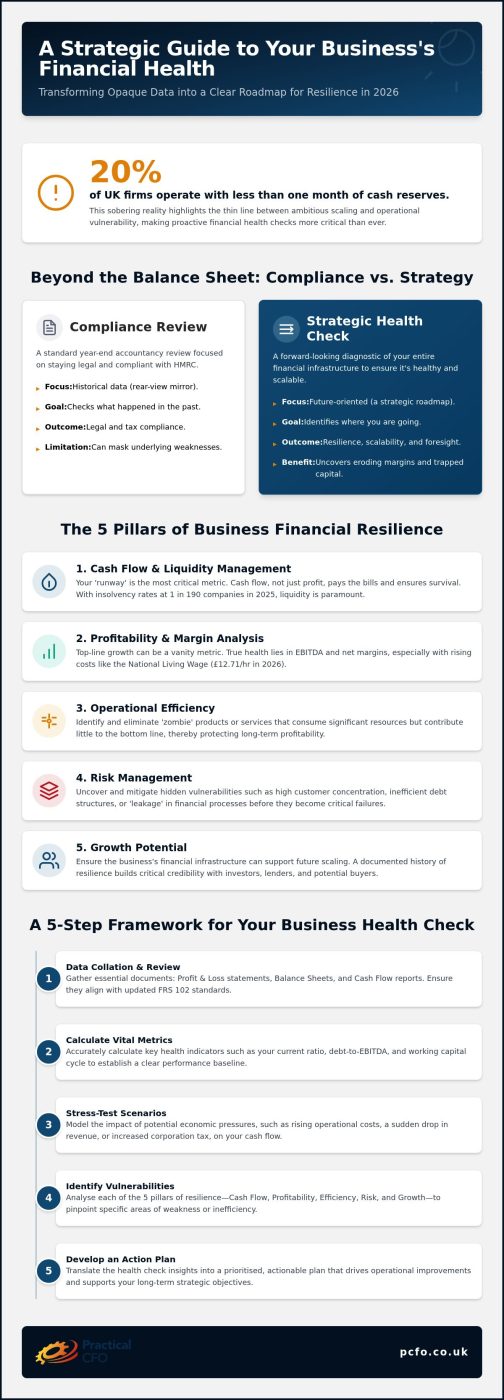
Resilience in a modern commercial environment isn’t a static achievement. It’s the result of five interconnected pillars: Cash Flow, Profitability, Efficiency, Risk, and Growth. When conducting a business financial health check uk, you must view these areas as a single ecosystem. A failure in one pillar can quickly destabilise your entire organisation, regardless of how high your top-line revenue appears. These metrics form the strategic basis of our outsourced accountancy solutions, providing a clear view of your company’s true standing.
Cash Flow and Liquidity Management
Your “runway” is the most critical health metric you possess. It represents the number of months your business can survive if all revenue ceased today. Whilst many scaling firms focus on profit, cash flow is what pays the bills. With insolvency rates reaching 1 in 190 active companies in England and Wales during 2025, maintaining liquidity has never been more vital. According to official government guidance, regular monitoring of your working capital cycle is essential to avoid breaching insolvency tests. Red flags often include a widening gap between completing work and receiving payment, or an over-reliance on short-term SME lending, which reached £17.5 billion in 2025.
Profitability and Margin Analysis
Top-line growth is often a vanity metric. True health is found in your EBITDA and net margins. In 2026, rising operational costs, including a National Living Wage of £12.71 per hour, mean that even successful firms must scrutinise their overheads. This might involve engaging specialists like Lift Portfolio Management Pty Ltd to audit lift maintenance contracts and identify billing errors. A strategic health check also identifies “zombie” products or services; these are offerings that consume significant resources but contribute little to the bottom line. By stripping away these inefficiencies, you protect your long-term sustainability and ensure your capital is deployed where it generates the highest return.
Risk Mitigation and Strategic Growth
Scaling requires a delicate balance between leverage and stability. Evaluating your debt-to-equity ratio is vital to ensure you aren’t over-extended in an era where the era of cheap borrowing has ended. Before entering a new market or expanding your team, you need to assess your financial readiness. This proactive analysis is a core component of business growth advisory uk. If you find your internal reporting lacks the depth to support these decisions, our Finance Director services can provide the high-level oversight needed to navigate these complexities with confidence.
DIY Audit vs. Professional CFO Health Check
Founders often rely on internal pulse checks to monitor their company’s trajectory. These basic reviews, usually consisting of bank balance monitoring and a cursory glance at the profit and loss statement, are useful for day-to-day oversight. However, automated banking tools and self-assessment apps have significant limitations. They offer a surface-level score but cannot interpret the nuance of a complex corporate structure or account for specific sector volatility. Professional oversight isn’t merely an administrative cost; it’s a strategic investment in the future value of your organisation.
Internal teams frequently develop blind spots. When you’re embedded in daily operations, it’s difficult to maintain the objectivity required to spot systemic risks. Relying on a business financial health check uk conducted by an external expert ensures that your data is interpreted through the lens of institutional knowledge and strategic foresight. This transition from DIY monitoring to professional analysis is often the catalyst for a business moving from survival to sustainable scaling.
When a Spreadsheet is No Longer Enough
Spreadsheets are static tools. Once a business reaches a certain complexity threshold, perhaps through multiple revenue streams or a growing payroll, DIY methods often fail to capture the full picture. Making board-level decisions based on incomplete or siloed data is a significant risk. A strategic finance director uncovers insights that a spreadsheet simply misses. They identify hidden correlations, such as how debtor days affect your ability to fund new projects, and translate these into actionable intelligence. They look beyond the cells to understand the narrative of your business performance.
The Value of an Independent Strategic Perspective
An external health check provides a neutral, rigorous assessment that internal reviews cannot match. This process includes benchmarking your performance against UK industry standards, allowing you to see exactly where you lead or lag amongst your peers. Such an independent perspective is vital when engaging in exit strategy planning services. A clean, professionally verified health report significantly increases business value during a strategic sale. It removes the uncertainty discount that buyers often apply to founder-managed data, providing a foundation of trust and intellectual rigour that facilitates smoother negotiations and higher valuations.
A 5-Step Framework for Your Business Health Check
To perform an effective business financial health check uk, you must follow a methodical process that prioritises accuracy over speed. This framework ensures you capture the granular details that influence your strategic positioning. It’s not enough to simply look at high-level figures; you need to understand the mechanics behind them to build a truly resilient organisation.
- Step 1: Aggregate and Clean Data. Collate all financial records from the previous 12 months. You must ensure transactions are correctly categorised to avoid skewed results, particularly regarding revenue recognition under the updated FRS 102 standards.
- Step 2: Calculate Key Ratios. Focus on the current ratio to assess liquidity and debt-to-EBITDA to understand your leverage. These figures provide an immediate snapshot of your company’s ability to meet its obligations.
- Step 3: Cost-Centre Analysis. Conduct a deep-dive review of all overheads. With the National Living Wage rising to £12.71 per hour in April 2026, a precise labour cost analysis is essential for maintaining margins; for those in the creative sector, you can visit Performance Accountancy to ensure your payroll documentation is fully compliant.
- Step 4: Stress-Test Forecasts. Model your cash flow against “worst-case” scenarios. You should consider the impact of a 20% turnover decrease or a significant spike in energy and fuel prices.
- Step 5: System Review. Audit your internal controls and accounting software. Inefficient systems often lead to the opaque data that prevents confident, board-level decision-making.
Data Integrity and System Review
A health check is only as reliable as the underlying data. Common accounting errors, such as misallocated VAT or inconsistent reporting of lease liabilities, can create a false sense of security. You must evaluate whether your current software stack supports strategic growth or if it’s merely acting as a digital filing cabinet. If your systems don’t provide real-time visibility into your working capital, they’re likely an obstacle to your scalability rather than a support.
Forecasting and Scenario Planning
“What-if” analysis is the cornerstone of a proactive health check. You need to model how external shocks, such as the 25% corporation tax rate for larger profits, will impact your net position. Sensitivity analysis is a tool for UK SMEs that quantifies how specific changes in underlying assumptions, such as a rise in interest rates or a drop in sales volume, will impact your final profit margins. This level of preparation ensures you aren’t caught off guard by market volatility.
If you require an objective, expert review of these pillars, our team can provide a comprehensive Business Planning Consultant assessment to future-proof your operations.
Transforming Health Insights into a Growth Strategy
A business financial health check uk is only as valuable as the action plan it inspires. Identifying a vulnerability in your cash flow or an inefficiency in your margins is merely the diagnostic phase. To drive genuine value, you must translate these insights into a structured growth strategy. This requires a shift from passive observation to active management, ensuring that every financial decision aligns with your long-term commercial objectives. You don’t just want to know your business is healthy; you want to ensure it’s positioned to scale.
Prioritisation is the first step in this transformation. You should categorise your findings based on two criteria: the level of risk they pose and the potential return on investment (ROI) they offer. Addressing a critical liquidity gap or a high debt-to-equity ratio is an immediate priority. Conversely, refining your internal software stack for incremental efficiency gains might be a secondary objective. By focusing on the most impactful changes first, you protect your organisation whilst building the momentum needed for larger strategic shifts.
From Diagnosis to Execution
Execution begins with a 90-day roadmap. This plan breaks down the complex findings of your health check into manageable, time-bound milestones. It moves the conversation from the balance sheet to the boardroom, establishing clear accountability for financial goals. You shouldn’t rely on generic industry metrics; instead, develop bespoke KPIs that reflect your specific business lifecycle. Whether it’s reducing debtor days by 15% or increasing your net margin by 3% through cost-centre optimisation, these targets provide the clarity your team needs to succeed. Monitoring progress against these benchmarks ensures that your strategic adjustments remain on track.
Leveraging Fractional CFO Expertise
Leadership is often the missing component in successful financial turnarounds. Whilst an internal team can manage daily transactions, they may lack the high-level strategic foresight required to execute complex changes. A fractional Chief Financial Officer provides this institutional knowledge on a part-time basis, offering a cost-effective solution for UK SMEs that don’t yet require a full-time executive. This role is about more than just reporting; it’s about providing the steady hand needed to navigate market volatility.
At PCFO, we act as your authoritative strategic partner. We don’t just deliver a report; we embed ourselves in your organisation to help you move from “healthy” to “scaling.” Regular health checks, when paired with professional CFO oversight, build a documented history of financial rigour. This transparency significantly increases your business valuation amongst investors and buyers, as it demonstrates a level of professional management that mitigates risk and promises sustainable growth.
Securing Your Company’s Financial Future
A resilient business is built on more than just historical compliance; it requires a proactive commitment to strategic foresight. By moving beyond the limitations of basic spreadsheets and embracing a comprehensive business financial health check uk, you gain the clarity needed to navigate the 2026 economic landscape. You now have a framework to evaluate your cash flow runway, protect your EBITDA margins, and identify the systemic risks that often remain hidden within opaque financial data.
Our fractional CFO leadership provides the institutional knowledge and intellectual rigour required to transform these diagnostic insights into a 90-day roadmap for growth. Whether you’re preparing for a scaling phase or seeking specialist exit strategy support, having an authoritative strategic partner ensures your decisions are grounded in reality. It’s time to replace financial anxiety with a methodical strategy that builds long-term institutional value.
Book your strategic financial health check with PCFO today to begin your transition from operational survival to sustainable scalability. We look forward to supporting your vision with the steady, experienced hand your business deserves.
Frequently Asked Questions
What is included in a business financial health check for a UK SME?
A comprehensive check includes a deep-dive analysis of your profit and loss, balance sheet, and cash flow forecasts. It evaluates your current ratio, debt-to-EBITDA, and working capital cycles. Beyond the numbers, it reviews your financial systems and internal controls to ensure data integrity. This process identifies inefficiencies in your overheads and assesses your readiness for scaling or investment. It provides the clarity needed for confident board-level decision-making.
How often should my company undergo a strategic financial review?
We recommend a strategic review at least annually to align with your business planning cycle. However, for companies experiencing rapid growth or navigating market volatility, quarterly checks are more effective. Regular monitoring ensures you aren’t caught off guard by shifts in operational costs or tax regulations. It allows for agile adjustments to your strategy before small inefficiencies escalate into systemic risks. Consistent reviews build a foundation of reliability for stakeholders.
Can my regular accountant perform a business financial health check?
Whilst your regular accountant manages essential tax compliance and historical reporting, a business financial health check uk requires a forward-looking strategic perspective. Accountants ensure you are legal; a fractional CFO ensures you are healthy and scalable. The health check focuses on future-proofing and strategic navigation, which often falls outside the scope of traditional accountancy services focused on year-end filings. It is the first step toward engaging a strategic Finance Director.
What are the most common financial red flags for growing businesses?
Common red flags include a persistent tightening of cash reserves despite increasing turnover and a lengthening of debtor days beyond your standard terms. Declining net margins amidst rising labour costs, such as the 2026 National Living Wage increase to £12.71, also signal trouble. An over-reliance on short-term lending to fund daily operations is a critical warning sign. Identifying these issues early allows you to implement corrective measures before they impact your viability.
How long does a professional business financial health check typically take?
A professional health check typically takes between two and four weeks to complete, depending on the complexity of your corporate structure. This timeframe allows for the thorough aggregation of data, deep-dive analysis of cost centres, and the development of a bespoke action plan. It’s a methodical process that prioritises intellectual rigour to ensure the final strategic roadmap is both accurate and actionable for your board. We focus on delivering thorough, explanatory insights rather than rushed reports.
What documents do I need to prepare for a financial health audit?
You will need to prepare your management accounts from the last 12 to 24 months, including detailed profit and loss statements and balance sheets. Access to your current cash flow forecasts, aged debtor and creditor reports, and existing debt agreements is also essential. Providing your payroll data and a breakdown of major overheads allows for a more precise analysis of your operational efficiency. These documents form the basis of a transparent and intellectual assessment.
How does a health check impact my business valuation before a sale?
A recent health check significantly enhances your business valuation by demonstrating financial discipline and transparency to potential buyers. It removes the uncertainty discount often applied to founder-led businesses with opaque reporting. By identifying and fixing inefficiencies beforehand, you present a leaner, more profitable organisation. This documented history of resilience builds the investor confidence required to secure a higher multiple during a strategic sale. It positions your company as a future-proofed, low-risk asset.
Is a business financial health check the same as a statutory audit?
A business financial health check uk is fundamentally different from a statutory audit. An audit is a formal examination of historical records to ensure accuracy and legal compliance for external stakeholders. In contrast, a health check is a proactive, internal diagnostic designed to improve future performance. It focuses on strategic navigation and operational efficiency rather than just verifying that your past accounts are free from material misstatement. It is a tool for growth, not just compliance.