

The most recognisable name in fractional finance isn’t always the most effective partner for an ambitious SME. You’ve likely investigated the FD Centre because its global scale suggests a level of security and reliability for your financial strategy. It’s entirely understandable to seek the comfort of a known network whilst you’re looking to move beyond basic bookkeeping. However, many business owners find that the limitations of the fd centre model become apparent just when they require the most agility and bespoke support.
You deserve a strategic partner who acts as a dedicated extension of your board, rather than a consultant following a rigid franchise manual. This article provides an objective analysis of the portfolio network model to help you choose the most effective leadership for your specific growth trajectory. We’ll examine the impact of high network overheads, the risks of receiving standardised advice, and how to secure tier-1 financial talent that is genuinely embedded in your industry niche. By understanding these dynamics, you can ensure your financial leadership is a catalyst for growth rather than a transactional expense.
Key Takeaways
- Understand how the portfolio finance director model evolved and determine if a large-scale network aligns with your current growth objectives.
- Identify the specific limitations of the fd centre model, focusing on the potential friction between standardised franchise methodologies and your need for bespoke strategic advice.
- Evaluate the impact of “network churn” and learn why an embedded, partner-led approach offers superior continuity for your long-term financial planning.
- Analyse the cost-to-value ratio of different fractional models to ensure your budget is invested in senior expertise rather than regional franchise overheads.
- Discover how a boutique consultancy provides the industry-specific foresight and intellectual rigour necessary to navigate complex business lifecycles and exit strategies.
Understanding the FD Centre and the Portfolio FD Model
The portfolio finance director model revolutionised how UK SMEs access high-level leadership. Historically, a full-time Finance Director was a luxury reserved for large corporations with substantial budgets. The rise of the Fractional executive changed this dynamic, allowing smaller businesses to hire a seasoned professional for just a few days a month. The FD Centre pioneered this approach in the UK, creating a structured marketplace for what is now commonly known as fractional or portfolio finance.
At its core, the FD Centre operates as a large-scale network of independent contractors. These professionals work under a central brand umbrella, utilising shared marketing and operational systems. Business owners often gravitate towards this model because it offers a sense of institutional security. There’s a perceived safety in hiring from a global organisation with hundreds of FDs on its books, especially when a company is facing its first major scaling challenge or preparing for a complex transaction.
The Mechanics of a Finance Network
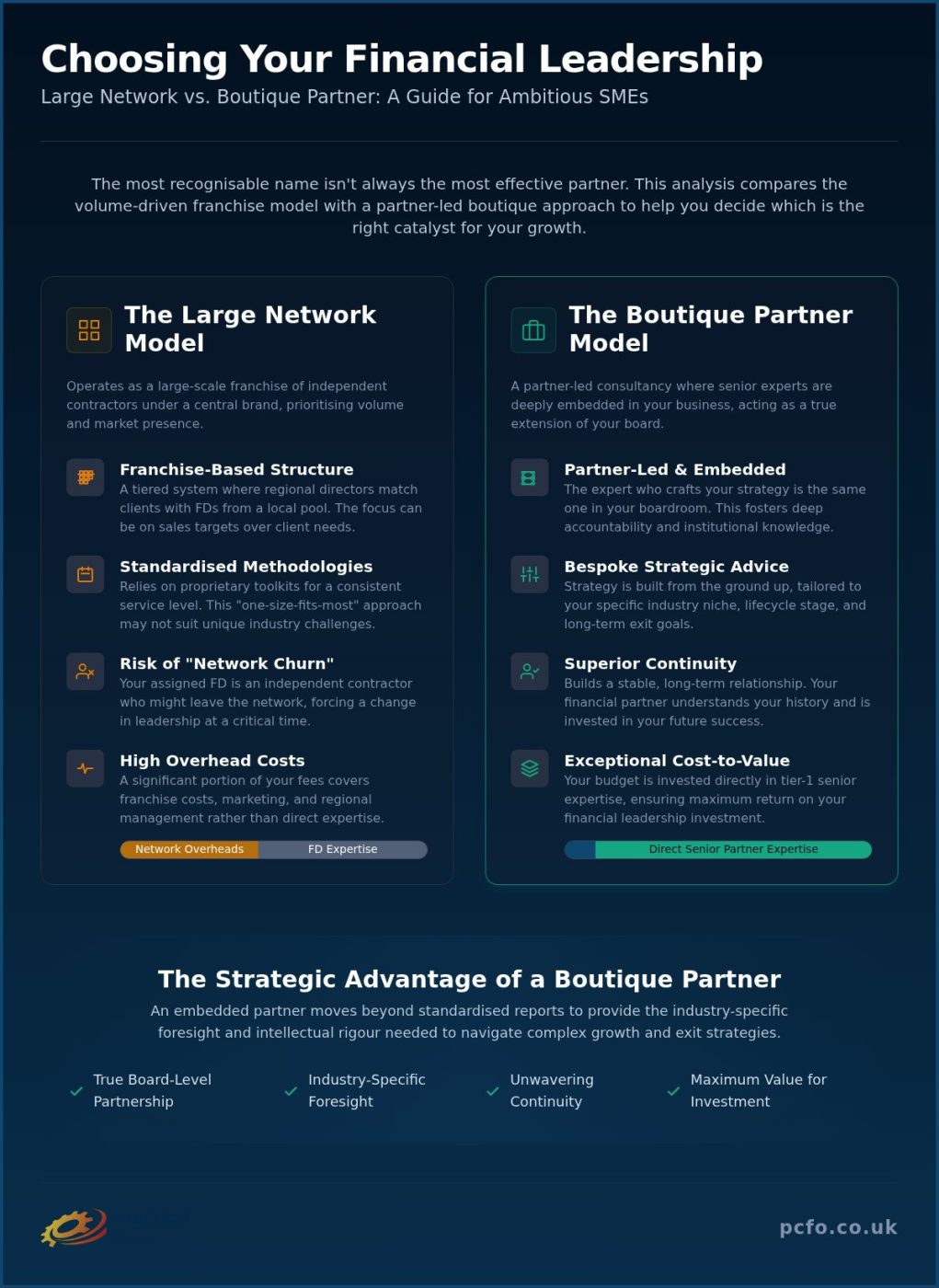
The system relies on a tiered management structure. Regional directors or principals typically act as the first point of contact, assessing a business’s needs before matching them with a specific FD from the local pool. Once matched, the FD often uses standardised toolkits and proprietary financial methodologies designed to ensure a consistent service level across the brand. This is a primary differentiator between a franchise-led model and a traditional boutique consultancy. Whilst the network provides the framework, the individual FD remains an independent contractor; this is one of the inherent limitations of the fd centre model when it comes to deep, long-term organisational integration.
Why the Model Succeeded
The success of this model stems from its ability to democratise C-suite expertise. It provided a clear, digestible framework for essential finance director tasks, such as cash flow forecasting and board-level reporting, which were previously neglected in many mid-market firms. By building a recognisable national brand, the network replaced the uncertainty of hiring a solo freelancer with a structured, professionalised service. This reliability helped thousands of founders feel more confident in their financial decision-making, even if the “one-size-fits-most” approach didn’t always account for highly specific industry nuances.
The Structural Limitations of Large-Scale Finance Networks
Engaging a large network often begins with a high-level consultation, but the person selling the vision is rarely the one sitting in your boardroom each month. This creates a fundamental gap in expectations. Regional directors focus on hitting recruitment and sales targets, which can sometimes overshadow the specific operational needs of your business. This volume-driven approach is one of the primary limitations of the fd centre model; it prioritises network growth over deep, individual client focus. When a business becomes just another number in a vast portfolio, the quality of strategic partnership inevitably suffers.
Relationship Continuity and Embeddedness
Continuity is the bedrock of strategic finance. In large organisations, “network churn” is a genuine risk that many founders overlook. If your assigned FD leaves the network or takes on too many clients to maintain their own portfolio, you may find your financial leadership changing hands at a critical moment. An embedded advisor needs to think like an owner, not a contractor. They should understand your long-term vision, not just your quarterly reports. If you’re looking for a more stable partnership, you might explore partner-led financial leadership to see how an embedded CFO functions within a boutique framework. A smaller firm ensures you aren’t passed between consultants, fostering a deeper sense of accountability.
Culture Fit in the Boardroom
Every SME has a distinct heartbeat and its own way of doing things. Standardised methodologies can feel cold or restrictive in a high-growth environment where agility is your greatest asset. You need a finance director who doesn’t just provide data but understands the creative problem-solving required by entrepreneurs. Large networks often match based on geographical availability or who has “capacity” rather than cultural alignment. This can lead to a “consultant mindset” where the FD follows a script instead of adapting to your specific organisational behaviour. Boutique firms prioritise a strategic fit, ensuring the advisor’s personality and industry experience complement your existing leadership team. This alignment is what transforms a financial reporter into a trusted strategic partner who can navigate complex growth hurdles alongside you.
Standardised Methodologies vs. Bespoke Strategic Requirements
Proprietary frameworks often provide a sense of comfort to founders who feel their financial processes are chaotic. Large networks frequently market these “proven systems” or “architectures” as universal solutions for any business. Whilst these templates can help establish basic order, they often become a restrictive cage for high-growth SMEs. One of the primary limitations of the fd centre model is this reliance on a standardised methodology that may prioritising the system over the specific, nuanced needs of your industry. A disruptive tech startup and a traditional manufacturing firm have fundamentally different capital requirements and risk profiles; they cannot be managed effectively using the same pre-filled playbook.
When Frameworks Fail to Flex
Rigid frameworks often lead to a “tick-box” exercise rather than genuine value creation. When an advisor is bound by a network’s proprietary toolkit, they might spend more time aligning your data with their templates than they do on creative problem-solving. This approach struggles to adapt to rapid market shifts or unconventional business models. Your organisation requires a tailored roadmap that reflects your specific competitive landscape, not a generic set of benchmarks. Relying on standardised reporting for niche industries often masks the very insights you need to gain a competitive advantage. Effective strategic business planning requires the agility to discard the manual when the situation demands a bespoke response.
Bespoke Strategic Growth Advisory
A boutique consultancy prioritises building a financial strategy from the ground up. This process begins with an immersion into your business lifecycle, identifying the unique levers that drive your profitability. Instead of imposing an external structure, an embedded CFO integrates with your existing leadership team to foster collaborative decision-making. This level of business growth advisory uk demands deep, industry-specific insight that a generalist network often lacks. By choosing a partner-led approach, you ensure your financial leadership is built on intellectual rigour and strategic foresight. This bespoke model allows for the sophisticated navigation required for complex transactions, international expansion, or preparing for a high-value exit. You gain a strategist who understands your vision, rather than a contractor who simply manages your reports.
Evaluating the Cost-to-Value Ratio of Franchise-Based Models
Investment in financial leadership is one of the most critical decisions an SME founder can make. Whilst large networks offer a sense of security, their pricing structures often include what industry insiders call a “franchise tax.” This refers to the portion of your daily rate that is diverted away from the professional delivering the work to fund the network’s internal infrastructure. Understanding these limitations of the fd centre model is essential for ensuring your capital is working as hard as possible for your business. When you pay a premium for a national brand, you aren’t necessarily paying for higher expertise; you’re often subsidising regional management, head office costs, and global marketing campaigns.
Where Your Money Actually Goes
Fee structures in large networks are designed to support a multi-layered organisation. A significant percentage of the client fee covers the “Marketing Premium” and the commissions paid to regional directors who manage the sales process. This creates a situation where a business pays a top-tier rate but only a fraction of that investment reaches the FD sitting at the table. In contrast, boutique firms operate with leaner overheads and a partner-led structure. This allows them to provide direct access to senior leadership without the added burden of franchise fees. You can compare different investment levels in our guide to fractional cfo pricing uk to see how these models differ in practice. By removing the middleman, boutique firms often attract higher-calibre talent who prefer a direct, unencumbered relationship with their clients.
Maximising ROI in Fractional Finance
True ROI comes from value-based outcomes rather than the mere application of a proprietary methodology. If an FD is incentivised to follow a specific network programme, their focus may drift from your bottom line to their internal compliance. Strategic partners should be judged on their ability to improve cash flow, secure funding, or prepare a business for a lucrative exit. This requires a level of transparency that is sometimes missing in large-scale outsourced accountancy solutions. Assessing the real-world impact of your FD involves looking at strategic milestones achieved, not just the number of reports filed. By choosing a partner-led model, you ensure every pound invested goes directly towards high-level strategic foresight and intellectual rigour. If you’re ready to move beyond standardised frameworks, you can view our partner-led FD services to understand the difference an embedded advisor makes to your long-term trajectory.
The Boutique Alternative: Moving Beyond the “One-Size-Fits-Most” Approach
Choosing a boutique consultancy over a large-scale network represents a shift from transactional service to genuine partnership. Whilst large organisations provide a sense of scale, they often struggle to deliver the depth of integration that a growing SME requires to thrive. When you move away from the structural limitations of the fd centre model, you open the door to a more intimate and effective strategic collaboration. In a boutique environment, senior leaders aren’t just managing a volume of contracts; they’re deeply invested in the long-term trajectory of a select group of clients. This focused approach ensures that your financial strategy is built on your specific business lifecycle, rather than a generic framework.
Transitioning to a bespoke fractional CFO relationship allows for a level of agility that franchise models rarely match. You gain a strategist who acts as a steady, experienced hand at the helm of your company’s financial strategy. This model prioritises intellectual rigour and proactive navigation, focusing on future-proofing your business rather than just historical reporting. By removing the layers of regional management, every pound of your investment goes directly towards high-level leadership and industry-specific foresight.
The PCFO Difference: Strategic Partnership
Our approach is defined by being an Authoritative Strategic Partner for UK SMEs. We provide the high-level corporate authority you expect from a top-tier finance professional, but with the approachable nature of a boutique consultancy. This means you receive direct access to senior talent without the franchise bureaucracy or the “cookie-cutter” strategies often found in larger networks. We focus on becoming an embedded advisor, ensuring our goals are perfectly aligned with your business growth and exit strategy. It’s a composed, professional relationship that alleviates financial anxiety through reliability and deep institutional knowledge.
Next Steps for Your Financial Leadership
If you’re currently evaluating your options or considering a move from a large network, it’s vital to ask the right questions before committing. Consider the following points to determine if a boutique model is right for you:
- Does the FD have a genuine “owner mindset” or are they following a consultant manual?
- How much of your fee is supporting network overheads versus direct strategic work?
- Is the person you met during the sales process the same person who will be in your boardroom?
Securing the Strategic Leadership Your Growth Demands
Selecting the right financial leadership is a pivotal moment for any SME founder. Whilst large networks offer a recognisable brand, the limitations of the fd centre model often stem from a focus on volume and standardised methodologies that don’t always suit your specific industry niche. You require a partner who is genuinely embedded in your business, providing the intellectual rigour and proactive foresight necessary to navigate complex growth cycles. By prioritising bespoke strategic advisory over rigid franchise frameworks, you ensure your investment is focused entirely on results rather than network overheads.
We provide a composed and professional alternative that offers direct access to seasoned Finance Directors without the burden of regional management fees. Our partner-led approach ensures your financial strategy is as unique as your organisation. If you’re ready to move beyond “one-size-fits-most” solutions, it’s time to discover a more bespoke approach to financial leadership with PCFO. You can scale your business with the confidence that comes from having a steady, experienced hand at the helm of your financial strategy.
Frequently Asked Questions
What is the main difference between the FD Centre and a boutique consultancy?
The FD Centre operates as a large franchise network using independent contractors and standardised toolkits. In contrast, a boutique consultancy like PCFO provides a partner-led, embedded relationship. The primary difference lies in the level of integration; boutique firms prioritising cultural fit and deep strategic partnership over the volume-based approach of a global franchise. This allows for more agile decision-making and financial strategies tailored specifically to your business lifecycle.
Why are large finance networks often more expensive for SMEs?
Large finance networks carry higher costs due to significant franchise overheads and regional management fees. A portion of your investment funds the network’s national marketing and head office infrastructure rather than direct financial leadership. Boutique consultancies operate with leaner structures, ensuring your budget is directed towards senior talent and strategic foresight. This transparency allows you to secure tier-1 expertise without subsidising a large brand’s global expansion costs.
Does the FD Centre model work for businesses planning an exit?
The model can support exits, but the standardised approach is one of the limitations of the fd centre model in high-stakes transactions. Successful exits require deep, industry-specific insight and a CFO who is fully embedded in your board’s vision. A boutique partner provides the intellectual rigour and personalised support needed to navigate complex valuations and due diligence, ensuring your business is positioned for maximum value rather than following a generic template.
Can I get the same level of expertise from a smaller firm like PCFO?
You receive the same level of senior leadership, often with more direct access to the firm’s partners. PCFO focuses on providing high-calibre Finance Directors who possess deep institutional knowledge and experience in strategic growth. Because we aren’t a high-volume network, our advisors can dedicate more time to your specific challenges. This fosters a proactive mindset that focuses on future-proofing your business rather than just providing historical financial reports.
What happens if the FD assigned by a network doesn’t fit my company culture?
Large networks often match based on availability or geography, which can lead to friction in the boardroom. If the assigned FD doesn’t align with your SME’s heartbeat, you may be passed to another contractor within the network, causing a loss of momentum. Boutique firms prioritise “fit” from the outset, matching you with a professional whose personality and problem-solving style complement your leadership team. This ensures a collaborative and steady partnership.
Is the methodology used by large networks actually effective for all industries?
Standardised methodologies are often too rigid for niche or disruptive industries. Whilst proprietary frameworks provide basic structure, they can stifle the creative problem-solving required by entrepreneurs. High-growth businesses frequently face unconventional challenges that a “one-size-fits-most” playbook cannot address. One of the limitations of the fd centre model is the potential for these frameworks to become a box-ticking exercise, rather than a catalyst for bespoke, agile strategic planning.
How do I know if my business has outgrown a standardised network model?
You’ve likely outgrown a network model when you require more than monthly reporting and basic financial hygiene. If you find yourself needing an advisor who understands the nuances of your specific industry niche or requires complex exit strategy support, a standardised framework will feel restrictive. When your business needs a partner who is fully invested in your long-term trajectory rather than a distant contractor, it’s time to transition to a boutique consultancy.
What are the risks of “network churn” in large-scale FD providers?
Network churn occurs when independent contractors leave a franchise or take on too many clients to maintain focus. In large organisations, this risk can lead to a lack of continuity at critical moments in your business lifecycle. If your FD changes, the deep institutional knowledge of your company is lost, forcing you to restart the onboarding process. Boutique firms mitigate this risk by fostering long-term, partner-led relationships that prioritise stability and accountability.