

Asking a Financial Controller to behave like a Finance Director is one of the most common strategic errors a growing UK business can make. Whilst both roles are essential to a healthy finance function, they serve entirely different purposes within your organisation’s lifecycle. If you’ve found yourself drowning in spreadsheets but still lacking the actionable insights needed for board-level decisions, you’re likely facing the classic financial controller vs finance director dilemma. It’s a frustrating position to be in, especially when you’re trying to navigate the complexities of the 2026 FRS 102 accounting standards or prepare for a potential investment round.
You deserve a finance function that doesn’t just report on the past but actively architects your future. This guide provides a clear roadmap to help you understand which role solves your specific bottleneck and how the transition from financial control to strategic direction actually works. We’ll explore current 2026 salary benchmarks and show you how to access high-level expertise through flexible, fractional models that protect your cash flow. By the end, you’ll have the clarity required to ensure your leadership team is equipped for its next stage of growth.
Key Takeaways
- Distinguish between the operational focus of a Financial Controller and the strategic mandate of a Finance Director to prevent “title inflation” and strategic drift.
- Recognise the Financial Controller as the guardian of your data integrity and statutory compliance, particularly regarding the 2026 FRS 102 accounting standards.
- Understand the Finance Director’s role as a board-level partner who architects growth through commercial strategy, risk management, and capital planning.
- Apply our 2026 comparison framework to resolve the financial controller vs finance director dilemma and identify the right leadership for your current business lifecycle.
- Explore how fractional FD services offer a scalable way to access high-level strategic expertise without the significant cost of a permanent executive appointment.
Beyond the Job Title: Why the Distinction Matters for Scaling SMEs
Many UK business owners accidentally stifle their own growth by mislabelling their finance staff. Title inflation is a common trap; promoting a senior accountant to “Finance Director” without ensuring they have the commercial acumen required for the boardroom. This isn’t just a matter of semantics. It’s a fundamental misalignment that can lead to strategic drift. When you’re trying to navigate the financial controller vs finance director debate, you’re really deciding between a professional who manages your current state and one who architects your future.
A Financial Controller acts as the guardian of your operational integrity. Their focus is historical; they ensure the books are balanced, the tax is paid, and the statutory accounts are filed accurately. Whilst this is essential for stability, it doesn’t drive growth. A “Strategic Accountant” is far more than a standard bookkeeper. They provide the clean data that a Finance Director then uses to build commercial models, secure funding, or plan an exit. If you only have a Controller, you’ll know exactly where your money went, but you won’t necessarily know where it should go next.
The Evolution of the Finance Function
The finance role undergoes a radical transformation as a business moves from a startup to a scale-up. In the early days, “Compliance-First” thinking is the priority. You need to keep the HMRC happy and ensure the lights stay on. However, scaling requires a “Growth-First” mindset. By 2026, the widespread adoption of AI-enhanced ERP systems and advanced fintech tools has automated much of the traditional data processing. This technological shift means the value of finance leadership has moved away from data production towards high-level data interpretation and strategic navigation.
The Financial Ceiling: When Data Alone Isn’t Enough
There is a specific point in every scaling SME’s lifecycle where accurate reports stop providing a competitive advantage. You reach a financial ceiling. You might have a clean set of books, yet you still feel “stuck” when trying to communicate your financial health to investors or stakeholders. This happens because a Controller provides the “what”, whilst a Director provides the “so what?”. Without a strategic partner at the board table, you lack the insight to turn a balance sheet into a business plan. Recognising the difference in financial controller vs finance director responsibilities is the only way to break through this ceiling and ensure your leadership team is equipped for the complexities of the 2026 market.
The Financial Controller: The Guardian of Operational Integrity
A Financial Controller (FC) is the individual responsible for the accuracy and timeliness of your company’s financial reporting. While the financial controller vs finance director debate often focuses on strategy, the FC provides the essential foundation of data integrity that makes strategy possible. They lead the accounting department, ensuring that every transaction is recorded correctly and that internal controls are robust enough to prevent fraud or error. Their focus is historical and operational; they are the experts in what has already happened within the business.
The primary outputs of an FC are tangible and compliance-driven. You can expect them to deliver monthly management accounts, submit VAT returns, and manage the rigorous process of audit preparation. For Scaling SMEs, this role ensures that the business remains on the right side of HMRC and Companies House. Without this level of operational oversight, a business risks significant statutory penalties and financial instability that no amount of strategy can fix.
Key Responsibilities of a Financial Controller
The FC manages the day-to-day finance team and processes. They are the gatekeepers of the balance sheet and P&L, ensuring that the ledger reflects reality. In 2026, this involves overseeing a complex tech stack where AI-driven automation handles much of the data entry, leaving the FC to focus on exception reporting and rigorous internal controls. Their work ensures that the business maintains a high standard of financial hygiene, which is critical for maintaining stakeholder trust and preparing for future investment.
When the FC is the Hero of Your Business
An FC is often the hero when a business is struggling with messy data or lacks standard operating procedures. They excel at cleaning up historical records and establishing the protocols needed for scalability. This includes managing cash flow at an operational level, specifically focusing on Accounts Payable (AP) and Accounts Receivable (AR) to ensure liquidity is maintained. Recognising the specific strengths in the financial controller vs finance director dynamic allows you to deploy your talent effectively. If you currently have an FC but feel your business needs more strategic guidance, our outsourced accountancy solutions can complement their work by providing the board-level insight they may lack.
Meeting the 2026 UK GAAP (FRS 102) requirements is a significant task for any FC. With the removal of the distinction between operating and finance leases, the FC must ensure all leases are correctly recognised on the balance sheet. Their technical expertise ensures that these changes don’t lead to compliance failures or misreported gearing ratios. In essence, the FC ensures the business is fit to fly, even if they aren’t the ones deciding the flight path.
The Finance Director: The Architect of Strategic Growth
While the Financial Controller ensures your business is fit to fly, the Finance Director (FD) decides where the plane is going. An FD acts as a strategic co-pilot to the CEO, moving beyond historical reporting to actively driving business value. Their focus shifts from internal controls to commercial strategy, capital structure, and risk management. In the boardroom, the FD provides the intellectual rigour needed to turn raw financial data into a roadmap for sustainable growth. They aren’t just managing money; they are architecting the future of the organisation.
The distinction in the financial controller vs finance director dynamic becomes clearest during high-stakes decision-making. According to the ACCA, the Role and responsibilities of a Financial Controller usually involve overseeing the day-to-day accounting function. This reliable foundation allows the FD to focus on outward-facing activities, such as investment appraisal and stakeholder management. Without this strategic layer, a company may remain profitable but will likely miss opportunities for exponential scaling.
The FD as a Commercial Catalyst
An FD functions as a catalyst for commercial performance by looking through the numbers to see the business reality. They don’t just report on profit margins; they analyse them to identify where the business is leaking value. This might involve advising on new pricing strategies or identifying overhead reductions that haven’t been reviewed for years. By implementing advanced cash flow forecasting services, they provide the leadership team with a clear view of their long-term runway. This foresight is vital in the 2026 economy, where market volatility requires a proactive rather than reactive stance.
Strategic Support: Investment and Exit Planning
One of the most significant value-adds of an FD is their ability to lead complex financial projects like fundraising or debt financing. If your business is preparing for Series A or B funding, the FD manages the entire process, from building the investment case to handling intensive due diligence. They act as the primary point of contact for investors and banks, speaking their language to build the confidence required for successful capital injection.
For many founders, the ultimate goal is a successful sale. Leading exit strategy planning services is where an FD truly earns their seat at the table. They often work years in advance to maximise company valuation by cleaning up the balance sheet and ensuring the business model is demonstrably scalable. This level of foresight ensures that when you’re ready to step away, you do so with the highest possible return on your investment.
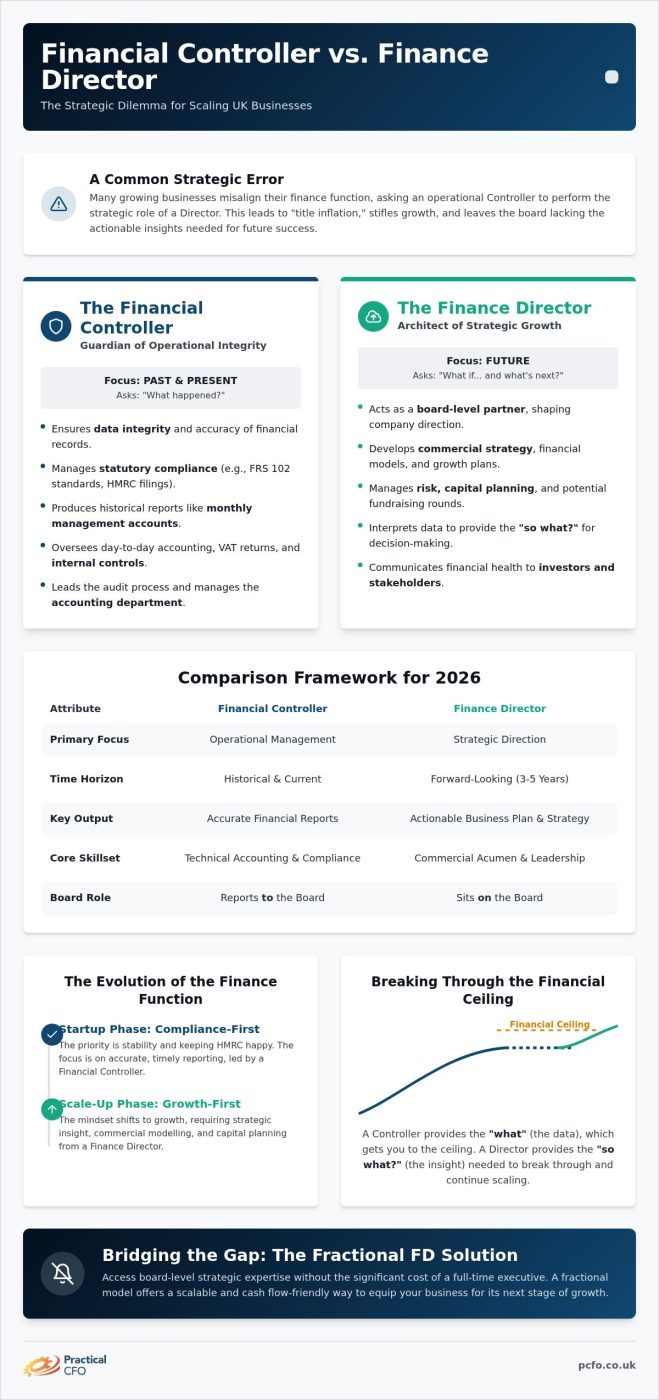
Financial Controller vs Finance Director: A Comparison Framework for 2026
The financial controller vs finance director distinction is best viewed through the lens of time and intent. A Financial Controller is traditionally rooted in the past and present. They ensure that every pound is accounted for and that historical data is flawless. In contrast, a Finance Director is focused on the future. They translate that data into a commercial strategy that drives growth. While the FC provides accuracy, the FD provides insight. This shift in focus has a direct impact on your business valuation. An FD doesn’t just manage costs; they optimise EBITDA by identifying high-margin opportunities and refining your capital structure.
Red Flags: Signs You Have Outgrown Your Financial Controller
It is easy to miss the moment your business needs transition. You might have perfectly clean data but find yourself unable to use it for strategic planning. If your CEO is spending over 20% of their time on financial strategy rather than leadership, it is a clear indicator of a missing leadership link. Similarly, if you are planning a major pivot, acquisition, or an exit, an FC’s technical focus will not be enough to navigate the complexities of deal structure and due diligence. These situations require a partner who can communicate financial health to external stakeholders with confidence.
Decision Matrix: Revenue, Complexity, and Ambition
Revenue isn’t the only metric for hiring an FD. A low-revenue tech startup with complex R&D tax credits and venture capital requirements often needs an FD sooner than a high-revenue traditional consultancy. You must assess the strategic role of a finance director based on your business complexity and your long-term ambition. Many businesses fall into the ‘Hybrid’ trap. Asking an FC to ‘act like an FD’ rarely works because the skill sets are fundamentally different. One is a specialist in precision; the other is a specialist in possibility. If your ambition is to scale rapidly, you need the latter at the board table.
If you recognise these red flags in your own organisation, it may be time to elevate your financial leadership. You can speak with our team to determine the best path forward for your scale-up and access the strategic support your business deserves.
Bridging the Gap: How Fractional Finance Leadership Supports Growth
Many SMEs assume the financial controller vs finance director debate requires a binary choice. They believe they must either settle for the operational focus of a Controller or commit to a full-time executive salary, which in 2026 often exceeds £150,000 for experienced talent. Fractional leadership removes this barrier. It allows you to retain the operational stability of your existing Financial Controller whilst adding the strategic foresight of a seasoned Finance Director on a part-time basis. This “best of both worlds” approach ensures your books are accurate whilst your growth strategy remains ambitious.
Our fractional model at PCFO is designed to scale alongside your business lifecycle. We don’t believe in a one-size-fits-all solution; instead, we provide the specific level of board-level advice you need to navigate your current challenges. Whether you’re preparing for a series of 2026 accounting changes or looking to secure fresh investment, fractional support provides the intellectual rigour of a heavy-hitting FD without the heavy-hitting overhead.
The ROI of Fractional Finance Leadership
When evaluating the cost of senior talent, it’s essential to compare fractional CFO pricing in the UK against the total cost of a permanent hire. A full-time FD doesn’t just cost their base salary; you must also factor in national insurance, bonuses, and equity. A fractional FD often pays for themselves through tangible margin improvements and enhanced tax efficiency. They identify the commercial leaks that a technically-focused FC might miss. The flexibility of this model means you can turn strategic support on and off as needed, ensuring you only pay for high-level expertise when it’s actually driving value.
Next Steps for Your Finance Function
The first step in evolving your leadership is conducting a thorough strategic financial review of your current setup. You need to define the immediate “gap” in your team. Is it a lack of clean data, or a lack of insight into what that data means? Once you’ve identified the bottleneck, integrating a fractional FD into your existing culture is a methodical process. They act as a mentor to your FC, elevating the entire department’s performance and future-proofing your organisation. By resolving the financial controller vs finance director dilemma through a fractional model, you ensure your business has the right leadership for its next stage of growth.
Architecting Your Strategic Financial Future
Ensuring your business has the right leadership is not just about filling a seat; it’s about aligning your finance function with your long-term ambitions. Whilst the Financial Controller provides the essential foundation of data integrity and statutory compliance, the Finance Director acts as the architect of your strategic growth. Recognising the nuances of the financial controller vs finance director dynamic allows you to deploy the right expertise at the right time, especially as you navigate the complexities of the 2026 UK GAAP updates.
You don’t need to commit to a full-time executive overhead to access high-level commercial insight. As specialists in fractional FD services for UK SMEs, we provide the intellectual rigour and board-level advice required to drive business growth and successful exit strategies. We invite you to book a Strategic Review with PCFO to determine your ideal finance structure and identify the specific leadership gaps currently holding you back. With the right strategic partner by your side, you can move forward with absolute confidence in your financial trajectory.
Frequently Asked Questions
What is the main difference between a Financial Controller and a Finance Director?
The primary difference lies in their focus and time horizon. A Financial Controller manages the accounting function, ensuring data accuracy and compliance with standards like FRS 102. A Finance Director uses that data to architect future growth, focusing on commercial strategy and capital structure. In the financial controller vs finance director dynamic, the Controller looks at what has happened, whilst the Director determines what should happen next to increase business value.
When should a UK SME hire a Finance Director?
A UK SME should consider hiring a Finance Director when basic reporting no longer supports the complexity of the business. This typically occurs during rapid scaling, when seeking Series A or B funding, or when preparing for a strategic sale. If the CEO is spending more than 20% of their time on financial planning rather than leadership, it is a clear signal that board-level expertise is required to maintain momentum.
Can a Financial Controller eventually become a Finance Director?
Yes, many Financial Controllers transition into FD roles by developing their commercial acumen and leadership skills. This shift requires moving away from the “guardian” mindset of data precision towards a “catalyst” mindset of strategic value. Professionals who successfully make this leap often seek mentorship from experienced FDs and focus on areas like investment appraisal, stakeholder management, and long-term business planning rather than just historical reporting and statutory compliance.
How much does a full-time Finance Director cost in the UK in 2026?
In 2026, a permanent Finance Director for a UK SME typically commands a base salary between £90,000 and £150,000. Regional premiums and industry-specific demand can push these figures even higher, particularly for candidates with specialist ERP or M&A experience. When you factor in secondary costs like national insurance and bonuses, the total investment is substantial. Fractional models allow businesses to bypass these full-time costs whilst still securing board-level financial leadership.
Is it better to hire a part-time Finance Director or a full-time Financial Controller first?
The choice depends on your specific organisational bottleneck. If your current financial data is messy or non-compliant, a full-time Financial Controller is the priority to establish a reliable foundation. However, if your books are clean but you lack the strategic insight to scale or raise capital, a part-time Finance Director is often the better investment. This approach provides board-level guidance without the financial burden of a full-time executive hire.
Do I need a Finance Director if I already have a good external accountant?
External accountants are essential for tax compliance and statutory filings, but they rarely provide the embedded, day-to-day strategic guidance an FD offers. A Finance Director works inside your business to drive commercial performance, manage internal risks, and support the CEO’s growth objectives. Whilst your accountant looks after the HMRC, your FD looks after your profit margins, cash flow runway, and long-term valuation to ensure you are ready for future opportunities.
What are the typical qualifications for an FD vs an FC?
Both roles typically require a professional qualification such as ACA, ACCA, or CIMA. A Financial Controller must possess deep technical knowledge of accounting standards and internal controls. A Finance Director needs these foundations but must also demonstrate extensive experience in commercial leadership. This includes a track record in fundraising, exit planning, and strategic business advisory. The FD role is defined more by its commercial impact and board-level influence than technical accounting alone.
How does a fractional FD work with my existing finance team?
A fractional FD acts as a strategic mentor to your existing finance team rather than a replacement. They typically spend one or two days a week focused on high-level strategy, such as cash flow forecasting and investment appraisal, whilst leaving the day-to-day operations to your Financial Controller. This collaborative structure elevates the entire department’s performance. It ensures that the financial controller vs finance director roles complement each other perfectly to support your company’s growth lifecycle.