

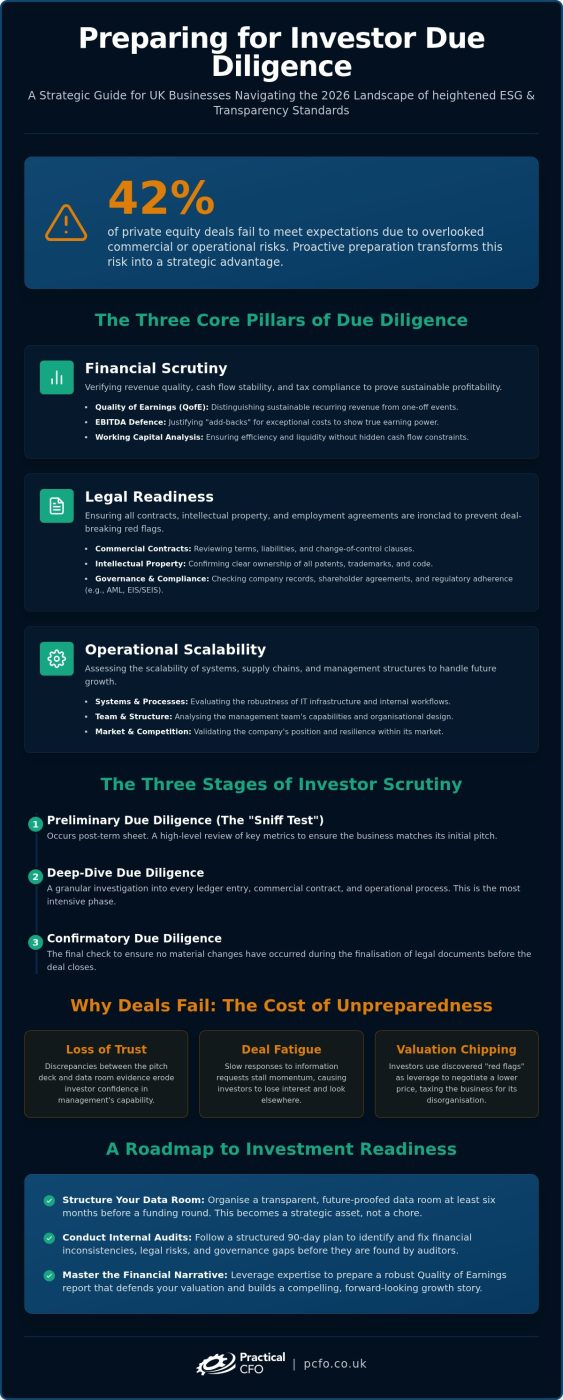
Did you know that 42% of private equity deals fail to meet underwriting expectations because of overlooked commercial or operational risks? When you’re preparing for investor due diligence UK markets require a level of precision that goes far beyond simple bookkeeping. It’s natural to feel overwhelmed by the sheer volume of information requested or to worry that a single “red flag” might collapse months of negotiation. You’ve built a successful business, and the prospect of having every transaction and decision scrutinised by external auditors is understandably daunting.
This guide is designed to transform that anxiety into a strategic advantage. We’ll show you how to move past mere compliance and build a robust financial narrative that actively defends your valuation. By organising a structured data room and addressing inconsistent reporting early, you can present a transparent, future-proofed organisation to potential partners. We’ll explore the essential 2026 workstreams, from new AML risk-based approaches to the latest EIS and SEIS regulations, ensuring you’re fully equipped to secure your next funding round with confidence.
Key Takeaways
- Master the “Quality of Earnings” report to effectively defend your EBITDA and distinguish sustainable recurring revenue from one-off financial events.
- Gain a strategic advantage by preparing for investor due diligence UK requirements, focusing on the 2026 shift towards heightened ESG and transparency standards.
- Identify and remediate legal risks in commercial contracts and intellectual property ownership before they become deal-breaking red flags for potential investors.
- Follow a structured 90-day roadmap to conduct internal audits and fix governance gaps, ensuring your data room is robust and investment-ready.
- Leverage the expertise of a Fractional CFO to act as a strategic bridge, managing the financial narrative and professionalising the due diligence process.
Understanding Investor Due Diligence in the UK Market (2026)
Due diligence is the rigorous process through which a potential investor validates the financial, legal, and operational claims of a business. In the current UK venture capital and private equity landscape, this process has evolved into a comprehensive audit of a company’s integrity and resilience. By 2026, the market has shifted towards a standard of “extreme transparency.” Investors no longer simply check the books; they scrutinise ESG (Environmental, Social, and Governance) credentials and long-term sustainability metrics. Successfully preparing for investor due diligence UK wide requires a holistic approach that treats the data room as a strategic asset rather than a simple filing cabinet.
Sophisticated founders understand that this level of scrutiny cannot be managed in a fortnight. Starting your preparation at least six months before a funding round is now the industry benchmark. This lead time allows you to identify gaps and professionalise your reporting before an external eye finds a fault. The process typically rests on three core pillars:
- Financial: Verifying revenue quality, cash flow stability, and tax compliance.
- Legal: Ensuring all contracts, intellectual property, and employment agreements are ironclad.
- Operational: Assessing the scalability of systems, supply chains, and management structures.
The Different Stages of Investor Scrutiny
Investor investigation typically moves through three distinct phases. It begins with Preliminary DD, often called the “sniff test.” This occurs shortly after the term sheet is signed and focuses on high-level metrics to ensure the business matches its pitch. If passed, you enter Deep-Dive DD. This is a granular investigation into every ledger entry and commercial contract. Finally, Confirmatory DD serves as the closing check. It ensures no material changes have occurred while the legal documents were being finalised. Successfully preparing for investor due diligence UK investors expect involves managing these phases with methodical precision to maintain momentum.
Why Investors Walk Away: The Cost of Unpreparedness
A deal rarely dies because of a single problem; it dies because of a cumulative loss of trust. If the figures in your pitch deck don’t align with the evidence in your data room, investors will question your management capability. Deal fatigue is another silent killer. When founders take weeks to respond to information requests, the momentum of the round stalls, often leading the investor to look elsewhere. Even if the deal survives, a lack of preparation leads to valuation chipping. Investors use discovered “red flags” as leverage to negotiate a lower price, essentially taxing you for your own disorganisation.
The Financial Scrutiny: Beyond the Balance Sheet
While the balance sheet provides a static snapshot of your company’s health, investors dig deeper into the Quality of Earnings (QofE). This report is the most critical financial document in your data room because it validates the sustainability of your profits. It peels back the layers of your income to ensure that your bottom line is repeatable and not a result of accounting anomalies or one-off windfalls. Successfully preparing for investor due diligence UK investors expect involves proving that your financial performance is a reliable indicator of future success.
Defending your EBITDA is a strategic exercise in distinguishing between one-off costs and recurring revenue. If your business has incurred exceptional legal fees for a patent filing or one-time restructuring costs, these should be “added back” to show the true earning power of the underlying operation. You must maintain historical accuracy whilst presenting a forward-looking growth narrative that justifies your current valuation. Working capital is the lifeblood of the business that investors will scrutinise for efficiency and liquidity to ensure you aren’t hiding cash flow constraints. Aligning your reporting with the Investor Readiness Essentials recommended by the government provides a solid framework for this level of detail.
Revenue Recognition and Cash Flow Consistency
Investors prioritise predictable income streams, such as Monthly Recurring Revenue (MRR), over lumpy, project-based fees. They look for consistency in how you recognise revenue to ensure it matches the actual delivery of services. Your cash flow forecast must be bulletproof to demonstrate exactly how much “runway” the business has before it requires further capital. Regular management accounts act as the primary evidence of your financial control, proving that you understand your unit economics and burn rate. Engaging an experienced Chief Financial Officer can help you professionalise these reports before they face external audit.
The Cap Table and Shareholder Structure
A messy cap table can derail a deal before it reaches the confirmatory stage. You must ensure your shareholder structure is clean and free of “zombie” shareholders who no longer contribute to the company’s growth. Previous funding rounds will be analysed to see how they impact current investor appetite, particularly regarding liquidation preferences. If you utilise Enterprise Management Incentives (EMI), ensure the dilutive effects are clearly modelled and documented. Investors want to see that the management team remains sufficiently incentivised to drive the business toward a successful exit.
Operational and Legal Readiness: Closing the Gaps
Legal and operational readiness is where many founders lose the valuation gains they secured during the financial audit. Whilst financial DD proves you’ve made money, legal DD proves you have the right to keep making it. When preparing for investor due diligence UK firms will expect a flawless trail of ownership and obligation. If your commercial contracts contain restrictive change-of-control clauses, an investor might see a risk of losing key customers post-acquisition. You must ensure every agreement is signed, digitally stored, and legally transferable without triggering a renegotiation of terms.
Intellectual Property (IP) remains a frequent stumbling block in the mid-market. Investors require proof that all “work for hire”—whether from employees or external contractors—has been formally assigned to the company. Similarly, your employment compliance must go beyond basic contracts. Review your staff handbooks and identify “key person” dependencies that could threaten continuity if a founder or technical lead were to depart. To mitigate these risks by securing expert legal talent for your in-house team, you can find specialist recruitment support at conektlegal.com. In 2026, cyber-resilience and GDPR compliance are no longer optional extras; they’re deal-breakers. A single vulnerability in your data security can wipe millions off your valuation or cause an institutional fund to withdraw entirely.
Whilst you prepare your internal records, don’t forget that partnership is a two-way street. It’s wise to conduct your own due diligence on investors to ensure their capital comes with the right strategic support and cultural alignment for your long-term goals.
An organised VDR is the hallmark of a professional management team. You should structure your folders logically—typically starting with corporate governance, followed by financial records, and then legal agreements. Use clear, consistent naming conventions like “2025_06_Sales_Ledger” to help auditors navigate quickly. Controlling access is equally vital. You must decide who amongst the investor’s team sees sensitive IP or payroll data, and at what stage of the process that information is released.
ESG and Regulatory Compliance in the UK
By 2026, ESG reporting has become a standard requirement for mid-market deals. Investors look for documented policies on environmental impact and social responsibility as part of their risk assessment. Sector-specific hurdles, such as FCA regulations for FinTech or clinical data standards for HealthTech, require even deeper scrutiny. Finally, ensure your statutory records at Companies House are perfectly aligned with your internal registers to avoid unnecessary delays during the confirmatory stage of the deal.
A 90-Day Roadmap for Pre-Investment Readiness
Successfully preparing for investor due diligence UK investors expect involves more than a last-minute scramble. Whilst we recommend beginning general structural preparations six months out, the final 90 days are critical for intensive data room construction. This methodical timeline allows you to control the narrative rather than reacting to investor queries under pressure. By following a structured sprint, you ensure that every document is not only present but defensible.
- Day 1-30: The Internal Audit. This phase is about identifying the “skeletons in the cupboard” before an external auditor finds them. You should review every ledger entry, contract, and board minute to find inconsistencies. Identifying these issues early allows you to frame the explanation on your own terms.
- Day 31-60: Remediation. Use this period to fix the gaps found during your audit. Fixing a contract issue or a governance error in month two is significantly more cost-effective than suffering a valuation drop in month four. You’ll need to formalise verbal agreements and ensure all accounting entries are backed by clear evidence.
- Day 61-90: The Dry Run. Have your Finance Director stress-test the data room. They should act as a “friendly auditor” to challenge your assumptions and ensure the financial narrative is ironclad. This rehearsal is vital for identifying lingering weaknesses in your reporting.
- Final Week: Pitch Refinement. The last few days should be dedicated to Q&A preparation. You must be able to move seamlessly between high-level vision and granular financial detail without losing your composure.
The “Red Flag” Audit
Investors look for specific warning signs that signal a lack of internal control. You should identify related-party transactions that could confuse the business narrative, such as founder-owned assets being leased back to the company. It’s also the time to resolve any outstanding litigation or commercial disputes whilst they are still manageable. You must clean up “messy” accounts that rely on the founder’s personal finances; separating your personal lifestyle from the business’s P&L is essential for a clean audit trail. A transparent approach to these issues builds the trust necessary to close a deal.
Coaching the Management Team
Consistency across your leadership team is the foundation of investor confidence. Your C-suite must be fully prepared for the “Management Presentation,” where investors assess the team’s depth and alignment. It’s vital that the CTO’s technical roadmap aligns perfectly with the CEO’s growth targets and the CFO’s budget. Practise handling difficult questions about customer churn or competitive threats to ensure preparing for investor due diligence UK rounds doesn’t falter during face-to-face meetings. If different leaders give conflicting answers, the investor’s confidence will erode rapidly, regardless of how strong the data room looks.
If you’re looking for a partner to guide you through this process, our business growth advisory services provide the strategic oversight needed to secure your next funding round.
Strategic Financial Leadership: How a Fractional CFO Secures the Deal
A Fractional CFO acts as the essential bridge between a visionary founder and a data-driven investor. Whilst the CEO sells the future, the CFO validates the present. This partnership is vital when preparing for investor due diligence UK rounds, as it ensures the financial narrative is both ambitious and technically sound. The CFO takes ownership of the “Quality of Earnings” audit, translating complex ledger data into a clear story of sustainable growth that investors can trust. They provide a sense of calm confidence that alleviates the financial anxieties often associated with intense scrutiny.
Delegating the management of the DD process to a seasoned professional allows the founder to focus on maintaining business momentum. Investors look for companies that continue to perform well during the audit phase; a distracted CEO often leads to a dip in sales, which can spook potential partners. PCFO positions itself as the strategic partner that ensures your exit strategy is executed flawlessly. We provide the high-level corporate authority needed to command respect in the boardroom whilst remaining an approachable, embedded advisor to your team.
Deal Negotiation and Valuation Support
Investors often use the due diligence phase to find reasons to lower the price, a tactic known as “valuation chipping.” A CFO uses granular financial data to defend the valuation, providing evidence-based rebuttals to an investor’s concerns. Beyond the price, they help structure the deal to protect your interests. This includes negotiating earn-outs, ratchets, and protective covenants that align with the company’s long-term trajectory. A robust post-deal integration plan is also essential; the CFO ensures the proposed transition is financially viable and that the business can scale into its new capital structure without friction.
Building Long-Term Investor Confidence
The quality of your preparation sets the tone for the entire post-investment relationship. Professionalism during the DD process signals to investors that the business is managed with intellectual rigour and strategic foresight. You establish the reporting cadence and governance standards that institutional funds expect from day one. Choosing fractional leadership is a cost-effective way to scale your finance function. It provides access to deep institutional knowledge without the overhead of a full-time executive. This proactive mindset ensures you aren’t just reporting on the past, but future-proofing the business for its next stage of growth.
Securing Your Financial Future with Strategic Foresight
Navigating the transition from a founder-led business to an investor-backed organisation requires a fundamental shift in how you manage your data. Successfully preparing for investor due diligence UK markets demand in 2026 is a multi-layered process that prioritises transparency, financial rigour, and operational resilience. By mastering your Quality of Earnings report and following a methodical 90-day roadmap, you transform a potentially stressful audit into a powerful tool for defending your valuation.
Professionalising your finance function is the most effective way to eliminate the risks that stall deals. Our expert fractional CFOs bring extensive M&A experience and a proven track record in UK SME growth advisory to your leadership team. We provide the strategic exit support needed to maximise business value and ensure your hard work results in a successful funding round. Ensure your business is investment-ready with a PCFO Strategic Review. Your next stage of growth is within reach. With the right partner at the helm, you can move forward with absolute confidence.
Frequently Asked Questions
What is the most common reason UK investor deals fail during due diligence?
Deals most frequently collapse because of discrepancies between pitch deck claims and the evidence found in the data room. This loss of trust is often fatal. According to industry data, 42% of private equity deals fail to meet expectations due to missed commercial or operational risks. When preparing for investor due diligence UK founders often overlook “red flags” like undisclosed related-party transactions or inconsistent management accounts. These inconsistencies suggest a lack of internal control.
How long does the investor due diligence process typically take in the UK?
The process typically takes between three and five months to complete. Research suggests the optimal duration for due diligence is approximately 139 days to achieve the best long-term returns for both parties. This timeline includes preliminary “sniff tests,” deep-dive investigations, and final confirmatory checks. Factors like the quality of your data room and the responsiveness of your management team significantly influence whether you close closer to the 90-day mark or face delays.
Do I need a full-time CFO to manage a Series A due diligence process?
You don’t necessarily need a full-time CFO to navigate a Series A round successfully. Many high-growth UK SMEs utilise fractional CFO services to professionalise their finance function at a fraction of the cost of a permanent hire. A fractional lead provides the same level of institutional knowledge and M&A experience required to manage the data room and defend your valuation. This approach allows you to scale your strategic financial leadership as your business grows.
What is a Quality of Earnings (QofE) report and why is it required?
A Quality of Earnings report is a detailed analysis that validates the sustainability and repeatability of a company’s profits. Unlike a standard audit, it focuses on the underlying economic drivers of the business rather than just compliance. Investors require this to ensure that EBITDA isn’t inflated by one-off gains or accounting anomalies. It provides a transparent view of recurring revenue and normalised expenses, which forms the basis for a reliable and defensible business valuation.
Can an investor change the valuation after due diligence is complete?
Investors frequently attempt to adjust the valuation if due diligence uncovers material risks or financial discrepancies. This practice, known as “valuation chipping,” occurs when the reality of the data room doesn’t match the initial pitch. Common triggers include high customer concentration, undisclosed liabilities, or restated financial statements. Maintaining a robust financial narrative and addressing potential issues early is the best defence against these post-audit price reductions that can erode your hard-earned equity.
What documents should be in my Virtual Data Room (VDR) from day one?
Your Virtual Data Room should contain three years of financial statements, all material commercial contracts, and clear proof of IP ownership. You must also include corporate governance records, such as board minutes and your articles of association. Having these organised from the start signals professional management and prevents deal fatigue. A structured folder hierarchy for employment contracts, tax compliance records, and your current cap table ensures that the investor’s investigation begins with positive momentum.
How does ESG compliance affect investor due diligence in 2026?
ESG compliance has become a primary workstream in mid-market deals by 2026. Investors now scrutinise environmental impact, social responsibility policies, and governance structures as part of their core risk assessment. This shift reflects a move towards “extreme transparency” where non-financial risks are viewed as potential threats to long-term value. Successfully preparing for investor due diligence UK companies must now provide documented evidence of their sustainability efforts to meet the latest institutional funding requirements.
Is it possible to conduct due diligence on the investor as well?
It’s highly recommended to conduct your own due diligence on potential investors to ensure cultural and strategic alignment. You should investigate their track record with previous portfolio companies, their typical follow-on investment behaviour, and the specific expertise they bring beyond capital. The British Business Bank encourages this “reverse due diligence” to ensure the partnership supports your long-term exit strategy. Understanding an investor’s reputation helps you select a partner who adds genuine value.