

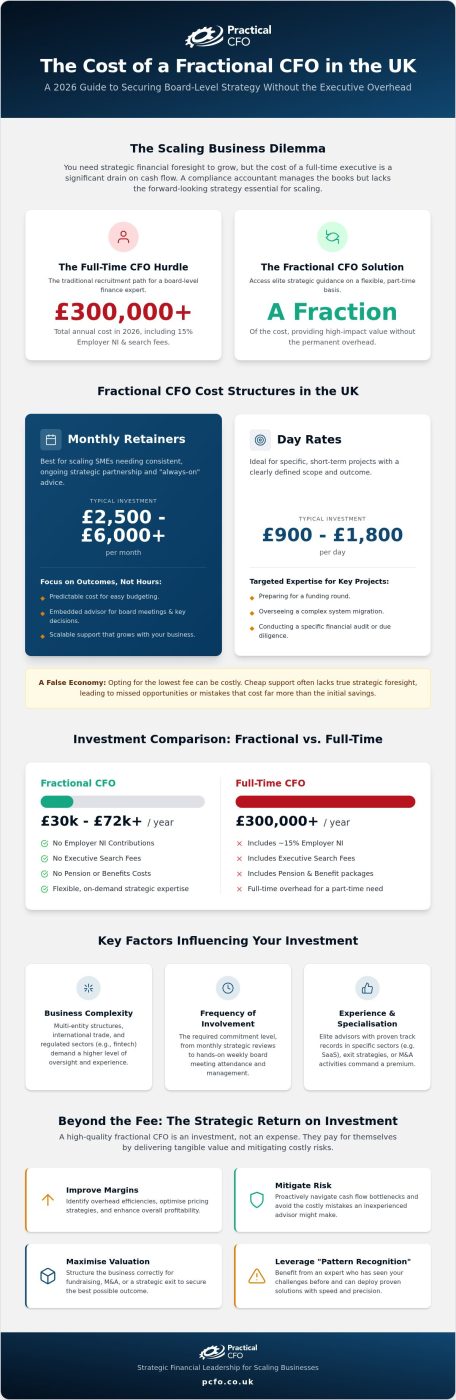
Hiring a full-time CFO in 2026 can cost your business upwards of £300,000 once you account for the 15% employer National Insurance contributions and executive search fees, yet many scaling companies only need a fraction of that time to secure their financial future. Understanding exactly how much does a fractional CFO cost UK firms is the first step toward securing high-level strategy without the executive price tag. You’ve likely realised that whilst your compliance accountant keeps the books tidy, they aren’t providing the strategic foresight needed to navigate complex growth. It’s a common dilemma; you need board-level expertise to scale, but the traditional recruitment path feels like a reckless drain on your cash flow.
This guide provides a transparent breakdown of investment levels, from typical day rates for SMEs to monthly retainers for mid-market firms. We’ll show you how to justify the expenditure to your board and why an “embedded advisor” model often pays for itself through improved margins and risk mitigation. By the end of this article, you’ll have a clear framework to secure senior finance support that adapts to your business lifecycle without the burden of a permanent overhead.
Key Takeaways
- Understand 2026 market benchmarks and exactly how much does a fractional CFO cost UK firms across different engagement models and seniority levels.
- Compare the total cost of ownership between fractional and full-time roles, including the impact of the 15% employer National Insurance contributions.
- Uncover how a strategic partner pays for themselves by identifying overhead efficiencies and maximising business valuation for future exit strategy support.
- Determine the ideal engagement model for your current growth stage, whether you’re navigating a scaling phase or preparing for a strategic sale.
Understanding Fractional CFO Cost Structures in the UK
A fractional CFO operates as a part-time strategic partner, providing high-level financial leadership without the permanent overhead of a full-time executive. This Fractional Executive Model allows scaling firms to access board-level expertise on a flexible basis. When asking how much does a fractional CFO cost UK businesses, it’s essential to look beyond the headline figure. The investment usually falls into two primary categories: project-based day rates or value-led monthly retainers. Selecting the right structure depends on whether you need a specific problem solved or an embedded advisor to guide your long-term trajectory.
The Day Rate Model: When It Makes Sense
Day rates are most effective for short-term projects, such as preparing for a funding round, overseeing a system migration, or conducting a specific financial audit. In 2026, UK day rates typically range from £900 to £1,800. Seniority and a proven track record in specific sectors dictate where a professional sits on this scale. Mid-tier CFOs often charge around £1,000 to £1,200 per day. Elite advisors with extensive exit experience or international trade expertise command the higher end of the spectrum. Whilst day rates provide clear boundaries for specific tasks, they don’t always encourage the deep, proactive partnership that a scaling business requires.
Monthly Retainers: Predictability for Scaling SMEs
For businesses in a consistent growth phase, monthly retainers offer the best balance of predictability and value. These usually range from £2,500 to over £6,000 per month. The exact fee depends on the complexity of your multi-entity structure or the volume of strategic work required. Retainers move the focus away from “buying time” toward “buying outcomes.” You gain “always-on” strategic availability. This ensures your CFO is present for board meetings and critical decision-making moments without the friction of tracking individual hours. It’s a model built for scalability, allowing the level of support to increase as your business grows.
Opting for the lowest possible fee can be a false economy. Cheap support often comes from compliance-focused accountants who lack the strategic foresight of a true CFO. This lack of depth can lead to missed growth opportunities or poorly structured debt. These mistakes ultimately cost far more than the initial savings on fees. High-quality fractional support is an investment in pattern recognition. You’re paying for an expert who has seen your specific challenges before and knows how to navigate them safely. When you calculate how much does a fractional CFO cost UK firms, remember that the true price includes the cost of the mistakes an amateur might make.
Key Factors Influencing Your Fractional CFO Investment
The investment required for senior financial leadership isn’t static; it scales alongside the complexity of your organisational architecture. When evaluating how much does a fractional CFO cost UK businesses, you must first audit your current growth stage and the specific hurdles your company faces. A seed-stage startup seeking its first round of professional capital has vastly different requirements than a mid-market firm preparing for a private equity exit. The more “high-stakes” the milestone, the more you should expect to invest in the expertise required to navigate it safely.
Complexity factors act as the primary drivers of cost. If your business operates across multi-entity structures or engages in international trade, the CFO must manage transfer pricing, currency risk, and varied tax jurisdictions. Regulated sectors, such as fintech or healthcare, also demand a higher level of oversight. The frequency of involvement is another critical variable. A CFO who attends weekly board meetings and provides hands-on turnaround management will naturally require a larger retainer than an advisor providing monthly strategic oversight and performance reviews.
Experience and Specialisation Premiums
Sector-specific experience often commands a premium because it brings the benefit of “pattern recognition.” A CFO who has scaled multiple SaaS companies understands the specific metrics, such as CAC and LTV, that investors prioritise. They don’t just report on the past; they anticipate future cash flow bottlenecks before they occur. This deep institutional knowledge allows them to move faster and with greater precision. Additionally, an elite CFO often brings a valuable network of lenders, investors, and legal experts, which can significantly reduce the time and cost of fundraising or M&A activities. If you are unsure which level of expertise your business requires, it’s often helpful to discuss your strategic goals with a growth advisor to align the investment with your desired outcomes.
The Scope of the Finance Function
Your investment level also depends on the existing infrastructure within your company. A fractional CFO might be brought in to oversee an established finance team, or they may need to build the function from scratch. In many cases, the most cost-effective approach involves integrating their leadership with outsourced accountancy solutions. This ensures the CFO focuses entirely on high-level strategy whilst the day-to-day processing is handled by a dedicated external team. Reporting requirements also influence the fee; if you have demanding stakeholders or institutional investors who require bespoke monthly packs and rigorous KPIs, the CFO will need to allocate more time to data architecture and stakeholder management.
Comparing the Investment: Fractional vs Full-Time CFO
Deciding between a permanent executive and a fractional partner requires a forensic look at the Total Cost of Ownership (TCO). Whilst the headline fee for a part-time advisor is the primary focus, the true value emerges when you compare it against the fully loaded cost of a full-time hire. For many scaling firms, the question of how much does a fractional CFO cost UK businesses is best answered by looking at the 40% to 60% savings typically achieved in the first year compared to a permanent equivalent.
Full-Time CFO: The True Cost to the Business
A full-time CFO in 2026 commands a base salary between £190,000 and £300,000. However, the base salary is merely the starting point. Once you factor in the 15% employer National Insurance contributions, executive pension schemes, and private health insurance, the true annual cost often reaches £250,000 to £420,000. Recruitment fees add another layer of immediate capital drain; typically ranging from 20% to 30% of the first year’s salary, these fees can cost your business between £44,000 and £66,000 before the executive even starts. Non-cash costs, such as equity grants and performance bonuses, further increase the long-term financial commitment. A fractional model eliminates these “hidden” recruitment and benefit burdens, allowing you to redirect that capital into growth initiatives.
The fractional model also provides essential agility during periods of market volatility. A permanent executive is a fixed overhead that’s difficult to adjust if market conditions shift. In contrast, a fractional engagement can be scaled up or down as your requirements change. You might increase their involvement during a series B funding round and reduce it once the capital is secured and the new financial systems are bedded in. This flexibility ensures you aren’t paying for surplus capacity during quieter operational periods.
Fractional CFO vs Strategic Accountant
It’s a common mistake to assume a standard compliance accountant can fulfil the duties of a finance director or CFO. Compliance roles focus on historical reporting and statutory accuracy. A CFO, however, focuses on strategic foresight and future-proofing your business model. Whilst a compliance-led accountant might cost less per month, they rarely provide the ROI that comes from sophisticated cash flow modelling or capital structure optimisation. The cost difference reflects the shift from “keeping the score” to “winning the game.” A fractional CFO pays for themselves by identifying margin improvements and preventing the costly scaling mistakes that a standard accountant might not anticipate. You’re investing in a partner who helps you navigate the horizon, not just someone who reports on the wake behind the ship.
Beyond the Fee: Measuring Value and Strategic ROI
Measuring the return on investment for senior financial leadership requires a shift in perspective. Whilst you may be focused on how much does a fractional CFO cost UK SMEs in terms of monthly fees, the true metric is the value they unlock through strategic intervention. A seasoned CFO often pays for themselves within the first six months by identifying inefficiencies that a compliance-led accountant might overlook. This includes achieving strategic overhead reduction by rationalising your tech stack and optimising supplier contracts. They transform your finance function from a reporting department into a growth engine.
The most significant ROI often comes during transition periods. If you are considering a sale, exit strategy planning can significantly increase your business valuation. By cleaning up the balance sheet and presenting a robust financial narrative, a CFO ensures you don’t leave money on the table. Conversely, the cost of not having this leadership during a scaling phase is often measured in burnt runway and missed opportunities. Better forecasting directly improves your cash flow, giving you the confidence to reinvest profits without jeopardising your operational stability.
Impact on Fundraising and Capital Structure
Securing capital is more efficient when an “investor-ready” expert leads the process. A fractional CFO facilitates Series A and B rounds by providing the rigorous data architecture that institutional investors demand. They can also reduce the cost of debt by improving your financial positioning with lenders. By optimising working capital, they help you fuel growth using internal resources, which reduces the need for dilutive external equity. This strategic capital management preserves founder value whilst maintaining the pace of expansion.
Risk Mitigation and Strategic Planning
Independent oversight prevents the costly compliance failures that often plague rapid-growth firms. A CFO provides board-level financial advice that steers the CEO away from high-risk decisions, ensuring every strategic move is backed by data. They identify tax inefficiencies and ensure your corporate structure is fit for purpose. This objective perspective is vital for future-proofing your business against market shifts. If you are ready to move beyond basic accounting and secure this level of strategic oversight, you can book a consultation for our CFO services today.
Choosing the Right Model for Your SME
Selecting the ideal engagement model requires a candid assessment of your organisational maturity and the specific gaps in your leadership team. Whilst the initial question is often how much does a fractional CFO cost UK businesses, the focus should quickly shift to the specific outcomes you intend to achieve. Are you preparing for a three-year exit, or are you navigating the complexities of a Series B funding round? Defining these milestones early ensures your investment is tied to tangible results rather than just administrative oversight.
When interviewing a potential partner, prioritise cultural and strategic fit over a generic list of services. You need an embedded advisor who understands the nuances of your sector and can challenge your assumptions in the boardroom. Ask about their previous experience with companies at your specific stage of growth. A CFO who has successfully navigated a turnaround situation may have a different approach than one who specialises in rapid international expansion. This “pattern recognition” is what separates a true strategic partner from a standard contractor.
Structuring the Engagement
Most successful partnerships begin with a comprehensive financial health check or diagnostic. This initial phase identifies immediate risks and sets the baseline for future growth. Following this, it’s essential to establish clear KPIs for the role, such as improving EBITDA margins or extending cash runway. A flexible engagement allows you to scale the level of support as your business evolves. You might start with two days a month for oversight and increase this to one day a week as you approach a major transaction or audit. This methodical progression builds a foundation of trust without over-committing your capital.
Why PCFO is the Strategic Choice
PCFO positions itself as an authoritative strategic partner focused on your long-term trajectory rather than just historical reporting. Our approach integrates high-level leadership with bespoke business growth advisory, ensuring your finance function is a proactive driver of value. By choosing a fractional model through PCFO, you avoid the significant recruitment fees and loaded overheads associated with permanent executive hires. We provide the intellectual rigour and foresight needed to future-proof your organisation.
Our advisors don’t just fill a gap; they build a foundation for sustainable success. This steady, transparent process allows you to make informed decisions with confidence. When you calculate how much does a fractional CFO cost UK firms, the PCFO model stands out by delivering board-level wisdom that adapts to your unique business lifecycle. We act as a steady hand at the helm, alleviating financial anxiety through intellectual rigour and a proactive mindset.
Scaling Your Business with Strategic Confidence
Investing in senior finance leadership is no longer a choice reserved for the corporate elite. By understanding how much does a fractional CFO cost UK firms, you can secure the pattern recognition and strategic foresight needed to navigate complex growth without the permanent overhead of a full-time executive. Moving from a compliance-led approach to a strategy-led partnership ensures that every financial decision aligns with your long-term objectives; whether you’re eyeing a Series B round or preparing for a high-value exit.
PCFO provides the steady, experienced hand your business needs. We specialise in delivering strategic finance leadership for UK SMEs, focusing on exit strategy support and business growth advisory through transparent, value-driven pricing. You don’t have to navigate financial uncertainty alone or risk your cash flow on a premature permanent hire. Instead, you can lean on an embedded advisor who is fully invested in your success. Take the first step toward a more resilient financial future today and Book a Strategic Consultation with PCFO. We look forward to helping you future-proof your business.
Frequently Asked Questions
Is a fractional CFO worth it for a business with £1m turnover?
Yes, a fractional CFO is often essential for a £1m turnover business that aims to scale rapidly or secure external investment. At this revenue level, many firms find that their existing accounting support lacks the strategic foresight needed for sophisticated cash flow modelling. Investing in this leadership ensures you have a professional at the helm who can navigate growth risks and prepare the business for the next stage of its lifecycle.
What is the difference between a part-time FD and a fractional CFO?
Whilst the terms are sometimes used interchangeably, a Finance Director (FD) typically focuses on internal controls, statutory reporting, and day-to-day financial health. A Chief Financial Officer (CFO) takes a more external-facing, strategic approach. This includes managing capital structure, lead-negotiating fundraising rounds, and overseeing investor relations. When considering how much does a fractional CFO cost UK businesses, remember that the higher fee reflects this broader, board-level strategic influence.
Can a fractional CFO help with my exit strategy planning?
Expert exit strategy support is a core function of a fractional CFO. They work to maximise your business valuation by ensuring your financial records are “investor-ready” and your growth narrative is backed by rigorous data. By identifying and resolving potential red flags long before the due diligence process begins, they help you secure a more favourable deal. This proactive approach often results in a significant increase in the final sale price.
Do fractional CFO fees include VAT in the UK?
Professional fees for CFO services are typically quoted exclusive of VAT. Most UK-based consultancies and independent advisors are VAT-registered, meaning a 20% charge will be added to the invoice. If your business is also VAT-registered, you can usually reclaim this amount as input tax. It’s always advisable to clarify the total invoice amount during the initial engagement phase to ensure your budget for senior finance support remains accurate and transparent.
How many days a month does a fractional CFO typically work?
Most engagements involve between one and four days of work per month, though this varies based on your specific organisational needs. A seed-stage company might only require one day of strategic oversight to review performance and guide the CEO. In contrast, a mid-market firm navigating a complex merger may need weekly involvement. The flexibility of the model allows you to scale the time commitment up or down as your business complexity changes.
Will a fractional CFO manage my day-to-day bookkeeping?
A fractional CFO does not typically handle day-to-day bookkeeping or transactional processing. Their role is to provide high-level leadership and strategic oversight of the entire finance function. They ensure that your bookkeeping team or outsourced providers are producing accurate data that can be used for board-level decision-making. This separation of duties ensures that your most expensive financial resource is focused on strategy, growth advisory, and risk mitigation rather than administrative tasks.
How quickly can a fractional CFO start delivering ROI?
Many businesses begin to see a tangible return on their investment within the first three to six months. This ROI often manifests as overhead reductions, improved profit margins, or a more stable cash runway through better forecasting. By identifying tax inefficiencies and optimising working capital, a seasoned CFO can often uncover savings that offset their own fees. The long-term value is found in the “pattern recognition” that prevents costly strategic errors during scaling.
Can I hire a fractional CFO for a one-off project like fundraising?
You can certainly engage a fractional CFO for specific, project-based milestones such as fundraising or system implementations. This approach is ideal for businesses that don’t yet require ongoing strategic oversight but need elite expertise for a high-stakes event. Project-based fees are usually structured around a day rate, providing a clear budget for the deliverable. It’s a practical way to access board-level wisdom during critical transition periods without a long-term retainer commitment.