

Is the “prestige” of a full-time executive actually a strategic anchor holding your growth back? Many UK business owners feel a sense of paralysis when faced with the high cost of executive recruitment, wondering if their organisation is truly ready for a permanent six-figure salary. You likely recognise that your board meetings lack the high-level financial data needed for confident navigation, yet the leap to a traditional hire feels like an immense risk in a market defined by talent shortages. This strategic comparison of an outsourced vs in house CFO will help you determine which model offers the best financial ROI for your scaling business in 2026.
It’s a common challenge to feel caught between needing Tier-1 strategic oversight and wanting to maintain cost-effective scalability. We promise to clarify whether a permanent hire or fractional expertise is the right fit for your current lifecycle, ensuring you remain investor-ready and future-proofed. We will examine the total cost of ownership, including the £161,241 average salary burden, the “single point of failure” risk associated with in-house roles, and how modern fractional models provide a steady, experienced hand at the helm of your financial strategy.
Key Takeaways
- Understand why scaling beyond basic bookkeeping requires a strategic architect to bypass growth ceilings and provide high-level board navigation.
- Evaluate the true financial impact of an outsourced vs in house CFO, accounting for hidden payroll burdens such as Employer National Insurance and pension contributions.
- Discover how the “Embedded Advisor” model offers the cultural alignment of a permanent hire alongside the flexibility and institutional knowledge of fractional expertise.
- Compare the total cost of ownership between a traditional six-figure executive and fractional services to maximise your organisation’s financial ROI.
- Learn how strategic financial leadership prepares your business for future success, from securing new investment to planning a robust exit strategy.
Bridging the Financial Leadership Gap in 2026
In 2026, the distinction between a traditional accountant and a strategic CFO is no longer just a matter of job titles; it is a matter of business survival. Many UK SMEs reach a “growth ceiling” where the retrospective data provided by basic bookkeeping cannot support the weight of expansion. While an accountant looks back at where the money went, a strategic CFO looks forward to where the organisation is going. This shift from historical reporting to proactive architecture is essential for navigating current market volatility.
The 2026 fiscal environment, shaped by evolving tax regulations and shifting interest rates, requires a level of foresight that standard finance functions often lack. Relying on yesterday’s figures to make tomorrow’s decisions creates a strategic vacuum. When evaluating the merits of an outsourced vs in house CFO, it is vital to recognise that this role is designed to bridge the gap between operational accounting and high-level commercial strategy.
The Strategic Architect vs The Accountant
Your current accountant is likely excellent at compliance, VAT filings, and year-end reporting. However, they might not be equipped for the complexities of Series A funding or the rigours of exit planning. Modern leadership requires data-driven storytelling to convince investors and stakeholders of a company’s long-term trajectory. While a finance director typically focuses on the efficiency of the internal finance function, a strategic CFO operates at a higher altitude, focusing on capital structure and value creation.
The strategic CFO acts as the essential co-pilot to the CEO, providing the navigational data required to reach long-term commercial goals.
Signs Your SME Has Outgrown Its Current Structure
Recognising the need for high-level financial leadership often starts with identifying specific organisational pains. If your finance function is struggling to keep pace with your ambitions, you will likely notice several recurring issues:
- An inability to provide accurate 12-month cash flow forecasts that account for various market scenarios.
- A palpable lack of financial clarity during board-level meetings, leading to hesitant or delayed decision making.
- Increasing stress amongst founders who feel they are carrying the burden of financial risk management alone.
- Financial reports that offer plenty of data but very little actionable insight for growth.
If these challenges sound familiar, your business has likely hit its growth ceiling. The decision regarding an outsourced vs in house CFO becomes the pivotal factor in whether you can break through that ceiling or remain stagnant in an increasingly competitive UK market.
The True Cost of a Permanent In-House CFO
Hiring a full-time executive is a significant milestone for any scaling business, yet the financial commitment extends far beyond the number on the offer letter. In 2026, the executive salary landscape for UK finance leaders has shifted significantly. Data from Glassdoor indicates that the average CFO salary in the UK has reached £161,241, whilst base salaries for SMEs typically range between £90,000 and £140,000. For organisations in the capital, this often carries a 20 to 40 per cent premium, making the entry-level cost for a permanent hire a daunting prospect for many founders.
The decision between an outsourced vs in house CFO requires a granular understanding of the “hidden” payroll burden. Employer National Insurance contributions, pension requirements, and private health insurance packages add a substantial layer of non-negotiable expense. Additionally, the initial acquisition of this talent is costly; standard executive recruitment fees in 2026 hover around 30 per cent. For a senior hire, this represents a one-off payment that often exceeds £40,000 before the individual has even completed their first week of work.
The Recruitment and Retention Challenge
Finding the right fit is increasingly difficult as top-tier talent moves towards fractional portfolios for greater variety and flexibility. If a permanent hire doesn’t work out, the impact is devastating. Industry estimates suggest a “bad hire” at the executive level can cost an organisation up to three times their annual salary in lost productivity and re-hiring expenses. Beyond this, the lack of agility is a major concern; with notice periods typically lasting three to six months, a small in-house team faces a “Single Point of Failure” risk if their sole financial leader departs suddenly.
Beyond the Basic Salary
A permanent executive expects a comprehensive benefits package that includes performance bonuses, car allowances, and often equity stakes. These elements are essential for retention but complicate your long-term financial planning. You must also account for the physical overhead of office space and high-end equipment required for a full-time board member. When all these factors are combined, the total cost of ownership becomes a heavy weight for a scaling firm to carry.
For a CFO with a £120,000 base salary, the fully loaded cost often climbs beyond £170,000 once you incorporate mandatory contributions, benefits, and operational overheads.
If the financial burden of a permanent hire feels disproportionate to your current stage of growth, exploring Chief Financial Officer Services can provide the high-level expertise you require without the executive price tag.
Leveraging Strategic Agility with an Outsourced CFO
Choosing an outsourced vs in house CFO allows your business to access Tier-1 strategic leadership at a fraction of the cost of a full-time executive. This model isn’t about hiring a distant contractor; it’s about securing an “Embedded Advisor” who integrates with your leadership team whilst maintaining a high-level strategic perspective. You gain the advantage of a seasoned expert who understands your culture but isn’t bogged down by internal politics or daily administrative minutiae. This agility is vital for SMEs that need to scale their financial support in line with their specific business lifecycle.
Risk mitigation is a primary benefit of this approach. Unlike the “Single Point of Failure” risk inherent in a small in-house team, a fractional service is team-backed. If your primary advisor is unavailable, the collective institutional knowledge of the consultancy ensures your strategic navigation remains uninterrupted. This continuity provides a level of reliability that a permanent hire simply cannot match, especially in a competitive recruitment market where executive turnover remains high.
Institutional Knowledge and Cross-Sector Insight
An outsourced CFO brings better ideas to the table because they work across a diverse client portfolio. This exposure prevents the “echo chamber” effect that often limits the vision of long-term internal hires. In 2026, staying at the forefront of financial technology is a full-time job. Fractional leaders are naturally incentivised to master the latest AI-driven forecasting tools and cloud-based reporting systems, ensuring your organisation benefits from cutting-edge efficiency without the need for internal training programmes.
Focus on Results, Not Presence
The fractional model shifts the focus from “time-based” employment to an “outcome-based” partnership. You aren’t paying for someone to sit in an office; you’re paying for high-level strategic sessions that drive measurable growth. This efficiency is amplified when your strategic leader works alongside outsourced accountancy solutions. This integration ensures that your day-to-day transactional data flows seamlessly into the high-level reporting required for board meetings and investor updates. It creates a unified financial architecture that supports rapid scaling without the friction of managing multiple permanent departments.
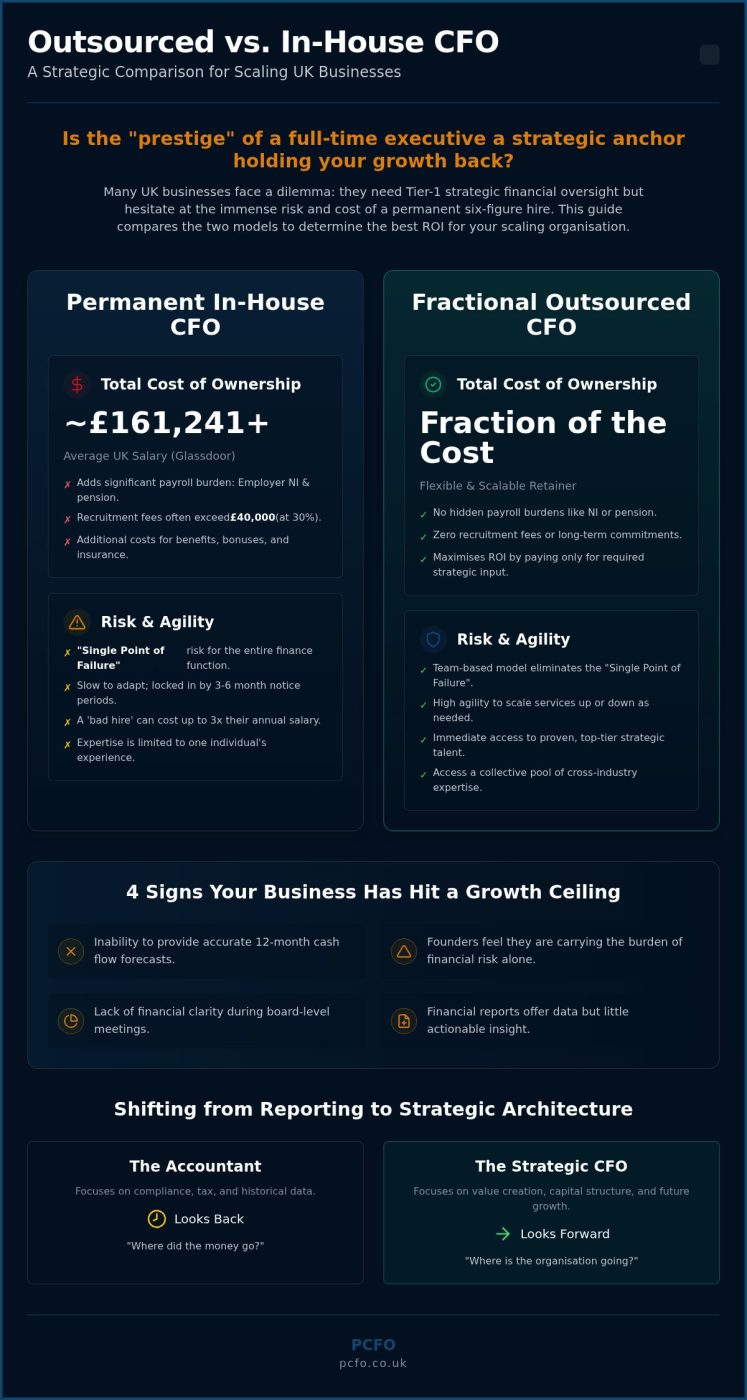
Financial Breakdown: Comparing Total Cost of Ownership
When evaluating the choice of an outsourced vs in house CFO, many directors focus solely on the base salary. This narrow view ignores the Total Cost of Ownership (TCO), which represents the true impact on your organisation’s bottom line. For a permanent CFO with a £130,000 base salary, the actual Year 1 expenditure often exceeds £190,000 once recruitment fees and statutory burdens are included. In contrast, a fractional service allows you to redirect significant capital back into your operational runway, preserving cash flow for growth-critical activities.
Visualising the ROI of these models requires a shift from viewing finance as an administrative overhead to seeing it as a strategic investment. Whilst an in-house executive provides constant presence, a fractional partner provides concentrated expertise. By paying for high-level strategic output rather than hours at a desk, you significantly improve your EBITDA by converting a heavy fixed cost into a flexible, scalable investment. Understanding fractional cfo pricing uk is the first step in realising how much “stuck” capital you can liberate for your business.
The TCO Framework for UK SMEs
A comprehensive line-item breakdown reveals the hidden weight of a permanent executive hire. Your organisation must account for several non-discretionary costs that do not apply to a fractional partnership:
- Executive Recruitment: A standard 30 per cent fee on a £130,000 salary costs £39,000 as a one-off payment.
- Employer National Insurance: 2026 statutory rates add a significant monthly burden to your payroll.
- Pension Contributions: Mandatory workplace pension schemes further increase the “fully loaded” cost.
- Benefits and Perks: Private health insurance, car allowances, and performance bonuses typically add 15 to 20 per cent to the base.
The “Break-Even” point for a permanent hire often takes 18 to 24 months to reach. Until that point, the fractional model remains the more efficient vehicle for scaling businesses that require elite financial direction without the long-term liability.
The Opportunity Cost of Delay
The cost of staying “stuck” without strategic leadership during a lengthy recruitment process is often higher than the salary itself. A typical executive search takes four to six months, during which your business may miss investment windows or suffer from poor working capital management. Fractional services can be deployed in as little as 48 hours. This immediate deployment provides an instant impact on your cash flow and ensures that your strategic navigation remains steady whilst you decide on your long-term leadership structure.
To determine the most efficient financial structure for your organisation, we invite you to explore our Chief Financial Officer Services for a tailored ROI analysis.
Securing Your Future with Fractional Financial Leadership
The decision between an outsourced vs in house CFO should ultimately be dictated by your three-year growth plan. Whilst immediate cost savings are compelling, the true value of fractional leadership lies in its ability to prepare your organisation for a significant future event. Whether you are eyeing a trade sale, a management buyout, or a private equity injection, your financial architecture must be robust enough to withstand intense scrutiny. A fractional CFO acts as a bridge, ensuring your current operations are aligned with your long-term exit objectives.
Transitioning to this model is a methodical process. PCFO ensures a seamless handover by first stabilising your existing finance function before implementing higher-level strategic controls. This embedded approach means that as your business evolves, your financial leadership evolves with it. You aren’t locked into a permanent executive structure that might become redundant; instead, you maintain the flexibility to pivot as market opportunities arise.
Investor Readiness and Exit Support
External investors often prefer the objective rigour provided by an outsourced strategic partner. A fractional leader brings a disciplined approach to cleaning up balance sheets and preparing comprehensive data rooms for M&A activity. By utilising business growth advisory uk, you can identify value-levers that internal teams might overlook. This proactive preparation is central to our exit strategy planning services, where the focus is on maximising business value long before the first offer arrives on the table.
Taking the First Step
Auditing your current finance function is the essential starting point for any scaling SME. You must identify where gaps in data, forecasting, and strategic foresight are creating friction. A professional audit often reveals that the “growth ceiling” discussed earlier is caused by a lack of executive-level oversight rather than a failure of the operational team. Booking a strategic consultation allows you to assess your specific needs without the pressure of a recruitment cycle. It ensures your finance function becomes a proactive driver of growth, rather than a heavy weight on your overheads. Your future success depends on having a steady, experienced hand at the helm; fractional leadership provides exactly that.
Navigating Your Path to Strategic Financial Excellence
The debate of an outsourced vs in house CFO isn’t merely about cost; it’s about the strategic agility required to lead in a volatile market. You’ve seen how the hidden burdens of permanent recruitment and executive salaries can anchor a scaling business. By choosing a fractional model, you gain access to elite UK-based strategic partners who specialise in SME scale-ups without the long-term liability of a six-figure hire.
Whether you’re preparing for a trade sale or refining your three-year growth plan, your financial leadership must be proactive. PCFO provides the intellectual rigour and cross-sector expertise needed to ensure your organisation is always investor-ready. It’s time to transform your finance function from a necessary overhead into a powerful driver of business value.
Take the next step in your growth journey and Book a Strategic Consultation with PCFO today. Our team is ready to help you navigate your financial future with confidence and clarity. We look forward to partnering with you to secure the long-term success of your organisation.
Frequently Asked Questions
What is the main difference between an in-house and an outsourced CFO?
The primary distinction lies in the employment structure and the scope of the role. An in-house CFO is a permanent executive with a fixed salary and comprehensive benefits. An outsourced vs in house CFO comparison shows that the outsourced model provides flexible, high-level strategic oversight on a fractional basis. This allows you to access elite financial leadership without the long-term liability of a six-figure hire, focusing on strategic architecture rather than daily administration.
Is an outsourced CFO suitable for a small business with under £5m turnover?
Yes, businesses with a turnover under £5m often benefit most from fractional support. At this stage, you likely need more than basic bookkeeping but aren’t ready for a full-time executive salary. A fractional CFO helps you bypass the “growth ceiling” by providing the data-driven clarity required for scaling. This ensures your financial structure supports your ambitions without the heavy fixed overhead of a permanent hire.
How much does a fractional CFO cost in the UK compared to a full-time salary?
When evaluating an outsourced vs in house CFO, the financial contrast is significant. A full-time CFO in the UK commands an average salary of £161,241, which rises when you include employer National Insurance and pension contributions. Fractional services offer a concentrated investment, allowing you to pay only for the strategic input you require. This outcome-based approach reduces your total cost of ownership whilst providing the same level of institutional knowledge as a permanent board member.
Can an outsourced CFO help with my exit strategy or business sale?
Absolutely. A strategic CFO is essential for maximising business value during a sale or management buyout. They provide expert exit strategy support by cleaning up balance sheets and preparing professional data rooms for investor scrutiny. This proactive preparation ensures your organisation is investor-ready, helping you identify and leverage value-drivers that lead to a more successful and profitable transition for all stakeholders involved.
Will an outsourced CFO work with my existing bookkeeper or accountant?
An outsourced CFO is designed to integrate seamlessly with your existing finance function. They act as an “embedded advisor,” working alongside your bookkeeper or accountant to elevate their output. By providing the strategic layer that transactional roles often lack, they turn your raw financial data into actionable insights. This collaborative approach ensures your internal team remains focused on efficiency whilst your CFO handles high-level board navigation.
What happens if I decide I need a full-time CFO later on?
The fractional model is built for scalability and flexibility. If your organisation grows to a point where a full-time presence is required, your fractional CFO can help facilitate a smooth transition. They ensure your systems, reporting, and strategic roadmaps are in excellent health, making the eventual handover to a permanent hire much easier. This ensures your financial leadership remains a driver of growth throughout every stage of your lifecycle.
How many days a month does an outsourced CFO typically work?
Engagement levels are entirely dependent on your specific business needs and growth trajectory. Typically, a fractional CFO might work between one and eight days per month, depending on the complexity of your projects. This flexibility allows you to increase support during critical periods, such as investment rounds or exit planning, and scale back during steadier times. It ensures you only invest in executive-level expertise when it adds the most value.
Are outsourced CFO services tax-deductible for UK companies?
Professional fees for strategic business advice are typically treated as a deductible business expense for UK Corporation Tax purposes. This means that the investment in fractional financial leadership can often be offset against your company’s profits. Whilst this provides an additional financial benefit, you should always consult with a qualified tax professional to confirm how these rules apply to your specific organisational structure and current fiscal circumstances.