

A high sales volume can be the very catalyst that destabilises a growing UK business if the underlying liquidity isn’t managed with precision. It’s a stressful paradox to see a healthy order book whilst simultaneously struggling to meet payroll because your capital is trapped in a cycle of unpaid invoices and stagnant stock. You aren’t alone in feeling that supplier relationships are becoming strained due to slow payments, even as your turnover reaches record highs.
This guide provides a structured framework to master working capital management strategies for smes, allowing you to optimise your cash flow, reduce liquidity risk, and fund your 2026 expansion plans using your own internal resources rather than relying on external debt. By refining your financial architecture, you can achieve a shorter cash conversion cycle and more predictable liquidity. We’ll examine how to leverage the latest legislative shifts, such as the Commercial Payments Bill, to secure better credit terms and ensure your cash flow supports your long-term strategic trajectory instead of hindering it.
Key Takeaways
- Understand the fundamental mechanics of your balance sheet to ensure your daily operations are supported by a robust liquidity buffer.
- Master specific working capital management strategies for smes that shorten your cash conversion cycle and unlock internal funding for growth.
- Implement a “cash-first” culture and rigorous credit protocols to ensure sales volume translates directly into predictable bank balances.
- Learn to balance lean inventory levels with strategic supplier negotiations to maintain operational flexibility without tying up vital capital.
- Discover how fractional financial leadership provides the strategic oversight needed to transition from historical reporting to proactive future-proofing.
Understanding Working Capital Management for UK SMEs
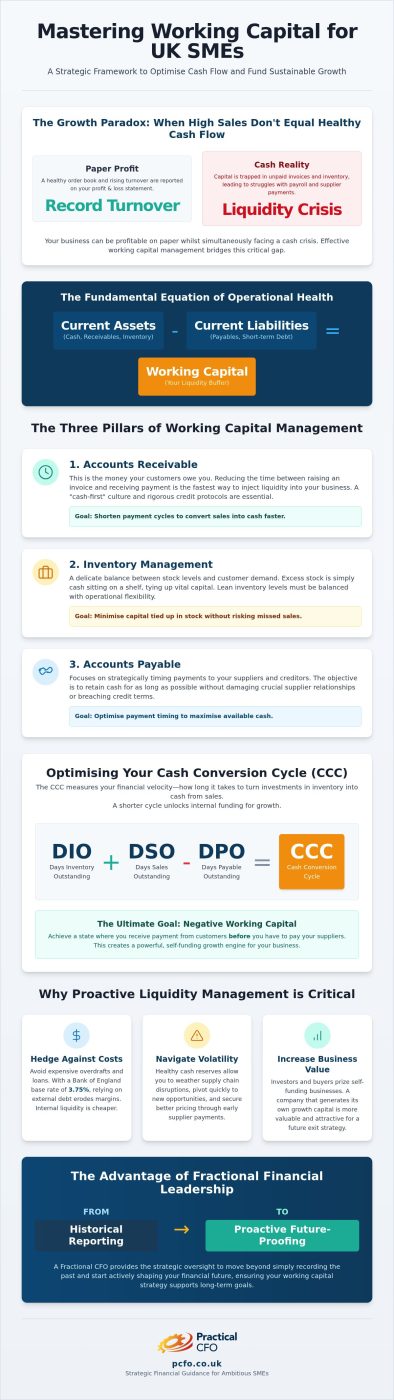
Working capital represents the operational liquidity available to your business. It’s the lifeblood that sustains your daily functions, from purchasing raw materials to meeting your monthly payroll. At its core, Understanding Working Capital involves a simple but vital calculation: your current assets minus your current liabilities. Whilst the formula is straightforward, the strategic execution is where many firms find their limits. It’s the difference between a business that survives and one that scales with confidence.
A common pitfall for many business owners is the assumption that a profitable month equates to a healthy bank balance. This is rarely the case. “Paper profit” is an accounting metric; it doesn’t pay your suppliers or your staff. You can report record-breaking turnover whilst simultaneously facing a cash crisis because your capital is locked in unpaid invoices or unsold inventory. This is why we treat net working capital as a primary strategic health indicator. It reveals the true agility of your organisation and its ability to fund growth without the burden of external debt.
The Three Pillars of SME Working Capital
To master working capital management strategies for smes, you must balance three interconnected areas of your balance sheet:
- Inventory Management: This involves a delicate act of balancing stock levels against real-time demand. Excess stock is simply cash sitting on a shelf, whilst insufficient stock leads to missed revenue opportunities.
- Accounts Receivable: This is the money your customers owe you. Reducing the time between raising an invoice and receiving payment is the fastest way to inject liquidity into your business.
- Accounts Payable: This pillar focuses on strategically timing payments to your creditors. The goal is to retain cash for as long as possible without damaging your reputation or breaching credit terms with key suppliers.
Why Liquidity Management is Critical in 2026
The economic environment of 2026 demands a proactive approach to liquidity. With the Bank of England base rate currently held at 3.75%, the cost of short-term borrowing remains a significant overhead for businesses that lack internal cash reserves. Relying on overdrafts or revolving credit facilities to cover operational gaps is an expensive habit that erodes your margins. A robust working capital position provides a natural hedge against this cost of capital.
Beyond immediate costs, healthy liquidity protects your firm against ongoing supply chain volatility. When you have cash readily available, you can pivot quickly, secure better pricing through early payments, or weather unexpected delays. Finally, there is a clear link between working capital health and your eventual exit strategy. Investors and buyers look for businesses that are self-funding. A company that generates its own growth capital is far more valuable than one that is perpetually reliant on external financing.
Optimising the Cash Conversion Cycle (CCC)
The Cash Conversion Cycle (CCC) is the definitive measure of your business’s financial velocity. It tracks the duration between the moment you pay for raw materials or services and the moment you receive cash from your customers. For a UK business, shortening this window is a core component of working capital management strategies for smes. A tighter cycle effectively unlocks cash that would otherwise be trapped in your operations, reducing your dependence on costly bank facilities or overdrafts.
High-growth firms often aim for a “negative working capital” model. In this scenario, you receive payment from customers before you have to pay your suppliers. This creates a self-funding growth engine where your operations provide the liquidity needed for expansion. Achieving this requires meticulous coordination across your entire supply chain, supported by academic research on SME financing which suggests that disciplined internal processes are often more sustainable than seeking external capital. Implementing these working capital management strategies for smes ensures that your growth remains sustainable and internalised.
Measuring Your Current Financial Velocity
To optimise your cycle, you must first quantify its components. We focus on three critical metrics. Days Sales Outstanding (DSO) measures how long your customers take to settle their invoices. If your DSO is rising, your cash is essentially subsidising your clients’ businesses. Days Inventory Outstanding (DIO) tracks how long your capital is tied up in physical stock. For service-based firms, this might represent unbilled work-in-progress. Finally, Days Payable Outstanding (DPO) reflects your credit leverage. Whilst you should never damage supplier relationships, extending your DPO within agreed terms keeps cash in your business for longer.
Identifying and Eliminating Operational Bottlenecks
Operational friction is often the silent killer of liquidity. Internal delays in the billing process, such as slow manager approvals or missing purchase order numbers, can add weeks to your payment cycle. Poor data quality is another frequent culprit. If an invoice contains an error, it’s likely to be rejected, restarting the payment clock from zero. These administrative failures directly impact your ability to fund daily operations.
Gaining real-time visibility is the first step toward resolution. Many growing firms find that their internal systems lack the sophistication required to track these metrics accurately. Implementing outsourced accountancy solutions provides the necessary oversight to identify these bottlenecks before they impact your bank balance. If you’re concerned about your current cash flow velocity, a professional Finance Director service can help you map out a more efficient cycle.
Strategic Management of Accounts Receivable
Liquidity begins at the point of sale. Whilst many UK businesses view credit control as a back-office administrative task, high-growth firms treat it as a front-line commercial priority. Establishing a “cash-first” culture within your sales and account management teams ensures that the value of a deal is only recognised once the cash is in the bank. This cultural shift prevents sales teams from chasing turnover at the expense of your company’s liquidity, aligning their incentives with the long-term financial health of the organisation.
Effective working capital management strategies for smes rely on preventing payment delays before they occur. Rather than simply reacting to late invoices, you should implement rigorous credit checks for all new B2B clients during the onboarding process. This proactive approach identifies potential risks early and allows you to design tiered payment terms that incentivise early settlement. Offering small discounts for payments made within seven days, for example, can significantly accelerate your inbound cash flow without damaging client relationships.
Implementing Robust Credit Control Policies
Credit control is a proactive risk management function designed to protect the business from bad debt and cash flow volatility. It’s not merely about chasing money; it’s about setting clear boundaries for your commercial relationships. We recommend setting firm credit limits based on objective financial risk assessments and reviewing these regularly as your clients’ businesses evolve. When an invoice does fall overdue, a formal escalation process must be triggered immediately. This ensures that minor delays don’t spiral into significant liquidity gaps, whilst maintaining a professional tone that preserves the partnership.
Accelerating Inbound Cash Flow
Reducing friction in the payment process is one of the most effective working capital management strategies for smes. Moving towards direct debit or upfront payment models where possible provides the highest level of certainty for your cash flow forecasting. Technology plays a vital role here. Automated reminders can handle routine follow-ups, leaving your team free to manage the personal relationships that are so critical for resolving complex payment issues. Offering multiple digital payment methods also removes common excuses for delay, ensuring that your invoice is at the top of the client’s payment run.
The strategic role of a Finance Director is often the deciding factor in negotiating major contract terms that favour your liquidity. By involving senior financial leadership in the contract stage, you can secure more favourable payment milestones and protect your margins. This high-level oversight ensures that your accounts receivable process isn’t just an exercise in data entry, but a strategic tool for funding your 2026 expansion plans.
Balancing Accounts Payable and Inventory Levels
Effective working capital management strategies for smes require a precise balance between what you owe and what you hold. Whilst previous sections focused on inbound cash, managing your outflows is equally critical for maintaining a healthy liquidity buffer. Many modern UK businesses now adopt a “Just-in-Time” (JIT) approach, ensuring that resource inputs arrive only when needed for production or service delivery. This reduces the capital trapped in warehouses and allows for a more agile response to market shifts without the burden of excessive storage costs.
Supplier relationship management is a strategic asset, not just a procurement task. There is often a temptation to over-extend accounts payable to preserve cash, but this carries significant risks. Damaging your reputation with key creditors can lead to tighter credit limits or disrupted supply chains, which ultimately costs more than any interest saved. For service-based firms, inventory often takes the form of unbilled professional hours or work-in-progress. Managing this requires the same level of rigour as a product firm managing physical stock, as unbilled time is a perishable asset that cannot be recovered once the capacity has passed.
Negotiating Favourable Terms with Suppliers
Leverage your history of prompt payments to secure better commercial terms or volume discounts. It’s often more beneficial to align supplier payment dates with your own customer receipt cycles rather than chasing early payment discounts. Whilst a 2% discount might look attractive on paper, the cost to your liquidity during a growth phase could be far higher. Focus on creating a predictable payment rhythm that supports your cash flow forecasting and builds a foundation of trust with your supply chain partners.
Lean Inventory Management Strategies
Slow-moving stock is essentially cash that has been spent but not yet recovered. Identifying these items is vital for improving your overall business ROI. High inventory turnover indicates a lean, efficient operation that minimises storage costs and obsolescence risks. Utilising strategic business planning allows you to forecast demand with greater accuracy, ensuring your stock levels reflect real-world requirements rather than optimistic guesswork. This data-led approach ensures that your capital is always deployed where it can generate the highest return.
If you wish to explore how these balance sheet adjustments can fund your next phase of expansion, our Business Growth Advisory services provide the strategic navigation you need to succeed.
How a Fractional CFO Transforms Working Capital Strategy
Whilst accounting software and bookkeepers are essential for recording historical transactions, they lack the strategic foresight to architect complex working capital management strategies for smes. A fractional CFO acts as the navigator, transforming static balance sheet data into a dynamic roadmap for expansion. They provide high-level corporate expertise on a flexible basis, making elite financial leadership accessible to scaling firms without the overhead of a full-time executive salary. This strategic layer is what allows a business to move from simply tracking money to actively managing its velocity.
A strategic partner also plays a pivotal role in securing and managing revolving credit facilities. By speaking the language of lenders and presenting your working capital health as a sign of operational excellence, a CFO can negotiate better terms that provide a safety net for growth. For businesses eyeing Series A or B funding, demonstrating a disciplined cash conversion cycle is a prerequisite for success. Investors are far more likely to commit capital to an organisation that has already mastered its internal cash flow, as it proves that new funds will be used for scaling rather than merely plugging operational leaks.
Moving Beyond Historical Reporting to Predictive Analysis
Transitioning from historical reporting to predictive analysis is the first hallmark of strategic leadership. Whilst a P&L statement records your past performance and accounting profit, a cash flow forecast predicts your future liquidity and survival. A CFO implements rolling 13-week cash flow forecasts to anticipate upcoming liquidity gaps months before they manifest as crises. This involves rigorous scenario planning for “what-if” situations, such as the sudden loss of a major client or a spike in raw material costs. This foresight enables you to make informed decisions about hiring and investment with a clear understanding of your actual cash runway.
Integrating Working Capital into Long-Term Growth
Rapid growth frequently outpaces a business’s cash reserves, often leading to the dangerous trap of overtrading. A fractional CFO ensures that your expansion remains sustainable by keeping your working capital requirements in lockstep with your revenue targets. By demonstrating efficient capital use now, you are also preparing the business for a future exit strategy. A strategic buyer will always pay a premium for a company that has moved beyond reactive firefighting to a state of proactive financial navigation. This level of maturity shows that the business is a stable, self-funding asset ready for its next chapter.
Securing Your Financial Future in 2026
Mastering your liquidity is the most effective way to insulate your business from economic volatility whilst funding sustainable expansion. By shortening your cash conversion cycle and implementing rigorous credit controls, you transform your balance sheet into a self-funding engine. These working capital management strategies for smes provide the stability needed to navigate the complexities of the current UK market without the constant burden of external debt. It’s about moving beyond simple survival to a state of proactive financial navigation.
Professional leadership is the catalyst for this transformation. Contact PCFO today to discover how our fractional CFO services can optimise your working capital and fund your growth. Our partnership model provides strategic FD oversight, expert cash flow forecasting, and bespoke business growth advisory tailored to your specific lifecycle. We help you build the intellectual rigour required to make informed, confident decisions about your company’s trajectory. You have the potential to turn your financial strategy into a powerful competitive advantage, and we’re ready to act as your steady hand at the helm.
Frequently Asked Questions
What is the most effective way for an SME to improve working capital quickly?
The fastest way to improve your position is to accelerate your accounts receivable. You should audit your current billing process to identify and remove administrative bottlenecks that delay invoice issuance. Implementing automated reminders and offering digital payment methods can often reduce your debtor days within a single billing cycle. This immediate injection of liquidity provides the breathing room needed to implement more complex working capital management strategies for smes over the long term.
How does working capital management differ from cash flow management?
Working capital management focuses on the balance between your current assets and liabilities to ensure operational stability. Cash flow management, however, is concerned with the specific timing of cash moving in and out of your bank accounts. Whilst they are closely linked, you can have positive working capital on your balance sheet whilst simultaneously facing a cash flow crisis if your assets are tied up in illiquid inventory or long-term debtors.
Is it always better to have a high working capital ratio?
A high working capital ratio is not always a sign of financial health. Whilst it suggests you can easily meet your short-term obligations, an excessively high ratio often indicates that your capital is being used inefficiently. You might be holding too much stagnant inventory or failing to reinvest idle cash into growth opportunities. The goal is to maintain an optimal buffer that balances safety with the need for high capital velocity and return on investment.
Can an SME grow too fast and run out of working capital?
Yes, this phenomenon is known as overtrading and it is a common risk for scaling UK firms. Rapid growth often requires significant upfront investment in stock, staff, and capacity before the resulting sales revenue is actually collected. If your growth rate outpaces your ability to generate internal liquidity, you may find your business technically profitable but functionally insolvent. Robust working capital management strategies for smes are essential to prevent your success from outstripping your cash reserves.
What are the risks of ignoring accounts payable in favour of cash preservation?
Ignoring your accounts payable can lead to severe supply chain disruptions and a tarnished commercial reputation. Whilst delaying payments preserves cash in the short term, it often results in suppliers withdrawing credit facilities or demanding upfront payments for future orders. This loss of trust can be far more expensive than any interest saved. Maintaining strong relationships with your creditors is a strategic necessity that ensures you have access to favourable terms during periods of volatility.
How much working capital should a UK SME ideally maintain?
There is no universal figure, as the ideal level of working capital depends heavily on your specific industry and business model. A current ratio between 1.2 and 2.0 is often cited as a healthy benchmark for UK SMEs. However, a service-based firm with low inventory requirements may operate safely with a lower ratio than a manufacturing business. A fractional CFO can help you determine the precise liquidity buffer required to support your 2026 growth objectives.
What role does a fractional FD play in managing daily liquidity?
A fractional FD provides the strategic architecture for your liquidity rather than performing daily bookkeeping tasks. They implement rolling cash flow forecasts and establish the credit control policies that your internal team will follow. By providing high-level oversight, they ensure that your daily operational decisions are aligned with your long-term financial goals. This leadership allows business owners to transition from reactive firefighting to a state of proactive, data-led financial navigation.
How can I improve my working capital without taking on more debt?
You can improve your liquidity by optimising your internal cash conversion cycle. This involves negotiating better payment terms with customers, reducing your inventory holding periods, and ensuring your billing process is error-free. By refining these operational levers, you unlock cash that is already present within your business but currently trapped in the balance sheet. This self-funding approach allows you to finance your expansion plans without the cost or burden of taking on external debt.