
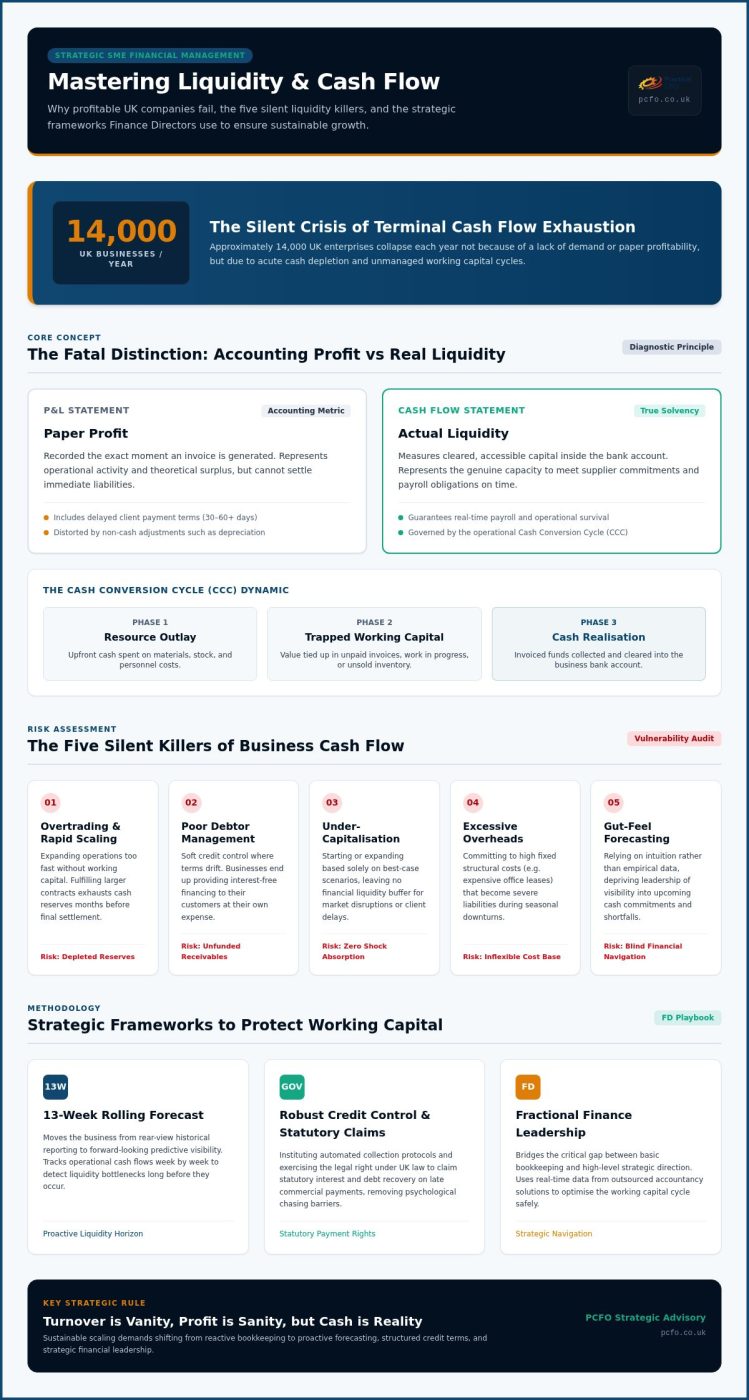
Did you know that roughly 14,000 UK businesses collapse every year due to terminal cash flow exhaustion, despite many of them being profitable on paper? It’s a frustrating, silent crisis for many SME owners. You’re winning contracts and scaling the team, yet your bank account remains stubbornly empty. You’re likely tired of chasing debtors whilst simultaneously worrying about meeting the next payroll or supplier commitment. It’s an exhausting cycle that limits your ability to invest in the future and creates unnecessary personal stress.
Understanding how to avoid business cash flow problems requires a shift from basic accounting to strategic financial leadership. This guide shares the specific frameworks and tactical insights used by experienced Finance Directors to secure liquidity and prevent crises in growing firms. We’ll explore how to move beyond historical reporting into proactive 13-week forecasting, robust credit control, and the latest statutory payment protections. By the end, you’ll have a clear roadmap to achieve a predictable bank balance and the strategic confidence needed to focus on sustainable, long-term growth.
Key Takeaways
- Distinguish between paper profit and actual liquidity to understand why a healthy P&L can still result in an empty bank account during periods of growth.
- Identify the strategic frameworks required for how to avoid business cash flow problems, focusing on mitigating the risks of overtrading and unmanaged debtor days.
- Implement a 13-week rolling cash flow forecast to move beyond historical reporting and gain proactive visibility over upcoming financial commitments.
- Optimise your working capital cycle by integrating real-time data from outsourced accountancy solutions into your daily decision-making process.
- Leverage fractional finance leadership to bridge the gap between basic bookkeeping and high-level strategic navigation for long-term stability.
Understanding the Difference Between Profit and Liquidity
Many UK business owners find themselves in a confusing position: the Profit and Loss statement shows a healthy surplus, yet the bank balance is nearing its limit. It’s a common trap. This “Profit Myth” occurs because accounting profit is recorded the moment an invoice is raised, rather than when the funds actually arrive. Understanding how to avoid business cash flow problems starts with recognising that turnover is merely a measure of activity, not a guarantee of financial health. Relying solely on a P&L can mask underlying issues that threaten the very existence of your company.
The Cash Flow Statement serves as the primary diagnostic tool for identifying liquidity health. It tracks the actual movement of currency in and out of the business, revealing the mechanics of your “Cash Conversion Cycle” (CCC). This cycle measures the time elapsed between spending money on resources and receiving cash from sales. If your cycle is too long, your capital remains trapped in unpaid invoices or unsold stock, leaving you vulnerable despite your success on paper. Learning how to avoid business cash flow problems requires monitoring this cycle closely to ensure liquidity remains ahead of obligations. Professionals often view the CCC as the heartbeat of operational efficiency, as it exposes exactly where your working capital is tied up.
The Fatal Distinction: Why Profit Isn’t Cash
The timing gap is the main culprit. When you issue an invoice, your P&L records revenue immediately. However, if your customer takes 60 days to pay, that “profit” cannot meet today’s bills. Beyond timing, non-cash expenses like depreciation lower your reported profit without actually removing cash from your account. Liquidity is the ability to meet short-term obligations whilst maintaining operations.
Why Even Growing Companies Fail
Rapid growth is dangerous for an SME. Larger contracts require upfront investment in staff and materials, often months before the final invoice is settled. Without strategic budgeting and forecasting, new orders can paradoxically deplete reserves and lead to overtrading. Successful directors use cash flow forecasting to predict these gaps. Maintaining a liquidity buffer amongst market uncertainty provides resilience against delayed payments.
The Five Silent Killers of Business Cash Flow
Cash flow problems rarely announce themselves with a sudden bang. They often creep in through subtle operational inefficiencies that erode your liquidity over months, contributing to the 14,000 business closures seen annually across the UK. Identifying these risks early is the first step in learning how to avoid business cash flow problems. Whilst many directors focus on the top line, the real threats often lie in the mechanics of how that revenue is collected and managed.
The Risks of Overtrading and Rapid Scaling
Overtrading occurs when a business expands its operations too quickly without enough working capital to support the growth. It is a dangerous paradox: your sales are soaring, but your bank account is draining. The cost of fulfilling new contracts, hiring additional staff, and purchasing inventory often outpaces the cash coming in from previous sales cycles. Identifying the tipping point where growth becomes a liability requires a balance between ambition and financial control. Engaging a business growth advisory uk specialist can help you scale safely by ensuring your capital reserves match your expansion goals.
The Impact of Poor Debtor Management
Allowing payment terms to drift beyond agreed limits is a direct threat to business survival. “Soft” credit control often stems from a founder’s fear of damaging client relationships, but this effectively means you are funding your customers’ businesses with your own interest-free cash. UK law provides a framework to combat this behaviour. You have a legal right to claim statutory interest and debt recovery on late commercial payments. Implementing a rigorous, automated process removes the psychological barrier of chasing invoices and ensures cash returns to your business where it belongs.
Under-capitalisation and excessive overheads further compound these issues. Many SMEs start or expand with just enough funding for the “best-case scenario,” leaving no room for delays whilst waiting for cash to arrive. Similarly, fixed costs like expensive office leases can become a heavy liability during seasonal dips. Finally, inaccurate forecasting based on gut feeling rather than data remains a primary cause of failure. UK small business owners spend an average of 86 hours per year chasing overdue invoices because they lack the visibility to predict gaps before they occur. Securing professional financial leadership can transform this reactive cycle into a proactive strategy that protects your long-term stability.
Implementing a Strategic Forecasting Framework
A simple spreadsheet isn’t enough to secure your firm’s future. To truly master how to avoid business cash flow problems, you need a dynamic system that provides visibility before a crisis hits. This involves moving beyond static monthly budgets and adopting a rolling framework that adapts to real-time market changes. It’s about shifting from reactive survival to proactive leadership by using data to navigate the months ahead.
The 13-Week Rolling Forecast: Your Financial Radar
A 13-week window is the gold standard for SME liquidity management. It’s long enough to capture a full quarter of trading but short enough to remain accurate. When creating a cash flow forecast, you should categorise receipts and payments into logical buckets like payroll, VAT, and trade debtors. This structured approach provides maximum clarity on your immediate commitments. This forecast acts as an early warning system, allowing you to identify potential shortfalls weeks before they impact your operations. Implementing this radar is a fundamental step in how to avoid business cash flow problems during periods of rapid scaling. By integrating real-time data from your outsourced accountancy solutions, you ensure that decisions are based on facts rather than outdated ledgers.
Scenario Planning for Market Volatility
Static forecasts often fail when the market shifts. You must conduct sensitivity analysis to understand how small changes affect your bottom line. This means modelling the impact of a 10% drop in sales or a 5% increase in supplier costs. Modelling these “What-If” scenarios allows you to prepare contingency plans whilst maintaining business as usual. Deciding between an fp&a consultant vs software uk depends on your company’s complexity. While software handles the numbers, a consultant provides the strategic interpretation that ensures your growth remains stable.
Finally, a forecast is only useful if it’s reviewed. A regular board-level comparison of your forecast against actual performance reveals where your assumptions were wrong. This feedback loop refines your accuracy over time, turning your financial data into a powerful tool for strategic navigation. It builds the confidence needed to invest in growth without risking the company’s solvency.
Tactical Solutions to Optimise Working Capital
Optimising working capital is about fine-tuning the internal components of your cash conversion cycle. It requires a disciplined approach to how value moves through your ledger, from the moment you purchase materials or hire staff to the second cash hits your bank account. By addressing inefficiencies in your receivables, payables, and inventory, you can unlock liquidity that is already present within your business. This tactical control is a fundamental pillar of how to avoid business cash flow problems whilst maintaining a lean, responsive organisation. Beyond the corporate world, fintech is also revolutionising how fixed costs are managed; for example, you can visit Rentify to see how Rent Now, Pay Later models allow for more flexible payment of large annual expenses.
Control begins before an invoice is even raised. Implementing rigorous onboarding for new clients, including formal credit checks, protects you from high-risk debtors. Whilst it is tempting to offer early settlement discounts to speed up cash inflows, you must weigh the benefit against the erosion of your net margin. These discounts are only efficient if the cost of the reduction is lower than your cost of capital or alternative borrowing. If payments drift, you must have a clear escalation path. Moving from polite reminders to professional debt recovery should be a standard operational procedure rather than a reactive emotional decision.
Managing Creditor Relationships and Terms
Strategic payables management is not about simply delaying payments to suppliers. It is about alignment. You should aim to synchronise your supplier payment cycles with your customer receipt dates where possible. When you need to ask for extended terms, lead with transparency. Suppliers are more likely to support a growing firm that communicates proactively about its cash requirements than one that simply goes silent. Maintaining this professional reputation ensures you have a resilient supply chain that can support you during seasonal dips or rapid expansion phases. Utilising vendors that offer credit terms, such as The CEO Creative, can also help you manage your working capital by providing essential business supplies on net-30 terms.
Inventory and Work-in-Progress (WIP) optimisation also play a critical role in releasing trapped cash. Stock sitting in a warehouse or hours logged on a project that hasn’t been billed represent “dead” capital. Reducing lead times and implementing milestone billing can significantly shorten the time it takes to turn effort into cash. Finally, your pricing strategy must be reviewed regularly. Ensure your margins are sufficient to cover not just your direct costs, but also the working capital required to fund the gap between delivery and payment. If you need expert assistance in refining these cycles, consider our Finance Director Services to implement a robust working capital framework.
While tactical measures like 13-week forecasts and working capital optimisations are vital, they require a steady hand at the helm to remain effective over the long term. Many UK SMEs struggle not because they lack data, but because they lack the high-level expertise to interpret that data in a strategic context. Truly mastering how to avoid business cash flow problems involves more than just installing the right software; it requires a fundamental shift in leadership. This is where the human element of financial oversight becomes the deciding factor between a business that merely survives and one that scales with confidence.
When Software Isn’t Enough: The Need for Human Insight
Automated accounting tools are excellent for processing transactions and generating reports, but they often suffer from the “garbage in, garbage out” trap if not overseen by a professional. A bookkeeper focuses on historical accuracy, which is necessary for compliance but insufficient for strategic growth. In contrast, a strategic finance partner looks through the windscreen rather than the rearview mirror. They identify subtle trends in your cash conversion cycle before they become crises, ensuring that the board-level decisions you make are grounded in financial reality. This level of insight allows you to pivot your strategy based on upcoming liquidity requirements rather than reacting to yesterday’s bank balance.
How a Part-Time FD Secures Financial Stability
A fractional finance director acts as the critical bridge between a CEO’s ambitious vision and the company’s actual bank balance. They provide the intellectual rigor needed to secure external investment or bank facilities through sophisticated financial modelling. This level of expertise was once reserved for large corporations with significant budgets, but the fractional model now allows growing firms to access CFO-level guidance at a scalable cost. By moving from reactive fire-fighting to proactive financial steering, you can ensure your business remains solvent whilst pursuing aggressive expansion goals. This leadership ensures that every new contract is supported by a robust capital structure, removing the anxiety associated with rapid scaling. Secure your business’s future with fractional CFO pricing uk that fits your specific growth stage and provides a clear return on investment.
Ultimately, the goal is to create a business that is resilient enough to withstand market volatility whilst maintaining the flexibility to seize new opportunities. Leadership is the final piece of the puzzle in how to avoid business cash flow problems. With a seasoned expert at the helm of your financial strategy, you gain the clarity needed to invest in your team, your technology, and your future without risking the core stability of your organisation.
Future-Proofing Your Business Liquidity
Transitioning from reactive firefighting to proactive financial steering is the hallmark of a resilient, scaling business. You’ve discovered that a healthy P&L doesn’t guarantee survival; instead, it’s the meticulous management of your cash conversion cycle and the implementation of a 13-week rolling forecast that provides true stability. Mastering how to avoid business cash flow problems isn’t just about technical accounting; it’s about embedding strategic financial architecture into your growth plans to ensure every new contract is backed by sufficient working capital.
You don’t have to navigate these complexities alone. Our expert Fractional CFOs bring deep UK SME experience to help you future-proof your liquidity through comprehensive outsourced finance functions. We provide composed, authoritative advice tailored specifically to your company’s growth stage. Contact PCFO today for a strategic finance consultation to gain the visibility and confidence your business deserves. With the right strategic partner at the helm, you can focus on sustainable expansion whilst we ensure your financial foundation remains unshakable.
Frequently Asked Questions
What is the most common cause of cash flow problems in UK SMEs?
Late payments from commercial customers remain the most frequent cause of liquidity crises for UK SMEs. Research suggests that late payments trigger approximately 14,000 business closures annually across the country. This issue is often exacerbated by “soft” credit control, where founders hesitate to chase debtors for fear of damaging relationships. Implementing a structured collection process is a vital step in learning how to avoid business cash flow problems and maintaining operational stability.
How much cash reserve should a small business ideally hold?
A small business should ideally hold a cash reserve equivalent to three to six months of essential operating expenses. This buffer provides a safety net against unexpected market volatility or delayed payments from major clients. The exact amount depends on your sector’s risk profile and the length of your cash conversion cycle. Maintaining this liquidity ensures you can meet payroll and supplier commitments even during seasonal dips or unforeseen economic shifts.
Can a business be profitable but still go bust?
Yes, a business can report significant profits on its P&L whilst simultaneously entering insolvency. This occurs because profit is an accounting concept recorded when an invoice is raised, whereas liquidity depends on when cash is actually received. If your cash is tied up in trade receivables or inventory, you may lack the immediate funds to pay creditors. Many successful firms fail because they lack the strategic oversight to manage this timing gap.
How often should I update my cash flow forecast?
You should update your 13-week rolling cash flow forecast at least once a week. Frequent updates allow you to integrate real-time data from your bank accounts and accounting software, ensuring your projections remain accurate. This weekly rhythm turns your forecast into a proactive steering tool rather than a static report. Updating your projections regularly is a core component of how to avoid business cash flow problems and maintain strategic control over your growth.
What is the difference between a cash flow forecast and a budget?
A budget is a strategic plan that outlines your financial targets and spending limits for a set period, usually a year. In contrast, a cash flow forecast is a dynamic projection of actual cash moving in and out of the business. Whilst a budget focuses on profitability and resource allocation, a forecast focuses on liquidity and solvency. Both are essential, but the forecast is your primary tool for navigating daily operational requirements.
How can I improve my cash flow without taking on more debt?
You can improve liquidity by optimising your internal working capital cycles. This includes tightening credit control to reduce debtor days, negotiating longer payment terms with suppliers, and reducing excess inventory levels. Additionally, reviewing your pricing strategy to ensure margins cover the cost of delayed payments can release trapped cash. These tactical adjustments allow you to fund growth through your own operations rather than relying on expensive external financing or additional debt.
Is a fractional CFO better than a full-time hire for managing cash flow?
A fractional CFO is often the superior choice for growing SMEs that require high-level expertise but don’t yet need a full-time executive hire. You gain access to seasoned financial leadership and strategic oversight at a scalable cost that fits your current lifecycle. This model provides the intellectual rigor needed for complex tasks like exit planning or securing investment, whilst ensuring your daily cash management remains robust and professionally managed by an expert.
What should I do if I cannot meet payroll due to cash flow issues?
If you face a payroll shortfall, immediate and transparent communication with your bank and professional advisors is essential. You should review your aged debtors for any invoices that can be settled urgently or consider invoice discounting as a temporary measure. It’s vital to avoid using statutory tax receipts, such as VAT or PAYE, as an informal overdraft, as HMRC penalties are severe. Seeking expert financial leadership can help you navigate these crises.