

Transitioning from a salaried executive to a business owner isn’t just a career move; it’s a fundamental shift in your relationship with risk and capital. You’ve likely spent years building the value of the company, yet the prospect of securing the necessary funding without over-leveraging the balance sheet remains a source of significant anxiety. It’s natural to feel uncertain about business valuation or how to manage a complex buyout process whilst maintaining daily operations. This tension often creates a gap between the desire for ownership and the confidence to execute the deal.
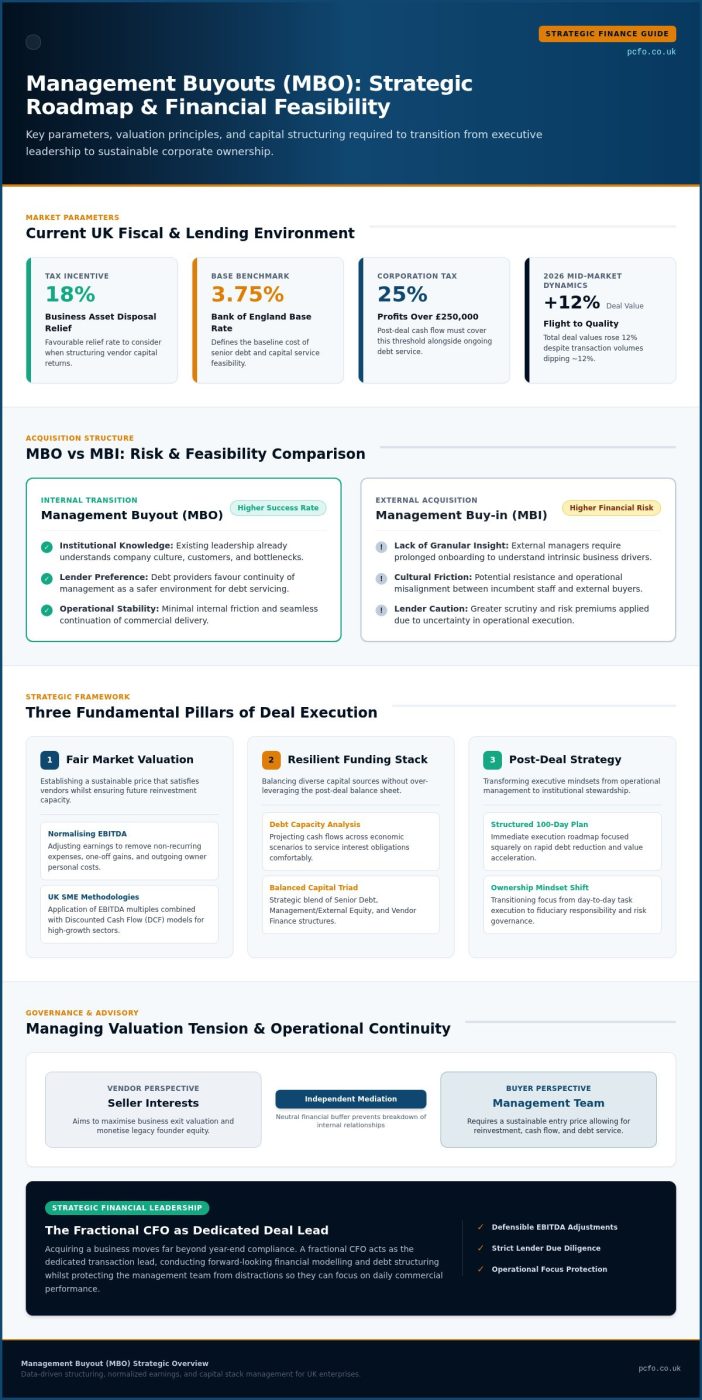
This guide provides the management buyout financial advice you need to navigate valuation hurdles, secure sustainable funding structures, and maintain operational momentum throughout the transition. Whether you’re considering the 18% Business Asset Disposal Relief rate or managing the current 3.75% Bank of England base rate environment, mastering these complexities is essential for long-term success. We will explore how to structure a deal that satisfies both vendors and lenders, ensuring your new company is built on a resilient financial foundation. You’ll discover a clear roadmap to move from the boardroom to the owner’s suite with professional poise and strategic foresight.
Key Takeaways
- Learn how to establish a fair market valuation by normalising earnings to reflect the true profitability and future potential of the company.
- Navigate the complexities of the ‘funding stack’ and leverage expert management buyout financial advice to balance debt, equity, and vendor finance for a sustainable transition.
- Understand how a fractional CFO acts as a dedicated deal lead, protecting daily operations whilst the management team focuses on driving performance.
- Transition effectively from management to ownership by implementing a structured 100-day plan focused on long-term value creation and debt reduction.
Management Buyouts: Why Strategic Advice is Essential
A management buyout represents a pivotal moment where a company’s leadership team transitions into ownership. It’s a complex financial undertaking that moves far beyond the scope of traditional year-end accounting. While your current finance team understands your history, the process of acquiring a business requires a forward-looking, strategic lens. Specialist management buyout financial advice is essential to navigate the intricate layers of corporate finance, tax implications, and capital structuring.
Standard accountancy often focuses on historical reporting and compliance. In contrast, an MBO demands sophisticated financial modelling, debt capacity analysis, and a deep understanding of the current lending market. You’re not just looking at where the money went; you’re projecting exactly how the business will service its new obligations under various economic scenarios. Success rests on three fundamental pillars: a fair valuation, a resilient funding stack, and a clear post-deal strategy. Neglecting any of these can lead to a business that is either over-leveraged or stagnant.
Beyond the spreadsheets, you’ll experience a significant professional shift. Moving from an employee mindset to that of a strategic owner requires you to embrace fiduciary risks and long-term value creation. It’s about shifting your perspective from daily execution to institutional stewardship. This evolution is often the most challenging part of the process, as it requires balancing operational duties with new ownership responsibilities.
The Key Differences Between an MBO and an MBI
It’s helpful to distinguish between a Management Buyout and a Management Buy-in (MBI). In an MBO, the existing team leverages their institutional knowledge to take control. This familiarity often results in a higher success rate, as the leaders already understand the company’s culture, customer base, and operational bottlenecks. Conversely, an MBI involves external managers purchasing the firm. This model carries higher financial risk due to the potential for cultural friction and a lack of granular business insight. Lenders often favour MBOs because the continuity of management provides a safer environment for debt servicing.
The Critical Need for Independent Financial Advice
During a buyout, a natural conflict of interest arises between the seller and the management team. The seller wants to maximise their exit value, whilst the buyers need a price that allows for future reinvestment and growth. Independent advisors serve as a vital buffer, providing objective mediation to resolve valuation disputes without damaging long-standing professional relationships. They ensure the transaction is structured for long-term viability rather than just short-term convenience. Ultimately, the MBO acts as a powerful vehicle for business continuity and strategic growth.
Preparing for the Buyout: Valuation and Financial Feasibility
Establishing a fair market value is the first significant hurdle in any MBO. It requires a delicate balance between the founder’s legacy expectations and the management team’s requirement for a viable, profitable future. You must “normalise” the company’s earnings, which involves adjusting the EBITDA to remove non-recurring expenses, one-off gains, or personal costs associated with the outgoing owner. This process reveals the true, sustainable profitability of the firm. Specialist management buyout financial advice ensures these adjustments are defensible and transparent to both the vendors and prospective lenders.
Due diligence in an MBO is a unique exercise. Whilst you likely understand the daily operations, you must now scrutinise the business through the lens of a prospective owner. This means auditing contracts, intellectual property, and compliance history with fresh eyes. The ultimate goal is to determine if the business can support the debt required for the purchase. With the UK corporation tax rate at 25% for profits over £250,000, your post-deal cash flow must be robust enough to cover tax obligations, reinvestment, and debt servicing simultaneously.
Valuation Methodologies for UK SMEs
Most UK transactions rely on EBITDA multiples, though discounted cash flow (DCF) models provide essential depth for high-growth or tech-enabled sectors. In 2026, we’ve seen a distinct “flight to quality” in the mid-market. While transaction volumes dipped by approximately 12%, total deal values rose by 12% as institutions prioritised resilient, premium targets. Understanding these sector-specific premiums is vital for a successful negotiation. For a more detailed look at how to prepare a business for this stage, explore our exit strategy planning services.
Assessing Financial Health and Future Runway
A successful deal hinges on proving deal viability to lenders through rigorous cash flow forecasting. Lenders are currently applying tighter debt-service coverage ratio (DSCR) covenants, typically requiring a minimum of 1.20x to 1.35x. You’ll need to identify any “hidden” liabilities, such as deferred tax or pension deficits, that could drain your runway post-completion. Establishing a baseline for working capital requirements is also critical to ensure the business isn’t starved of cash immediately after the transition. Exploring various equity financing options can help bridge any capital gaps identified during this feasibility phase. Our Chief Financial Officer services can provide the intellectual rigour needed to validate these projections and secure the necessary backing.
Funding the MBO: Navigating Debt, Equity, and Vendor Finance
Constructing a resilient funding stack is the most critical technical challenge of a management buyout. You must bridge the gap between the management team’s personal equity and the total purchase price using a combination of external debt and often deferred consideration. Securing professional management buyout financial advice is vital here, as the structure you choose today will dictate your company’s cash flow flexibility for years to come. Most lenders expect management to demonstrate skin in the game by contributing between 6 and 12 months of net salary, or a collective 2% to 5% of the enterprise value, to align interests with the new owners.
For larger transactions, Private Equity (PE) sponsors provide the capital necessary to complete the deal whilst allowing management to retain a significant equity stake. However, this involves a trade-off. Whilst PE provides strategic muscle and exit expertise, it also requires management to adhere to institutional reporting standards and shared control. Alternatively, Vendor Loan Notes (VLNs) have become a staple of the 2026 SME market. These allow a portion of the sale price to be paid over time from future profits, bridging the gap between what a bank will lend and the vendor’s price. It’s important to remember that senior lenders will typically insist on an Intercreditor Deed, placing VLNs strictly behind bank debt in priority.
Debt vs. Equity: A Strategic Comparison
The following table outlines the primary funding instruments currently available in the UK mid-market:
| Funding Type | Typical Cost (2026) | Key Characteristics |
|---|---|---|
| Senior Debt | SONIA + 350 to 600 bps | Lowest cost but requires high security and strict covenants. |
| Mezzanine Finance | 8% to 14% + PIK | Flexible repayment; sits between debt and equity. |
| Institutional Equity | Share of profits | No interest burden but dilutes ownership and control. |
With the Bank of England base rate held at 3.75%, debt servicing remains a significant line item. You must maintain a healthy debt-to-equity ratio to ensure the business can weather cyclical shifts without breaching lender covenants.
The Rise of Alternative Funding in 2026
Private credit funds and unitranche lenders have become dominant alternatives to traditional high-street banks. These lenders often provide greater covenant flexibility and faster execution speeds, which is essential for maintaining deal momentum. In some cases, Employee Ownership Trusts (EOTs) are used alongside MBOs to create a hybrid structure that benefits both management and the wider workforce. Professional business financial planning is essential to navigate these complex layers and present a robust case to prospective funders.
The Role of Strategic Financial Leadership During the Deal
The most significant obstacle to a successful MBO is often the management team’s own capacity. Running a company is a full-time commitment; layered on top of this, the buyout process demands hundreds of hours of complex negotiation and data analysis. Without dedicated support, the risk of operational drift is high. If performance dips during the transaction, lenders may reconsider their terms or withdraw entirely. This is why specialist management buyout financial advice focuses as much on process management as it does on the numbers themselves.
A fractional CFO serves as the dedicated “Deal Lead,” acting as the primary point of contact for solicitors, lenders, and the vendor’s advisors. By taking ownership of the data room and the financial due diligence process, they protect the management team’s time. This ensures that the leaders can remain focused on driving the revenue and EBITDA targets that the deal’s valuation is built upon. Effective project management here isn’t just about organisation; it’s about maintaining deal momentum and ensuring that every query from a prospective funder is answered with precision and speed.
Bridging the Expertise Gap with a Fractional CFO
For many SMEs, hiring a permanent, full-time CFO is an unnecessary expense, yet the strategic input of a finance director is indispensable during a buyout. Fractional support provides high-level corporate finance expertise exactly when it’s needed most. This model allows you to access board-level wisdom and sophisticated financial modelling without the long-term executive salary burden. Understanding the fractional CFO pricing uk model helps management teams budget for the transaction accurately, ensuring the cost of the deal doesn’t erode the company’s initial working capital.
Managing Stakeholder Confidence
Maintaining the trust of banks, creditors, and staff is essential during the transition period. Uncertainty can lead to “key person” flight or a tightening of supplier credit terms, both of which can jeopardise the business’s health. Clear, transparent communication is the best defence against these risks. Your financial lead should help you craft a narrative for stakeholders that emphasises continuity and growth. This preparation extends to the management team’s first board meeting as owners, where you must demonstrate a shift from operational managers to fiduciary stewards of the company’s future.
If you need an experienced hand to lead your transaction whilst you focus on the business, book a consultation with our strategic advisors today.
Post-Buyout Success: Scaling the Business as New Owners
The successful completion of your transaction is a milestone, not the destination. Once the legal documents are signed, the focus must shift immediately from deal execution to long-term value creation. The “day after” requires a fundamental change in mindset as you move from managing a department to stewarding a company’s entire capital structure. You’ll need a robust 100-day plan that prioritises financial visibility and operational efficiency to ensure the business meets its new obligations whilst thriving under new leadership. Expert management buyout financial advice at this stage focuses on institutionalising your finance function to support professional board-level decision-making.
Upgrading your financial systems is often the first priority for new owners. Many SMEs operate with reporting structures that satisfied a founder but lack the rigour required by institutional lenders or private equity partners. You must implement real-time management reporting that tracks key performance indicators (KPIs) tied directly to your debt-servicing capabilities and growth targets. This transparency doesn’t just satisfy creditors; it provides the data you need to identify margin improvements and scale the business effectively through business growth advisory uk services.
Optimising Cash Flow for Debt Servicing
Aggressive debt repayment is the most effective way to build equity value in the early years of ownership. With the UK’s main corporation tax rate at 25% for profits over £250,000, your cash flow must be managed with absolute precision to balance tax liabilities with loan interest and principal repayments. You should focus on working capital optimisation, specifically by tightening credit control and negotiating better terms with suppliers. Your CFO plays a vital role here, not just in monitoring cash, but in ensuring you remain in strict compliance with all lender covenants. Preventing a technical breach is far easier than renegotiating terms from a position of weakness.
Strategic Planning for the Next Exit
It may seem counterintuitive, but the best time to start planning your eventual exit is the day you take ownership. Every strategic decision you make should be filtered through the lens of how it affects the company’s future sale price. This means building a scalable finance function that isn’t dependent on any single individual and ensuring your systems can withstand the scrutiny of a future buyer’s due diligence. As you evolve into a strategic board of directors, your role shifts from “doing” to “leading.” By focusing on future-proofing the business today, you ensure that when the time comes for your own exit, the company is a premium, resilient asset that commands a high valuation.
Securing Your Future as a Business Owner
Executing a management buyout is one of the most significant transitions in a leader’s professional life. It’s about moving beyond daily operations to embrace the fiduciary responsibilities of true ownership. To succeed, you must balance a rigorous business valuation with a sustainable funding stack that protects your company’s future runway. The key to a smooth transition lies in maintaining operational momentum whilst navigating the intricate financial and legal layers of the deal.
Accessing specialist management buyout financial advice ensures your team has the board-level expertise needed to secure institutional backing and manage the post-deal strategy. PCFO provides fractional CFOs for UK SMEs, offering a proven track record in exit strategy and growth advisory. You gain authoritative financial leadership without the full-time executive cost, allowing you to focus on scaling your new acquisition. By future-proofing your financial function now, you set the stage for a resilient business that delivers lasting value.
Secure expert management buyout financial advice with PCFO today and take the first step toward successful business ownership with confidence.
Frequently Asked Questions
What is the typical timeline for a management buyout in the UK?
A typical MBO in the UK takes between six and nine months from the initial valuation to legal completion. The first phase involves feasibility studies and securing funding, which often spans three months. This is followed by detailed due diligence and legal documentation. Deal momentum is critical; delays often occur during the fundraising stage if the management team lacks dedicated support to manage lender queries whilst maintaining daily business operations.
How much personal money does a management team need for an MBO?
Management teams are generally expected to contribute between 6 and 12 months of their net salary to the transaction. Alternatively, institutional lenders and equity sponsors often require a collective contribution of 2% to 5% of the enterprise value. This “skin in the game” demonstrates commitment and aligns the team’s interests with those of the funders. It’s rarely about the absolute amount, but rather the relative personal significance of the investment.
Can we complete an MBO if the current owner wants to stay involved?
Yes, it’s common for a founding owner to remain involved through a minority equity stake or as a consultant post-deal. This often facilitates a smoother transition and can help bridge valuation gaps via Vendor Loan Notes. However, lenders will insist on clear governance structures to ensure the new management team has full fiduciary control. Strategic management buyout financial advice is essential to define these boundaries and prevent operational friction between the new owners and the former founder.
What are the main tax implications of a management buyout for the buyers?
The acquiring entity, usually a newly incorporated holding company (NewCo), must pay Stamp Duty or SDRT at a rate of 0.5% on share purchases over £1,000. Additionally, the new owners must navigate Corporate Interest Restriction rules, which cap interest deductions at 30% of UK tax-EBITDA for groups with over £2 million in net interest expense. Obtaining Section 138 clearance from HMRC is also vital to ensure share-for-share exchanges are not treated as taxable events.
How do we value our business for an MBO in 2026?
Valuations are currently driven by a “flight to quality,” where resilient businesses with non-cyclical cash flows command higher EBITDA multiples. Despite a 12% dip in deal volumes, total transaction values rose by 12% in 2026, reflecting the premium placed on high-performing targets. You must normalise earnings by removing non-recurring costs to reveal a sustainable profit baseline. Lenders are prioritising cash flow visibility, often requiring a minimum debt-service coverage ratio of 1.20x to 1.35x.
What happens if we cannot secure enough bank debt for the buyout?
If traditional high-street banks cannot provide sufficient leverage, management teams often turn to private credit funds or unitranche lenders. These alternative providers offer greater flexibility and higher leverage multiples, though often at a higher cost, such as SONIA plus 350 to 600 basis points. Vendor Loan Notes are another essential tool, allowing the seller to defer part of the payment. This structure bridges the funding gap whilst keeping the business’s debt-to-equity ratio within sustainable limits.
Is a management buyout better than selling to a third party?
An MBO offers superior business continuity and protects the company culture, which often leads to higher post-deal success rates compared to third-party acquisitions. Whilst a trade sale might achieve a higher headline price, it carries greater execution risk and potential for significant operational disruption. For many vendors, the certainty of a deal with a known management team is more attractive than the uncertainty of a lengthy auction process involving external competitors or private equity buyers.
Why do management buyouts fail and how can we avoid those pitfalls?
Most MBOs fail due to over-leveraging the balance sheet or neglecting operations during the negotiation phase. When a management team is too busy with deal mechanics, performance can dip, leading lenders to tighten terms or withdraw offers. You can avoid these pitfalls by appointing an independent advisor to lead the transaction. This allows the leadership team to focus on maintaining the EBITDA targets that underpin the entire deal valuation and future debt servicing capabilities.